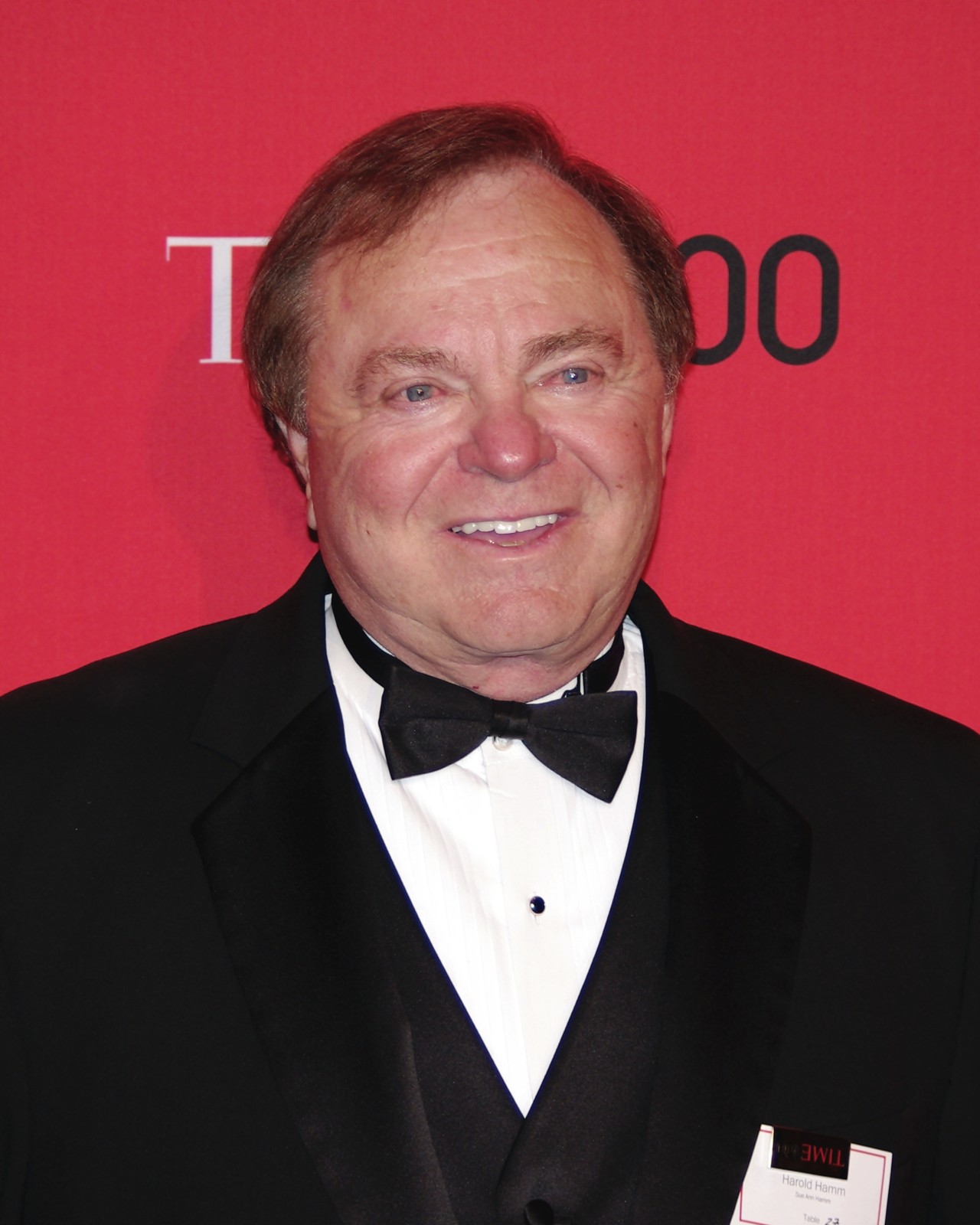
Charles Koch
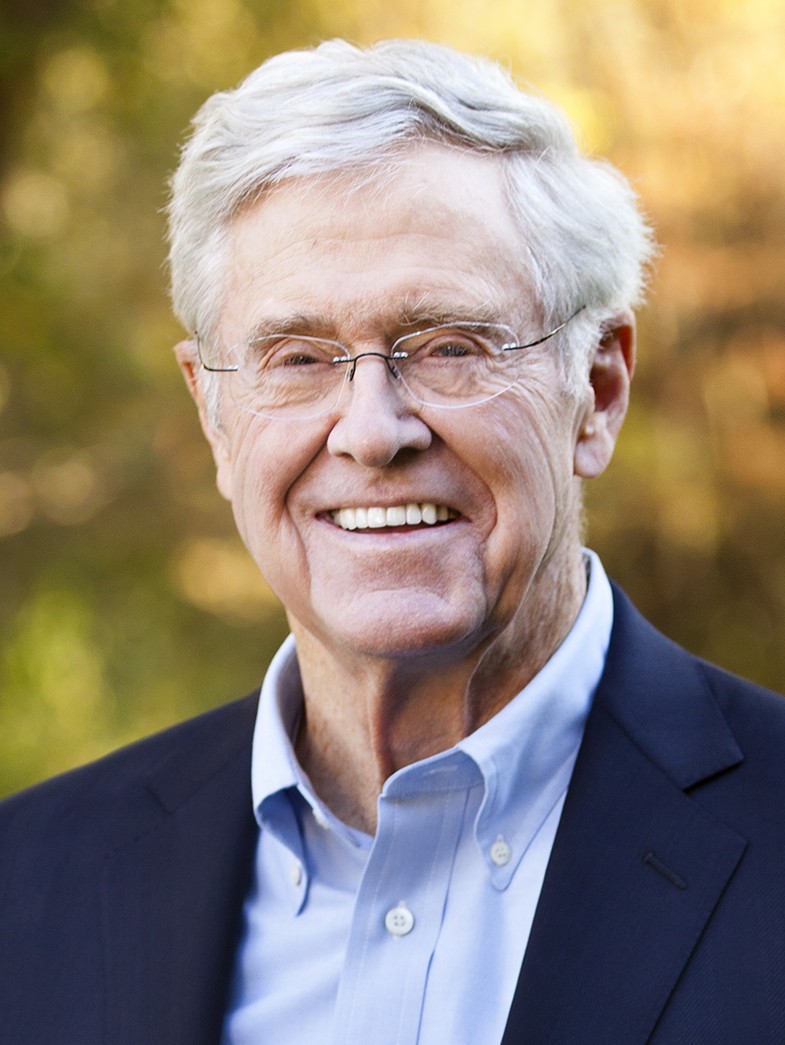
born Charles de Ganahl Koch
Chairman and CEO, Koch Industries (Koch, Inc.) — oil refining, chemicals, Georgia-Pacific, and diversified industrials · b. 1935 · Wichita, Kansas
Two calls made by hand, not formulas. how we score →
Summary
Charles Koch was born into a Wichita family made wealthy by his father's oil-refining business.
Three MIT degrees behind him, he joined the firm in 1961 and became president in 1967, when his father died. He renamed it Koch Industries, bought out two dissenting brothers in 1983, and spent decades reinvesting most of its earnings to build one of the largest private companies on earth.
How it happened
Born November 1, 1935, in Wichita, Kansas, the second of four sons of Fred C. Koch and Mary Robinson Koch. Fred Koch was himself an MIT- trained chemical engineer who had developed an improved oil-cracking process, sold refining technology to the Soviet Union in the late 1920s, and used the proceeds to build an engineering and refining business in Wichita — the company Charles would eventually inherit. Charles followed his father to MIT, earning a bachelor's degree in general engineering in 1957 and two further master's degrees, in nuclear engineering (1958) and chemical engineering (1959), all without documented student debt.
He joined his father's firm in 1961 as an engineer. When Fred Koch died in 1967, Charles — then 31 — became president of the company and renamed it Koch Industries in his father's honor. He inherited not a startup but an already-profitable regional oil and engineering business, along with the standing that came with running it.
Charles and his brother David favored plowing earnings back into the company rather than paying them out; brothers Frederick and Bill wanted larger distributions. In 1983 Charles and David bought out Frederick's and Bill's stakes for roughly $1.1 billion, becoming co-owners at about 42% each. From there, the strategy that defined the company's next four decades was set: keep it private, and put close to 90% of earnings back into acquisitions and expansion rather than dividends. That compounding, sustained far longer than almost any public company's shareholders would tolerate, is what turned a regional refiner into a conglomerate spanning refining, pipelines, chemicals, fertilizer, electronics, and consumer products.
The 1983 buyout did not end the family dispute. Frederick and Bill pursued litigation against Charles and David over the valuation of the buyout and control of the company; the fight ran from the mid-1980s until Koch Industries settled with them in May 2001 for a reported $25 million. It was an intra-family fight over ownership and control, not a finding against Charles personally.
Koch Industries acquired Invista, DuPont's polymer and fibers business, in 2003–2004, then bought paper and building-products giant Georgia-Pacific in 2005 and electronics-component maker Molex in 2013 for $7.2 billion. By 2021 the company's revenue reached roughly $125 billion, making it the second-largest privately held company in the United States by revenue, all still owned by the Koch family rather than public shareholders.
Separately from the business, Charles Koch co-founded the libertarian Cato Institute in 1977 and has spent decades funding think tanks and advocacy groups, including Americans for Prosperity — reported to have directed several hundred million dollars into libertarian and conservative causes since the 2000s. The spending is real and influential, and it has made him a deeply polarizing figure: prized as a serious champion of limited-government ideas by allies, and named a "climate villain" by some environmental reporting for funding groups skeptical of climate regulation. He has also written or co-written several business and philosophy books, including "The Science of Success" and "Good Profit."
Koch Industries — renamed Koch, Inc. — brought on its first co-CEO alongside Charles in 2023, a step toward succession after roughly sixty years at the top. Forbes put his personal net worth at about $76.9 billion as of September 29, 2026, built on a voting stake of roughly 42% in a company that has never gone public and never taken outside equity.
The coded evidence
Thirteen groups, every claim sourcedMulti-generational American on both the business and family side — his father, Fred C. Koch, was himself a US-born, MIT-educated businessman, so this is coded as no migration-linked headwind.
↗ en.wikipedia.orgnot established
Not clearly established in sources consulted; as an adult he has described himself as irreligious, but his childhood religious upbringing isn't separately documented.
↗ en.wikipedia.orgnot established
Not established in sources consulted; presumed English given a multi-generation US-born family.
↗ en.wikipedia.orgRaised in an affluent Wichita household funded by his father's established oil-refining and engineering business; no source documents any financial hardship or need for a fallback at any point in his life.
↗ en.wikipedia.orgJoined his father's already-profitable company directly as an engineer in 1961, drawing income from an established business rather than building one from nothing or drawing a salary elsewhere while saving toward a venture.
↗ en.wikipedia.orgnot established
He married Liz Koch in 1972, after he had already become president of the company in 1967; no source documents her labor as financially necessary to the business.
↗ en.wikipedia.orgnot established
He and Liz have two children, Chase and Elizabeth, born after he was already president of the company; not a factor during any build period.
↗ en.wikipedia.orgnot established
No student or personal debt is documented, consistent with a family funding three MIT degrees outright.
↗ en.wikipedia.orgnot established
No housing, income, or comparable instability is documented at any point in his life.
↗ en.wikipedia.orgThe hardship was imposed, not chosen. There was nothing to fall back on.
No period of chosen austerity is documented; every stage was funded from an already-wealthy family and an already-profitable company.
↗ en.wikipedia.orgFather Fred C. Koch was an MIT-trained chemical engineer who developed an improved oil-cracking process and built an oil-refining and engineering business in Wichita, Kansas — the company Charles inherited. Mother Mary Robinson Koch's occupation isn't detailed in sources consulted.
↗ en.wikipedia.orgA parent worked for themselves, the strongest known predictor of founding.
↗ en.wikipedia.orgFather Fred C. Koch held an MIT degree in chemical engineering (1922) — the same institution Charles would later attend for three degrees of his own.
↗ en.wikipedia.orgFamily standing traces to one generation back — Fred Koch's own refining-technology business, built from an engineering innovation he developed and later sold to the Soviet Union in the late 1920s — rather than multi-generational old-money status.
↗ en.wikipedia.orgFamily funded three degrees at MIT (a bachelor's and two master's) outright, with no student debt documented at completion.
↗ en.wikipedia.orgFather Fred C. Koch died in 1967, when Charles was 31 and already working inside the company; Charles became president on his father's death and renamed the firm Koch Industries. This reads as a succession event rather than a hardship one — he inherited an already-profitable business, not a gap he had to fill from nothing.
↗ en.wikipedia.orgWichita, Kansas — an affluent household built on an established family business.
↗ en.wikipedia.orgDirect entry into his father's company as an engineer in 1961, with an understood path to eventual leadership of a business his father had already built and named him to run on his death in 1967.
↗ en.wikipedia.orgMIT's engineering network, plus decades of standing inside the Wichita business community and, later, the national libertarian and conservative donor network he helped build through Cato Institute (1977) and Americans for Prosperity.
↗ en.wikipedia.orgHis father's company itself was the door: a direct engineering role in 1961 in a business his father had built, with succession to the presidency understood well before Fred Koch's death in 1967 made it formal.
↗ en.wikipedia.orgFred Koch's existing oil-refining and engineering business was the platform: an already-profitable operating company that supplied capital, credibility with lenders and partners, and an existing customer and supplier network before Charles ever had to build any of that himself.
↗ en.wikipedia.orgCapital, Credibility, Network
↗ en.wikipedia.orgBachelor of Science in general engineering, MIT, 1957; Master of Science in nuclear engineering, MIT, 1958; Master of Science in chemical engineering, MIT, 1959.
↗ en.wikipedia.orgMIT was also his father's alma mater (chemical engineering, 1922), making Charles's degrees there a continuation of an existing family credential rather than a first-generation credential win.
↗ en.wikipedia.orgBecame president of his father's company on Fred Koch's death in 1967, then in 1983 joined brother David in buying out brothers Frederick's and Bill's stakes for roughly $1.1 billion, leaving Charles and David as roughly 42%-each co-owners with full operating control of what he renamed Koch Industries.
↗ forbes.comKept the company privately held for over six decades, financing growth — including the roughly $21 billion 2005 acquisition of Georgia-Pacific and the 2013 purchase of Molex for $7.2 billion — through internally generated cash and debt rather than a public stock offering or outside equity investors.
↗ en.wikipedia.orgThe company describes reinvesting roughly 90% of earnings back into the business — over $190 billion since 2003, by its own account — rather than distributing it as dividends, a policy Charles set after the 1983 buyout and sustained across decades in a way few public-company boards would tolerate.
Figure and framing are the company's own; treated as a self-reported claim rather than an audited figure.
↗ kochinc.comOwns refineries, pipelines, and — after the 2005 acquisition — Georgia-Pacific's paper mills and consumer-products lines outright as operating assets, rather than through a portfolio of financial stakes.
↗ en.wikipedia.orgHolds roughly 42% of the voting stock but has run the company as chairman and CEO since 1967 with full operating control, never diluted by a public offering; Koch, Inc. brought on its first co-CEO alongside him in 2023.
↗ forbes.com0
No failed venture preceded his 1967 succession to the presidency; he inherited an operating, profitable business.
↗ en.wikipedia.orgDownside risk across acquisitions — including the leveraged 2005 Georgia-Pacific purchase — was carried by the company's own balance sheet, not by Charles Koch's personal savings under threat.
↗ en.wikipedia.orgNever took the company public despite it growing large enough, by revenue, to rank among the biggest companies in the United States — a deliberate, repeated choice to forgo the liquidity and market valuation a public listing would have provided.
↗ en.wikipedia.org31
Age when his father died in 1967 and he became president, renaming the firm Koch Industries.
↗ en.wikipedia.orgTook over a mid-sized regional oil and engineering firm in the resource-rich postwar US economy, then expanded through decades that included the 1970s energy shocks (which raised the value of owning refining and pipeline assets) and the 2000s consolidation of the US paper and forest-products industry, which set up the 2005 Georgia-Pacific purchase.
↗ en.wikipedia.orgWichita, Kansas, where the family company was headquartered.
↗ en.wikipedia.orgOverwhelmingly "buy": the base was inherited outright, then grown mainly through acquisitions — Invista (2003–2004), Georgia-Pacific (2005), Molex (2013) — layered onto the original refining business rather than through founding new ventures from nothing.
↗ en.wikipedia.orgDiversified industrials — oil refining and pipelines, chemicals, fertilizer, paper and consumer products (Georgia-Pacific), and electronic components (Molex)
↗ forbes.com76900000000
Forbes real-time billionaires-tracker figure as of 2026-09-29; a journalistic estimate of the value of his roughly 42% stake in a privately held company, not a filed or audited figure. Forbes notes his non-voting economic stake is somewhat smaller following about $5.3 billion in stock transfers to nonprofits between 2020 and 2022.
↗ forbes.comJournalistic estimate
Koch, Inc. is privately held; no public filing establishes his exact stake or net worth.
↗ forbes.com2026
↗ forbes.comnot established
No proxy-statement-level income figure exists for a privately held company; not established in sources consulted.
↗ forbes.comAlmost entirely unrealized, illiquid ownership value in a company that has never gone public and has no market-traded shares.
↗ forbes.comOverwhelmingly ownership wealth in a privately held company, not salary.
↗ forbes.comCo-founded the Cato Institute (1977); authored or co-authored several business and philosophy books, including "The Science of Success" (2007), "Good Profit" (2015), and "Believe in People" (2020); built the Americans for Prosperity political and policy network; and transferred roughly $5.3 billion in company stock to nonprofits between 2020 and 2022.
↗ forbes.comUncapped
↗ forbes.comKoch Industries has faced a string of environmental enforcement actions over the decades: a $6 million Minnesota fine plus $2 million remediation (1999); a $30 million civil penalty across six states over 312 reported spills, plus $5 million for environmental projects (2000); a $20 million Clean Air Act penalty tied to a Corpus Christi, Texas refinery, alongside an $80 million pollution-control investment and $4.5 million penalty (2000); and a $200,000 penalty over an export violation (2003). Bloomberg reporting put the company's total fines, penalties, and judgments from 1999–2003 at more than $400 million. These are corporate enforcement actions against Koch Industries and its subsidiaries, not personal findings against Charles Koch.
Figures and dates as reported by Wikipedia's account of press and regulatory-filing coverage; presented here at the company level per the site's reporting-vs-asserting standard.
↗ en.wikipedia.orgA 1996 pipeline rupture near Lively, Texas, that killed two teenagers led to a $296 million jury verdict against the company's pipeline subsidiary in 1999 — a corporate civil judgment, not a personal one against Charles Koch.
↗ en.wikipedia.orgBrothers Frederick and Bill Koch pursued litigation against Charles and David over the 1983 buyout's valuation and control of the company, running from the mid-1980s until Koch Industries settled with them in May 2001 for a reported $25 million — a family and corporate-control dispute, not an adjudicated finding of wrongdoing against Charles.
↗ forbes.comAfter
The environmental enforcement actions and the brothers' litigation both followed his 1967 succession and 1983 buyout, which had already established his control of the company.
↗ en.wikipedia.orgIncidental
The regulatory fines and litigation are documented but aren't established as having produced his fortune, which rests on the inherited business and the reinvestment strategy rather than on any of these episodes.
↗ en.wikipedia.orgCivil wrong
Coded at the level of the reported civil penalties and judgments against the company; not a personal criminal finding against Charles Koch.
↗ en.wikipedia.orgFine absorbed
Fines and settlements were paid by the company; no personal liability for Charles Koch is documented in sources consulted.
↗ en.wikipedia.orgDisciplined, Private, Ideological, Polarizing
↗ en.wikipedia.orgPublic
↗ en.wikipedia.orgBefore
His reputation as a private-industry builder preceded his most visible political spending by decades.
↗ en.wikipedia.orgMixed
An asset in business and libertarian-policy circles, where he is credited as a management thinker and philanthropist; a liability in broader press and progressive political coverage, which has cast him as a symbol of undisclosed political spending and climate-policy obstruction.
↗ en.wikipedia.orgHis reputation splits sharply along political lines: praised by allies and libertarian-aligned commentators as a serious champion of limited-government ideas and a disciplined, long-horizon business builder; criticized by progressive commentators, environmental reporting, and some journalism (Jane Mayer's "Dark Money") over the scale and opacity of his political spending and his funding of groups skeptical of climate regulation. Reporting on this spending is attributed reporting, not an assertion of wrongdoing.
↗ en.wikipedia.orgIn November 2020 he said he regretted having contributed to "hyper-partisanship" and said he intended to work across political lines going forward — a public statement of regret rather than a documented change in giving patterns.
↗ en.wikipedia.orgStructural context
The cost-of-failure score comes from this person's own money and circumstances. But who they were in America carried its own weight, the same way their household or income did, and it shaped how hard the path was just as much. That part isn't in the cost-of-failure number. It's here instead.
Men held about 90% of Fortune 500 CEO seats in 2023, and a wider majority of the rungs below. The ladder is widest for them the whole way up.
↗ forbes.comAmong the people recorded here — men: 169 · white subjects: 12. Representation here is who reached these outcomes, not equal odds of reaching them.
Controlled comparisons
Each holds one thing constant and varies another, so the difference is the point. A list of similar names wouldn't tell you anything.