Earvin Johnson
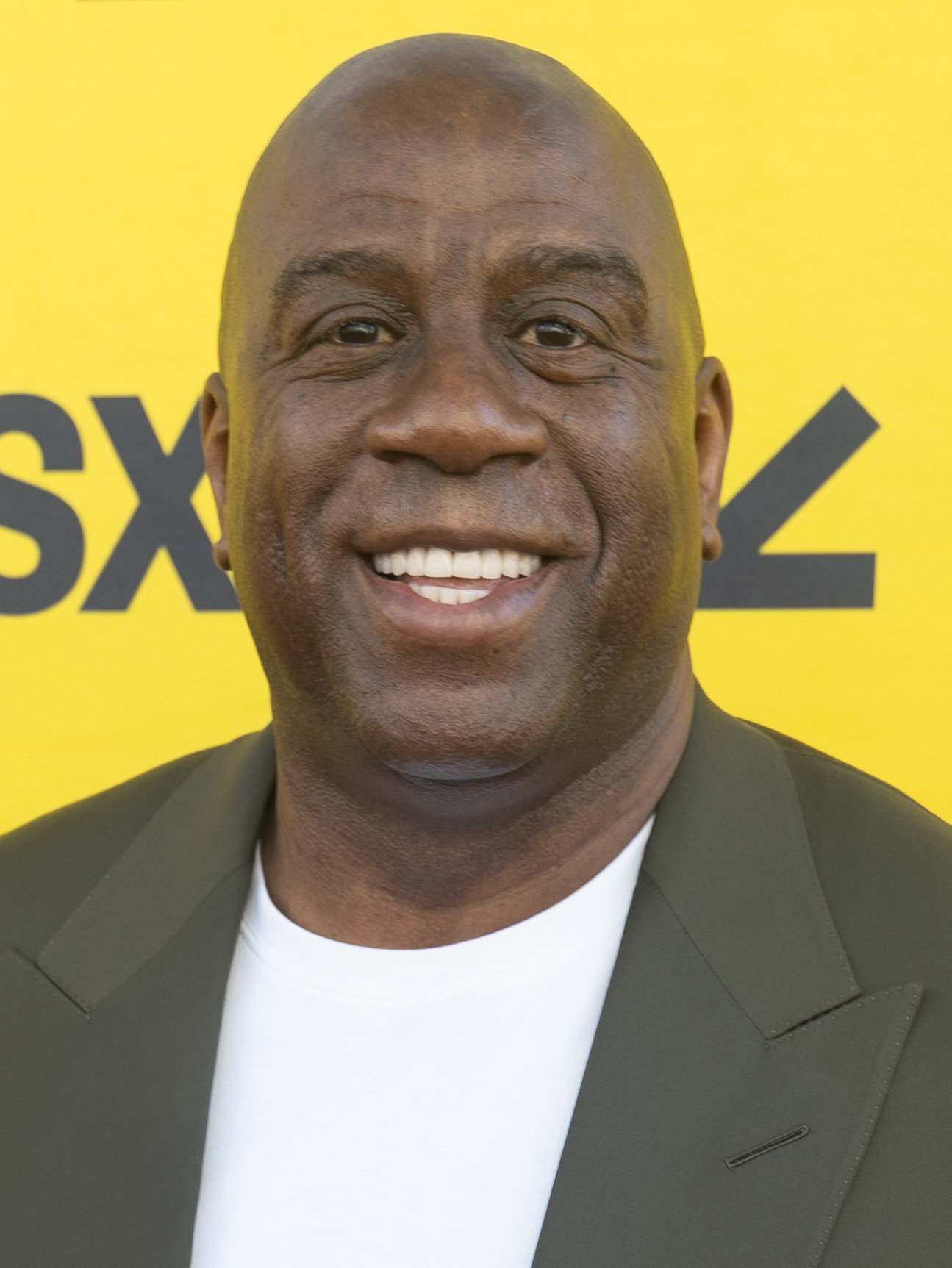
NBA Hall of Famer ("Magic" Johnson); founder, Magic Johnson Enterprises · b. 1959 · Lansing, Michigan
Two calls made by hand, not formulas. how we score →
Summary
Raised in a two-income working-class household — an assembly-line father who hauled trash at night, ten children under one roof — he built a Hall of Fame career with no capital behind him.
The real second act came after: forced into retirement at 32 by his 1991 HIV diagnosis, he spent decades converting his name into controlling stakes in businesses sited where corporate America wouldn't invest.
How it happened
Earvin Johnson Jr. was born August 14, 1959, in Lansing, Michigan, the sixth of ten children in a blended family of six full and three half-siblings. His father, Earvin Sr., worked the assembly line at a General Motors plant by day and hauled trash and did janitorial work at a used-car lot at night to support the household. His mother, Christine, worked as a school custodian. Neighborhood kids teased him as "Garbage Man" for helping his father on the route.
In ninth grade, a school counselor named Ms. Bird told him bluntly that he was reading below grade level and no one would ever know how good a player he was if he couldn't stay eligible. She arranged morning and evening tutoring and summer school. He got his reading up, starred at Everett High School, and picked up the nickname "Magic" at fifteen after a 36-point, 18-rebound, 16-assist game. He became the first in his family to go to college, on scholarship to Michigan State, where he beat Larry Bird's Indiana State for the 1979 national title in the most-watched college basketball game ever played.
The Lakers took him first overall in the 1979 draft. He won Finals MVP as a rookie, then signed a 25-year, roughly $25 million contract in 1981 — the richest deal in sports at the time. Five NBA championships, three regular-season MVPs, three Finals MVPs, and a career assist record followed. He became one of the faces of the league without ever attending a business school or working for anyone but the Lakers.
A preseason physical came back HIV-positive. He announced it at a press conference and retired the same day, at 32, saying he'd contracted the virus through unprotected sex with multiple partners during his playing career. The stigma was immediate — some players said they didn't want to play against him — but the announcement is widely credited with reshaping public understanding of HIV transmission. He kept his name in public life through TV commentary and a short comeback, but the question in front of him now was what to do with the fame once the playing career was over.
He answered it by buying pieces of things instead of just endorsing them, and by putting them in neighborhoods other companies skipped. A 1995 partnership with Loews put a 12-screen multiplex in Baldwin Hills, a majority-Black Los Angeles neighborhood with no first-run theater. In 1998 he partnered with Starbucks to open roughly 125 stores in urban markets, selling most of them back to the company in 2010 for about $100 million. In 2001 he and Canyon Capital launched a real-estate fund aimed at underserved urban areas that grew from a two-year slog to raise $300 million to a $1 billion third fund by 2008. A 2012 investment in Florida Medicaid insurer Simply Healthcare returned about 16 times his stake when Anthem bought it for roughly $1 billion in 2015; he put the proceeds into a majority, controlling stake in EquiTrust Life Insurance, an annuity company whose assets under management have since roughly doubled. Along the way he took minority ownership positions in the Los Angeles Dodgers, the WNBA's Los Angeles Sparks, LAFC, and the Washington Commanders.
Forbes put his net worth at about $1.6 billion in 2026, built almost entirely from business equity rather than the roughly $40 million he earned playing. In January 2025, President Biden awarded him the Presidential Medal of Freedom, citing both the basketball career and the business and philanthropic record that followed it.
The coded evidence
Thirteen groups, every claim sourcedRaised in the Seventh-day Adventist Church by his mother; denomination-level detail beyond that isn't established.
↗ en.wikipedia.orgNo family wealth or property to fall back on, but a stable two-parent household with two working incomes throughout childhood — no documented eviction or homelessness.
Cited via Wikipedia's reference trail; the original USA Today profile page could not be fetched directly (blocked to automated tools).
↗ usatoday.comFather Earvin Sr. worked GM's assembly line by day and hauled trash and did janitorial work at a used-car lot by night; mother Christine worked as a school custodian. Two modest but steady incomes supported a household of ten children.
Cited via Wikipedia's reference trail; see note on housingFallback.
↗ usatoday.comThe hardship was imposed, not chosen. There was nothing to fall back on.
Both parents working two jobs between them was necessity, not a chosen austerity.
↗ notablebiographies.comFather Earvin Sr., a General Motors assembly-line worker who also hauled trash and did janitorial work at night. Mother Christine, a school custodian.
↗ notablebiographies.comNeither parent was self-employed.
His father's night-time trash-hauling and janitorial work reads as informal side income rather than registered self-employment — not the entrepreneurial self-employment this field is meant to capture.
↗ notablebiographies.comNot documented in detail. He has been described as the first in his family to attend college, implying neither parent held a degree.
↗ nacacnet.org9
Widely reported as six full siblings plus three half-siblings from his father's earlier marriage (ten children total). One lower-quality biography describes him instead as "the fourth of seven children"; the ten-child figure is the consistent, better-supported one.
↗ en.wikipedia.org6
Commonly cited as sixth of ten; exact birth order across the blended family isn't independently confirmed.
↗ en.wikipedia.orgNo criminal record established.
↗ en.wikipedia.orgDiagnosed HIV-positive after a routine physical before the 1991-92 season; announced it publicly on November 7, 1991, and retired the same day at age 32. He has said he contracted the virus through unprotected sex with multiple partners during his playing career. He has lived with the diagnosis for more than three decades and built his HIV/AIDS foundation and advocacy work around it.
Public and self-disclosed, not a sequestered field — central to his biography and to his business second act.
↗ biography.comEverett High School in Lansing, reached by way of the city's school desegregation busing program rather than the school nearest his home.
↗ en.wikipedia.orgBused to a school under Lansing's desegregation program during a period when the city was actively integrating its schools.
Specific busing-program detail is thin in the sources reviewed.
↗ en.wikipedia.orgHis 1991 HIV disclosure triggered public fear rather than only sympathy — several NBA players, including Karl Malone, voiced concern about playing against him, and he still faced a booing crowd protest at the 1992 All-Star Game vote before winning its MVP award.
Identity/health-status headwind feeding coded.headwinds, distinct from hardness.
↗ en.wikipedia.orgMs. Bird, his ninth-grade counselor, identified that he was reading below grade level and arranged tutoring and summer school so he could stay eligible and go on to a scholarship. He called her first, years later, when he bought a radio station.
↗ nacacnet.orgAlready a national name before turning pro — a state championship, a sportswriter-coined nickname at fifteen, and the 1979 NCAA final against Larry Bird, still the most-watched college basketball game ever broadcast.
↗ en.wikipedia.orgStar at Everett High School; inaugural McDonald's All-American (1977) and Mr. Basketball of Michigan (1977), recruited nationally before enrolling at Michigan State.
↗ en.wikipedia.orgNo degree. Attended Michigan State University (1977-1979), studying communication, and left after his sophomore year — the first in his family to attend college — to enter the 1979 NBA draft.
↗ nacacnet.orgDirect — recruited to Michigan State on athletic scholarship straight out of high school.
↗ en.wikipedia.orgHis first major money was the 1979 rookie NBA contract, followed by a renegotiated 1981 deal worth roughly $25 million over 25 years — about $89 million in 2025 dollars and the richest contract in sports at the time. Venture capital came later, funded from playing and endorsement income rather than any outside raise.
↗ en.wikipedia.orgEarly ventures — the 1995 Loews theatre partnership and the 1998 Starbucks urban-franchise deal — were funded from wealth built during his playing career. Career NBA earnings ran to roughly $40 million pretax, with peak endorsement income of $2-4 million a year, modest next to the $1.6 billion net worth his business career later produced.
↗ forbes.comEquiTrust is an annuity and life-insurance company — a compounding vehicle built on policyholder float and fee income, distinct from his earlier direct-equity brand deals. Forbes reports its assets under management grew from about $16 billion to $33 billion since Magic Johnson Enterprises took a reported 60% controlling stake in 2015.
↗ forbes.comSold a 2012 investment in Florida Medicaid insurer Simply Healthcare to Anthem in 2015 for about $1 billion, roughly a 16-times return on his stake, and rolled the proceeds directly into buying a majority, controlling interest in EquiTrust Life Insurance the same year rather than diversifying into consumption.
↗ blackenterprise.comPersonal experience of neighborhoods corporate retail ignored. His theater, coffee-store, and real-estate ventures were deliberately sited in Black and Latino urban markets — Baldwin Hills, South Los Angeles, Harlem — that national chains had passed over.
↗ en.wikipedia.orgConsistently structured deals for majority or controlling stakes rather than passive minority checks — a reported 60% of EquiTrust, and majority positions described in his theater and Starbucks-store partnerships — while his professional sports stakes (Dodgers, Sparks, LAFC, Commanders) are minority positions inside larger ownership groups.
↗ forbes.com7
Movie theaters (Loews/Magic Johnson Theatres, 1995), retail coffee (Starbucks urban stores, 1998), real estate (Canyon-Johnson Urban Fund, 2001), healthcare (Simply Healthcare, 2012), insurance/financial services (EquiTrust, 2015), food service (Fatburger investment), and professional sports ownership (Dodgers 2012, Sparks, LAFC, Commanders 2023).
↗ en.wikipedia.orgnot established
No failed venture is documented. A short-lived 1999 co-ownership stake in a Swedish basketball club folded after one season, but it reads as a minor side project rather than a real setback in the wealth-building pattern.
↗ en.wikipedia.orgThe early-1990s AIDS epidemic carried heavy public stigma and fear about transmission; his announcement is widely credited with shifting public understanding of HIV and increasing research funding and awareness.
↗ en.wikipedia.orgA mix. Founded Magic Johnson Enterprises and the Canyon-Johnson Urban Fund from nothing; bought into existing operations for the Loews theater partnership, Starbucks stores, Simply Healthcare, EquiTrust, and every sports-team stake.
↗ en.wikipedia.org35
The 1995 Loews theater deal marks the start of the equity-conversion pattern that defines his business career.
↗ en.wikipedia.orgProfessional basketball, then business (media, retail, real estate, healthcare, insurance, sports ownership)
↗ forbes.com1600000000
Forbes real-time billionaire tracker; Forbes first named him a billionaire in October 2023.
↗ forbes.comJournalistic estimate
↗ forbes.com2026
↗ forbes.comAlmost entirely wealth, not salary. Career NBA earnings totaled roughly $40 million pretax over 13 seasons; the $1.6 billion net worth comes overwhelmingly from equity stakes built after he stopped playing, led by the EquiTrust insurance stake.
↗ forbes.comNaismith Basketball Hall of Fame (2002, individually; 2010, with the 1992 Dream Team); NBA 75th Anniversary Team (2021); Presidential Medal of Freedom (January 2025), the nation's highest civilian honor, awarded by President Biden citing both his playing career and his business and philanthropic record.
↗ yahoo.comUncapped
↗ forbes.comCharismatic, Business savvy, Self made, Advocate
↗ forbes.comPublic
↗ forbes.comBefore
His reputation as a transcendent player and, later, a candid public figure was set well before the post-1995 business-equity pattern this record tracks.
↗ en.wikipedia.orgAsset
His name and reputation were the consideration in most of his equity deals, from the Loews theatre partnership onward.
↗ forbes.comThe reputation was deliberately built, through books, press, and PR.
Built a long-running TV commentary and public-advocacy presence alongside the business ventures rather than relying on press coverage alone.
↗ biography.comHis 1991 disclosure drew broad admiration for candor but also fear-driven pushback rooted in AIDS-era stigma — several NBA players voiced discomfort about playing against him, and fan backlash briefly followed his 1992 All-Star selection before he won that game's MVP. That division faded over time; by his 2025 Presidential Medal of Freedom, his public standing was close to unanimous.
↗ en.wikipedia.orgNever really lost standing to rebuild — the stigma around his 1991 announcement subsided as public understanding of HIV transmission improved, and his reputation only grew across the following decades.
↗ yahoo.comStructural context
The cost-of-failure score comes from this person's own money and circumstances. But who they were in America carried its own weight, the same way their household or income did, and it shaped how hard the path was just as much. That part isn't in the cost-of-failure number. It's here instead.
Men hold most of the ownership and gatekeeping across the creative and media industries, the default that recognition and deals flow toward.
↗ assets.uscannenberg.orgIn the creative and media industries, recognition comes far more easily to underrepresented creators than the ownership it should turn into. Among 2023's top-grossing film directors, for one measure, eight were Black.
↗ assets.uscannenberg.orgAmong the people recorded here — men: 115 · Black subjects: 58. Representation here is who reached these outcomes, not equal odds of reaching them.
Controlled comparisons
Each holds one thing constant and varies another, so the difference is the point. A list of similar names wouldn't tell you anything.