J.K. Rowling
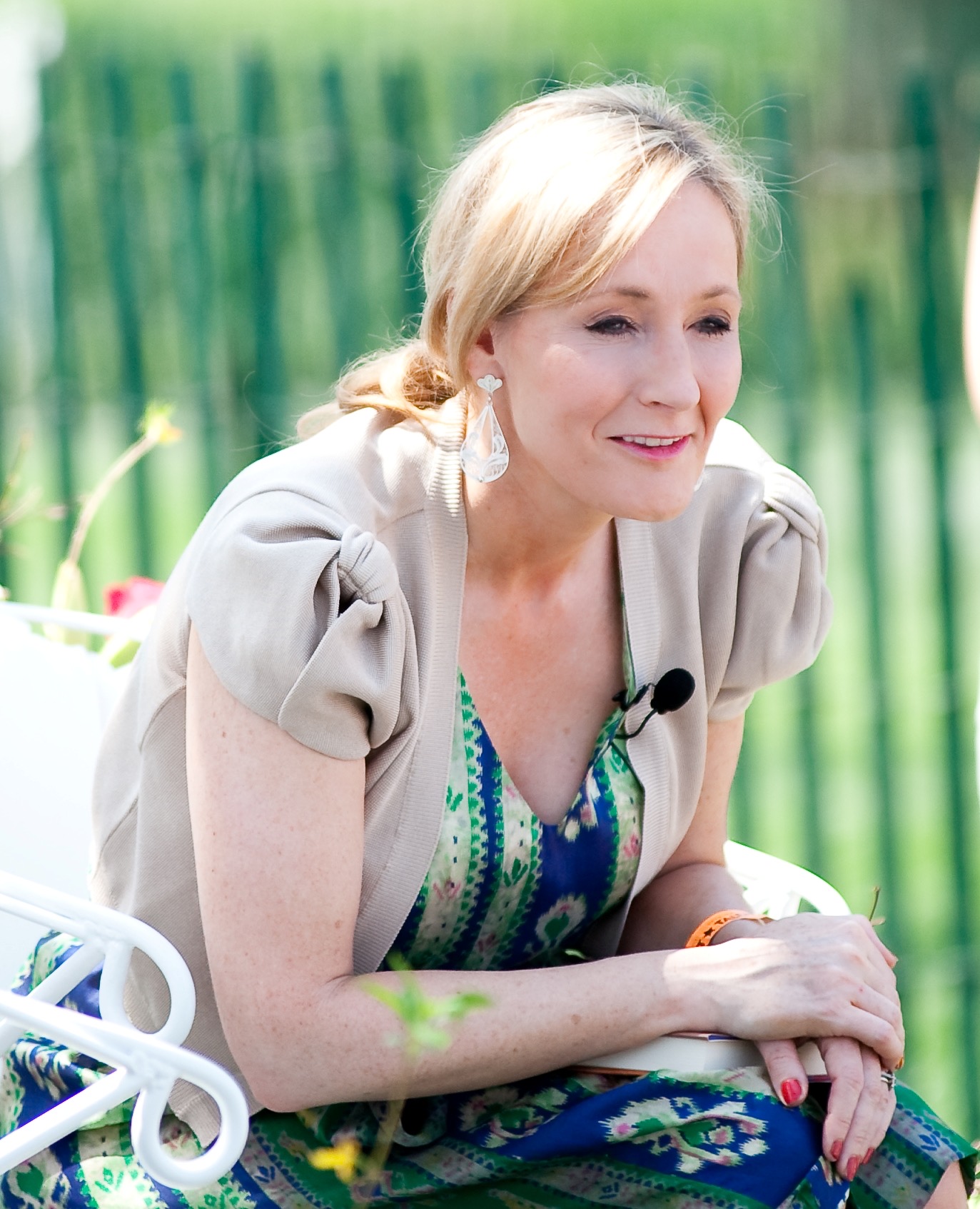
born Joanne Rowling
Author, Harry Potter series · b. 1965 · Yate, Gloucestershire, England
Two calls made by hand, not formulas. how we score →
Summary
She grew up solidly middle-class, but by the time she wrote the first Harry Potter book she was divorced, on state benefits, and raising an infant alone in Edinburgh.
A publisher paid £1,500 for the manuscript and hid her gender behind initials so boys would buy it. She then kept the rights to her characters through every deal that followed, and that ownership built the fortune.
How it happened
Born in Yate, Gloucestershire, in 1965 to an aircraft-factory engineer and a science technician, neither of whom had gone to university. A steady, unremarkable middle-class childhood: a state comprehensive school, then a French degree at Exeter. The family had a floor. Whether she could still reach it later is a separate question from whether she had one growing up.
She married Portuguese journalist Jorge Arantes in 1992; their daughter Jessica was born the next year, and the marriage ended within months. She has said on the record that she is a domestic-abuse and sexual-assault survivor and that she escaped the marriage "with some difficulty." She moved to Edinburgh in late 1993, jobless and living on about £69 a week in state benefits, and has described depression and suicidal thoughts from that period in interviews. She wrote much of the manuscript in cafés, in part because she couldn't afford to heat the flat during the day.
Twelve publishers turned the manuscript down. Bloomsbury's Barry Cunningham bought it in 1996, reportedly after his eight-year-old daughter read the first chapter and demanded the rest, paying an advance of £1,500. A Scottish Arts Council grant of £8,000, one of the largest the council had given a children's writer, helped her keep writing. Bloomsbury also chose to publish her as "J.K." rather than "Joanne," on the theory that boys wouldn't buy a book from a woman.
Warner Bros. bought film rights to the first two books in 1999 for a reported $1 million, but the contract gave her final approval over scripts, control of merchandising, and restricted the studio to adapting only books she wrote herself. She later built her own digital platform, Pottermore, to hold e-book and audiobook rights rather than license them out. The characters and the underlying IP stayed hers through every deal that followed.
Forbes called her the first billion-dollar author in 2004, then dropped her from the billionaire list in 2012, citing more than $200 million given to charity. She was added back to Forbes's billionaire list in 2025. Her public statements on sex and gender, from 2019 onward, have drawn both significant criticism and significant support; that debate postdates the wealth and isn't part of how she built it.
The coded evidence
Thirteen groups, every claim sourcedBloomsbury published her under the initials "J.K." rather than "Joanne" specifically because staff believed young boys would not buy a book credited to a woman — a documented gender headwind at the point of publication, not an incidental styling choice.
↗ en.wikipedia.orgDescendant, no recent immigration on either parent's side established
↗ en.wikipedia.orgnot established
No specific religious upbringing is established in the public record.
↗ en.wikipedia.orgHer parents were stable and middle-class, but she was living independently in Edinburgh with her infant daughter, apart from them, and relied on state benefits rather than a family home during the period she wrote the first book.
Origin and build diverge here: a soft-landing family existed in principle, but it was not the thing that caught her during the build itself.
↗ en.wikipedia.orgRoughly £69 a week in UK state benefits after moving to Edinburgh in late 1993, followed by a low-paid secretarial job and, from 1996, a teaching post at Leith Academy while she finished the manuscript.
↗ en.wikipedia.orgnot established
Single throughout the build; no partner income or labor to draw on.
↗ en.wikipedia.orgShe carried childcare and domestic labor alone as a single parent while writing, often in cafés with her daughter beside her.
↗ news.harvard.eduNo significant debt beyond an informal £600 loan from a friend during the Edinburgh years; dischargeable, not structural.
↗ en.wikipedia.orgHas described herself as "poor as it is possible to be in modern Britain, without being homeless" during the Edinburgh years, and has spoken about depression and nine months of therapy from that period.
↗ news.harvard.eduThe hardship was imposed, not chosen. There was nothing to fall back on.
Imposed, not chosen. The poverty followed directly from divorce, unemployment, and single parenthood, not from a deliberate austerity against an available family safety net.
↗ en.wikipedia.orgFather Peter Rowling worked on the assembly line at a Rolls-Royce aircraft factory, later moving into management; mother Anne Rowling was a science technician at the comprehensive school her daughter attended.
↗ en.wikipedia.orgNeither parent was self-employed.
↗ en.wikipedia.orgNeither parent attended university.
↗ en.wikipedia.orgNo documented family sanction of writing as a vocation. She studied French and Classics at Exeter, a conventional path rather than one chosen and actively facilitated toward a writing career.
↗ en.wikipedia.orgHer mother, Anne, died on 30 December 1990 after a decade with multiple sclerosis, aged 45. Rowling has said she had not yet told her mother about the book she was writing, and has linked her mother's death to Harry's own parents dying in the story.
↗ hp-lexicon.orgHas said on the record, in a 2008 interview reprinted in the Sunday Times, that she experienced serious depression and suicidal thoughts in the mid-1990s following her separation, and sought professional help, crediting her daughter with motivating her to do so.
Self-disclosed and predates any success or resources — a definitive headwind input, weighted accordingly, since it hit while she had nothing to buy help with beyond nine months of NHS-adjacent therapy.
↗ abc.net.auHas written on the record, in a June 2020 essay on her own website, that she is a survivor of domestic abuse from her first marriage and of a separate sexual assault, saying she has "never talked publicly about being a domestic abuse and sexual assault survivor" before that.
Attributed entirely to her own published account. No third party is named in this field.
↗ jkrowling.comGrew up in Winterbourne and then Tutshill, small towns on the Gloucestershire side of the England–Wales border, after being born in Yate.
↗ en.wikipedia.orgWyedean Comprehensive School and College, a state comprehensive in Gloucestershire where her mother also worked as a science technician.
↗ en.wikipedia.orgBloomsbury children's editor Barry Cunningham acquired the manuscript in 1996, reportedly after his eight-year-old daughter Alice read the first chapter and asked for more.
↗ en.wikipedia.orgInstitutional: standard agent-to-publisher submission through the Christopher Little Literary Agency, with no pre-existing relationship to Bloomsbury.
↗ en.wikipedia.orgThe manuscript was rejected by twelve publishing houses before Bloomsbury accepted it.
↗ en.wikipedia.orgBA in French and Classics, University of Exeter, 1986, including a year in Paris.
↗ en.wikipedia.orgnot established
No debt or named scholarship is documented for the Exeter degree. 1980s UK higher education carried no tuition fee and a means-tested state maintenance grant; the specific split between that grant and any family contribution is not established in the record.
↗ en.wikipedia.orgDirect undergraduate degree, no vocational or transfer route.
↗ en.wikipedia.org£1,500 advance from Bloomsbury for "Harry Potter and the Philosopher's Stone," paid in 1996.
↗ biography.comIt paid its own way from the start. Revenue came before any outside money.
Funded by book sales and advances throughout; no outside capital was ever raised.
↗ en.wikipedia.orgSold film rights to the first two novels to Warner Bros. in 1999 for a reported $1 million, but the deal gave her final approval over scripts, control of merchandising, and restricted Warner Bros. to adapting only books she wrote herself — keeping the underlying characters and story rights out of the studio's hands.
Terms are widely reported in secondary coverage; the underlying contract is not public.
↗ en.wikipedia.orgBuilt and controlled Pottermore (later folded into Wizarding World Digital), her own digital platform for e-book and audiobook rights, rather than licensing those rights to an outside publisher.
↗ en.wikipedia.orgAn £8,000 Scottish Arts Council grant, reported as the largest the council had given a children's writer at the time, helped support her writing in the mid-1990s.
Some accounts tie the grant to work on the second book rather than the first; the exact timing relative to the Bloomsbury deal is not fully settled across sources.
↗ ebsco.comPersonal creative work rather than a prior employer or commission. She has said the idea for Harry Potter came to her on a delayed train from Manchester to London in 1990.
↗ en.wikipedia.org0
No prior distinct ventures; the same manuscript was submitted repeatedly rather than relaunched.
↗ en.wikipedia.orgState benefits, then a secretarial wage, then a teaching salary at Leith Academy from 1996, while she finished and sold the manuscript.
↗ en.wikipedia.orgMid-1990s UK children's fiction was not considered a strong commercial category, and Bloomsbury was a small independent publisher taking a bet on an unknown, unagented-to-market author.
↗ en.wikipedia.orgBuilt. Original characters and world created from scratch, not an acquired property.
↗ en.wikipedia.orgPublishing and literature
↗ en.wikipedia.org1200000000
Forbes figure as of August 2026. She was Forbes's first billion-dollar author in 2004, was removed from billionaire lists from 2012 onward citing over $200 million in charitable giving, and was re-added to Forbes's billionaire list in 2025. Band only; treat the number as approximate.
↗ forbes.comJournalistic estimate
↗ forbes.com2026
↗ forbes.comWealth from owned intellectual property — copyright, film and merchandising participation, and controlled digital rights — rather than a fixed salary.
↗ en.wikipedia.orgBest-selling book series in history, over 600 million copies sold; OBE in 2001, Companion of Honour in 2017; founded the children's charity Lumos.
↗ en.wikipedia.orgUncapped
↗ en.wikipedia.orgGenerous, Combative, Outspoken
↗ en.wikipedia.orgPublic
↗ en.wikipedia.orgBefore
Her reputation as a beloved children's author was established for over two decades before the 2019-onward gender debate.
↗ en.wikipedia.orgMixed
↗ en.wikipedia.orgHer public statements on sex and gender, beginning in 2019, have drawn both significant criticism and significant support. The debate postdates her rise to wealth and fame and is not part of how she built it.
↗ en.wikipedia.orgNot a recovery situation in the usual sense — the split has persisted on both sides rather than resolving toward either forgiveness or permanent penalty.
↗ en.wikipedia.orgStructural context
The cost-of-failure score comes from this person's own money and circumstances. But who they were in America carried its own weight, the same way their household or income did, and it shaped how hard the path was just as much. That part isn't in the cost-of-failure number. It's here instead.
Across film, music, and digital, ownership and control stay in far fewer women's hands than men's. For one measure, women directed only about 12% of 2023's top-grossing films.
↗ assets.uscannenberg.orgWhite creators hold most of the ownership and catalog control relative to their share of the population. Recognition turns into ownership most reliably for them.
↗ assets.uscannenberg.orgAmong the people recorded here — women: 54 · White subjects: 74. Representation here is who reached these outcomes, not equal odds of reaching them.
Controlled comparisons
Each holds one thing constant and varies another, so the difference is the point. A list of similar names wouldn't tell you anything.