Howard Schultz
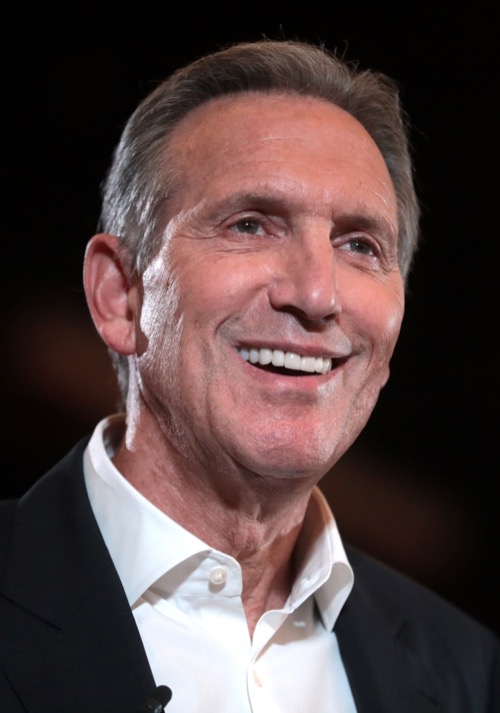
Founder and former CEO, Starbucks · b. 1953 · Brooklyn, New York
Two calls made by hand, not formulas. how we score →
Summary
Brooklyn public housing, and a father who lost his job with no insurance after breaking his ankle on a delivery route.
A football scholarship made him the first in his family to finish college. A decade in sales built the credibility to raise investor money after his employer rejected his coffee-bar idea, and in 1987 he bought that employer outright.
How it happened
Bayview, a public-housing project in Canarsie, Brooklyn. When Schultz was seven, his father broke his ankle on a delivery route for a diaper service and was fired the same week, with no sick pay, no workers' comp, and no health insurance to fall back on. His mother worked as a receptionist.
A football scholarship got him to Northern Michigan University, where he later called himself an unmotivated student. He graduated in 1975, the first person in his family to finish college.
Sales jobs at Xerox and then a Swedish housewares company, Hammarplast, took him to Seattle in 1981 to check on a small coffee-bean retailer that was ordering an odd number of drip filters. He joined that company, Starbucks, as director of retail operations and marketing in 1982, and a 1983 buying trip to Milan showed him Italian espresso bars.
Starbucks' founders turned down his pitch to build espresso bars, so he quit and started his own chain, Il Giornale, in 1985. He pitched 242 investors and 217 said no.
He raised enough anyway, including money from Starbucks itself, and in 1987 used a fresh round of investor capital to buy Starbucks' name, stores, and roasting plant for about $3.8 million, folding Il Giornale into it.
He took the company public in 1992 and grew it into a global chain, and along the way gave part-time workers health insurance and stock, a decision he traces directly to his father. Forbes puts his net worth near $3.6 billion. He also left and returned as CEO twice, and during his last return a labor board judge found the company engaged in widespread, illegal anti-union conduct.
The coded evidence
Thirteen groups, every claim sourcednot established
No family property or savings to fall back on in childhood. By the time he left Starbucks to found Il Giornale in 1985 he had nine years of sales and marketing experience behind him, which is a different, softer kind of fallback than money in the bank.
↗ encyclopedia.comLeft a paid director-level job at Starbucks to found Il Giornale; the new venture was financed mainly by outside investors rather than his own savings or a working spouse's income.
↗ referenceforbusiness.comnot established
No eviction, homelessness, or comparable instability documented during the 1985-87 founding period; he moved directly from a corporate salary into fundraising.
↗ encyclopedia.comThe hardship was imposed, not chosen. There was nothing to fall back on.
The childhood hardship, public housing and a father who lost his job and insurance in one week, was imposed, not chosen.
↗ encyclopedia.comFather Fred held low-paying jobs including truck driver and delivery driver for a diaper service; broke his ankle on the job in 1961 and was fired with no sick pay or workers' comp. Mother Elaine worked as a receptionist.
↗ encyclopedia.com2
Not corroborated in the business-biography sources used elsewhere in this record.
↗ en.wikipedia.orgBayview Houses, a public-housing project in Canarsie, Brooklyn.
↗ encyclopedia.comCanarsie High School, a public school, graduated 1971.
↗ en.wikipedia.orgWhile running U.S. operations for Hammarplast, a Swedish housewares company, he visited Seattle in 1981 to see why a small coffee-bean retailer was ordering an unusual number of drip filters. That visit was his introduction to Starbucks.
↗ referenceforbusiness.comStarbucks itself, then a small Seattle coffee-bean roaster with a handful of stores. He joined as director of retail operations and marketing in 1982, and it supplied the industry credibility and the early investor relationships (including a $150,000 investment from Starbucks in Il Giornale) that let him raise money for his own idea after the founders turned it down.
↗ en.wikipedia.orgCapital, Credibility, Network, Idea
↗ en.wikipedia.orgAfter Starbucks' founders rejected his espresso-bar concept, he cold- pitched 242 prospective investors himself to fund Il Giornale; 217 said no.
↗ en.wikipedia.org9
Xerox (1976), Hammarplast (1979), then Starbucks (1982) before founding Il Giornale in 1985.
↗ referenceforbusiness.comBA, Northern Michigan University, 1975, on a football scholarship. Sources differ on the field: some say communications, one says business administration.
↗ encyclopedia.comDirect four-year degree, funded by an athletic scholarship rather than family money.
↗ referenceforbusiness.comIt needed capital up front, before it earned anything.
Il Giornale was capital-first; investor money was raised before the first store opened.
↗ en.wikipedia.orgNeeded about $400,000 to open the first Il Giornale. Starbucks itself put in $150,000 and a single investor, a doctor named Ron Margolis, put in $100,000; the rest came from the 25 of 242 pitched investors who said yes.
Figures are widely repeated and trace back to Schultz's own account in "Pour Your Heart Into It."
↗ en.wikipedia.orgBought Starbucks' assets in 1987 with investor money, then took the combined company public on NASDAQ in 1992, a raise reported at $271 million that funded doubling the store count. His personal stake was diluted through that raise and the financings that followed.
↗ referenceforbusiness.comPersonal experience at a prior employer. A 1983 buying trip to Milan showed him Italian espresso-bar culture; he brought the idea back to Starbucks, whose founders had no interest in it.
↗ encyclopedia.com217 of 242 prospective investors declined to back Il Giornale before he assembled the round.
↗ en.wikipedia.org0
No venture before Il Giornale; this was his first and only founding attempt.
↗ referenceforbusiness.comOutside investors, not personal savings, financed the founding round.
↗ en.wikipedia.orgnot established
Continuous paid employment from 1976 (Xerox) through the 1987 buyout; no unexplained gaps.
↗ referenceforbusiness.comA US specialty-coffee category still being invented; Starbucks had only a handful of stores when he bought it.
↗ referenceforbusiness.comBought. He acquired an existing six-store coffee-bean retailer and its name rather than building a chain from nothing, then merged in the espresso-bar format he had built at Il Giornale.
↗ en.wikipedia.org39
1987 to 2026, though not continuous as CEO. He stepped down twice (2000, 2017) and returned twice (2008, 2022) while remaining a major shareholder and board presence throughout.
↗ forbes.comConsumer retail
↗ referenceforbusiness.com3600000000
↗ forbes.comJournalistic estimate
↗ forbes.com2026
↗ forbes.comWealth in owned, appreciating equity, primarily Starbucks stock, plus stakes built through his venture firm Maveron, rather than a fixed salary.
↗ forbes.comCredited with building the modern Starbucks and, in 1988, making it the first major US retailer to offer health insurance to part-time workers, followed in 1991 by equity grants (Bean Stock) to full- and part-time staff alike. Briefly explored an independent 2020 presidential run before withdrawing in September 2019.
↗ encyclopedia.com2
From leaving Starbucks to found Il Giornale (1985) to buying Starbucks outright (1987).
↗ en.wikipedia.orgUncapped
↗ forbes.comOn March 1, 2023, NLRB Administrative Law Judge Michael A. Rosas found that Starbucks committed "egregious and widespread misconduct" across 21 Buffalo-area stores during the 2021-22 union campaign, including illegal surveillance, restrictions on discussing wages, discriminatory transfers, and the permanent closure of one store. Seven employees were found to have been unlawfully discharged. The judge ordered reinstatement and back pay, reopening of the closed store, a bargaining order at one location, and required Schultz personally, alongside senior VP Denise Nelson, to read or be present for the reading of a workers'-rights notice to Buffalo store employees.
↗ nlrb.govAfter
↗ nlrb.govUnrelated
This conduct dates to his 2022-23 return as interim CEO, decades after the 1987-92 buyout and IPO that produced his fortune. It didn't produce the outcome; it happened well after the outcome was secured.
↗ hrdive.comCivil wrong
↗ nlrb.govNone
No personal fine or liability for Schultz; the company bears the cost of back pay and store reopening. The one personal consequence is non-monetary: the order that he take part in reading the workers'- rights notice.
↗ hrdive.comAs an employer he both reformed and, later, resisted the conditions he came up under. In 1988 he made Starbucks the first major US retailer to give part-time workers health insurance, a decision he's said came directly from watching his father lose his job and his coverage in the same week. In 2022-23, back as CEO, he presided over a labor board finding that the company he rebuilt fought its own workers' unionization drive through illegal surveillance, firings, and a store closure.
↗ encyclopedia.comMission driven, Paternalistic, Controlling
The judge's decision found corporate executives' involvement in the Buffalo stores "relentless" and likely to have left a lasting impression on workers. Press profiles separately describe him in mission-driven, paternalistic terms tied to the health-benefits story he tells about his father.
↗ nlrb.govInsiders
↗ nlrb.govAfter
The mission-driven, worker-benefits reputation built up through the late 1980s and 1990s, after the 1987 buyout.
↗ encyclopedia.comMixed
↗ fortune.comThe reputation was deliberately built, through books, press, and PR.
Wrote four books about his own leadership and values ("Pour Your Heart Into It," "Onward," "For Love of Country," "From the Ground Up").
↗ en.wikipedia.orgTo much of the business press and public, a self-made success story and a pioneer on worker benefits. To labor organizers and the senators who questioned him in March 2023, the face of an illegal union-busting campaign. He told Fortune he was "shocked, stunned to hear the loneliness, the anxiety" among workers organizing against him; Starbucks called the judge's remedies "inappropriate."
↗ fortune.comStructural context
The cost-of-failure score comes from this person's own money and circumstances. But who they were in America carried its own weight, the same way their household or income did, and it shaped how hard the path was just as much. That part isn't in the cost-of-failure number. It's here instead.
Men held about 90% of Fortune 500 CEO seats in 2023, and a wider majority of the rungs below. The ladder is widest for them the whole way up.
↗ forbes.comWhite executives hold most Fortune 500 CEO seats relative to their share of the population, an edge that adds up at every rung of the climb.
↗ finance.yahoo.comAmong the people recorded here — men: 169 · White subjects: 114. Representation here is who reached these outcomes, not equal odds of reaching them.
Controlled comparisons
Each holds one thing constant and varies another, so the difference is the point. A list of similar names wouldn't tell you anything.