Bill Gates
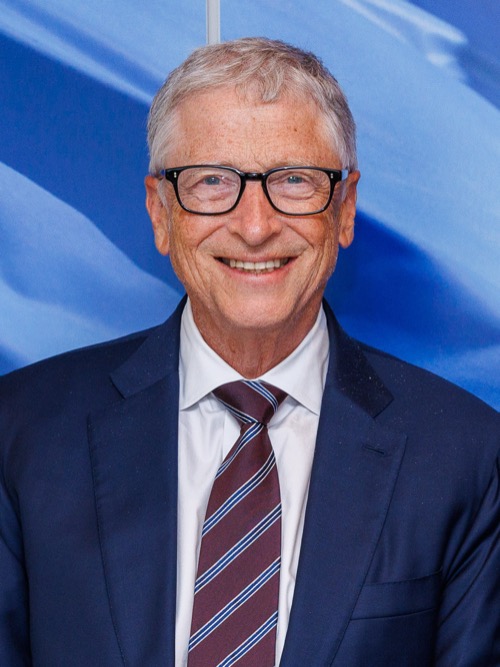
Co-founder, Microsoft · b. 1955 · Seattle, Washington
Two calls made by hand, not formulas. how we score →
Summary
A computer terminal at his private school in 1968 gave him thousands of programming hours almost no one his age could get near.
His mother's seat on a United Way committee put the family in front of IBM's chairman in 1980, and money at home made leaving Harvard low-risk. What actually built the fortune was the terms of that IBM deal, not just getting it.
How it happened
A Seattle family of lawyers and civic board members. In 1968, the Lakeside School Mothers' Club used rummage-sale money to buy a Teletype terminal and computer time on a GE system, and it gave him and a small group of friends, including Paul Allen, thousands of programming hours almost nobody their age could touch.
He left Harvard in 1975 to work on software full time. An earlier venture with Allen, a traffic-counting business called Traf-O-Data, had made a little money and gone nowhere. None of it put the family at risk. If the software business failed, he had a comfortable house and, by his own account, an open door back to Harvard.
In 1980 IBM needed an operating system fast for its first personal computer. His mother, Mary Gates, sat on the national United Way executive committee with IBM chairman John Opel and mentioned her son's company to him. Microsoft bought an existing operating system, 86-DOS, for under $100,000, adapted it, and licensed it to IBM without giving up the right to sell the same software to every other company building IBM-compatible machines.
That non-exclusive license is what built Microsoft, more than the IBM contract itself. Every clone maker needed the same operating system, so Microsoft collected a small fee on nearly every PC sold across the industry. The 1986 IPO and the wealth that followed came directly out of that arrangement.
Decades of some of the largest personal wealth in the world, a 1990s antitrust case that found Microsoft had illegally protected its monopoly, and a foundation that has since given away tens of billions of dollars. The Lakeside terminal and a family that could absorb any failure were the whole first act.
The coded evidence
Thirteen groups, every claim sourcedPaternal line traces to English ancestry; his great-grandfather ran a furniture business and prospected during the Klondike gold rush.
↗ en.wikipedia.orgDescendant, several generations settled in the Pacific Northwest
↗ en.wikipedia.orgAn affluent attorney's household behind him meant zero risk of losing housing or income over the decision to leave Harvard.
↗ en.wikipedia.orgFamily money and, by his own account at Harvard's 2007 commencement, an implied ability to go back and finish the degree if the software business didn't work out.
↗ news.harvard.eduThe hardship was chosen. There was a home to go back to if it failed.
Early Microsoft famously ran on long hours and a spartan office, but that was chosen intensity against a real safety net, not survival need.
↗ en.wikipedia.orgFather William H. Gates Sr., a prominent Seattle attorney who co-founded what became the K&L Gates firm; mother Mary Maxwell Gates, a bank and United Way board member who also sat on the University of Washington board of regents for 18 years.
↗ en.wikipedia.orgLakeside School, an elite private Seattle school; the family paid the tuition.
↗ en.wikipedia.orgThe Lakeside Programmers Club, formed around the school's computer access, including Paul Allen, Kent Evans, and Ric Weiland. Allen became his Microsoft co-founder.
↗ en.wikipedia.orgHis mother Mary Gates sat on the national United Way executive committee alongside IBM chairman John Opel and mentioned her son's company to him in 1980. Opel reportedly mentioned her to other IBM executives, and IBM approached Microsoft about an operating system shortly after.
↗ en.wikipedia.orgMITS, maker of the Altair 8800, agreed to distribute the BASIC interpreter Gates and Allen wrote for it in 1975, without either of them having owned the machine they wrote it for.
↗ en.wikipedia.orgNetwork, Credibility
His mother's board network supplied the introduction; Harvard's computing resources also supplied early development capacity for the Altair BASIC work.
↗ en.wikipedia.orgPaul Allen, a Lakeside classmate one grade above him, co-founded Microsoft in 1975 and had already worked with Gates on Traf-O-Data.
↗ en.wikipedia.orgIn eighth grade, the Lakeside Mothers' Club used rummage-sale proceeds to buy a Teletype Model 33 terminal and computer time on a General Electric system. Gates wrote his first program on it, a tic-tac-toe game, and kept finding ways to get more machine time through his teens, including a bug-hunting arrangement with a local computer firm that gave the group free access until it went out of business in 1970.
↗ en.wikipedia.orgAttended Harvard College 1973 to 1975, no degree; scored 1590 of 1600 on the SAT. Received an honorary Doctor of Laws from Harvard in 2007.
↗ en.wikipedia.orgNone established. Harvard tuition came from an affluent family with no need for aid or loans.
↗ en.wikipedia.orgRoyalties from the Altair BASIC deal with MITS, 1975, the interpreter he and Allen wrote on Harvard's PDP-10 for a machine neither of them owned.
↗ en.wikipedia.orgTechnology Venture Investors, led by David Marquardt, made the one outside investment before the 1986 IPO, around 1981. Wikipedia's account of Marquardt states Microsoft "did not need the venture capital investment" by that point and took it mainly in preparation for going public.
↗ en.wikipedia.orgGrew on software licensing revenue from the first product onward. The one outside financing round came after the company was already profitable, not to fund survival.
↗ en.wikipedia.orgLicensed the DOS to IBM non-exclusively in 1981, keeping the right to sell the same software to every maker of IBM-compatible clones. The instinct to keep rights had already been tested: an earlier dispute with MITS over the BASIC interpreter went to arbitration, and the arbitrator ruled Microsoft could sell it to other computer makers too.
↗ en.wikipedia.orgBought an existing operating system, 86-DOS (also called QDOS), from Seattle Computer Products for under $100,000 rather than writing one from scratch, then adapted it for IBM.
↗ en.wikipedia.org1
Traf-O-Data (1972-1975), a traffic-counter data business with Allen and Paul Gilbert. Gates called it "only modest success"; it closed when Washington state began offering the same processing for free. Not a collapse so much as a venture that stopped mattering.
↗ en.wikipedia.orgTraf-O-Data ran on the founders' own modest teenage earnings; no real capital was ever at risk.
↗ en.wikipedia.org25
IBM approached Microsoft in July 1980 and awarded the PC DOS contract in August 1981; Gates turned 25 that October.
↗ en.wikipedia.orgThe 1975 Altair 8800 had already opened a hobbyist personal-computer market; by 1980 IBM's decision to enter that market with an open, off-the-shelf architecture created the opening Microsoft filled.
↗ en.wikipedia.orgBought the core of the operating system (86-DOS) rather than building one from nothing, then licensed and extended it.
↗ en.wikipedia.orgSoftware
↗ forbes.comJournalistic estimate
↗ forbes.com2026
↗ forbes.comnot established
Not established in this pass. He drew a modest CEO salary relative to his wealth for decades; the fortune is almost entirely equity, not pay.
↗ forbes.comNearly all wealth sits in Microsoft equity built at founding, plus its reinvestment since; not a salary story at any point.
↗ forbes.comCo-founded the Gates Foundation in 2000 with an initial $5 billion stock donation, and has since given more than $59 billion to it.
↗ en.wikipedia.orgUncapped
↗ forbes.comUnited States v. Microsoft Corp. (1998-2001): the district court found Microsoft had illegally maintained its Windows monopoly and tied Internet Explorer to it, and initially ordered a breakup. The appeals court vacated the breakup in 2001 but left the underlying findings largely intact. A 2001-2002 settlement required Microsoft to share APIs with third parties and submit to five years of outside monitoring; it did not require code changes or a fine.
↗ en.wikipedia.orgAfter
↗ en.wikipedia.orgIncidental
The conduct at issue was about defending and extending a dominant position built in the 1980s, not about producing the original 1980 IBM deal or the fortune's foundation.
↗ en.wikipedia.orgCivil wrong
↗ en.wikipedia.orgNone
No breakup, no personal liability for Gates, and no monetary fine in the US case; the remedy was behavioral, with outside monitoring.
↗ en.wikipedia.orgBrilliant, Combative, Philanthropic
↗ en.wikipedia.orgPublic
↗ en.wikipedia.orgMixed
↗ en.wikipedia.orgSpent roughly two decades rebuilding his public image through the Gates Foundation, moving from the public face of a federal antitrust case to one of the most prominent philanthropists in the world.
↗ en.wikipedia.orgStructural context
The cost-of-failure score comes from this person's own money and circumstances. But who they were in America carried its own weight, the same way their household or income did, and it shaped how hard the path was just as much. That part isn't in the cost-of-failure number. It's here instead.
Men founded the companies that took nearly all the venture funding and almost every top outcome, a tailwind that never shows up in one person's own circumstances.
↗ techcrunch.comWhite founders are heavily overrepresented among funded companies and top-tier wealth relative to their share of the population, an edge that has nothing to do with a person's own money.
↗ techcrunch.comAmong the people recorded here — men: 169 · White subjects: 114. Representation here is who reached these outcomes, not equal odds of reaching them.
Controlled comparisons
Each holds one thing constant and varies another, so the difference is the point. A list of similar names wouldn't tell you anything.