Jack Welch
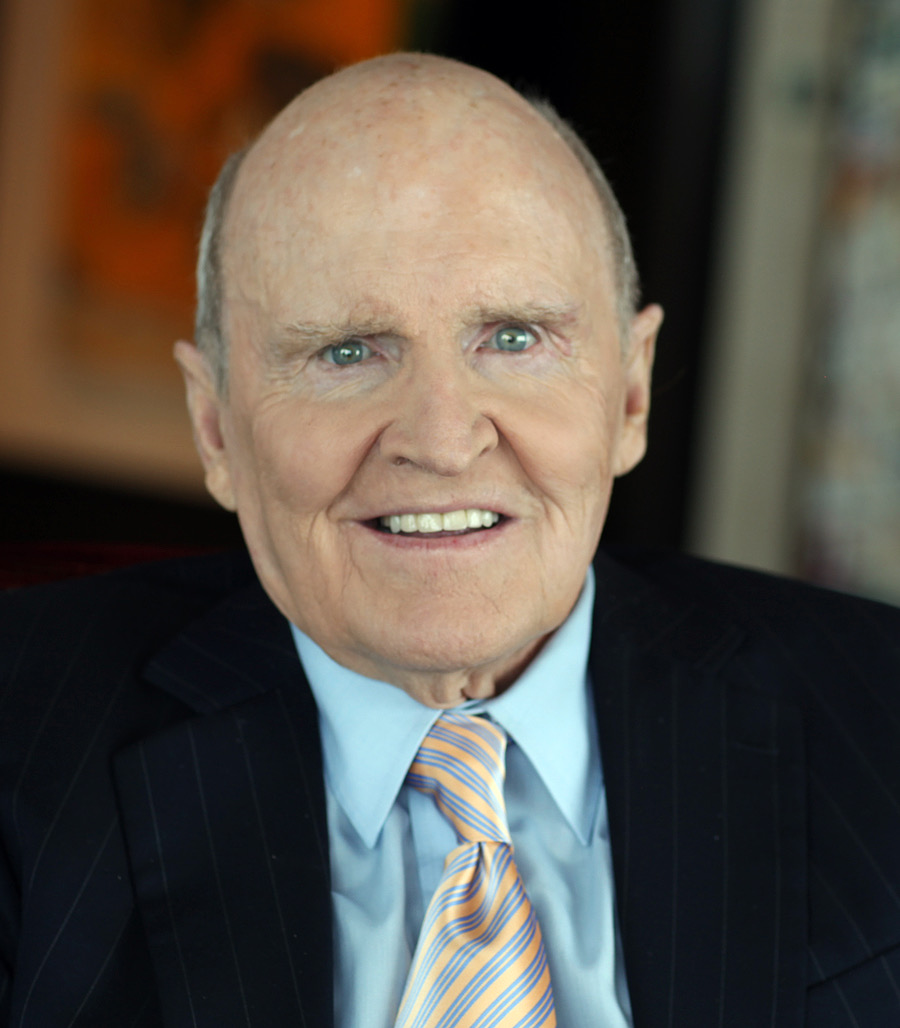
born John Francis Welch Jr.
Chairman and CEO, General Electric (1981-2001) · b. 1935–2020 · Peabody, Massachusetts
Two calls made by hand, not formulas. how we score →
Summary
A railroad conductor's only son, he studied his way through a state engineering degree and a PhD, then spent 21 years climbing one company to its youngest-ever chairmanship in 1981.
He ran General Electric for two decades, was named "Manager of the Century" on the way out, and built a fortune from salary, bonus, and stock, not ownership. Critics later argued the same playbook set up its decline.
How it happened
Born in 1935 in Peabody, Massachusetts, and raised in nearby Salem, the only child of a Boston & Maine Railroad conductor and a homemaker mother. He worked summer jobs through school as a golf caddie, newspaper delivery boy, shoe salesman, and drill-press operator, and captained his high school hockey team.
He was accepted late in his senior year to the University of Massachusetts Amherst, where he studied chemical engineering and worked summers at Sunoco and PPG. He graduated in 1957 and turned down several job offers to go on for a master's and PhD in chemical engineering at the University of Illinois, finishing in 1960.
He joined General Electric in 1960 as a junior chemical engineer at $10,500 a year, in Pittsfield, Massachusetts. He nearly quit within a year over a small raise; an executive, Reuben Gutoff, talked him into staying. In 1963 an explosion blew the roof off a GE plant under his management and he was almost fired over it.
He stayed. By 1968 he was running GE's plastics division, a $26 million unit built around Lexan and Noryl. Promotions followed through the 1970s — group executive, senior vice president, vice chairman by 1979 — inside the same company the entire time.
In 1981 GE's board made him chairman and CEO, its youngest ever at 45, succeeding Reginald H. Jones. This is the appointment that produced everything that followed — the wealth, the reputation, and the fight over the reputation. He ran the company for the next twenty years.
He cut GE's payroll from about 411,000 in 1980 to about 299,000 by 1985, earning the nickname "Neutron Jack," and later ran an annual "vitality curve" that removed the bottom 10% of managers. He pushed GE Capital from a financing arm into a business that came to generate about 40% of GE's revenue, adopted Six Sigma in 1995, and by his own board's account grew GE's market value by more than $460 billion over his tenure. Fortune named him "Manager of the Century" in 1999.
He retired on December 31, 2001, with a severance package reported at roughly $417-420 million, then the largest in U.S. business history. The following year, testimony in his divorce made public an additional set of lifetime retirement perks attached to his 1996 employment contract — an apartment, a car and driver, use of the company jet — on top of deferred salary and bonus payments, and the disclosure drew an SEC review and public criticism. He subsequently gave up some benefits and began paying for others himself.
He wrote two bestselling books, "Jack: Straight from the Gut" (2001) and "Winning" (2005), founded the Jack Welch Management Institute in 2009, and taught at MIT Sloan. He died March 1, 2020, at 84, of kidney failure. Two years later, journalist David Gelles published "The Man Who Broke Capitalism," arguing that Welch's shareholder-value focus, layoffs, offshoring, and financialization of GE through GE Capital left a template that later contributed to the company's decline and its 2021 breakup into three separate companies.
The coded evidence
Thirteen groups, every claim sourcedBoth paternal and maternal grandparents were Irish; the family was Irish-Catholic.
↗ en.wikipedia.orgMulti-generational American. His paternal and maternal grandparents were Irish immigrants, but neither he nor his parents were foreign-born.
↗ en.wikipedia.org0
Continuous employment at GE from 1960 to his December 2001 retirement, 40 years of credited service by early 2001.
↗ sec.govA stable two-parent household in Salem, Massachusetts, on a single railroad conductor's income. No evidence of housing instability at any point in the record.
↗ en.wikipedia.orgContinuously salaried from his 1960 entry into GE at $10,500 a year onward, through 41 years at a single employer with no personal venture or capital of his own ever at risk.
↗ en.wikipedia.orgnot established
No debt figure is documented in sources reviewed for his UMass or Illinois years.
↗ en.wikipedia.orgnot established
No documented homelessness, food insecurity, or comparable instability at any career stage.
↗ en.wikipedia.orgThe hardship was imposed, not chosen. There was nothing to fall back on.
No period of chosen austerity is documented; his origin was stable but modest, not a soft landing he stepped away from.
↗ en.wikipedia.orgHis father, John Francis Welch Sr., was a Boston & Maine Railroad conductor. His mother, Grace Andrews Welch, was a homemaker.
↗ en.wikipedia.orgNeither parent was self-employed.
↗ en.wikipedia.orgnot established
No documented account of a specific family sacrifice aimed at tuition; he worked summer jobs (caddie, paper route, shoe sales, drill press, and later chemical-engineering summer work at Sunoco and PPG) through his school years, but whether that money went toward tuition or general support isn't established.
↗ en.wikipedia.orgWelch has described having a childhood stutter, and has recounted his mother telling him it was because his brain worked faster than his tongue could keep up — an explanation he said he came to believe and that he credited with keeping the stutter from limiting him.
Self-disclosed in his own memoir and repeated across multiple secondary profiles; not independently documented via a primary medical or contemporaneous record.
↗ entrepreneur.comSalem, Massachusetts.
↗ en.wikipedia.orgSalem High School, a public high school; then the University of Massachusetts Amherst, a public state university, for his undergraduate degree.
↗ en.wikipedia.orgnot established
No childhood relocations documented; he grew up in Salem through high school.
↗ en.wikipedia.orgGE executive Reuben Gutoff talked him out of quitting within a year of joining, promising the "small-company atmosphere" Welch said he wanted. A direct superior chose to keep and continue promoting him after a 1963 plant explosion nearly got him fired.
↗ en.wikipedia.orgGeneral Electric. He joined in 1960 as a junior chemical engineer and never worked anywhere else across his entire career.
↗ en.wikipedia.org1
A single, continuous 41-year employer relationship from 1960 to his 2001 retirement.
↗ en.wikipedia.orgPhD in chemical engineering, University of Illinois Urbana-Champaign (1960), with a master's in the same program; BS in chemical engineering, University of Massachusetts Amherst (1957).
↗ en.wikipedia.orgWorked chemical-engineering summer jobs at Sunoco and PPG Industries during his UMass Amherst undergraduate years.
↗ en.wikipedia.orgDirect: a public state university undergraduate degree into a chemical-engineering PhD program, then straight into industry at GE with no gap.
↗ en.wikipedia.orgnot established
Not applicable in the founder sense; his entire adult income came from GE salary, bonus, and equity grants, never a venture he personally financed.
↗ en.wikipedia.orgSalary, annual bonus, stock options, and restricted stock units from a single employer across a 41-year career, not any investment vehicle or venture he personally controlled.
↗ sec.gov0
No independent venture attempted. His closest brush with failure was a 1963 explosion that blew the roof off a GE plant under his management, which nearly got him fired.
↗ en.wikipedia.orgGE itself absorbed the cost and consequence of the 1963 explosion; his direct superior chose to retain him rather than dismiss him, and he continued to be promoted afterward.
↗ en.wikipedia.orgA GE salary throughout his career. There were no employment gaps to sustain.
↗ en.wikipedia.orgJoined GE in 1960 during the postwar American industrial boom; became CEO in 1981 as hostile takeovers, deregulation, and shareholder-value activism began reshaping U.S. corporate management, and built GE Capital through the 1980s-90s credit expansion that preceded the 2008 financial crisis.
↗ en.wikipedia.orgIndustrial conglomerate management; financial services (GE Capital)
↗ en.wikipedia.org720000000
Estimates at his 2020 death range from roughly $650 million to $900 million across secondary sources with no disclosed methodology; $720 million is among the more commonly repeated figures. Treated here as a band-level, not precise, number.
↗ en.wikipedia.orgAggregator
↗ en.wikipedia.org16754019
Total salary, bonus, and other annual compensation for fiscal year 2000, his final full year as CEO, per GE's 2001 proxy Summary Compensation Table: $4,000,000 salary, $12,700,000 bonus, $54,019 other annual compensation. Excludes the separately reported grant-date value of 3,000,000 stock options that year (about $108 million under the Black-Scholes method disclosed in the same proxy) and a $57.1 million pre-tax gain he realized that year exercising previously granted SARs.
↗ sec.govProxy statement
↗ sec.govThe bulk of his wealth was realized stock and option gains accumulated and exercised over four decades as an employee, plus a guaranteed deferred-compensation and retirement package, rather than illiquid founder equity in anything he built.
↗ sec.govHigh salaried income with stock and option grants, not an owned, appreciating asset base he created. He was paid extraordinarily well by a board he sat in front of; he never held a founder's equity stake.
↗ sec.govNamed Fortune's "Manager of the Century" in 1999. Authored two bestselling books, founded the Jack Welch Management Institute in 2009, and taught at MIT Sloan. GE's market value grew by more than $460 billion over his 20-year tenure, by his own board's account.
↗ en.wikipedia.orgCapped
A salaried public-company executive with board-set compensation, not an open-ended founder's equity stake.
↗ sec.govIn September 2002, testimony in Welch's divorce proceedings made public an extensive set of post-retirement perquisites attached to his 1996 GE employment contract. A shareholder proposal included in GE's 2003 proxy statement, citing press reporting, described the disclosed terms as "a guaranteed deferred salary totaling nearly $22 million and deferred incentive bonuses totaling near $30 million," plus an apartment and its furnishings, use of the corporate jet, cooking staff, country club membership, and a car and driver. The disclosure led to press criticism and, according to other public reporting, a Securities and Exchange Commission review of how the arrangement had been disclosed. Welch subsequently renounced some of the benefits and began paying for others out of pocket.
The SEC-review detail is corroborated by Wikipedia (https://en.wikipedia.org/wiki/Jack_Welch), which states that court filings from the divorce "led to a Securities and Exchange Commission investigation of the then-retired Welch's employment contracts with GE." No finding of wrongdoing against Welch personally is documented in sources reviewed.
↗ sec.govUnrelated
The perks were negotiated as part of his 1996 retirement contract after he had already reached the top job; the later disclosure controversy did not produce his rise or his fortune, though it did affect his reputation.
↗ en.wikipedia.orgLegal gray
A compensation-disclosure controversy reviewed by the SEC, not an adjudicated civil wrong or criminal matter in sources reviewed.
↗ en.wikipedia.orgNone
No fine, personal liability, or criminal charge is documented; he voluntarily gave up or began paying for some benefits following public criticism.
↗ en.wikipedia.orgManager of the Century, Neutron Jack
Fortune's 1999 honor and the "Neutron Jack" press nickname for his 1980s layoffs are the two poles of his contemporaneous reputation.
↗ en.wikipedia.orgPress
↗ en.wikipedia.org2
Fortune's 1999 "Manager of the Century" designation and David Gelles's 2022 book represent two independently sourced, opposing characterizations reviewed here; broader coverage of both his management style and his legacy is far more extensive.
↗ en.wikipedia.orgMixed
An asset during his tenure and for years afterward, commanding speaking fees, book deals, and a consulting and teaching career; later cited by critics as a liability once his management template was argued to have contributed to GE's post-2008 decline.
↗ en.wikipedia.orgThe reputation was deliberately built, through books, press, and PR.
Two bestselling books, a named management institute bearing his name, and a teaching post at MIT Sloan amount to a deliberately built management-guru brand, not merely an accrued reputation.
↗ en.wikipedia.orgJournalist David Gelles's 2022 book, titled "The Man Who Broke Capitalism: How Jack Welch Gutted the Heartland and Crushed the Soul of Corporate America—and How to Undo His Legacy," argues that Welch's shareholder-value focus, mass layoffs, offshoring, and the financialization of GE through GE Capital established a management template that later contributed to GE's decline and eventual 2021 breakup into three companies. Published two years after Welch's death, it is a reassessment he did not control and had no chance to answer.
↗ en.wikipedia.orgBusiness and management audiences largely celebrated Welch at his peak — Fortune named him "Manager of the Century" in 1999 — while economists, labor advocates, and journalists have grown more openly critical since the 2008 financial crisis and GE's later decline, arguing his shareholder-value and financialization playbook did lasting damage. The two assessments coexist in current discourse rather than having resolved into one.
↗ en.wikipedia.orgStructural context
The cost-of-failure score comes from this person's own money and circumstances. But who they were in America carried its own weight, the same way their household or income did, and it shaped how hard the path was just as much. That part isn't in the cost-of-failure number. It's here instead.
Men held about 90% of Fortune 500 CEO seats in 2023, and a wider majority of the rungs below. The ladder is widest for them the whole way up.
↗ forbes.comWhite executives hold most Fortune 500 CEO seats relative to their share of the population, an edge that adds up at every rung of the climb.
↗ finance.yahoo.comAmong the people recorded here — men: 169 · White subjects: 114. Representation here is who reached these outcomes, not equal odds of reaching them.
Controlled comparisons
Each holds one thing constant and varies another, so the difference is the point. A list of similar names wouldn't tell you anything.