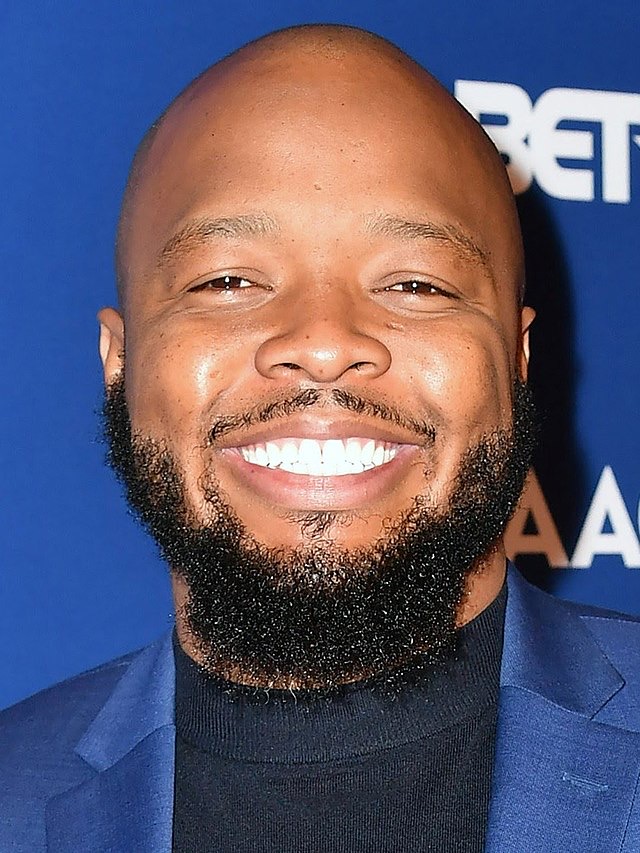
Alex Karp
born Alexander C. Karp
Co-founder and CEO of Palantir Technologies · b. 1967 · New York City, New York
Two calls made by hand, not formulas. how we score →
Summary
Born in New York City to a pediatrician father and an artist mother, and raised in Philadelphia in a household active in civil-rights causes.
Three degrees followed: Haverford, Stanford Law, and a Frankfurt PhD in social theory, then a decade running a small European money-management firm. In 2003 a Stanford Law classmate, Peter Thiel, made him CEO of a startup neither had run before.
How it happened
Alexander C. Karp was born October 2, 1967, in New York City. His father, Robert Joseph Karp, was a Jewish pediatrician; his mother, Leah Jaynes Karp, was an African American artist. He grew up in Philadelphia with his younger brother, Oliver "Ben" Karp, in a household he has said was shaped by his parents' involvement in civil-rights and social- justice activism, which he has described taking him to protests as a child.
He earned a BA in philosophy from Haverford College in 1989, then a JD from Stanford Law School in 1992, where he met fellow student Peter Thiel. Rather than practicing law, he moved to Frankfurt and enrolled in a doctoral program in social theory at Goethe University, in the tradition associated with the Frankfurt School. He attended Jürgen Habermas's seminars and drew on Habermas's concept of the lifeworld, but Habermas did not supervise his dissertation; it was read by social psychologist Karola Brede, with whom Karp shared research interests at the Sigmund Freud Institute. His dissertation, on how aggression moves through ordinary speech and culture rather than erupting openly, used German commentator Martin Walser's controversial 1998 peace-prize speech as its case study. He received the degree in 2002.
With a $12,000 inheritance from his paternal grandfather, Karp founded Caedmon Group, a London-based money-management firm, sometime in the 1990s while completing his Frankfurt doctorate. Early investment successes attracted a number of wealthy European clients. It was his only sustained income-generating work before Palantir and gave him no technology-industry experience of any kind.
In 2003 Thiel, who had just sold PayPal, asked Karp to run a new data-analysis startup he was starting with Joe Lonsdale, Stephen Cohen, and Nathan Gettings. Thiel funded it initially with roughly $30 million of his own money alongside a $2 million check from the CIA's venture arm, In-Q-Tel; Karp, with no prior operating or engineering background, became CEO. It is the single event that set his outcome: a philosophy and social-theory PhD installed atop a company selling data software to intelligence and defense agencies, a role he has held for more than two decades since.
Palantir went public via direct listing on the NYSE in September 2020. Karp, Thiel, and Stephen Cohen hold their shares in a Founder Voting Trust whose Class F stock, alongside a separate Founder Voting Agreement, keeps the three founders' combined voting power fixed at just under half the company's total regardless of their economic stake; per the company's 2026 proxy statement, Karp alone holds 11.4% of total voting power. The New York Times identified him as the highest-paid U.S. public-company CEO in 2020, built around a stock option package tied to share-price targets rather than cash; as Palantir's stock has since risen sharply, the disclosed value of that award marked to market has run into the billions in some years under SEC pay-versus-performance rules, far above his roughly $1.1 million base salary.
Forbes put Karp's net worth at $20.5 billion as of September 24, 2026, built almost entirely on his Palantir equity and reportedly making him the wealthiest Black American. He describes himself as a socialist and progressive who has voted for Democrats, while championing Palantir's defense and intelligence work and Western technological strength; civil-liberties groups and immigration advocates have criticized the company's contracts with U.S. Immigration and Customs Enforcement and police departments, which Karp has defended on the record as part of a "fair but rigorous" immigration policy. He has not married and has described being in long-term relationships with two women.
The coded evidence
Thirteen groups, every claim sourcedCoarse public-record coding; both his mother's African American heritage and his father's Jewish heritage are widely reported, and Forbes reporting has separately described him as the wealthiest Black American. Race and ethnicity are noisy, interpretive categories here.
↗ en.wikipedia.orgAfrican American (maternal) and Ashkenazi Jewish (paternal)
Karp has described himself as Jewish; his mother's African American background is separately reported.
↗ en.wikipedia.orgNot an immigrant — born in New York City to US-born parents; no immigration event in his own biography.
↗ en.wikipedia.orgnot established
His father was Jewish and Karp has described himself as Jewish, but a specific religious upbringing or denomination is not documented in the sources reviewed.
↗ en.wikipedia.orgnot established
Not established; English is presumed given a New York City/Philadelphia upbringing, but not directly documented.
↗ en.wikipedia.orgA stable, professionally employed two-parent household in Philadelphia — a pediatrician father and an artist mother — with no housing precarity or financial hardship documented at any point in his childhood.
↗ en.wikipedia.orgCaedmon Group, the money-management firm he ran through much of the 1990s, provided his own income; Palantir itself was capitalized almost entirely by Peter Thiel and In-Q-Tel rather than by Karp taking on personal financial risk to found it.
↗ en.wikipedia.orgnot established
No housing or income instability during his Frankfurt years, Caedmon Group, or Palantir's founding is documented.
↗ en.wikipedia.orgnot established
No period of visible austerity, chosen or imposed, is documented at any point in the record.
↗ en.wikipedia.orgFather Robert Joseph Karp was a pediatrician; mother Leah Jaynes Karp was an artist. Younger brother Oliver "Ben" Karp.
↗ en.wikipedia.orgnot established
Not established whether his father's pediatric practice was private (self-employed) or institutional.
↗ en.wikipedia.orgnot established
A pediatrician implies a medical degree for his father; neither parent's specific educational institution is established in the sources reviewed.
↗ en.wikipedia.orgA paternal grandfather left him a $12,000 inheritance, which Karp used to found Caedmon Group in London — the seed of his only pre-Palantir income.
↗ en.wikipedia.orgnot established
No documented family sacrifice or second income specifically aimed at tuition; a professional two-parent household appears to have covered it directly.
↗ en.wikipedia.orgKarp has described his parents' own civil-rights and social-justice activism and taking him to protests as a child, suggesting a politically engaged household that sanctioned an unconventional, activism-adjacent worldview rather than a narrowly careerist one.
↗ en.wikipedia.orgnot established
No moves, evictions, or instability during childhood are documented; he is described as growing up in Philadelphia.
↗ en.wikipedia.orgnot established
Philadelphia is documented as where he was raised; a specific neighborhood or ZIP code is not established in the sources reviewed.
↗ en.wikipedia.orgnot established
His K-12 schooling is not documented in the sources reviewed; his higher education is Haverford, Stanford Law, and Goethe University Frankfurt.
↗ en.wikipedia.orgBorn in New York City; raised in Philadelphia; Haverford College for undergraduate; Stanford for law school; Frankfurt, Germany for his PhD; London for Caedmon Group; then Palo Alto, California for Palantir's founding. He has since split time abroad and, as of recent reporting, lives primarily in rural Lyman, New Hampshire rather than Silicon Valley.
↗ en.wikipedia.orgnot established
Not applicable — his time in Frankfurt and London was for education and work, not family immigration.
↗ en.wikipedia.orgPeter Thiel, whom he met as a fellow student at Stanford Law School in the early 1990s, asked him more than a decade later to become CEO of the company that became Palantir — the single connection that gave him an entry into technology and defense software with no prior industry background.
↗ en.wikipedia.orgThe CIA's venture arm, In-Q-Tel, was an early investor and among Palantir's first government customers, which shaped the company's subsequent client base of intelligence, defense, and law-enforcement agencies.
↗ en.wikipedia.orgNo conventional tech launch platform — Karp came to Palantir from a small money-management firm and a social-theory doctorate rather than an engineering or startup background. The platform was supplied externally, by Thiel's capital and network and In-Q-Tel's government relationships, rather than by any prior employer of Karp's own.
↗ en.wikipedia.orgCredibility, Network
↗ en.wikipedia.orgPeter Thiel, Joe Lonsdale, Stephen Cohen, and Nathan Gettings co-founded Palantir with Karp in 2003; Karp took the CEO role.
↗ en.wikipedia.org35
Palantir, founded in 2003, was his first venture in technology; he was born in October 1967.
↗ en.wikipedia.org11
From his 1992 Stanford JD to Palantir's 2003 founding, spent completing the Frankfurt PhD and running Caedmon Group.
↗ en.wikipedia.orgPalantir's founding client relationships ran through In-Q-Tel and federal intelligence and defense agencies from the outset, giving Karp direct proximity to government power immediately upon becoming CEO.
↗ en.wikipedia.orgPhD in social theory, Goethe University Frankfurt (2002); JD, Stanford Law School (1992); BA in philosophy, Haverford College (1989).
↗ en.wikipedia.orgnot established
Not documented for any of the three degrees; no scholarship, loan, or family-funding detail is established in the sources reviewed.
↗ en.wikipedia.orgNot direct — a philosophy BA into a law JD, then a roughly decade-long detour through a self-founded money-management firm and a doctoral program in Continental social theory in a different country, before any career in technology.
↗ en.wikipedia.orgnot established
No scholarship or targeted access program is documented for any of his three degrees.
↗ en.wikipedia.orgStanford Law was where he met Peter Thiel; the Frankfurt PhD connected him to social theorist Karola Brede and the Sigmund Freud Institute circle rather than to any technology or business network.
↗ en.wikipedia.orgA $12,000 inheritance from his paternal grandfather funded Caedmon Group, the London money-management firm he founded in the 1990s.
↗ en.wikipedia.orgThe $12,000 paternal-grandfather inheritance that founded Caedmon Group.
↗ en.wikipedia.org$12,000 from his paternal grandfather, used to found Caedmon Group.
↗ en.wikipedia.orgIt needed capital up front, before it earned anything.
Caedmon Group itself ran on management fees, but Palantir — the venture that made Karp's fortune — was capital-raised from Thiel and In-Q-Tel from its founding rather than revenue-funded.
↗ en.wikipedia.orgnot established
Palantir was funded by Peter Thiel (roughly $30 million) and a $2 million In-Q-Tel check, not from Karp's own income or savings.
↗ en.wikipedia.orgPalantir's certificate of incorporation created Class A, Class B, and Class F common stock. All Class F shares are held in a Founder Voting Trust established by the three co-founders — Thiel, Karp, and Stephen Cohen — under a trustee; per the company's 2026 proxy statement, Karp individually holds 86,907,993 Class B shares (64.0% of that class) and 335,000 Class F shares (33.3% of that class), together with 6,432,258 Class A shares, equal to 11.4% of total voting power on the record date.
↗ sec.govPalantir's data-analysis approach originated with Thiel, Lonsdale, Cohen, and Gettings, drawing on fraud-detection techniques from PayPal and extending them to intelligence and defense applications. Karp's role from the outset was CEO and public face rather than technical originator.
↗ en.wikipedia.orgUnder the Founder Voting Agreement and Founder Voting Trust described in Palantir's 2026 proxy statement, Thiel, Karp, and Cohen jointly hold just under 50% of the company's total voting power regardless of their combined economic stake — a structure engineered before the 2020 direct listing and preserved since, and separate from Karp's compensation as CEO.
↗ sec.govnot established
No failed venture before Palantir is documented; Caedmon Group is described as having attracted clients on the strength of early investment success rather than failing.
↗ en.wikipedia.orgCaedmon Group's management fees sustained him financially between his 1992 Stanford JD and Palantir's 2003 founding, during which time he also completed the Frankfurt doctorate.
↗ en.wikipedia.orgPalantir was founded in 2003 into elevated post-9/11 US government demand for intelligence-analysis and data-integration software, with In-Q-Tel and federal defense and intelligence agencies as early customers.
↗ en.wikipedia.orgPalo Alto, California, where Palantir was founded, though Karp himself has not been consistently based in Silicon Valley.
↗ en.wikipedia.orgBuilt — Palantir was founded from scratch in 2003 rather than acquired.
↗ en.wikipedia.org23
From Palantir's 2003 founding through 2026, as CEO continuously, without a reset.
↗ en.wikipedia.orgAs of recent reporting he lives primarily in rural Lyman, New Hampshire and describes owning properties in multiple countries, an atypical residency pattern for the CEO of a Palo Alto-headquartered public company.
↗ en.wikipedia.orgTechnology entrepreneurship — data-integration and analytics software for government, defense, intelligence, and commercial clients
↗ en.wikipedia.org20500000000
Forbes real-time tracker, September 24, 2026, ranked #134 globally. Built almost entirely from Palantir equity, so the figure moves sharply with PLTR's stock price; other 2026 estimates from Forbes and other trackers earlier in the year ranged from roughly $13 billion to $18 billion.
↗ forbes.comJournalistic estimate
↗ forbes.com2026
↗ forbes.com8623000
His Summary Compensation Table total for fiscal 2025 — base salary $1,101,637 (about 73% of it paid as a travel/security stipend) plus stock and other awards. Separately, Palantir's SEC "compensation actually paid" (CAP) figure under pay-versus-performance rules was about $11.09 billion for 2025 (and ~$6.79 billion for 2024) — but that is a mark-to-market accounting number driven almost entirely by the rising value of his 2020 price-hurdle stock option grant, not income he received, so it is not used as the peak-income value here. That CAP figure is the basis for reporting that calls him one of the highest-paid US executives.
↗ sec.govProxy statement
↗ sec.govAlmost entirely unrealized — his wealth and reported compensation both track the mark-to-market value of Palantir stock and stock options he continues to hold rather than cash paid or shares sold.
↗ sec.govAlmost entirely wealth rather than cash income: a roughly $1.1 million base salary against equity gains worth billions in years when Palantir's stock rose sharply.
↗ sec.govLed Palantir through its September 2020 direct listing on the NYSE. Reported by Forbes to be the wealthiest Black American. Publicly describes himself as a socialist and progressive while being one of the most prominent advocates for Western defense and intelligence technology; has defended Palantir's ICE and law-enforcement contracts on the record against sustained criticism from civil-liberties and immigration-advocacy groups.
↗ en.wikipedia.org17
From Palantir's 2003 founding to its September 2020 direct listing, when his equity stake first became publicly priced.
↗ en.wikipedia.orgUncapped
↗ sec.govnot established
No regulatory action against Karp personally is documented. Palantir's government contracts, including with ICE and police departments, have drawn sustained criticism and scrutiny from civil-liberties and immigration-advocacy groups at the company level; see d13.
↗ en.wikipedia.orgnot established
No personal misconduct admission is documented. Karp has spoken on the record defending Palantir's ICE contract, calling family separations "a really tough, complex, jarring moral issue" while favoring what he called "a fair but rigorous immigration policy" — his own attributed words, not an admission of wrongdoing.
↗ en.wikipedia.orgEccentric, Combative, Provocative, unconventional CEO, Media quotable
↗ en.wikipedia.orgPress
↗ en.wikipedia.org5
Wikipedia, Palantir's Wikipedia entry, Forbes, Palantir's SEC proxy statement, and reporting on his Frankfurt dissertation, among others reviewed.
↗ en.wikipedia.orgAfter
His public reputation as an unconventional, outspoken CEO formed largely through Palantir's rising public profile, especially after the 2020 direct listing, rather than before it.
↗ en.wikipedia.orgMixed
↗ en.wikipedia.orgPalantir's government, defense, and intelligence customers and much of the investor base treat Karp's outspoken defense of Western technological and military strength as a genuine asset, and Palantir's stock has rewarded that positioning. Civil-liberties organizations and immigration-advocacy groups have repeatedly criticized Palantir's contracts with US Immigration and Customs Enforcement and police departments, and reporting has scrutinized the company's role in government surveillance and predictive-policing programs; Karp has defended the ICE contract on the record. Reaction to Karp personally tracks this same split between defense-and-security audiences and civil-liberties critics.
↗ en.wikipedia.orgnot established
Not applicable in the usual sense — no single reputational collapse and rebuild; segmented, durable views have run in parallel across his time as CEO.
↗ en.wikipedia.orgStructural context
The cost-of-failure score comes from this person's own money and circumstances. But who they were in America carried its own weight, the same way their household or income did, and it shaped how hard the path was just as much. That part isn't in the cost-of-failure number. It's here instead.
Men founded the companies that took nearly all the venture funding and almost every top outcome, a tailwind that never shows up in one person's own circumstances.
↗ techcrunch.comAmong the people recorded here — men: 169 · Mixed-race — Black/African American through his mother and white/ Ashkenazi Jewish through his father. subjects: 1. Representation here is who reached these outcomes, not equal odds of reaching them.
Controlled comparisons
Each holds one thing constant and varies another, so the difference is the point. A list of similar names wouldn't tell you anything.