John D. Rockefeller
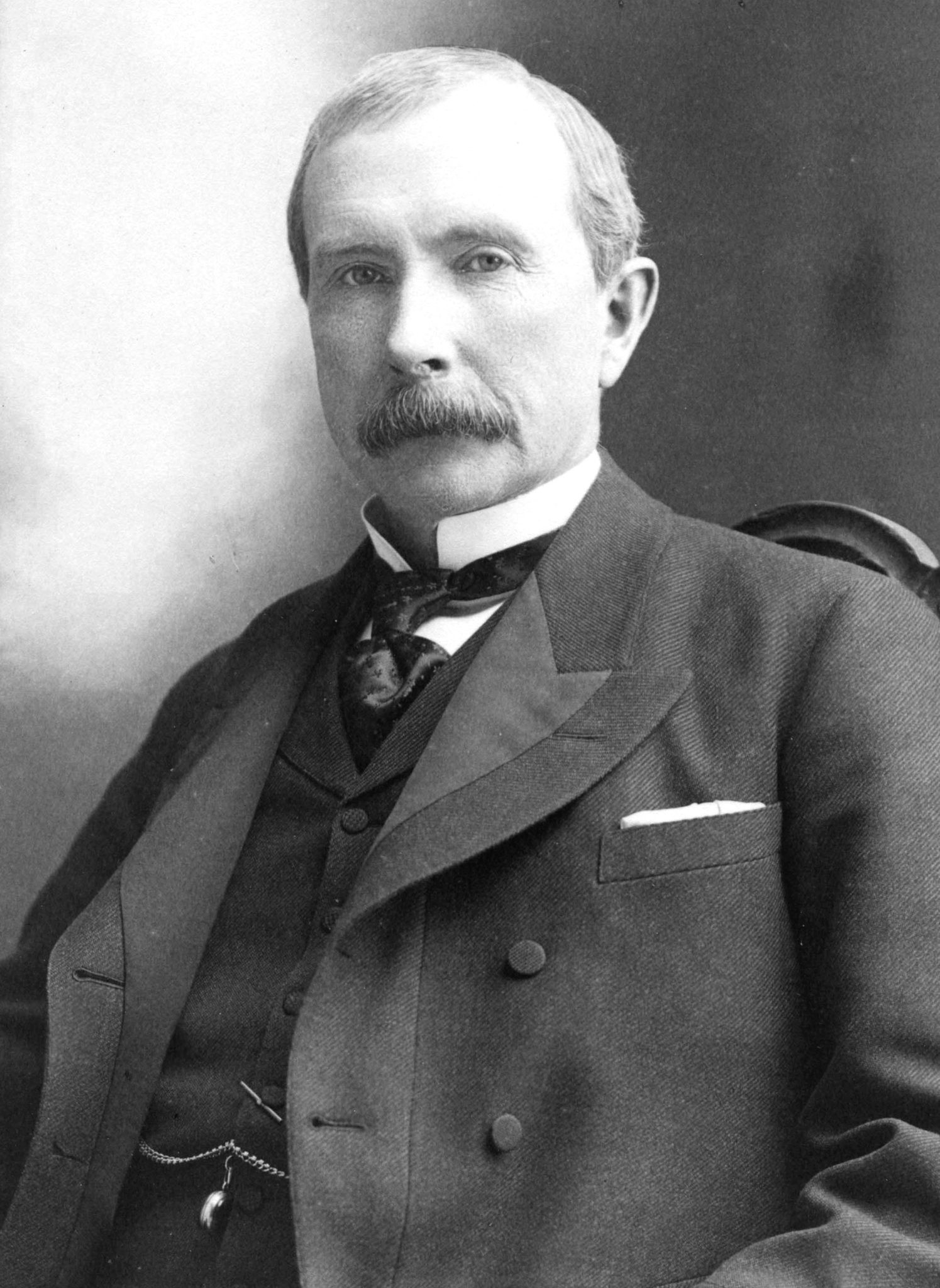
born John Davison Rockefeller
Founder of Standard Oil · b. 1839–1937 · Richford, New York
Two calls made by hand, not formulas. how we score →
Summary
His father was a traveling patent-medicine peddler who kept a second, bigamous family and left the household's income unpredictable.
A bookkeeping job at sixteen and a produce business partly funded by his father's loan led him into oil refining in 1863. Rebates and rapid buyouts built Standard Oil into a monopoly the Supreme Court broke apart in 1911 — a ruling that left him richer than before.
How it happened
Born July 8, 1839, in Richford, New York, the second of six children of William Avery "Big Bill" Rockefeller and Eliza Davison. His father worked as a traveling salesman who posed as a "botanic physician," selling elixirs and running land-speculation and horse-trading schemes, and was gone from home for long stretches. He is on record telling people, "I cheat my boys every chance I get. I want to make 'em sharp." In 1856, using the alias "Dr. William Levingston," he married a second woman in Canada while still legally married to Eliza. Eliza Davison, a devout Baptist, ran the household largely alone and taught her son that "willful waste makes woeful want." The family moved at least four times before he reached his teens — Richford to Moravia to Owego, New York, then to Strongsville, Ohio, in 1853 — tracking his father's unstable income rather than any plan of the family's own.
He attended Owego Academy and then Cleveland's Central High School, the first high school built west of the Alleghenies, before his parents paid for a roughly ten-week bookkeeping course at Folsom's Commercial College in 1855. That summer he spent weeks walking Cleveland's produce and shipping firms alone, asking for work with no introduction from anyone. Hewitt & Tuttle, a commission merchant house, hired him that September as an assistant bookkeeper for $16 a month, later raised to $58. He kept a meticulous personal ledger he called "Ledger A" and, from his first paycheck, gave away six percent of his income to his church and to charity, a share that grew past ten percent within a few years.
In 1859 he left Hewitt & Tuttle to start a produce commission partnership with Maurice B. Clark and George Gardner. The roughly $4,000 in starting capital came from Clark and Gardner's contributions, Rockefeller's own $800 in savings, and $1,000 he borrowed from his father at 10 percent interest — real debt, even if it was owed inside the family rather than to a bank.
He moved into oil refining in 1863, building a refinery in Cleveland's Flats with Clark and a chemist, Samuel Andrews, who supplied the technical know-how he lacked. He bought out the Clark brothers in 1865 for $72,500 and brought in Henry M. Flagler in 1867, who became his closest partner in deal-making and finance. By 1868 the operation was the largest oil refiner in the world, and on January 10, 1870, the partners incorporated it as the Standard Oil Company of Ohio.
In early 1872 Standard Oil joined the South Improvement Company scheme, which used secretly negotiated railroad rebates and drawbacks — Standard Oil got a lower shipping rate, and in some cases a cut of what its rivals paid — to undercut every competitor's cost structure at once. Public backlash killed the scheme within weeks, but the damage to Cleveland's refiners was already done: Standard Oil absorbed 22 of the city's 26 refineries in about four months, an episode historians call the Cleveland Conquest. It was the moment refining stopped being a fragmented, price-warring commodity trade and became a system one man controlled end to end — crude supply, transport, and refining capacity all bought or built under one roof.
Standard Oil kept buying, and in 1882 the various Rockefeller-controlled companies were reorganized into the Standard Oil Trust, more than 40 firms managed by nine trustees. By the 1880s it refined somewhere north of 90 percent of the oil sold in the United States, running its own pipelines, thousands of tank cars, and tens of thousands of wells.
Ida Tarbell's 1904 "History of the Standard Oil Company" laid out the rebate scheme and the company's other tactics in detail and helped drive the federal case that followed. On May 15, 1911, the Supreme Court ruled in Standard Oil Co. of New Jersey v. United States that the company had illegally monopolized the oil trade under the Sherman Antitrust Act and ordered it split into 34 independent companies within six months. Rockefeller held more than a quarter of the stock and received a proportional share of each new company. Within about a decade the combined value of those pieces had risen roughly fivefold, and the ruling meant to cut his fortune down instead made him considerably richer.
He had stepped back from day-to-day management by the mid-1890s and spent his later decades giving money away at a scale nobody had before him: the University of Chicago, which he funded starting in 1889 and later called "the best investment I ever made"; the Rockefeller Institute for Medical Research, founded in 1901 and now Rockefeller University; the General Education Board in 1903; and the Rockefeller Foundation in 1913. He gave away more than $530 million over his lifetime and, around 1916, became the first person in the country commonly described as a billionaire. He died on May 23, 1937, at his Florida estate in Ormond Beach, at 97.
The coded evidence
Thirteen groups, every claim sourcedCoarse public-record coding; race is a noisy, interpretive category applied retrospectively to a 19th-century subject.
↗ en.wikipedia.orgEnglish, German, and Scots-Irish colonial-American descent
Family genealogies trace the paternal Rockefeller line to an early-18th-century German (Palatine) immigrant ancestor; not central to the standard biographical sources and not independently verified here.
↗ en.wikipedia.orgMulti-generation descendant. Both the paternal and maternal family lines had been in the United States for well over a century before his birth; this was not an immigration-era story for him personally.
↗ en.wikipedia.orgDevout throughout his life — daily Bible reading, twice-weekly prayer meetings, Sunday-school teaching, lifelong abstention from alcohol and tobacco.
↗ en.wikipedia.orgEnglish
↗ en.wikipedia.orgNo move was made for a partner's career.
Not documented either way; his household moves as a child tracked his father's unstable income, not a partner's career.
↗ en.wikipedia.orgThe family always had a roof, but never a stable or owned one — they moved at least four times in his childhood, driven by his father's unreliable income and business schemes rather than by any plan the family controlled.
↗ en.wikipedia.orgNo dependable income floor from his father, who was frequently absent for months at a stretch selling patent medicines and running land and horse-trading schemes. His mother and, from age sixteen, his own wages were the household's real floor.
↗ en.wikipedia.orgHis mother, Eliza Davison, ran the household essentially alone during her husband's long absences and, after the mid-1850s, his effective abandonment of the family for a second, bigamous household he kept under an assumed name.
↗ en.wikipedia.org0
No dependents of his own as a young man; he married in 1864, after the founding businesses were already underway.
↗ en.wikipedia.orgNo money was owed or sent outward during the build.
↗ en.wikipedia.orgThe $1,000 he borrowed from his father in 1859 at 10 percent interest to help fund the produce commission partnership was real, interest-bearing debt, even though it was owed inside the family rather than to a bank.
↗ en.wikipedia.orgAt least four childhood and adolescent moves — Richford to Moravia to Owego, New York, then to Strongsville, Ohio, in 1853 — substantially driven by his father's unstable income rather than family choice. No homelessness is documented once the family was established in Ohio.
↗ en.wikipedia.orgThe hardship was imposed, not chosen. There was nothing to fall back on.
Imposed, not chosen. The household's instability traced directly to his father's unreliability and eventual double life, not to any austerity the family adopted against a standing cushion.
↗ en.wikipedia.orgFather William Avery Rockefeller worked as an itinerant salesman who styled himself a "botanic physician" selling elixirs, and ran land speculation, timber, and horse-trading schemes on the side. Mother Eliza Davison Rockefeller managed the household without steady outside income.
↗ en.wikipedia.orgA parent worked for themselves, the strongest known predictor of founding.
His father was self-employed as an independent peddler and dealmaker rather than a wage employee, though the income this produced was unreliable.
↗ en.wikipedia.org5
Older sister Lucy, and younger siblings William Jr., Mary Ann, Franklin ("Frank"), and Frances.
↗ en.wikipedia.orgnot established
No grandparent or relative supplying capital, mentorship, or industry exposure is documented in the sources reviewed.
↗ en.wikipedia.orgnot established
No documented family standing, wealth, or prominent relatives beyond his immediate parents.
↗ en.wikipedia.orgnot established
His parents did pay for a roughly ten-week commercial-college course in 1855 (see d6), but no broader sustained sacrifice specifically for his schooling is documented.
↗ en.wikipedia.orgnot established
No account of the family actively sponsoring an unconventional path; the expectation was ordinary paid work, which is exactly what he took at sixteen.
↗ en.wikipedia.orgnot established
No formal change of guardian is documented. His father's absences grew more frequent and eventually permanent by the mid-1850s, but this was abandonment in practice rather than a legal custodial transfer.
↗ en.wikipedia.orgAs his father grew increasingly absent through the 1850s — eventually maintaining a second, bigamous household under an assumed name — young Rockefeller, the eldest son, became one of the household's dependable sources of income once he began earning wages at sixteen.
↗ en.wikipedia.orgAt least four moves before his mid-teens (Richford, Moravia, and Owego, New York, then Strongsville, Ohio), tied to his father's income instability rather than a single planned relocation.
↗ en.wikipedia.org3
Owego Academy, then Cleveland's Central High School, then the short commercial-college course — three distinct schools tied to the family's moves.
↗ en.wikipedia.orgnot established
Mother Eliza died in 1889 and father William in 1906, both well after Standard Oil's fortune was made; neither death fell during the build.
↗ en.wikipedia.orgDid not serve personally in the Civil War; paid for substitute soldiers, a legal option under the era's draft law, while his younger brother Frank enlisted. He continued building his produce and refining businesses through the war and gave money to the Union cause.
↗ en.wikipedia.orgRichford, New York, then Moravia and Owego, New York, then Strongsville and Cleveland, Ohio, from 1853.
↗ en.wikipedia.orgCommon schools in New York, then Owego Academy; Cleveland's Central High School, the first high school built west of the Alleghenies; and a roughly ten-week bookkeeping course at Folsom's Commercial College in Cleveland.
↗ en.wikipedia.orgnot established
Not applicable — HOLC redlining maps postdate this subject's childhood by roughly eighty years.
↗ en.wikipedia.orgCleveland was becoming a regional commercial hub on Lake Erie by the time the family arrived in 1853, and within a decade of his own arrival the nearby Pennsylvania oil fields turned it into a refining center — the exact industry he entered in 1863.
↗ en.wikipedia.orgnot established
His father's peddling and land schemes did not connect him to the oil or shipping trade he later entered.
↗ en.wikipedia.orgAt least four domestic moves before age 14, all family-initiated in response to his father's shifting fortunes rather than to his own agency; no international migration.
↗ en.wikipedia.orgDevout Baptist church membership in Cleveland gave the family a congregation and, later in his life, a durable source of business contacts and philanthropic partners.
↗ en.wikipedia.orgnot established
No named individual is documented opening the door to his first job; he is specifically recorded as having gone looking for work alone with no introduction (see constructedAccess).
↗ en.wikipedia.orgNone in the sense of a prior employer supplying capital or credibility — Hewitt & Tuttle gave him bookkeeping and shipping-trade skill, which he then applied on his own account.
↗ en.wikipedia.orgSkill
↗ en.wikipedia.orgSpent roughly six weeks in the summer of 1855 walking Cleveland's produce and shipping firms alone asking for work, with no family connection or introduction, before Hewitt & Tuttle hired him.
↗ en.wikipedia.orgMaurice B. Clark and George Gardner in the 1859 produce-commission partnership; chemist Samuel Andrews supplied refining expertise from 1865; Henry M. Flagler joined in 1867 and became his primary deal-making and finance partner through Standard Oil's founding.
↗ en.wikipedia.org16
Age at his first paid work (bookkeeping, 1855); his entry into oil refining specifically came later, in 1863, at age 24.
↗ en.wikipedia.org4
From the 1855 Hewitt & Tuttle hire to founding the 1859 produce-commission partnership.
↗ en.wikipedia.orgStandard Oil built and owned its own pipeline network from the 1870s on, reducing its dependence on the railroad shipping rates it had earlier relied on rebates to control.
↗ en.wikipedia.orgRoughly four years (1855-1859) as a bookkeeper at Hewitt & Tuttle, a Cleveland produce-commission house, learning shipping, credit, and ledger discipline he then applied to his own ventures.
↗ en.wikipedia.org1
Hewitt & Tuttle was his only outside employer before he became his own employer in 1859.
↗ en.wikipedia.orgHis parents paid for a roughly ten-week bookkeeping and commercial course at Folsom's Commercial College in Cleveland in 1855, shortly before his job search began.
↗ en.wikipedia.orgNo college degree. A roughly ten-week bookkeeping and commercial course at Folsom's Commercial College, Cleveland, completed in 1855.
↗ en.wikipedia.orgnot established
Direct entry into paid work at sixteen, with no further formal schooling after the commercial course.
↗ en.wikipedia.orgA $16-a-month wage as assistant bookkeeper at Hewitt & Tuttle, starting September 1855, later raised to $58 a month.
↗ en.wikipedia.orgBorrowed $1,000 from his father in 1859 at 10 percent interest to help fund the produce-commission partnership — a meaningful share of the roughly $4,000 in starting capital alongside his own $800 in savings and partners Maurice Clark's and George Gardner's contributions.
↗ en.wikipedia.orgnot established
No meaningful inheritance during the founding period; both parents outlived the founding of Standard Oil by decades.
↗ en.wikipedia.orgIt paid its own way from the start. Revenue came before any outside money.
The produce business and the refining businesses were both funded from operating revenue and reinvested profit, never from an outside equity raise.
↗ en.wikipedia.orgReinvested savings from his Hewitt & Tuttle wages, and later profits from the produce-commission business and the refinery, into each successive venture.
↗ en.wikipedia.orgThe 1859 produce partnership's roughly $4,000 in capital came from Rockefeller ($800 in savings plus the $1,000 loan from his father) and partners Maurice Clark and George Gardner; no outside passive investors were involved.
↗ en.wikipedia.orgEvery venture — the produce partnership, the refining partnerships, and Standard Oil itself at founding — was a private partnership or closely held corporation financed by partner capital and reinvested earnings, never by selling equity to outside passive investors.
↗ en.wikipedia.orgWealth compounded on his own retained ownership stake, reinvested over decades, not on a fund or other people's capital; even after the forced 1911 breakup he held a proportional share of each of the 34 successor companies.
↗ en.wikipedia.orgReinvested nearly every dollar of profit into refining capacity and, later, into buying rival refiners and building pipelines, tank cars, and barrel-making plants rather than into personal spending.
↗ en.wikipedia.orgStandard Oil came to own its own refineries, pipelines, oil-tank railcars, and barrel-making plants rather than paying market rates for any of them — the vertical integration Rockefeller and Flagler built through the 1870s and 1880s.
↗ en.wikipedia.orgHis own produce-commission and bookkeeping experience convinced him the young, chaotic oil-refining trade needed the same consolidation and cost discipline he had already applied to shipping and credit.
↗ en.wikipedia.orgHeld straightforward majority economic ownership and control of a private partnership and later a trust; no dual-class structure was needed since he simply owned most of it outright.
↗ en.wikipedia.org0
No major documented failed ventures before Standard Oil; the produce business and the refineries were each profitable from early on.
↗ en.wikipedia.org33
Age at the early-1872 South Improvement Company rebate scheme and the "Cleveland Conquest" acquisitions that followed it.
↗ en.wikipedia.orgPost-Civil War industrial expansion, a chaotic and overbuilt oil-refining industry running ruinous price wars, and railroads willing to trade secret volume rebates for guaranteed shipping — all before the Sherman Antitrust Act (1890) or any federal rate regulation existed.
↗ en.wikipedia.orgCleveland, Ohio, already the center of his refining operations.
↗ en.wikipedia.orgSecret railroad rebates and drawbacks arranged through the South Improvement Company scheme in early 1872 gave Standard Oil a shipping-cost advantage rivals could not match. Public backlash killed the scheme within weeks, and the practice was later made illegal outright by the Interstate Commerce Act (1887) and the Elkins Act (1903).
↗ en.wikipedia.orgA mix: built the original refineries and pipeline network from scratch, then bought roughly 22 of Cleveland's 26 refining competitors within about four months in 1872, and kept acquiring rival refiners for the following decade.
↗ en.wikipedia.org48
From the 1863 refining entry to the 1911 court-ordered breakup; his wealth continued compounding through the successor-company shares for decades afterward.
↗ en.wikipedia.orgKept a famously modest personal lifestyle relative to his income through the building years — no yachts or lavish public spending are documented — before philanthropic giving scaled sharply from the 1890s on.
↗ en.wikipedia.orgOil refining and industrial trusts
↗ en.wikipedia.org900000000
Commonly cited estimate of his peak fortune in 1913, equal to roughly 2.3 percent of U.S. GDP at the time. Inflation- and GDP-share-adjusted estimates of this fortune in today's terms vary widely by method — from roughly $28 billion (pure CPI inflation) to about $631 billion (economic-share method, per Guinness World Records) — and are estimates, not filings; treat as a log band, not a precise figure. By this economic-share method he is frequently cited as the richest person in modern history.
↗ en.wikipedia.orgJournalistic estimate
↗ en.wikipedia.orgnot established
No distinct annual-income figure separate from net worth and dividend income is clearly established for this era.
↗ en.wikipedia.orgnot established
↗ en.wikipedia.orgWealth was overwhelmingly realized ownership — shares in Standard Oil, and after 1911 proportional shares in each of the 34 successor companies — rather than illiquid, disputed paper valuations.
↗ en.wikipedia.orgAlmost entirely ownership and dividend wealth from an early age; he was never a salaried employee again after leaving Hewitt & Tuttle in 1859.
↗ en.wikipedia.orgFunded the University of Chicago beginning in 1889-90 (which he called "the best investment I ever made"); founded the Rockefeller Institute for Medical Research in 1901 (now Rockefeller University); founded the General Education Board in 1903; founded the Rockefeller Foundation in 1913; gave away more than $530 million over his lifetime; and became, around 1916, the first person in the United States commonly described as a billionaire.
↗ biography.comUncapped
↗ en.wikipedia.orgThe U.S. Supreme Court ruled on May 15, 1911 (Standard Oil Co. of New Jersey v. United States) that Standard Oil had illegally monopolized the oil-refining trade under the Sherman Antitrust Act and ordered it dissolved into 34 independent companies within six months. A federal district judge, Kenesaw Mountain Landis, had earlier imposed a $29.24 million fine on a Standard Oil subsidiary in 1907 over railroad rebates; it was reversed on appeal.
↗ en.wikipedia.orgPennsylvania prosecutors indicted Rockefeller in 1879 on charges of criminal conspiracy to monopolize the oil trade; the case did not result in a conviction.
↗ en.wikipedia.orgThe 1911 Supreme Court antitrust ruling was itself the outcome of a civil suit brought by the federal government against the company, not a separate private civil judgment against Rockefeller personally.
↗ en.wikipedia.orgnot established
No adjudicated labor finding against Rockefeller personally is established in the sources reviewed. His family's later Colorado Fuel & Iron holding was the site of the 1914 Ludlow Massacre, but by then he had already transferred controlling interest to his son, John D. Rockefeller Jr., who managed the company and testified before Congress; the elder Rockefeller's personal operational role in that episode is not established.
↗ en.wikipedia.orgDuring
The secret rebates and rapid competitor acquisitions ran throughout the 1870s-1900s build of the monopoly.
↗ en.wikipedia.orgProduced the advantage
The railroad rebates and rapid acquisitions directly produced Standard Oil's cost advantage and market dominance, per Tarbell's reporting and the Supreme Court's own findings.
↗ en.wikipedia.orgCivil wrong
Secret rebates were closer to legal-gray when first used in the early 1870s, since rebating wasn't clearly outlawed until the Interstate Commerce Act (1887) and the Elkins Act (1903); the 1911 ruling itself was a civil antitrust violation, not a criminal one.
↗ en.wikipedia.orgNone
No personal fine or liability was ever sustained by Rockefeller himself. The combined value of the dissolved company's pieces rose roughly fivefold within about a decade, making him considerably richer after the antitrust ruling than before it — a clean instance of the enforcement-asymmetry this schema tracks.
↗ en.wikipedia.orgruthless monopolist, robber baron, Self made, later recast as the father of modern philanthropy
↗ en.wikipedia.orgPublic
↗ en.wikipedia.org3
Ida Tarbell's 1904 book, the Supreme Court's own findings, and contemporaneous business-press coverage each independently document the rebate scheme and monopoly tactics.
↗ en.wikipedia.orgAfter
The "ruthless monopolist" reputation solidified after the 1872 Cleveland Conquest and was cemented by Tarbell's 1904 exposé.
↗ en.wikipedia.orgMixed
An asset in intimidating rivals and negotiating favorable terms; a liability once public and political backlash triggered the federal antitrust campaign that ended in dissolution.
↗ en.wikipedia.orgThe reputation was deliberately built, through books, press, and PR.
From the 1910s he deliberately worked to rehabilitate his public image — handing out shiny dimes to children, sitting for friendlier press profiles, and in 1914 retaining Ivy Lee, one of the first professional publicists, to help manage the family's reputation.
↗ en.wikipedia.orgIda Tarbell's 1904 "History of the Standard Oil Company," though grounded in original reporting, functioned as both journalism and a dramatization he did not control, and it fixed the "robber baron" image that outlasted him.
↗ en.wikipedia.orgFinancial and business circles generally respected his methods and results, while much of the press and public, especially after Tarbell's exposé, treated him as the era's leading symbol of monopoly abuse.
↗ en.wikipedia.orgDecades of large-scale, well-publicized philanthropy — the University of Chicago, the Rockefeller Institute, the General Education Board, and the Rockefeller Foundation — substantially rehabilitated his reputation within his own lifetime, though historians have continued to weigh the Standard Oil monopoly record heavily against it.
↗ en.wikipedia.orgStructural context
The cost-of-failure score comes from this person's own money and circumstances. But who they were in America carried its own weight, the same way their household or income did, and it shaped how hard the path was just as much. That part isn't in the cost-of-failure number. It's here instead.
Men founded the companies that took nearly all the venture funding and almost every top outcome, a tailwind that never shows up in one person's own circumstances.
↗ techcrunch.comWhite founders are heavily overrepresented among funded companies and top-tier wealth relative to their share of the population, an edge that has nothing to do with a person's own money.
↗ techcrunch.comAmong the people recorded here — men: 115 · White subjects: 74. Representation here is who reached these outcomes, not equal odds of reaching them.
Controlled comparisons
Each holds one thing constant and varies another, so the difference is the point. A list of similar names wouldn't tell you anything.