Mary Barra
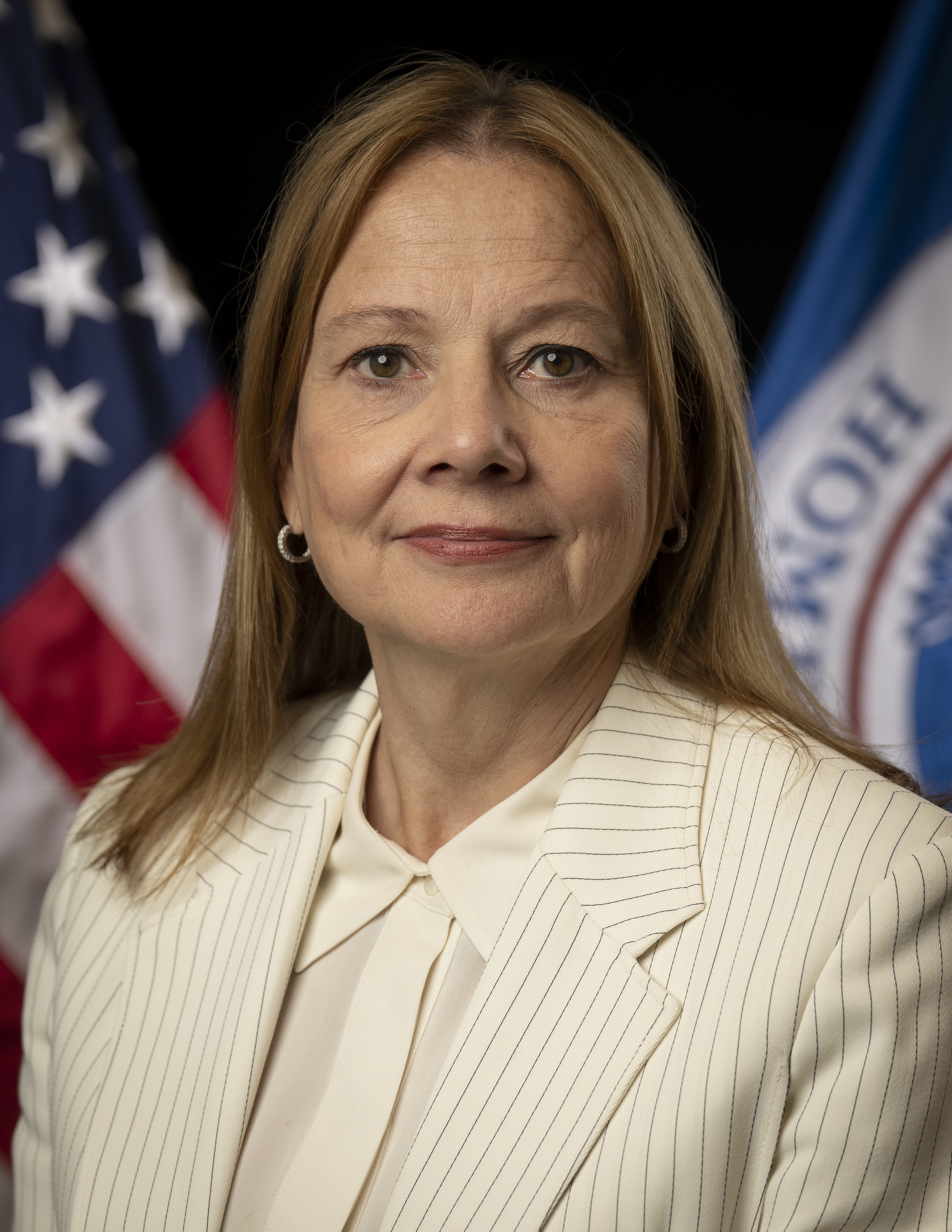
born Mary Teresa Barra
Chair and CEO of General Motors · b. 1961 · Royal Oak, Michigan
Two calls made by hand, not formulas. how we score →
Summary
Her father spent 39 years as a die maker at GM's Pontiac plant, a steady union job that bought stability but no capital.
She paid her own way through an engineering degree on GM's co-op line at eighteen, and GM later paid for her Stanford MBA. Thirty-four years and one company later she ran a Big Three automaker, and weeks in inherited a defect that had already killed people for a decade.
How it happened
Born December 24, 1961, in Royal Oak, Michigan, to Ray Makela, a die maker of Finnish descent who spent 39 years on the floor at GM's Pontiac Motor Division, and Eva Makela. Ray was a UAW member; the job paid steadily and came with health coverage, but it wasn't a source of savings or capital. Barra has said her mother told her that if she worked hard she could do or be anything, and her father's decades at Pontiac gave her an early, close-up view of how cars actually got built.
She joined GM in 1980 at eighteen as a co-op student, inspecting fender panels and hoods on the line to pay her own tuition at General Motors Institute, the company's in-house engineering school now known as Kettering University. She graduated with a degree in electrical engineering in 1985 with no debt attached, then worked as a plant engineer before GM sent her to Stanford on a company fellowship for an MBA, finished in 1990.
She moved through plant management at Detroit-Hamtramck, then vice president of global manufacturing engineering in 2008, vice president of global human resources in 2009, and executive vice president of global product development in 2011 — control over how every GM vehicle actually gets designed and built, the closest thing the company has to a proving ground for a CEO. As HR chief she once replaced a ten-page dress code with two words, "dress appropriately," and held the line against a director who wanted it rewritten with more rules.
Running product development put her in charge of the function GM's board would look to first when picking a successor to Dan Akerson, and in December 2013 the board named her the next CEO. She took over on January 15, 2014, the first woman to lead a Big Three or global automaker.
Weeks into the job, GM disclosed a defective ignition switch — known internally since at least 2005 — that could slip out of "run" and cut power to the airbags. GM recalled over 30 million vehicles that year. Barra testified before Congress in April 2014, saying she didn't know why it took nearly a decade to act, and hired attorney Anton Valukas to investigate and Kenneth Feinberg to run a victim compensation fund. Valukas's June 2014 report described a pattern of incompetence and neglect rather than a deliberate cover-up; Barra fired 15 employees over it. GM ultimately compensated the families of 124 deaths through Feinberg's fund, and in September 2015 the company reached a $900 million deferred prosecution settlement with the Justice Department, admitting it had concealed the defect and misled regulators between 2012 and 2014. Some victims' families dismissed her apology as public relations; others credited her for bringing in independent investigators and staying visible through it.
She became chairman in January 2016 and steered GM toward electric vehicles under a stated goal of "zero crashes, zero emissions, and zero congestion," unveiling the Ultium battery platform in March 2020 as a shared architecture across GM's brands. She also cut unprofitable global operations, including a 2018 restructuring that closed several North American plants. Her total compensation reached $29.9 million in 2025, on top of $27.8 million in 2023, all of it salary and performance stock rather than founder's equity.
The coded evidence
Thirteen groups, every claim sourcedWikipedia cites CNN/Fortune (Dec. 17, 2012) and the Helsinki Times (Dec. 16, 2013) for her Finnish descent; her paternal grandparents, Viktor Makela and Maria Saarinen, emigrated from Teuva, Finland.
↗ en.wikipedia.orgMulti-generation American. Her paternal grandparents immigrated from Finland; her father was US-born, making Barra herself third generation on that side.
↗ en.wikipedia.orgA single steady UAW income from her father's die-maker job at GM's Pontiac plant. No documented family savings, real estate, or capital cushion beyond the job itself, but the job was stable for nearly four decades and came with health coverage.
↗ gsb.stanford.eduA GM paycheck from age 18 onward, first as a co-op student and then as a full employee — the entire climb ran on one employer's payroll with no personal venture or capital ever at risk.
↗ forbes.comThe hardship was imposed, not chosen. There was nothing to fall back on.
↗ gsb.stanford.eduFather Ray Makela was a die maker at GM's Pontiac Motor Division for 39 years and a UAW member. Her mother's occupation is not established in available profiles.
↗ en.wikipedia.orgRoyal Oak, Michigan, a Detroit suburb.
Confirmed as birthplace; whether she was raised there or in another nearby Detroit suburb through childhood is not clearly established.
↗ en.wikipedia.orgGeneral Motors, joined as an 18-year-old co-op student in 1980 and never worked anywhere else through the entire climb to CEO.
↗ forbes.comNamed executive vice president of global product development in February 2011 under CEO Dan Akerson, control over the function GM's board treated as the direct pipeline to the top job. She was named his successor less than three years later.
↗ en.wikipedia.orgBS electrical engineering, General Motors Institute (now Kettering University), 1985; MBA, Stanford Graduate School of Business, 1990.
↗ gsb.stanford.eduNone documented. The GMI degree was paid through her own co-op wages; the Stanford MBA was funded by a GM fellowship.
↗ gsb.stanford.eduInspected fender panels and hoods on GM's assembly line as a co-op student from age 18, using the wages to pay her own tuition at General Motors Institute.
↗ forbes.comDirect. GM's own co-op engineering school straight into a GM career, followed by a company-funded MBA back into the same company.
↗ gsb.stanford.edu0
No personal venture to fail; a single unbroken salaried climb inside one company.
↗ en.wikipedia.org52
Age when she became CEO, effective January 15, 2014 (Wikipedia's infobox gives January 14; body text and secondary coverage give January 15).
↗ en.wikipedia.orgShe took over five years after GM's 2009 bankruptcy and government bailout, running a company still rebuilding its balance sheet and reputation, and inherited a decade-old safety defect within weeks of starting.
↗ en.wikipedia.orgAutomotive manufacturing and executive management
↗ en.wikipedia.orgnot established
No Forbes net-worth estimate exists for her; she has never held a significant equity stake in GM. A salaried and stock-compensated executive, not an owner — magnitude is coded from documented compensation instead.
↗ forbes.com29895868
Total FY2025 compensation from GM's 2026 proxy statement's Summary Compensation Table, the most recent figure available. FY2023 total compensation was $27,847,405 per the 2024 proxy.
↗ sec.govProxy statement
↗ sec.govHigh salaried and stock-award income accumulated over a twelve-year CEO tenure, not an owned, appreciating founder's stake. She was paid very well to run the company; she did not own it.
↗ sec.govFirst woman to lead a Big Three or global automaker; elected to the National Academy of Engineering in 2018; led GM's public pivot to electric vehicles under the Ultium platform; serves on the boards of Disney, Stanford, and Duke.
↗ en.wikipedia.orgCapped
↗ sec.govGM reached a $900 million deferred prosecution settlement with the Justice Department in September 2015 over the ignition-switch defect, admitting it had concealed the defect and made misleading safety statements to regulators between 2012 and 2014. The underlying engineering failure and the years of internal inaction predated Barra's 2014 appointment as CEO; she was not personally charged, and the settlement was corporate. Investigators, including the internal Valukas report she commissioned, described a pattern of incompetence and inter-departmental failure to escalate the problem rather than a directed cover-up.
↗ en.wikipedia.orgBefore
The defect was first flagged internally around 2005 and the years of inaction ran through 2013, before she became CEO in January 2014; the recall, congressional testimony, and settlement all followed within her first two years in the role.
↗ en.wikipedia.orgUnrelated
The defect and the delay that produced it were not instrumental to her rise; they were a crisis she inherited weeks into the job she'd already been given.
↗ en.wikipedia.orgNone
The $900 million penalty was borne by GM as a corporation; Barra faced no personal charges or liability.
↗ en.wikipedia.orgOperational, Direct, Unshowy
As HR chief in 2012 she cut a ten-page dress code to "dress appropriately," telling an objecting director, "If they cannot handle 'dress appropriately,' what other decisions can they handle?" — cited widely as characteristic of her management style.
↗ blog.mycorporation.comInsiders
↗ blog.mycorporation.comBefore
A reputation for operational competence built over three decades inside GM, before the 2014 crisis tested it.
↗ en.wikipedia.orgMixed
Some families of ignition-switch victims called her early apologies public relations and Senator Barbara Boxer publicly challenged how much she knew; others credited her for hiring independent investigators, firing employees over the findings, and staying publicly accountable through congressional testimony rather than deflecting it.
↗ en.wikipedia.orgThe reputation accrued from behaviour rather than being manufactured.
↗ en.wikipedia.orgStructural context
The cost-of-failure score comes from this person's own money and circumstances. But who they were in America carried its own weight, the same way their household or income did, and it shaped how hard the path was just as much. That part isn't in the cost-of-failure number. It's here instead.
Women ran 10.4% of Fortune 500 companies in 2023, an all-time high and still only a tenth of the seats. A 'broken rung' thins their numbers at every level below the top.
↗ forbes.comWhite executives hold most Fortune 500 CEO seats relative to their share of the population, an edge that adds up at every rung of the climb.
↗ finance.yahoo.comAmong the people recorded here — women: 54 · White subjects: 74. Representation here is who reached these outcomes, not equal odds of reaching them.
Controlled comparisons
Each holds one thing constant and varies another, so the difference is the point. A list of similar names wouldn't tell you anything.