Brian Chesky
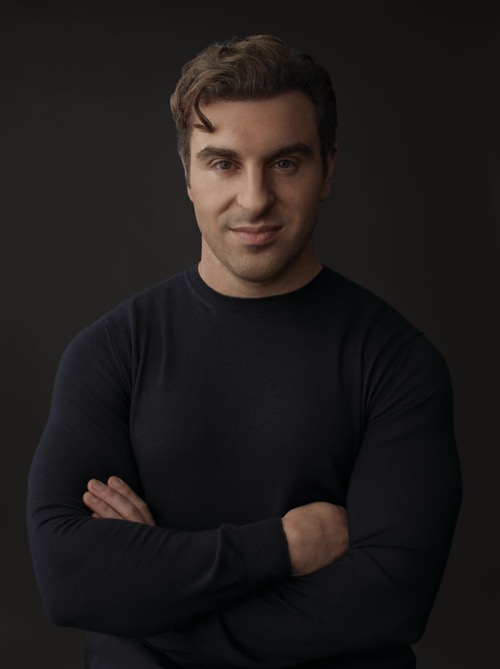
Cofounder and CEO, Airbnb · b. 1981 · Niskayuna, New York
Two calls made by hand, not formulas. how we score →
Summary
His parents were social workers, not investors.
When rent came due in San Francisco in 2007, he and a roommate filled the apartment with air mattresses. A year later, still $20,000 in debt each, they sold novelty election cereal to cover it. What actually opened doors was Y Combinator, then Sequoia. Airbnb went public in December 2020 with the three founders controlling the vote.
How it happened
Both of Chesky's parents worked as social workers in Niskayuna, a suburb outside Schenectady, New York. He captained the hockey team at Rhode Island School of Design and graduated in 2004 with a degree in industrial design, then moved to Los Angeles to design toys, guitars, and medical equipment for a firm called 3DID, earning around $40,000 a year. He grew restless there and cut back his hours in 2007 to work on furniture on the side.
In October 2007 he moved to San Francisco to room with a RISD classmate, Joe Gebbia. Neither of them could make rent, and a design conference in town that month had booked every hotel room. They put air mattresses on the floor, offered guests a spot to sleep and Pop-Tarts for breakfast, and brought in a third person, Nathan Blecharczyk, to build a real website. AirBed & Breakfast launched before South by Southwest in March 2008 and got two bookings, one of them Chesky himself.
They relaunched around that August's Democratic National Convention in Denver, and press coverage sent enough traffic to crash the site, but it still wasn't paying the bills. By then Chesky and Gebbia were each about $20,000 in debt. They designed and sold two runs of election-themed cereal, Obama O's and Cap'n McCain's, and by Airbnb's own later account the boxes brought in nearly $30,000, enough to cover most of what they owed. That got them to Y Combinator's winter 2009 class, a connection made through Michael Seibel at SXSW, where Paul Graham put in $20,000 for 6% of the company. Sequoia Capital added $585,000 a few months later.
Chesky took the CEO title in the fall of 2010 as the company grew into a global platform, and spent much of the next decade fighting city-by-city over what a short-term rental was even allowed to be. In 2016, after reports that hosts were turning away guests whose names read as Black, Airbnb hired former Attorney General Eric Holder to help rewrite its policies and began hiding guest photos until a booking was accepted. When the pandemic hit in 2020, the company laid off about 1,900 people, roughly a quarter of its staff, and Chesky gave up his own salary.
Airbnb priced its IPO at $68 a share on December 9, 2020, and the stock nearly doubled its first day of trading, pushing the company's value past $100 billion and Chesky's own stake above $11 billion by that afternoon. He still owns close to 14% of the company. Airbnb's Class B shares carry twenty votes apiece, and while Chesky alone holds about 15% of the vote, he and his two cofounders together control just over 42% of it through a standing voting agreement, enough to run the board without anyone's permission.
The coded evidence
Thirteen groups, every claim sourcednot established
Sources establish Italian and Polish ancestry but not which generation immigrated; not established to this record's sourcing standard.
↗ en.wikipedia.orgNo source documents him actually moving back in with his parents when money ran short in San Francisco; what's established is that both parents were employed social workers rather than a family with capital to lose, and that he had a design credential and prior salaried work to fall back on if the venture failed.
↗ en.wikipedia.orgHe and Gebbia were roughly $20,000 in debt each by the summer of 2008, accumulated covering rent and building the business before any outside money arrived. Consumer debt of this kind is dischargeable, unlike a student loan.
↗ en.wikipedia.orgReal cash-flow distress for about a year and a half, missed and late rent, mounting personal debt, but no documented homelessness, eviction, or loss of the apartment itself.
↗ en.wikipedia.orgThe hardship was chosen. There was a home to go back to if it failed.
The debt itself was real, but it was a risk a single 26-year-old with no dependents and a portable design degree could choose to take and recover from. Test: if the site had never taken off, he had a résumé that could still get him hired. Scored as chosen exposure rather than an imposed hard landing.
↗ en.wikipedia.orgBoth of Chesky's parents, Deborah and Robert Chesky, worked as social workers.
↗ en.wikipedia.orgNiskayuna, a middle-class suburb of Schenectady in upstate New York.
↗ en.wikipedia.orgNiskayuna High School, a public school; graduated 1999.
↗ en.wikipedia.orgMoved from upstate New York to Rhode Island for college, then to Los Angeles for his first design job, then to San Francisco in October 2007 for what became Airbnb.
↗ en.wikipedia.orgMet Michael Seibel, who would go on to run Y Combinator, at SXSW in 2008; that connection led to Airbnb's acceptance into YC's winter 2009 class.
↗ en.wikipedia.orgThe first two bookings came through the site's own SXSW 2008 launch; one guest was Chesky himself, testing the product.
↗ en.wikipedia.orgY Combinator's winter 2009 cohort, which supplied seed capital, Paul Graham's mentorship, and the credibility that led directly to Sequoia Capital's investment.
↗ ycombinator.comCapital, Credibility, Network
↗ ycombinator.comJoe Gebbia, a RISD classmate and San Francisco roommate, cofounded the business with him; Nathan Blecharczyk, recruited separately, built the original site and became the technical cofounder.
↗ en.wikipedia.org22
First industrial design job at 3DID in Los Angeles, straight out of RISD in 2004.
↗ en.wikipedia.org3
Roughly three years at 3DID between his 2004 graduation and the 2007 move to San Francisco.
↗ en.wikipedia.orgBachelor of Fine Arts in Industrial Design, Rhode Island School of Design, 2004.
↗ en.wikipedia.orgnot established
How RISD tuition was covered isn't established in the sources reviewed; his parents' work as social workers argues against a well-funded household, but no record of loans, scholarship, or work-study was found either.
↗ en.wikipedia.orgDirect from public high school to a four-year private art and design college.
↗ en.wikipedia.orgThe founders' own income and, once that ran out, their own consumer debt. There was no outside investor before Y Combinator.
↗ en.wikipedia.orgIt paid its own way from the start. Revenue came before any outside money.
Guests paid to stay from the first SXSW booking onward, well before any capital raise.
↗ en.wikipedia.orgY Combinator put in $20,000 for 6% of the company in early 2009; Sequoia Capital partner Greg McAdoo followed with $585,000 that spring.
↗ en.wikipedia.orgPersonal experience: unable to cover rent, and aware that a nearby design conference had booked every hotel room in the city.
↗ en.wikipedia.orgAirbnb's Class B shares carry 20 votes each. In the beneficial-ownership table filed ahead of the IPO, Chesky held about 15.3% of Class B stock and 15.2% of total voting power before the offering, and 15.3% of Class B and 15.1% of the vote after it. Class B holders as a group held 81.6% of economic ownership but 99.0% of total voting power, and the three founders together, bound by a Voting Agreement to vote as a bloc, held 42.2% of the vote following the offering, enough to control every matter put to shareholders without needing outside support.
Airbnb, Inc. Form S-1/A, filed December 7, 2020, "Principal and Selling Stockholders" table.
↗ sec.govWith no savings cushion to draw on, Chesky and Gebbia ran up roughly $20,000 in personal debt apiece keeping the company alive between the 2008 SXSW and Democratic National Convention launches and the 2009 Y Combinator acceptance.
Distinct from a chosen frugality signal: this was borrowed money spent to keep the lights on, not a lifestyle choice with savings underneath it.
↗ en.wikipedia.org0
No prior failed venture is documented; the same idea was relaunched twice before it worked, which is coded separately below.
↗ en.wikipedia.orgChesky and Gebbia personally, through credit-card and other consumer debt; no employer, family member, or investor is documented as having covered the early losses.
↗ en.wikipedia.org2
The site launched before SXSW in March 2008 with two bookings, then relaunched around the Democratic National Convention that August.
↗ en.wikipedia.orgWent public in the middle of a pandemic that had cut Airbnb's bookings by 80% in two weeks that spring; the company laid off a quarter of its staff to survive, then rebounded on a wave of people booking rural and drive-to getaways, and rode a hot late-2020 IPO market (DoorDash had priced the day before) to a $100 billion valuation.
↗ npr.orgSan Francisco, California
↗ en.wikipedia.orgTravel and hospitality — online home-sharing marketplace
↗ forbes.com12700000000
Forbes Real-Time Billionaires estimate; moves daily with Airbnb's share price. Band only.
↗ forbes.comJournalistic estimate
↗ forbes.com2026
↗ forbes.comOverwhelmingly paper wealth in Airbnb stock; his cash salary was nominal (about $110,000 in 2019) and he waived it entirely during the 2020 layoffs.
↗ sec.govWealth, not salary — nearly all of it unrealized value in an Airbnb stake held since founding.
↗ forbes.comJoined the Giving Pledge in 2016; committed $100 million over five years to the Obama Foundation's Voyager Scholarship program in 2022; named to Time 100 (2015) and given an honorary doctorate by RISD (2017).
↗ en.wikipedia.orgUncapped
↗ forbes.comAirbnb's core business has run into a patchwork of municipal short-term-rental restrictions worldwide: New York City requires registration and generally bars rentals under 30 days unless the host is present, Miami has banned short-term rentals in most neighborhoods, and San Diego caps rental units at 1% of the housing stock and requires licensing. These constraints target the platform's product, not Chesky personally.
Used as a fallback source after several primary municipal and news sources returned inaccessible or blocked pages during this pass.
↗ en.wikipedia.orgAfter
Characterizes the regulatory patchwork, which mostly tightened after Airbnb was already a large, well-capitalized company; New York City's strictest rules took effect in 2023, three years after the IPO.
↗ en.wikipedia.orgIncidental
The regulatory friction is a cost of the business at scale, not a mechanism that produced Chesky's founding advantage.
↗ en.wikipedia.orgLegal gray
Short-term home rental operated in a genuine regulatory gray zone relative to hotel and tenancy law before most cities wrote specific rules for it.
↗ en.wikipedia.orgNone
No fine or personal liability tied to Chesky is established; cities have generally responded by restricting the product rather than penalizing the company or its founder directly.
↗ en.wikipedia.orgIn May 2020, as the pandemic cut bookings 80% in two weeks, Airbnb laid off approximately 1,900 employees, about a quarter of its workforce, with severance packages that included extended healthcare coverage; Chesky gave up his own salary the same year.
↗ nytimes.comHands on, Detail obsessed, Design driven
↗ paulgraham.comInsiders
Characterization comes from Y Combinator's Paul Graham and the investors and founders present at the talk that prompted his essay.
↗ paulgraham.com1
Graham's essay is the primary documented account; it references other founders' reactions without naming them individually.
↗ paulgraham.comAfter
The "founder mode" reputation formed in September 2024, sixteen years after founding and four years after the IPO.
↗ paulgraham.comAsset
↗ paulgraham.comThe reputation was deliberately built, through books, press, and PR.
He gave the talk that produced this reputation deliberately, at a YC event, and it circulated widely afterward.
↗ paulgraham.comStructural context
The cost-of-failure score comes from this person's own money and circumstances. But who they were in America carried its own weight, the same way their household or income did, and it shaped how hard the path was just as much. That part isn't in the cost-of-failure number. It's here instead.
Men founded the companies that took nearly all the venture funding and almost every top outcome, a tailwind that never shows up in one person's own circumstances.
↗ techcrunch.comWhite founders are heavily overrepresented among funded companies and top-tier wealth relative to their share of the population, an edge that has nothing to do with a person's own money.
↗ techcrunch.comAmong the people recorded here — men: 169 · White subjects: 114. Representation here is who reached these outcomes, not equal odds of reaching them.
Controlled comparisons
Each holds one thing constant and varies another, so the difference is the point. A list of similar names wouldn't tell you anything.