Oscar Munoz
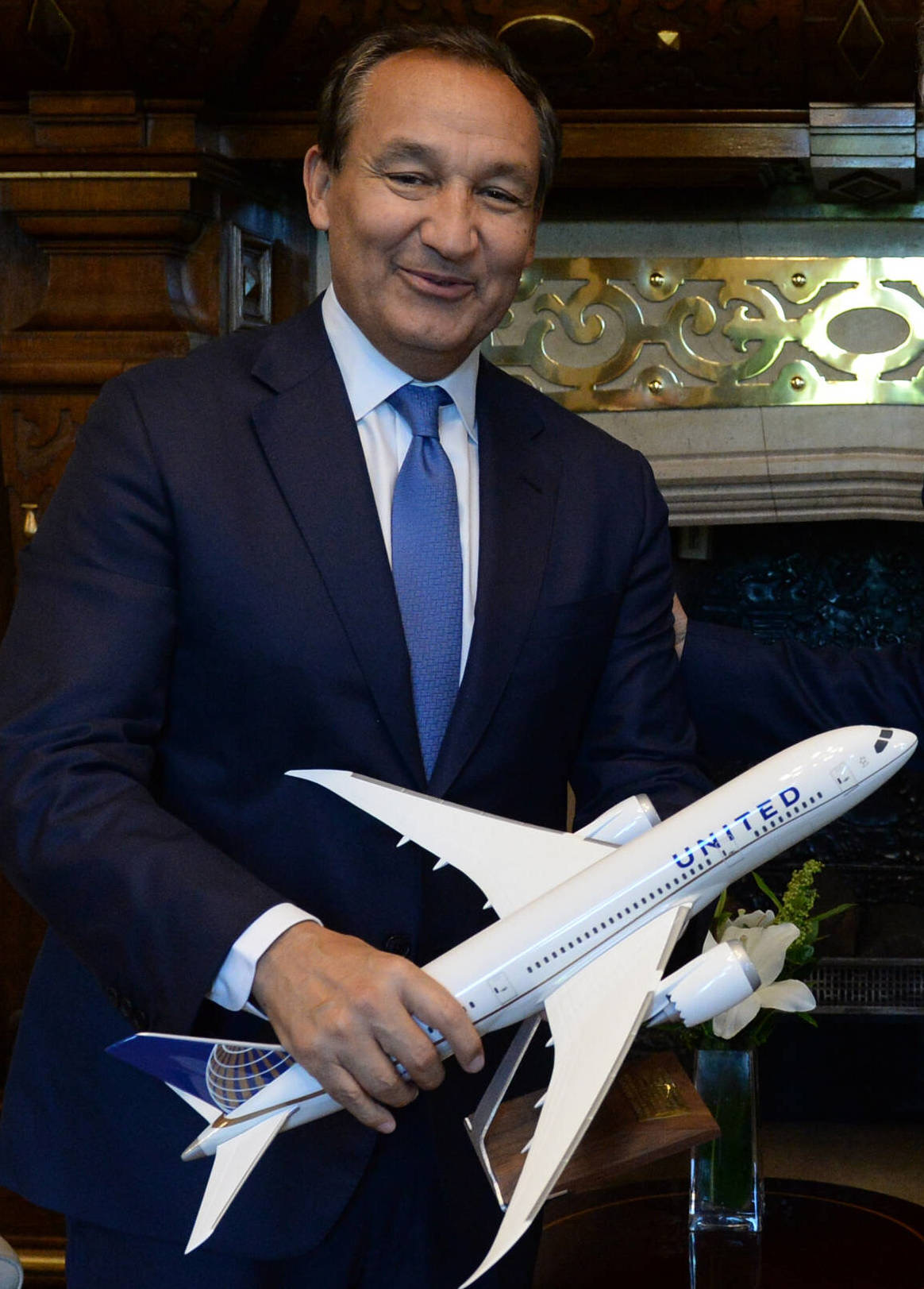
Former CEO and Chairman, United Airlines · b. 1959 · Mexico
Two calls made by hand, not formulas. how we score →
Summary
Born in Mexico to a single mother, raised by his grandmother until he crossed the border undocumented at eight, Munoz became first in his family to finish college and spent three decades in corporate finance before a long-held board seat put him in line to run United in 2015.
Five weeks in, a heart attack nearly ended it; he ran the airline through a transplant and, later, a bruising PR crisis.
How it happened
Born January 5, 1959, in Mexico to a single mother. About a year later his mother left for Los Angeles, where her brother had arranged the paperwork for her to work, and Munoz stayed behind with his maternal grandmother, Mama Josefina. There was no fixed home; she moved between relatives and friends across northern Mexico for the next seven and a half years while she worked. He has said he doesn't consider that childhood poor, since the family had little but each other, but by his own account there was no house he could call his own.
Around age eight, Munoz left Mexico to join his mother in the Los Angeles area, entering the United States without documentation — he has described himself as "a Dreamer long before DACA." He learned English after arriving and grew up afterward in a working household in Southern California, reportedly Huntington Beach, while his mother built a life there.
Neither of his parents had gone to college, and by his account nobody in his circle was talking about it either. A high school guidance counselor pushed him toward it anyway. He enrolled at the University of Southern California, earned a business degree in 1982, and became the first person in his family to graduate.
He spent the next two decades moving through corporate finance rather than staying anywhere long: various finance roles at PepsiCo, then regional vice president of finance and administration at Coca-Cola, then CFO of US West starting in 1999, carried into the same role at the merged Qwest, then CFO and vice president of consumer services at AT&T from 2001. He earned an MBA at Pepperdine while working at PepsiCo. In 2003 he joined the railroad CSX Corporation as CFO and chief of strategy, moved up to chief operating officer in 2012, and was named president in 2015 with a promotion to CEO already scheduled for the end of that year.
He never took the CSX job. Munoz had sat on the board of United's parent company since 2004, and in September 2015 United's CEO, Jeff Smisek, resigned abruptly after federal subpoenas connected the airline to an investigation into the former Port Authority chairman's dealings with United's Newark routes — a probe into Smisek and the company, not into Munoz. The board turned to its own longtime director rather than run an outside search, and named Munoz CEO on September 8, 2015.
He started with a "listening tour" of frontline employees. Thirty-eight days into the job, he had a heart attack. He kept working through it, by his own account interviewing management candidates from a hospital bed hooked to machines that kept his heart going, and received a heart transplant on January 5, 2016 — his 57th birthday. He returned to the office that March. Under his direction United settled a five-year flight attendant contract within four months, after years of stalled talks, and by the end of 2016 had renegotiated every union contract left over from the Continental merger.
In April 2017, a passenger was violently dragged off an overbooked United Express flight after refusing to give up his seat. Munoz's first internal email backed the crew and called the passenger "disruptive and belligerent"; it leaked and was widely reported as tone-deaf. A second, more contrite statement apologizing for having to "re-accommodate" passengers landed little better, and critics at the time called his handling a "fumbling response" and a "major disappointment." He testified before the House Transportation Committee that May, calling the incident "a mistake of epic proportions" and announcing a $10,000 cap increase on voluntary-bump payments and a set of policy changes to reduce overbooking. PRWeek, which had named him Communicator of the Year weeks earlier, said afterward it wouldn't have given him the award. United's board delayed a planned promotion to board chairman that had been scheduled for 2018 but kept him as CEO.
He ran United for four more years, then moved to executive chairman in May 2020 as Scott Kirby took the CEO title, and left the chairmanship in 2021. In 2023 he published a memoir, Turnaround Time, about the airline and his own path to it. He now sits on the boards of Salesforce, CBRE, Univision, and Archer, and co-chairs a USC trustee committee at the school that gave him his first degree.
The coded evidence
Thirteen groups, every claim sourced1.5 generation. Born in Mexico and immigrated to the United States around age eight to join his mother, rather than being born in the U.S. or arriving as an adult.
Wikipedia's infobox lists his birthplace as "California, U.S.," but the same article carries the category "Place of birth missing (living people)," meaning that detail is unsourced there. Multiple later sources drawing on his 2023 memoir and his own interviews — Pepperdine University's alumni magazine, a TIME leadership interview, and this Worth profile — describe him as born in Mexico, raised there by his grandmother, and immigrating to Los Angeles as a child. This file follows the memoir-sourced accounts.
↗ worth.comSpanish in early childhood with his grandmother in Mexico; he has said he learned English after arriving in the U.S. at around age eight.
↗ time.com0.5
Hospitalized after his October 2015 heart attack and away from daily duties from then until his March 2016 return, roughly five months, most of it as a medical leave rather than a full stop; the company continued operating with an executive team in place throughout.
↗ en.wikipedia.orgNone during his first seven-plus years. His grandmother had no permanent home of her own and moved between relatives and friends across northern Mexico while raising him. Once he joined his mother in the Los Angeles area around age eight, the household had a fixed home, but no property or savings behind it.
↗ worth.comContinuously salaried from his first post-USC job in the early 1980s onward, across six employers, through to the United CEO appointment. No documented gap in employment during his adult career-building years.
↗ en.wikipedia.org4
Four children with his wife, Cathy, per the Wikipedia infobox; not tied to a specific point in his career.
↗ en.wikipedia.orgnot established
No debt is documented in sources reviewed, including for his USC or Pepperdine education.
↗ en.wikipedia.orgnot established
No documented homelessness, food insecurity, or job loss during his adult corporate career; the severe instability in the record belongs to his childhood in Mexico, captured under d2 and d3 instead.
↗ en.wikipedia.orgThe hardship was imposed, not chosen. There was nothing to fall back on.
His mother's emigration for work and his grandmother's itinerant circumstances were economically driven, not a chosen simplicity.
↗ worth.comHis mother left Mexico for Los Angeles about a year after his birth to work, with her brother having arranged her immigration paperwork; her occupation there isn't specified in sources reviewed. His father is not mentioned in his own memoir-sourced accounts of his childhood. Two lower-detail profiles (APEX and a secondary aggregator site) instead describe a two-parent household with a father who worked as a meat cutter; that version isn't corroborated by his memoir, by Pepperdine's alumni magazine, or by his own interviews, which center a single mother and a grandmother.
Conflicting secondary accounts exist; this file follows the version corroborated by his own memoir and interviews.
↗ pepperdine.edunot established
Not established in detail; multiple sources agree neither parent attended college.
↗ pepperdine.edu8
Described as "the oldest of nine children" (eight siblings) in Pepperdine's alumni magazine, an RBC diversity feature, and other accounts drawing on his memoir. Wikipedia, citing a 2016 Fortune profile, instead says "the eldest of ten children." Left as nine given the weight of more recent, memoir-sourced accounts.
↗ pepperdine.eduHis maternal grandmother, whom he calls Mama Josefina in his memoir, raised him for roughly seven and a half years in Mexico after his mother left for the U.S. He has called her his first and most enduring role model and credits her with instilling his work ethic.
↗ worth.comNo documented family sacrifice funded his schooling. He has said college wasn't something his parents or friends discussed; a high school guidance counselor was the one who pushed him toward applying.
↗ brooksysociety.comPrimary custody moved from his grandmother in Mexico to his mother in the Los Angeles area when he was about eight years old, coinciding with his unauthorized entry into the United States.
↗ pepperdine.eduBy his own account, roughly seven and a half years with no fixed home, moving between relatives and friends across northern Mexico while his grandmother raised him, followed by an unauthorized border crossing around age eight to join his mother in the Los Angeles area.
↗ worth.comSuffered a heart attack on October 15, 2015, five weeks into his term as United's CEO, and received a heart transplant on January 5, 2016. He returned to work that March and is one of a small number of Fortune 500 CEOs to continue running a company after a transplant. The condition arrived after he had already reached the CEO role, not during the years he was building toward it.
↗ en.wikipedia.orgMunoz has spoken and written, including in his 2023 memoir, about being separated from his mother as an infant when she emigrated for work, spending his early childhood with no permanent home under his grandmother's care in Mexico, and crossing into the United States without documentation at about age eight to rejoin her — describing himself as "a Dreamer long before DACA." He frames the period as one of love and family rather than deprivation, but by his own account there was no house he could call his own until he reached Los Angeles.
↗ time.comnot established
↗ en.wikipedia.orgItinerant, across relatives' and friends' homes in northern Mexico until about age eight; afterward, Huntington Beach in Southern California, per one secondary source.
The Huntington Beach detail comes from a single lower-tier source and isn't independently corroborated.
↗ brooksysociety.comPublic schooling in the U.S. after arriving around age eight; no detail is established on any schooling in Mexico before that.
↗ en.wikipedia.orgBorn in Mexico in 1959. His mother emigrated to Los Angeles for work about a year later. He stayed in Mexico with his grandmother until around age eight, then crossed into the U.S. without documentation to join his mother.
↗ worth.comArrived in the U.S. undocumented and non-English-speaking as a child, and later built a multi-decade corporate finance career and ran a Fortune 500 airline as one of a small handful of Hispanic CEOs at that level; he was one of only two Hispanic CEOs in the Fortune 500's top 100 companies when he took the United job in 2015. No specific documented incident of bias against him personally is established in sources reviewed.
↗ en.wikipedia.orgHis own decade-plus tenure as a director on United's parent-company board, which he'd joined in 2004, put him in the room when CEO Jeff Smisek resigned abruptly in September 2015. The board named an internal director rather than running an outside search.
↗ bizjournals.comnot established
His first employer out of USC isn't specified beyond "various financial positions" at PepsiCo.
↗ en.wikipedia.orgA high school guidance counselor redirected him toward college admissions at a point when neither his family nor his peers were discussing it, leading to his USC application.
↗ brooksysociety.comSat on United Continental Holdings' board of directors from its 2004 formation through his 2015 CEO appointment, giving him more than a decade of direct board-level visibility into the company before he ran it.
↗ bizjournals.com6
PepsiCo, Coca-Cola, US West/Qwest, AT&T, CSX, and United — a career built by moving between employers rather than staying at one.
↗ en.wikipedia.orgBS in business, University of Southern California, 1982; MBA, Pepperdine University, earned while working full time at PepsiCo.
↗ pepperdine.eduEarned his Pepperdine MBA while employed full time at PepsiCo, which he describes as important to advancing his career at the time.
↗ pepperdine.eduFirst-generation college student, redirected toward a four-year degree by a high school counselor rather than family expectation, into a public research university and later a part-time graduate program completed alongside full-time work.
↗ pepperdine.eduLater became a USC trustee and co-chair of its Finance and Campus Planning Committee, an ongoing institutional tie rather than a one-time credential.
↗ en.wikipedia.orgnot established
Not applicable in the founder sense; his entire adult income came from employer salary and equity grants, never a venture he personally financed.
↗ en.wikipedia.orgSalary, bonus, and stock awards from a sequence of large-company employers, culminating in board-granted United equity as CEO, rather than any investment vehicle he personally controlled.
↗ sec.gov0
No independent ventures attempted; a continuous employment climb across six companies.
↗ en.wikipedia.orgUnited's 2010 merger with Continental had left flight crews on separate labor contracts for five years, straining relations with employees. Munoz's predecessor resigned amid a federal investigation into the company's dealings with the Port Authority of New York and New Jersey, not into Munoz himself, creating an abrupt vacancy the board filled from inside its own boardroom.
↗ chicago.suntimes.com6
September 2015 CEO appointment through his May 2021 departure as executive chairman.
↗ prnewswire.comAirlines and transportation; corporate finance and operations
↗ en.wikipedia.orgnot established
No Forbes profile or reliable net-worth estimate exists for Munoz; he isn't tracked as a billionaire or on Forbes's wealth lists. His outcome here is coded from disclosed compensation rather than a guessed net worth figure.
↗ forbes.com12643005
Fiscal-year-2019 total compensation from United Airlines Holdings' 2020 proxy Summary Compensation Table: $1,250,000 salary, $8,062,572 stock awards, $2,887,500 non-equity incentive plan compensation, and $442,933 other compensation. His highest disclosed year of the three shown in that filing; FY2018 was $10,493,832 and FY2017 was $9,561,134.
↗ sec.govProxy statement
↗ sec.govHigh salaried and equity-based income as a public-company executive, not ownership of anything he founded. No dual-class stock or control-block structure behind his position.
↗ sec.govWidely described as one of the first Hispanic CEOs to lead a major U.S. airline, and one of a small number of Fortune 500 CEOs to continue running a company after a heart transplant. Published a bestselling memoir, Turnaround Time, in 2023.
↗ en.wikipedia.orgCapped
A salaried public-company executive with board-set compensation targets, not an open-ended founder's equity stake.
↗ sec.govMunoz testified before the House Transportation and Infrastructure Committee on May 2, 2017, and United responded to inquiries from the Senate Commerce Committee, after the April 2017 Flight 3411 incident. These were legislative oversight hearings, not an enforcement action; no fine or personal finding was issued against Munoz.
↗ globalnews.caMunoz told Congress the incident was "a mistake of epic proportions, clearly, in hindsight," and separately apologized for his first internal statement, which had called the removed passenger "disruptive and belligerent."
↗ npr.orgAfter
The incident occurred in April 2017, about nineteen months after he became CEO.
↗ en.wikipedia.orgIncidental
The incident and his initial response threatened his position rather than having produced his rise; a planned promotion to board chairman was shelved because of it, though he kept the CEO title.
↗ en.wikipedia.orgNone
No personal fine or liability finding against Munoz. United reached an undisclosed settlement with the removed passenger and changed overbooking and compensation policies; Munoz's planned 2018 promotion to board chairman was withdrawn but he remained CEO for three more years.
↗ en.wikipedia.orgFumbling, Tone deaf, Turnaround focused, Employee centered
"Fumbling" and similar terms describe press reaction to his Flight 3411 response specifically; "turnaround-focused" and "employee-centered" describe the separate, earlier reputation built from his labor-contract settlements and listening tour.
↗ bloomberg.comPress
↗ npr.orgBefore
His reputation as a labor-relations turnaround CEO formed in his first eighteen months (2015–2016), before the April 2017 Flight 3411 incident damaged it.
↗ en.wikipedia.orgMixed
An asset through 2016 for settling long-stalled labor contracts; a liability through April 2017, when PRWeek's own editor said the outlet would not have named him Communicator of the Year had the choice come after the incident rather than weeks before it.
↗ prweek.comThe reputation accrued from behaviour rather than being manufactured.
↗ en.wikipedia.orgHe remained CEO for three more years after Flight 3411 and completed an orderly handoff to Scott Kirby in 2020. His 2023 memoir and subsequent board seats at Salesforce, CBRE, Univision, and Archer suggest the incident didn't end his standing as a business leader, even though it cost him the board chairmanship United had originally planned for him.
↗ en.wikipedia.orgStructural context
The cost-of-failure score comes from this person's own money and circumstances. But who they were in America carried its own weight, the same way their household or income did, and it shaped how hard the path was just as much. That part isn't in the cost-of-failure number. It's here instead.
Men held about 90% of Fortune 500 CEO seats in 2023, and a wider majority of the rungs below. The ladder is widest for them the whole way up.
↗ forbes.comImmigrants and their children are overrepresented among America's biggest companies, as founders and as senior leaders. They got there through the visa, credential, and network hurdles that make the path harder to even start down.
↗ forbes.comAmong the people recorded here — men: 115. Representation here is who reached these outcomes, not equal odds of reaching them.
Controlled comparisons
Each holds one thing constant and varies another, so the difference is the point. A list of similar names wouldn't tell you anything.