Ellen DeGeneres
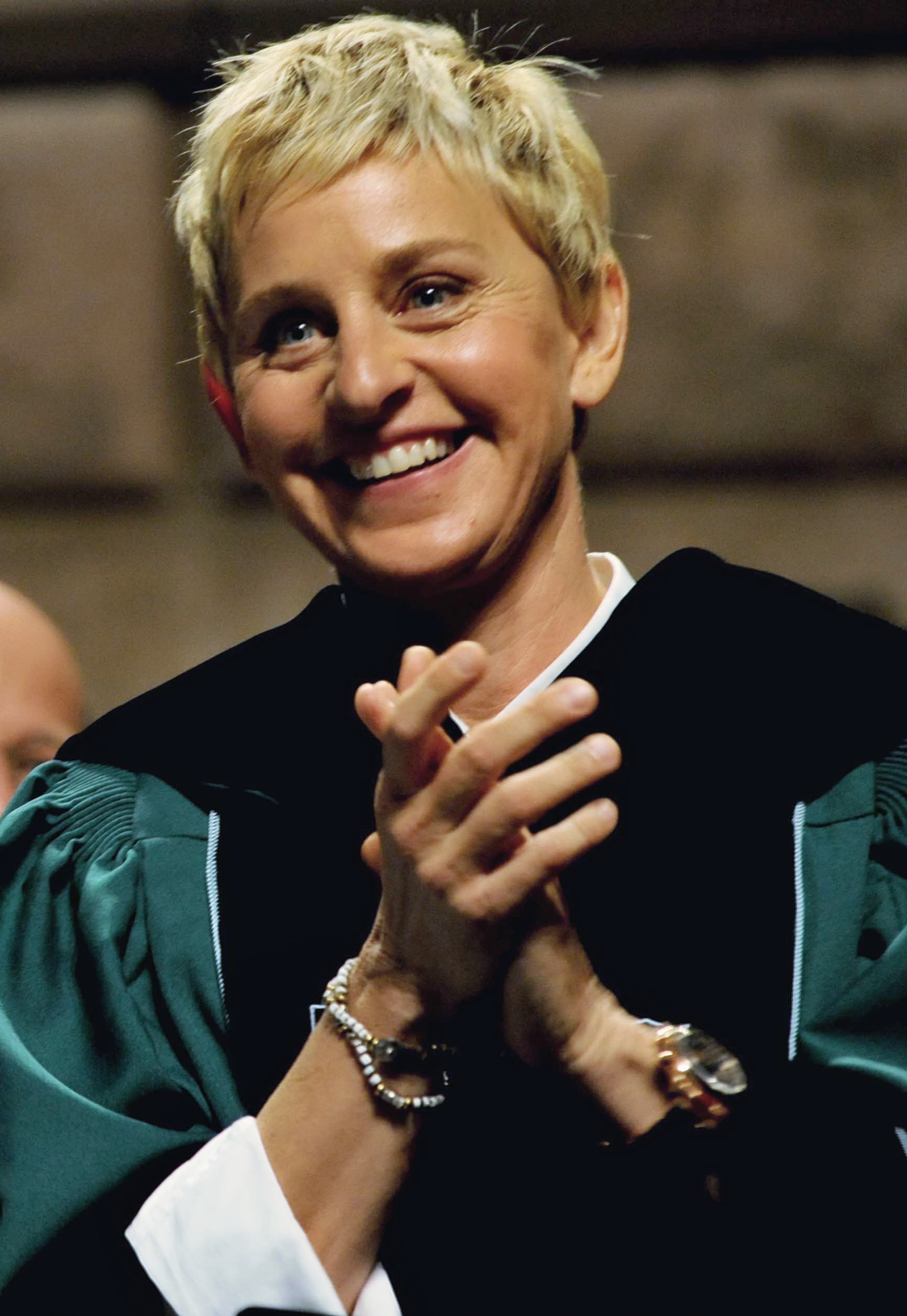
Stand-up comedian; host, "The Ellen DeGeneres Show" · b. 1958 · Metairie, Louisiana
Two calls made by hand, not formulas. how we score →
Summary
She built a stand-up career from nothing through her twenties, then came out publicly in 1997 at real professional cost: by her own account she lost three years of work afterward.
The rebuild came through a syndicated daytime show she co-owned rather than just hosted, which ran nineteen seasons and made her one of the wealthier people in comedy.
How it happened
Her father sold insurance and her mother worked as a speech therapist in Metairie, Louisiana, an ordinary childhood until her parents divorced when she was fifteen. She moved to a small town in East Texas with her mother, who soon remarried. DeGeneres has said on the record, in interviews in 2005 and 2019, that her stepfather sexually abused her as a teenager while her mother was ill, and that she eventually fled the house.
She left college after one semester and worked through jobs that had nothing to do with comedy: waitressing, house painting, selling vacuum cleaners, a stretch as a legal secretary. At twenty, her girlfriend Kat Perkoff was killed in a car accident, and she couldn't afford to keep their apartment alone. Lying on the floor of the flea-infested basement room she moved into instead, she wrote the bit that would define her act: a phone call to God asking why the fleas were still around and her girlfriend wasn't. It won a Showtime comedy contest in 1982, and by 1986 Johnny Carson had made her the only woman he ever invited to sit on his couch after a first appearance.
In April 1997 she came out on the cover of Time, then again through her sitcom character in an episode watched by more than 40 million people. ABC lost advertisers, added parental advisory warnings to the following season, and canceled the show within the year. She has said the backlash left her "really depressed" and that for three years afterward nobody in the industry would hire her: "I had no agent, no possibility of a job, I had nothing."
In 2003, at forty-five, she started over with a syndicated daytime talk show built through A Very Good Production, a company she co-founded and ran as CEO alongside Warner Bros.' Telepictures. It wasn't a hosting job with a paycheck attached, it was a stake in the thing itself. The show ran nineteen seasons and became the base for a production slate, a record label, and a home-goods and apparel brand.
In 2020, former employees told BuzzFeed News that the set behind the show's "be kind to one another" motto was a fear-driven place to work. WarnerMedia opened an investigation, and DeGeneres apologized on air, saying her name was on the show and she took responsibility. The show ended in 2022, and she's since joked that she was "kicked out of show business" a second time. She's reported to be worth around $450 million today, most of it from the company she built rather than a salary.
The coded evidence
Thirteen groups, every claim sourcedEuropean American, French-Louisianan surname/ancestry
No more specific ancestry is established from the public record.
↗ en.wikipedia.orgDescendant, multi-generation American
↗ en.wikipedia.orgA two-income but unremarkable household (insurance agent father, speech therapist mother) with no property or savings cushion behind it. After the 1973-74 divorce she moved with her mother into her stepfather's household in Texas, which is where the abuse happened rather than a safety net.
↗ en.wikipedia.orgNone of note through her twenties. She worked a series of survival jobs, not a stable salaried position, while building a stand-up act: waitressing, house painting, selling vacuum cleaners, and a stretch as a legal secretary.
↗ biography.comAt twenty, after her girlfriend Kat Perkoff died in a car accident, she couldn't afford to keep their shared New Orleans apartment and moved into what she has described as a flea-infested basement room, sleeping on a mattress on the floor.
↗ today.comThe hardship was imposed, not chosen. There was nothing to fall back on.
The odd jobs and the basement apartment were economic necessity, not a chosen austerity against a family cushion she could have returned to.
↗ today.comFather Elliott DeGeneres, an insurance agent; mother Betty DeGeneres, a speech therapist.
↗ en.wikipedia.orgnot established
Not established either way for an insurance agent role at this remove.
↗ en.wikipedia.orgnot established
No account of family encouragement or facilitation of a comedy career; she found her way into clubs on her own in her early twenties.
↗ biography.comHer parents separated in 1973 and divorced in 1974, when she was fifteen. She and her mother moved to a small town in East Texas, where her mother remarried; her brother stayed with their father.
↗ en.wikipedia.orgMoved from Metairie to a small town in East Texas at fifteen after her parents' divorce, attending Grace King High School and then Atlanta High School. Moved again to New Orleans as a young adult, then into a basement room after her girlfriend's death, then to Los Angeles to pursue comedy full time.
↗ en.wikipedia.orgHas said on the record that the backlash after coming out in 1997 left her "really depressed," and that for about three years afterward she was treated "as a failure in this business" and couldn't find work: "I had no agent, no possibility of a job, I had nothing." She has also said, of the show's cancellation and its aftermath, "for exactly three years, I lost my career."
A bounded, self-disclosed episode tied to a specific professional crisis in her late thirties, resolved once the 2003 show rebuilt her career, rather than a chronic or lifelong condition.
↗ today.comHas said on the record, first in a 2005 Allure interview and again in a 2019 Netflix interview with David Letterman, that her stepfather sexually abused her starting around age fifteen or sixteen, and that she fled the house through a window after he tried to force his way into her room. She has said she didn't tell her mother at the time because she didn't want to "ruin her happiness."
Her own on-record disclosures, attributed to her. The stepfather is not named here; she has not named him herself in these accounts.
↗ cbsnews.comMetairie, a New Orleans suburb, then a small town in East Texas from age fifteen.
↗ en.wikipedia.orgGrace King High School (Metairie, public), then Atlanta High School (Texas, public), graduating 1976.
↗ en.wikipedia.orgLouisiana to East Texas at fifteen, tied to her parents' divorce and her mother's remarriage. Back to the New Orleans area as a young adult, and later to Los Angeles to pursue comedy.
↗ en.wikipedia.orgA booking agent at the Improv in Hollywood gave her a shot after Jay Leno, who had seen her act, passed along a tip. That led to the 1986 Tonight Show appearance.
↗ biography.com23
First stand-up work in 1981 at a New Orleans coffeehouse, then emcee at Clyde's Comedy Club.
↗ biography.comBy 2003 she already carried two decades of stand-up, a canceled sitcom, a Tonight Show legacy appearance, and the voice of Dory in "Finding Nemo" that same year, so the new show launched to real name recognition rather than a cold start.
↗ en.wikipedia.orgWon Showtime's "Funniest Person in America" contest in 1982 with the "Phone Call to God" routine, a competition-circuit win that raised her profile before any TV work.
↗ biography.comNo degree. Attended the University of New Orleans for one semester, studying communications, then left.
↗ en.wikipedia.orgNone. She didn't complete a program.
↗ en.wikipedia.orgIt paid its own way from the start. Revenue came before any outside money.
Paid from club dates and TV appearances; no capital was ever raised for the stand-up career.
↗ biography.comA Very Good Production, founded in 2003, was a joint venture between DeGeneres and Warner Bros. Television's Telepictures division, with DeGeneres as CEO. It was not a solo-owned company like some peers' — it was a shared structure with a studio partner — but it made her an equity participant in the show and its spinoffs rather than a salaried host.
↗ en.wikipedia.orgNo single studio-purchase story like some peers; profiles describe her as an active real-estate investor who has repeatedly bought, renovated, and resold high-end California homes rather than concentrating proceeds into one piece of infrastructure.
↗ forbes.comRather than signing on purely as a host, she co-founded the production entity behind her own show, which went on to also produce "Ellen's Game of Games," "Little Big Shots," and "Green Eggs and Ham," plus the eleveneleven record label. The company was folded in 2024 after her retirement from show business.
↗ en.wikipedia.org2
Beyond the show and its production company: the ED lifestyle and apparel brand (2015, with a Walmart EV1 partnership from 2018) and the eleveneleven record label (2010, co-founded).
↗ forbes.com2
"Open House" (Fox, 1989) was quickly canceled, and "The Ellen Show" (CBS, 2001-2002), a sitcom made after the "Ellen" cancellation, was pulled after 13 episodes.
↗ en.wikipedia.orgThe networks absorbed the direct production losses on both canceled shows; she absorbed the career and reputational cost, including the multi-year hiring freeze she has described after 1997.
↗ today.comRoughly five years between "Ellen" being canceled in 1998 and "The Ellen DeGeneres Show" debuting in September 2003, a period that included the brief, also-canceled "The Ellen Show" on CBS.
↗ en.wikipedia.orgA first-run syndication market for daytime talk that Oprah Winfrey had already proven could be extremely lucrative, with broadcast stations still hungry for a strip-syndicated hit; her 2003 relaunch also landed the same year as "Finding Nemo," which reintroduced her to a family audience.
↗ en.wikipedia.orgLos Angeles/Burbank, on the Warner Bros. lot with Telepictures as the studio partner.
↗ en.wikipedia.orgBuilt a new show and format around two decades of her own stand-up and hosting persona rather than acquiring an existing property.
↗ en.wikipedia.org21
2003 through the company's 2024 dissolution, spanning the show's run, its production slate, and the brand extensions built on top of it.
↗ en.wikipedia.orgComedy and television
↗ en.wikipedia.orgJournalistic estimate
↗ forbes.com2025
↗ forbes.com84000000
Reported as her 2020 Forbes-estimated earnings (12th-highest-paid entertainer that year); sourced here via Wikipedia's citation of the Forbes list rather than the original list page directly.
↗ en.wikipedia.orgJournalistic estimate
↗ en.wikipedia.orgWealth sits mostly in the production company's equity, the associated brand extensions, and an active real-estate portfolio, rather than a pure hosting salary.
↗ forbes.comPresidential Medal of Freedom (2016); more People's Choice Awards than any other individual (20); first openly gay host of the Academy Awards (2007); 33-plus Daytime Emmy Awards for the talk show.
↗ en.wikipedia.org22
From her first paid stand-up work in 1981 to full ownership of the show's production entity in 2003.
↗ en.wikipedia.orgUncapped
↗ en.wikipedia.orgIn a July 2020 note to staff, after reports of a toxic workplace on her show, she wrote: "My name is on the show and everything we do and I take responsibility for that." She apologized on air that September, and again in later interviews.
↗ nbcnews.comUnrelated
A source close to the production told NBC News the review "is not about her at all"; the reporting concerns how the show was run at its peak, not how she reached her position.
↗ nbcnews.comNone
No fine, personal legal liability, or incarceration. The cost was reputational and, by her own later account, professional: several senior producers departed and the show ended two years later.
↗ nbcnews.comWarm, Relatable, (after 2020) difficult
↗ nbcnews.comPublic
↗ nbcnews.comBefore
The "be kind" persona was built and rewarded across the show's first 17 seasons, well before the 2020 reporting.
↗ en.wikipedia.orgMixed
↗ nbcnews.comThe reputation was deliberately built, through books, press, and PR.
"Be kind to one another" was the show's own explicit sign-off and branding, not just an accrued impression.
↗ en.wikipedia.orgHer on-air brand centered on kindness, "Be kind to one another" was the show's sign-off. In July 2020, BuzzFeed News reported that former staff alleged a toxic set, including claims of racial microaggressions and retaliation; Variety had reported crew pay complaints three months earlier. WarnerMedia and the show's producers opened an internal investigation and interviewed dozens of current and former staff. DeGeneres told her staff she took responsibility and apologized on air that September. Several senior producers left. The employees who spoke to BuzzFeed largely pointed at producers rather than DeGeneres herself, and a person close to the production told NBC News the review "is not about her at all," though she has since said publicly that she was pushed out of the industry partly because of it.
↗ nbcnews.comThe show ended in May 2022. In a 2024 stand-up special she joked that she'd been "kicked out of show business" a second time (the first being after she came out in 1997), and said "the 'be kind' girl wasn't kind." She has not returned to a regular television role since, beyond a one-off animated cameo.
↗ eonline.comStructural context
The cost-of-failure score comes from this person's own money and circumstances. But who they were in America carried its own weight, the same way their household or income did, and it shaped how hard the path was just as much. That part isn't in the cost-of-failure number. It's here instead.
Across film, music, and digital, ownership and control stay in far fewer women's hands than men's. For one measure, women directed only about 12% of 2023's top-grossing films.
↗ assets.uscannenberg.orgWhite creators hold most of the ownership and catalog control relative to their share of the population. Recognition turns into ownership most reliably for them.
↗ assets.uscannenberg.orgAmong the people recorded here — women: 54 · White subjects: 74. Representation here is who reached these outcomes, not equal odds of reaching them.
Controlled comparisons
Each holds one thing constant and varies another, so the difference is the point. A list of similar names wouldn't tell you anything.