Katharine Graham
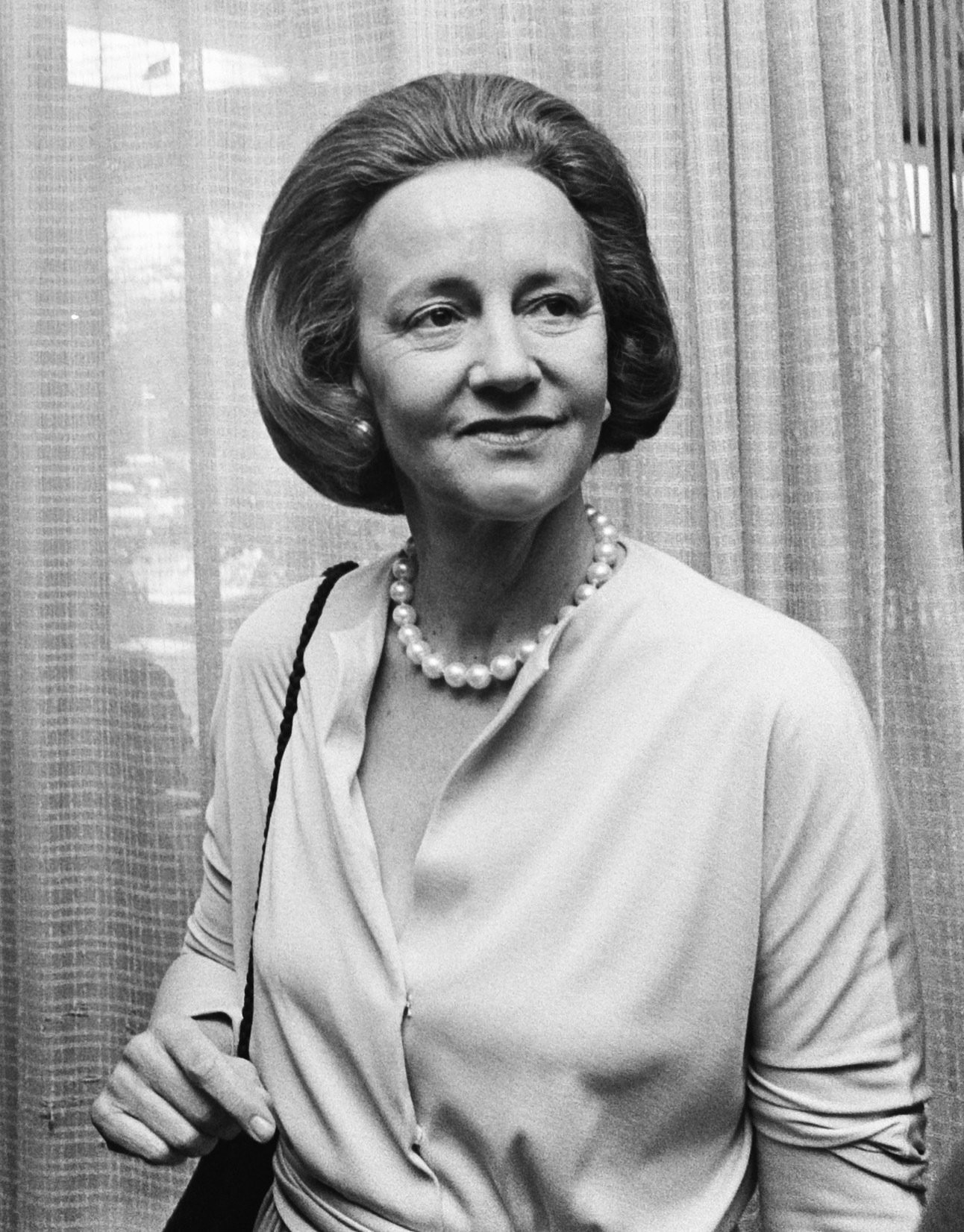
born Katharine Meyer Graham
Publisher and CEO, The Washington Post Company · b. 1917–2001 · New York City
Two calls made by hand, not formulas. how we score →
Summary
Born into one of the wealthiest families in American finance, she was raised for comfort, not command.
Her father bought The Washington Post at auction and handed control to her husband, not to her. When he died by suicide in 1963, she took over a company she had never been groomed to run, and spent the next decade learning to run it, then defending what it printed against a hostile White House.
How it happened
Born June 16, 1917, in New York City, the third of five children of Eugene Meyer and Agnes Ernst Meyer. Her father was a Wall Street financier of Alsatian Jewish descent who went on to chair the Federal Reserve under Herbert Hoover and later served as the first president of the World Bank; her mother, of German Lutheran immigrant stock, was a writer and intellectual who counted Albert Einstein among her correspondents. In 1933 Eugene Meyer bought the bankrupt Washington Post at auction for $825,000. Katharine grew up across Montessori school, the Potomac School, and the Madeira School (built partly on land her father donated), then attended Vassar before transferring to the University of Chicago, where she earned her degree in 1938.
After graduating she took a job covering labor and the waterfront for the San Francisco News, reportedly at $21 a week, then returned to Washington in 1938 to work at her father's paper, learning the business from the editorial side rather than being handed a title.
She married Philip Graham, a Harvard-trained lawyer and former clerk to Supreme Court Justice Felix Frankfurter, on June 5, 1940. In 1946 Eugene Meyer made Phil, not Katharine, publisher of the Post and sold him controlling stock. She later wrote that it never troubled her at the time and that it had not occurred to her that her father might have seen her as someone to run the paper herself. Phil expanded the company aggressively over the next decade and a half, buying a rival paper, TV stations, and Newsweek magazine.
By her own account in her memoir "Personal History," the later years of the marriage were marked by Phil's severe manic-depressive illness and by a period in which, she wrote, he belittled and undermined her; she has written that she learned of an affair not long before his death. On August 3, 1963, he died by suicide at the couple's Virginia farm. That death, not any plan or credential of her own, was what put her in charge of the company. She took the title of president that fall, describing the decision at the time as provisional, meant to hold the company for her son until he was old enough to run it.
She has written candidly that she distrusted her own judgment for years afterward, as the only woman in the room in a business run almost entirely by men, and leaned on advisers including Robert McNamara and Arthur Schlesinger Jr. as she learned the company from the top down rather than the bottom up. She became publisher in 1969 and chairman of the board in 1973. In 1971 the company went public with a dual-class stock structure that let the family keep board control through unlisted shares while selling ordinary shares to the public; by 1972, with the company on the Fortune 500 list, she was widely described as the first woman to run a Fortune 500 company.
In June 1971, with a federal court having already restrained The New York Times from continuing to publish the Pentagon Papers, Post editors pressed her to authorize publishing the same leaked material, over objections from the paper's own lawyers and board that it could jeopardize the pending stock offering and invite prosecution. She approved it. The Supreme Court sided with the newspapers days later.
Through 1972 and 1973 she backed editor Ben Bradlee and reporters Bob Woodward and Carl Bernstein as they kept pursuing the Watergate story while most other outlets moved on, over pressure from the Nixon White House. Nixon's attorney general John Mitchell told Bernstein by phone that "Katie Graham's gonna get her tit caught in a big fat wringer" if a particular story ran; the Post printed the quote, lightly edited, and Graham later noted it was strange for a man who had never met her to call her Katie. In 1973, allies of Nixon petitioned the FCC to strip the license renewals of two Post-owned Florida television stations, widely read at the time as retaliation for the paper's coverage; the challenge failed. Nixon resigned in August 1974.
In October 1975 the pressmen's union struck after members damaged press equipment during a contract dispute; Graham kept the paper publishing with replacement staff and management, and the company ultimately broke the union. She defended the decision publicly and it remained contested within the labor movement for years afterward.
She stepped down as CEO in 1991, handing the company to her son Donald, who had been publisher since 1979. In 1997 she published the memoir "Personal History," an account of the marriage, the takeover, and the decades that followed; it won the 1998 Pulitzer Prize for Biography or Autobiography. On July 14, 2001, she fell and struck her head on a sidewalk in Sun Valley, Idaho, and died three days later, on July 17, at a hospital in Boise, at 84.
The coded evidence
Thirteen groups, every claim sourcedDescendant. Both parents were U.S.-established by the time of her birth; the immigration events (Meyer and Ernst family lines) predate her generation.
↗ en.wikipedia.orgEnglish
↗ en.wikipedia.orgNo move was made for a partner's career.
No documented relocation of her career or education to accommodate Phil Graham's; if anything the reverse, since the family paper was already in Washington.
↗ en.wikipedia.orgAn affluent household in New York and later Washington, D.C., with a family estate, a working farm in Virginia (Glen Welby), and no documented period of housing insecurity at any point in her life.
↗ en.wikipedia.orgNone needed. She inherited effective control of a company already profitable and growing; there was no period of building a venture on uncertain income.
↗ en.wikipedia.orgnot established
No housing, income, or food instability is documented at any point in her life.
↗ en.wikipedia.orgFather Eugene Meyer was a Wall Street financier, war-industries administrator, Federal Reserve chairman (1930-1933), and first president of the World Bank (1946); mother Agnes Ernst Meyer was a writer, art patron, and later a co-owner and contributor at the Post.
↗ en.wikipedia.orgA parent worked for themselves, the strongest known predictor of founding.
Meyer built his own investment banking fortune before entering public service and buying the Post.
↗ en.wikipedia.orgSubstantial multigenerational financial and civic standing on her father's side; the family's wealth and connections (a Federal Reserve chairmanship, a World Bank presidency) long predated her own career and were the direct source of the newspaper she would eventually run.
↗ en.wikipedia.orgFamily wealth funded private schooling throughout (Montessori, Potomac School, Madeira School, on land her father partly donated) and undergraduate study at Vassar and the University of Chicago, with no documented financial strain.
↗ en.wikipedia.orgHer father sanctioned and funded her early exposure to the newspaper business generally, but the record indicates he directed the publisher's role specifically to her husband rather than to her; she wrote that this did not trouble her at the time and that she had not considered herself a candidate for the job.
↗ en.wikipedia.orgBy her own account in "Personal History," the later years of her marriage were dominated by her husband Phil Graham's severe manic-depressive illness; she has written that he belittled and undermined her during that period and that she learned of an affair shortly before his death. He died by suicide in August 1963, an event that put her in charge of the company rather than any plan of her own. Weighted here as trauma that hit during the earliest days of her professional life, when she had the least confidence and the least preparation to run what she inherited.
Self-disclosed in her own Pulitzer-winning memoir. The third party involved in the affair is not named here, in keeping with the rule that only the subject's own account renders, and only what she herself published.
↗ en.wikipedia.orgNew York City, then Washington, D.C., as her father's public career grew.
↗ en.wikipedia.orgPrivate schooling throughout: a Montessori school, the Potomac School, and the Madeira School, followed by Vassar College and a University of Chicago degree (1938).
↗ en.wikipedia.orgGrew up around Washington's financial and political establishment through her father's Federal Reserve chairmanship and later World Bank presidency, and around the newspaper industry directly once he owned the Post from 1933.
↗ en.wikipedia.orgWorked briefly for her father's paper as a young reporter and copyholder in the late 1930s before her San Francisco stint, giving her direct early access to the newsroom her father owned.
↗ en.wikipedia.orgNew York City to Washington, D.C. in childhood, as her father's public career developed.
↗ en.wikipedia.orgHer father, Eugene Meyer, who owned the paper outright; her entire access to the industry runs through him, first as a young reporter at his paper and later as the family member who inherited control of the company after her husband's death.
↗ en.wikipedia.orgThe Washington Post itself, already a going concern her father had owned since 1933; she never had to build or find a platform of her own.
↗ en.wikipedia.orgCapital, Credibility, Network
↗ en.wikipedia.org25
From her first newspaper job (1938) to assuming the presidency of the company (1963); she did not found the enterprise she came to run.
↗ en.wikipedia.orgRaised inside a household with direct proximity to the Federal Reserve, the World Bank, and later, through the paper, the White House itself; she went on to socialize with and rely on advisers including Robert McNamara and Arthur Schlesinger Jr. after taking over the company.
↗ en.wikipedia.org2
The San Francisco News, then her family's own Washington Post, where she remained for the rest of her career.
↗ en.wikipedia.orgB.A., University of Chicago, 1938 (after two years at Vassar College).
↗ en.wikipedia.orgDirect undergraduate study at elite private institutions, fully family-funded.
↗ en.wikipedia.orgnot established
Not applicable in the usual sense. She did not raise a first dollar to start anything; she inherited operating control of an already profitable company.
↗ en.wikipedia.orgEugene Meyer sold controlling stock in the company to Phil Graham in 1946 rather than to Katharine directly; she came into that same stock and control only after Phil's death in 1963.
↗ en.wikipedia.orgEffective control of The Washington Post Company, which her father Eugene Meyer bought at a 1933 bankruptcy auction for $825,000 and built into a profitable, growing media business, passed to her husband Phil Graham in 1946 and then to her after his 1963 death.
↗ en.wikipedia.orgIt paid its own way from the start. Revenue came before any outside money.
The company was an established, revenue-generating newspaper decades before she took charge of it.
↗ en.wikipedia.orgTook the company public in 1971 through a dual-class stock offering: unlisted Class A shares held by the Graham family retained board control, while Class B shares sold to the public traded on the New York Stock Exchange. The structure let the family raise outside capital and liquidity without surrendering control of the company.
↗ en.wikipedia.orgNot her own. The venture was her father's acquisition and her husband's build-out; her own contribution from 1963 forward was stewardship, growth, and defense of an enterprise she did not originate.
↗ en.wikipedia.orgAfter 1971 the family's economic stake in the company was diluted by public Class B shareholders, but voting control was preserved entirely through the unlisted Class A shares, a structural privilege set up at the IPO specifically to keep the founding family in charge.
↗ en.wikipedia.org0
No failed venture of her own is documented; she inherited an already-successful company rather than attempting and failing at something first.
↗ en.wikipedia.orgnot established
No documented venture failure for her to have absorbed the cost of.
↗ en.wikipedia.org46
Age when she assumed the presidency of the company in September 1963, following Phil Graham's death that August.
↗ en.wikipedia.orgA consolidating American newspaper industry in the 1960s-70s, and a confrontation between the press and the Nixon administration over Vietnam-era secrecy and Watergate that made her editorial choices unusually consequential.
↗ en.wikipedia.orgWashington, D.C.
↗ en.wikipedia.orgNeither, strictly: she took over an existing family enterprise rather than building one from nothing or acquiring one on the open market. Once in charge, she grew it substantially through the 1971 public offering and continued acquisitions and expansion.
↗ en.wikipedia.orgNewspaper and magazine publishing; broadcast media; corporate executive leadership.
↗ en.wikipedia.org350000000
A journalistic aggregator estimate at the time of her 2001 death, with no disclosed methodology. Treated per schema guidance as a tier-C figure; the company itself, which she built from a private family paper into a Fortune 500 media conglomerate, was worth substantially more, and the Graham family's combined holdings were reported at $1.8 billion as of a 2015 Forbes accounting, split among roughly five family members. Magnitude is coded from the more conservative personal figure.
↗ globegist.co.ukJournalistic estimate
↗ globegist.co.ukWealth built entirely from an inherited, appreciating ownership stake in a family-controlled media company, not from a salary track; the company's own scale (Fortune 500, ranked 271st by the time she handed it off in 1991) is the better measure of what the position was worth than any single personal net-worth estimate.
↗ ghco.gcs-web.comWidely described as the first woman to run a Fortune 500 company (from 1972, when the Washington Post Company first appeared on the list). First woman elected to the Associated Press board of directors (1974) and first woman president of the American Newspaper Publishers Association. Won the 1998 Pulitzer Prize for Biography or Autobiography for "Personal History." Awarded the Presidential Medal of Freedom posthumously in 2002.
↗ en.wikipedia.orgUncapped
↗ en.wikipedia.orgIn 1973, allies of President Nixon petitioned the FCC to deny renewal of the licenses of two Post-owned Florida television stations, WJXT in Jacksonville and WPLG in Miami, widely understood at the time as retaliation for the paper's Watergate coverage. The challenges failed and the stations kept their licenses.
↗ en.wikipedia.orgIn October 1975 the pressmen's union at the Post struck after members damaged press equipment amid a contract dispute; Graham kept the paper publishing using replacement staff and management, and the company ultimately broke the union's position at the paper. She defended the decision publicly, describing the equipment damage as the union's own doing; the episode remained contested within organized labor for years afterward.
↗ encyclopedia.comAfter
↗ en.wikipedia.orgUnrelated
The license challenge was retaliatory pressure against the company arising from its journalism, not conduct that produced her position; it tested her resolve rather than advantaging her.
↗ en.wikipedia.orgNone
The stations retained their licenses and no penalty was borne by the company or by Graham personally.
↗ en.wikipedia.orgAs an owner facing her own major labor dispute, she took a hard line against the pressmen's union rather than extending it flexibility, choosing to keep the paper running with replacements over reaching a settlement that preserved the union's position.
↗ encyclopedia.comself-doubting turned decisive, principled under pressure, Discreet, Formidable
↗ en.wikipedia.orgPress
↗ en.wikipedia.org3
Her own memoir, contemporaneous news coverage of Watergate and the FCC challenge, and later retrospective profiles each independently characterize her.
↗ en.wikipedia.orgAfter
Her public reputation as a serious, formidable publisher formed through the Pentagon Papers and Watergate years, not before she took over the company.
↗ en.wikipedia.orgAsset
A reputation for backing her editors under real pressure became one of the paper's most valuable assets, including with its own reporters and later a generation of publishers who studied the Pentagon Papers and Watergate decisions.
↗ en.wikipedia.orgThe reputation accrued from behaviour rather than being manufactured.
Described across sources as reserved and initially reluctant in public life; her reputation reads as accrued from her decisions rather than deliberately constructed, aside from the later, candid memoir.
↗ en.wikipedia.orgPortrayed by Meryl Streep in Steven Spielberg's 2017 film "The Post," which dramatized the Pentagon Papers decision and reinforced her public image as a reluctant figure who found her nerve.
↗ en.wikipedia.orgnot established
No reputational event requiring public recovery is documented; her public standing rose steadily rather than facing and recovering from a setback.
↗ en.wikipedia.orgStructural context
The cost-of-failure score comes from this person's own money and circumstances. But who they were in America carried its own weight, the same way their household or income did, and it shaped how hard the path was just as much. That part isn't in the cost-of-failure number. It's here instead.
Women ran 10.4% of Fortune 500 companies in 2023, an all-time high and still only a tenth of the seats. A 'broken rung' thins their numbers at every level below the top.
↗ forbes.comWhite executives hold most Fortune 500 CEO seats relative to their share of the population, an edge that adds up at every rung of the climb.
↗ finance.yahoo.comAmong the people recorded here — women: 54 · White subjects: 74. Representation here is who reached these outcomes, not equal odds of reaching them.
Controlled comparisons
Each holds one thing constant and varies another, so the difference is the point. A list of similar names wouldn't tell you anything.