Evan Spiegel
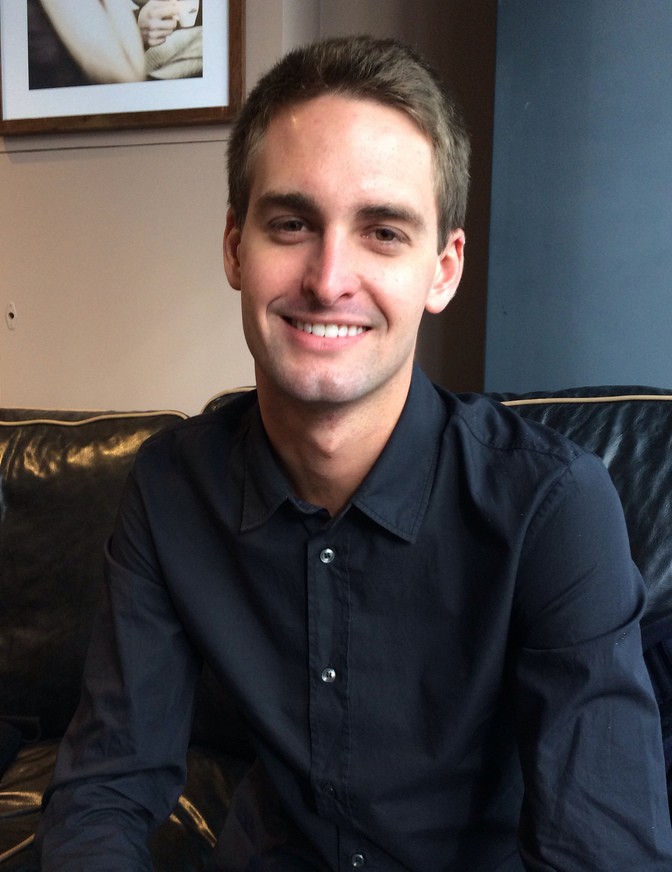
born Evan Thomas Spiegel
Co-founder and CEO of Snap Inc. (Snapchat) · b. 1990 · Los Angeles, California (Pacific Palisades)
Two calls made by hand, not formulas. how we score →
Summary
Raised in Pacific Palisades by two attorneys, he attended Crossroads School and Stanford, where a 2011 product-design class project with Bobby Murphy and Reggie Brown became Snapchat.
He declined a roughly $3 billion Facebook offer in 2013. Snap Inc. went public in 2017, making him one of the youngest self-made billionaires, with voting control alongside Murphy.
How it happened
Born Evan Thomas Spiegel on June 4, 1990, in Los Angeles. Both parents, John W. Spiegel and Melissa Ann Thomas, were attorneys, and the family lived in a roughly $2 million house in Pacific Palisades. As a teenager he got a $250-a-week allowance and later talked his parents up to a $2,000 monthly budget by presenting them with a written case for it. His parents divorced not long after his sixteenth birthday, and he spent his senior year of high school living with his father.
He attended Crossroads School for Arts and Sciences, an expensive private school in Santa Monica, then enrolled at Stanford in the product design program, an interdisciplinary engineering major, and joined the Kappa Sigma fraternity. In April 2011 he pitched an app for disappearing photos as a class project.
He built the prototype that spring and summer with two Stanford classmates, Bobby Murphy and Reggie Brown, working out of his father's Pacific Palisades living room. They called it Picaboo, then renamed it Snapchat that fall. The app reached 100,000 users by the following April. His father's house served as the company's office for most of the unpaid build phase, so the wealthy family safety net wasn't background to the founding: it was the founding's literal address.
In May 2012, Lightspeed Venture Partners became the company's first outside investor, putting in a $485,000 seed round after partner Jeremy Liew heard about the app from his teenage daughter, who told him it was one of only three apps her high school friends actually used.
Brown, who said he had come up with the original concept, the mascot, and the name, was pushed out; Spiegel and Murphy described him as an unpaid intern rather than a co-founder. He sued both of them in February 2013. The parties settled in September 2014 on confidential terms that Snap's 2017 IPO prospectus later disclosed as roughly $157.5 million; as part of the deal, the company credited Brown with the original conceptual idea for Snapchat. Neither co-founder admitted wrongdoing.
By late 2013, multiple companies were trying to buy Snapchat outright. Facebook offered roughly $3 billion; Spiegel turned it down, saying trading the app for a short-term payout wasn't interesting to him. Google reportedly floated an even larger offer around the same time.
Gawker published emails from his Stanford fraternity days containing misogynistic and homophobic content. Spiegel apologized, calling them "idiotic" and saying they didn't reflect who he was or his views toward women.
By 2015, with Snapchat's valuation climbing through successive private funding rounds, Forbes counted him as the youngest self-made billionaire in the world, at 24 or 25 depending on the valuation snapshot used.
Snap Inc. went public on the New York Stock Exchange on March 2, 2017, pricing at a nearly $24 billion valuation. The offering used three share classes: Class A shares sold to the public carried no vote at all, while Spiegel and Murphy held Class C super-voting shares giving them combined control of more than 70% of the vote on a combined economic stake of roughly 45%. Tied to the IPO, Spiegel received a restricted stock award that vested immediately and was worth about $636.6 million, on top of a $98,078 salary — a total package Snap's own proxy statement put at roughly $638 million for 2017. He married the model Miranda Kerr that May.
Snap's stock fell sharply after a disappointing 2017 earnings report, and a shareholder class action alleging the company had misled investors about competitive pressure from Instagram's Stories feature around the IPO ended in 2019 with Snap and its underwriters paying a $187.5 million settlement; no personal claim against Spiegel is documented as having been separately adjudicated. He and Murphy have since sold and been diluted down to a combined stake Forbes puts at just over 20% of the company, while keeping voting control through the same share structure. Forbes estimated his net worth at about $2.28 billion as of September 2026, against a stock that has traded well below its IPO price for most of the years since.
The coded evidence
Thirteen groups, every claim sourcedMulti-generational American; no recent immigration documented in the family line.
Inferred from absence of evidence, not directly documented.
↗ en.wikipedia.org0
No documented gap out of work between the 2011 founding and the present; he left Stanford without finishing his degree in 2012 and completed the remaining credits part-time, graduating in 2018.
↗ en.wikipedia.orgA wealthy two-parent household in Pacific Palisades, and after his parents' divorced, his father's home there — the same house that functioned as Snapchat's unpaid-phase office through most of 2011 and 2012. He never had to secure separate housing to build the company.
↗ scmp.comNo personal income during the unpaid 2011-2012 build phase; free housing and prior family financial support covered living costs until Lightspeed's $485,000 seed check arrived in May 2012.
↗ slate.comnot established
No dependents are documented during the founding years; his children were born after 2017.
↗ en.wikipedia.orgnot established
No debt is documented for his Crossroads or Stanford years; his private education was family-funded.
↗ en.wikipedia.orgnot established
No homelessness, food insecurity, or comparable instability is documented at any point.
↗ en.wikipedia.orgnot established
No period of visible austerity, chosen or imposed, is documented; the founding took place inside a family home with no financial strain.
↗ en.wikipedia.orgFather John W. Spiegel and mother Melissa Ann Thomas, both attorneys.
↗ en.wikipedia.orgnot established
Not clearly established whether either parent practiced as a firm partner, associate, or independent attorney.
↗ en.wikipedia.orgnot established
Not directly documented, though both parents' legal careers imply law degrees at minimum.
↗ en.wikipedia.orgCrossroads School for Arts and Sciences, the private school he attended, costs tens of thousands of dollars a year; the family paid it without any documented sacrifice or strain.
↗ scmp.comAround age 16, following his parents' divorce, his primary residence shifted to his father for his senior year of high school. A change of household, not a hardship event, inside an otherwise stable, wealthy upbringing.
↗ scmp.comPacific Palisades, an affluent Los Angeles neighborhood.
↗ scmp.comCrossroads School for Arts and Sciences, a private school in Santa Monica, then Stanford University's product design program.
↗ en.wikipedia.orgLos Angeles offered legal and entertainment-industry proximity through his parents' world, not a technology cluster; Stanford supplied direct entry into Silicon Valley's startup and venture-capital circles once he enrolled.
↗ en.wikipedia.orgLos Angeles to Stanford for college in 2008; after leaving Stanford in 2012 he built the company from his father's house in Pacific Palisades before Snap Inc. eventually set up its own offices in the Los Angeles area rather than the Bay Area.
↗ en.wikipedia.orgBobby Murphy, a fellow Stanford student, supplied the technical execution the product-design concept needed and became CTO; no outside sponsor or institution opened the door beyond Stanford itself.
↗ en.wikipedia.orgCold, direct-to-consumer distribution through Apple's App Store, spreading first among high-school and college users.
↗ en.wikipedia.orgBobby Murphy, a Stanford computer science graduate, became CTO and remains a co-founder. Reggie Brown, a third Stanford classmate, worked on the original concept and branding before being pushed out and later suing the other two.
↗ en.wikipedia.org20
He pitched the disappearing-photo concept as a Stanford class project in April 2011, before turning 21 that June.
↗ en.wikipedia.org0
He went directly from being a Stanford student to building Snapchat full time; no prior employer.
↗ en.wikipedia.orgStanford's product design program, a selective interdisciplinary major combining engineering and design coursework, where the class project that became Snapchat originated.
↗ en.wikipedia.orgB.S., product design, Stanford University. He left in 2012 without finishing, then completed the remaining coursework part time and graduated in 2018.
↗ en.wikipedia.orgDirect path from an elite private secondary school to a selective research university, family-funded throughout, degree eventually completed after a six-year gap.
↗ en.wikipedia.orgStanford's product design program supplied both the class-project origin of Snapchat and the co-founders who built it — Bobby Murphy and, initially, Reggie Brown were both Stanford classmates.
↗ en.wikipedia.orgA $485,000 seed round from Lightspeed Venture Partners, closed in May 2012, roughly a year after the app launched with no outside money at all.
↗ slate.comNo direct cash investment into the company is documented, but free housing and continued family support covered his living costs through the entire unpaid 2011-2012 build phase.
↗ scmp.comnot established
Not documented; his parents are, as of the sources reviewed, still living.
↗ en.wikipedia.orgIt needed capital up front, before it earned anything.
Snapchat was free with no monetization at launch and for years afterward, funded entirely by venture capital rather than revenue.
↗ en.wikipedia.org$485,000 seed from Lightspeed Venture Partners (May 2012), followed by rapid successive private rounds through 2013-2016 that raised the company's valuation from the low hundreds of millions to tens of billions of dollars, ahead of the March 2017 IPO's nearly $24 billion valuation.
Exact intermediate round sizes and dates between 2012 and 2016 are not fully itemized in sources reviewed.
↗ en.wikipedia.orgAt the March 2017 IPO, Snap sold Class A shares to the public with no voting rights at all, while Spiegel and Murphy held Class C super-voting shares. Combined, the two founders controlled more than 70% of the vote on roughly 45% of the economic equity; by 2026, Forbes put their combined economic stake at just over 20%, with voting control preserved through the same structure.
↗ en.wikipedia.orgHe has remained CEO and majority-voting founder rather than cashing out; his 2017 IPO-tied RSU award and subsequent compensation and stock sales have been held largely as an ongoing position in Snap rather than converted into a diversified fortune.
↗ techcrunch.comA Stanford product design class project in April 2011, built around the idea that photos didn't need to be permanent to be worth sharing.
↗ en.wikipedia.orgThe no-vote Class A share class, unprecedented for a US IPO at the time, let Spiegel keep full voting command of Snap while raising billions from public shareholders who had no say at all in the company's direction — control engineered independently of economic ownership, negotiated from a position of leverage most founders never reach.
↗ en.wikipedia.orgHis family absorbed the cost of the unpaid 2011-2012 build phase through free housing; Lightspeed and later venture investors absorbed the financial risk from May 2012 onward.
↗ slate.comLaunched three years after the App Store opened, as smartphone cameras had become ubiquitous and a backlash against permanent, curated photo-sharing on Facebook was building. Spiegel later described the app's aim as capturing "the full range of human emotion — not just what appears to be pretty or perfect," against what he called the "emergency detagging" of Facebook photos before a job interview.
↗ en.wikipedia.orgPalo Alto and Pacific Palisades, California.
↗ en.wikipedia.orgBuilt from a class project rather than acquired.
↗ en.wikipedia.org15
From the 2011 founding through the September 2026 net-worth figure used here, run continuously as CEO of the same company.
↗ forbes.comSnap built and has kept its headquarters in the Los Angeles area rather than relocating to Silicon Valley, a deliberate distance from the industry's usual cluster.
↗ en.wikipedia.orgConsumer technology and social media (Snap Inc./Snapchat)
↗ en.wikipedia.org2277000000
Forbes real-time tracker, as of September 21, 2026, ranked around #1,826 globally. Snap's stock has been volatile since the 2017 IPO and has traded well below its IPO-day valuation for most of the years since, so this figure should be read as a band snapshot, not a stable number.
↗ forbes.comJournalistic estimate
↗ forbes.com2026
↗ forbes.com638000000
2017 total compensation per Snap's proxy statement: a $98,078 base salary, a restricted stock award tied to the IPO worth about $636.6 million that vested immediately, and just over $1 million in other benefits.
↗ techcrunch.comProxy statement
↗ techcrunch.comLargely a held, appreciating (and, at times, sharply depreciating) position in Snap Class A and Class C stock rather than a cashed-out fortune; he has made periodic stock sales but has kept voting control and the CEO role rather than exiting.
↗ forbes.comWealth is almost entirely Snap equity and equity compensation; his cash salary has stayed nominal (under $100,000 in 2017) relative to the stock awards that make up nearly all of his reported net worth.
↗ techcrunch.comNamed to Time's 100 most influential people in 2014 and 2017. Snap Foundation, which he and Murphy created in 2017, has pledged over 13 million Class A shares over 15-20 years toward arts, education, and youth causes.
↗ en.wikipedia.org6
From the April 2011 founding to the March 2017 IPO, the event that crystallized his billionaire status and formal voting control.
↗ en.wikipedia.orgUncapped
↗ en.wikipedia.orgFollowing a 2017 shareholder lawsuit alleging Snap had understated the competitive threat from Instagram's Stories feature around the IPO, both the Justice Department and the SEC issued subpoenas to the company. No personal charge or finding against Spiegel is documented in sources reviewed.
↗ abcnews.go.comA securities class action alleging Snap and certain executives and directors made materially misleading statements around the March 2017 IPO was settled in 2019, with Snap, named individuals, and the IPO's underwriters paying a combined $187.5 million. The settlement involved no admission of wrongdoing.
↗ blockleviton.comReggie Brown, who said he originated Snapchat's concept, mascot, and name, sued Spiegel and Murphy in February 2013 after being pushed out and characterized by them as an unpaid intern. The parties settled in September 2014; Snap's 2017 IPO prospectus later disclosed the settlement amount as roughly $157.5 million, and Brown was credited with the original conceptual idea for Snapchat as part of the deal. Neither side admitted wrongdoing.
↗ en.wikipedia.orgIn 2014, Gawker published emails from his Stanford fraternity days containing misogynistic and homophobic content. Spiegel did not dispute authorship and apologized publicly, calling the emails "idiotic" and saying they didn't reflect who he was or his views toward women.
↗ en.wikipedia.orgBefore
The fraternity emails date to before Snapchat's founding, though they were leaked and became public in 2014, after he was already wealthy and well known.
↗ en.wikipedia.orgIncidental
The securities litigation and the founder dispute both concern conduct around a valuation and a company that had already been built; neither is documented as having produced the underlying product or user growth that created the advantage.
↗ en.wikipedia.orgCivil wrong
↗ blockleviton.comFine absorbed
Both the securities settlement and the Reggie Brown settlement were paid by the company (and, in the securities case, jointly with underwriters); no personal fine, liability, or criminal consequence for Spiegel is documented in either matter.
↗ blockleviton.comvisionary, design-focused product founder, guarded and media-averse, rarely gives interviews, tightly protective of company control and narrative
↗ en.wikipedia.orgPress
↗ en.wikipedia.org4
Wikipedia's sourcing, Forbes' ongoing profile, the SCMP feature, and the TechCrunch/proxy-statement compensation reporting are among the independently sourced accounts reviewed here.
↗ en.wikipedia.orgBefore
His reputation as a design-driven, unconventional founder was established by the 2013-2015 period, before the 2017 IPO crystallized his wealth.
↗ en.wikipedia.orgAsset
The visionary-founder framing has helped him keep investor and board tolerance for the no-vote share structure and for a volatile stock, even through the 2019 securities settlement and years of share-price underperformance.
↗ en.wikipedia.orgThe reputation accrued from behaviour rather than being manufactured.
He is notably private and avoids the books-and-podcast-circuit self-promotion common among peer founders; public perception reads as accrued from company performance and occasional controversy rather than deliberately constructed.
↗ en.wikipedia.orgnot established
No major film, book, or dramatization of Spiegel's story comparable to those made about some other founders in this dataset is documented.
↗ en.wikipedia.orgHis reputation absorbed the 2014 fraternity-email leak, which he apologized for, without lasting damage; he has remained CEO throughout, and the episode is treated in later coverage as a settled controversy rather than an ongoing liability.
↗ en.wikipedia.orgStructural context
The cost-of-failure score comes from this person's own money and circumstances. But who they were in America carried its own weight, the same way their household or income did, and it shaped how hard the path was just as much. That part isn't in the cost-of-failure number. It's here instead.
Men founded the companies that took nearly all the venture funding and almost every top outcome, a tailwind that never shows up in one person's own circumstances.
↗ techcrunch.comWhite founders are heavily overrepresented among funded companies and top-tier wealth relative to their share of the population, an edge that has nothing to do with a person's own money.
↗ techcrunch.comAmong the people recorded here — men: 169 · White subjects: 114. Representation here is who reached these outcomes, not equal odds of reaching them.
Controlled comparisons
Each holds one thing constant and varies another, so the difference is the point. A list of similar names wouldn't tell you anything.