Jay-Z
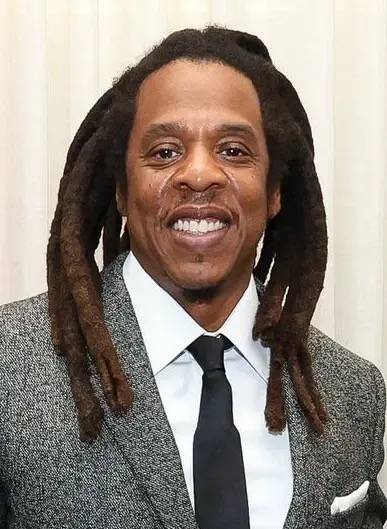
born Shawn Corey Carter
Artist and founder, Roc Nation (Jay-Z) · b. 1969 · Brooklyn, New York
Two calls made by hand, not formulas. how we score →
Summary
Every major label passed on him, so he and two friends started their own and sold the CDs out of a car.
By his own account, the seed money came from selling crack as a young teenager in the Marcy Houses. He then spent three decades running the same play: trading recognition for an ownership stake in clothing, liquor, streaming, and sports representation instead of taking a fee.
How it happened
Shawn Carter grew up in the Marcy Houses, a large public housing complex in Bedford-Stuyvesant, Brooklyn. His mother, Gloria Carter, worked as a clerk and raised four children largely alone after his father left when Shawn was around eleven or twelve. By his own account, he began selling crack in his early teens.
He went to every label he could find and, in his words, they thought he was terrible. Rather than keep asking, he and two friends, Damon Dash and Kareem "Biggs" Burke, put up their own money to press his debut album and founded Roc-A-Fella Records. He sold the CDs himself out of the trunk of his car at colleges that weren't paying much attention.
In 1997, rather than sign to a major label as an artist, Roc-A-Fella sold Def Jam half the company for a reported $1.5 million and kept the other half. He later ran Def Jam itself, and eventually the label and its catalog came fully back under his control.
From there it was the same move repeated: turn recognition into an equity stake rather than a check. A clothing line, a champagne house, a cognac brand, a streaming service, a sports agency. He sold pieces of several of them later for hundreds of millions and, in the case of the cognac, close to a billion.
Forbes puts his fortune in the billions, and by its own accounting less than a twentieth of it traces back to music royalties; most of it sits in the liquor brands and other companies he took ownership in. The habit of insisting on equity is the part that travels. The illegal seed money and the rest of it are not something to copy.
The coded evidence
Thirteen groups, every claim sourcedNo safety net beyond the Marcy Houses apartment his mother rented. Public housing was the family's base, not a cushion he could fall back to if the music didn't work — it was already the floor.
↗ notablebiographies.comThe hardship was imposed, not chosen. There was nothing to fall back on.
Imposed by circumstance, not chosen.
↗ notablebiographies.comMother Gloria Carter worked as a clerk and raised four children largely on her own. Father Adnis Reeves left the household when Shawn was around eleven or twelve; Carter has said that was "the end of our relationship" until they reconciled shortly before his father's death in 2003.
↗ notablebiographies.comThe Marcy Houses, a roughly 1,700-unit public housing complex in Bedford-Stuyvesant, Brooklyn.
↗ biography.comAttended George Westinghouse Career and Technical Education High School in Brooklyn alongside the future Notorious B.I.G. and Busta Rhymes in the same years — a concentration of future major artists in one building that cost nothing to access.
↗ capitalxtra.comHas said he went to every record label and they all called him terrible. Instead of continuing to ask, he and two friends financed and released his debut themselves through the label they founded.
↗ grammy.comBefore any distribution deal existed, he sold Reasonable Doubt himself out of the trunk of his car at sparsely attended college campuses — a channel he controlled outright before a label was involved at all.
↗ grammy.comHis first mentor was the older Marcy rapper Jaz-O, who taught him craft off the corner rather than on it. The two formed a short-lived group, High Potent, and released material together starting in 1986, years before Jay-Z went solo.
↗ ambrosiaforheads.comNo high school diploma and no college. In his own words, "I don't have a high school diploma or a college diploma."
↗ nickiswift.comStreet earnings, by his own account, financed the pressing and promotion of his debut album after every label passed.
↗ grammy.comProceeds from the Rocawear sale and the Def Jam years were redeployed into the next round of ownership stakes rather than spent; by Forbes' own accounting his liquor brands, not music, now account for most of his fortune.
↗ forbes.comKept half of Roc-A-Fella when it entered a joint venture with Def Jam in 1997 rather than signing away the label outright, and later structured deals across clothing, spirits, and streaming that gave him an equity stake rather than only a fee.
↗ labusinessjournal.comnot established
No conventional safety net existed to convert. See originCapital — the starting capital came from the informal economy, not from liquidating savings or credit.
↗ notablebiographies.comHas said on the record for more than a decade, in interviews, in the memoir "Decoded," and in his own lyrics, that he sold crack as a young teenager in the Marcy Houses, and has tied that period directly to the money that got his music career started.
Self-admitted only, never inferred and never from allegation. Not presented here as a strategy: the visible cases like this one are a small fraction of the people who did the same thing at the same time, and the overwhelming majority acquired a record that, per D3, closes off lending, licensing, and housing for good. The database holds the survivor and none of the statistically identical people who didn't survive it. What's notable isn't the conduct, which was common. It's that the consequence borne was close to zero for him.
↗ thedailybeast.com4
Apparel (Rocawear, sold to Iconix in 2007 for $204M), spirits (Armand de Brignac and D'Ussé), streaming (Tidal, majority stake sold to Square in 2021 for $297M), and sports representation (Roc Nation Sports, founded 2013). Individual deals sourced under their own fields.
↗ forbes.comnot established
No separate failed venture is documented before Roc-A-Fella. The repeated label rejection is coded under gatekeeperBypass (D5) rather than as a venture failure.
↗ grammy.comHe and his two co-founders self-financed Roc-A-Fella's first pressing after every label they approached passed.
↗ grammy.comReleased as hip-hop was becoming a dominant, mainstream commercial force in American music rather than a niche genre.
↗ grammy.comBuilt. Founded his own label, financed the debut himself, and promoted it directly after being turned down everywhere else.
↗ grammy.comMusic and business
↗ biography.comJournalistic estimate
↗ forbes.com2026
↗ forbes.comWealth built almost entirely from owned equity stakes in spirits, apparel, and streaming rather than from music income. Forbes has put music at well under a tenth of his current fortune.
↗ forbes.comUncapped
↗ forbes.comPleaded guilty in October 2001 to a misdemeanor assault charge for stabbing record producer Lance Rivera at a Manhattan club on December 1, 1999; sentenced to three years' probation.
↗ deseret.comHas repeatedly described, across interviews, his memoir, and his own songs, selling crack cocaine as a young teenager in the Marcy Houses.
↗ thedailybeast.comBefore
↗ thedailybeast.comProduced the advantage
By his own account, this money is what funded his entry into music.
↗ thedailybeast.comCrime
↗ thedailybeast.comNone
No arrest or conviction tied to this period is documented. Read against the criminalProceedings field above, this is the same person absorbing zero consequence for one act and a real conviction for another — worth holding side by side, not averaging.
↗ thedailybeast.comBusiness minded, Calculating, Self made, Street credible
↗ forbes.comPublic
↗ forbes.comBefore
The street reputation predates the music career and later became part of the public narrative around it.
↗ thedailybeast.comAsset
↗ forbes.comStructural context
The cost-of-failure score comes from this person's own money and circumstances. But who they were in America carried its own weight, the same way their household or income did, and it shaped how hard the path was just as much. That part isn't in the cost-of-failure number. It's here instead.
Men hold most of the ownership and gatekeeping across the creative and media industries, the default that recognition and deals flow toward.
↗ assets.uscannenberg.orgIn the creative and media industries, recognition comes far more easily to underrepresented creators than the ownership it should turn into. Among 2023's top-grossing film directors, for one measure, eight were Black.
↗ assets.uscannenberg.orgAmong the people recorded here — men: 115 · Black subjects: 58. Representation here is who reached these outcomes, not equal odds of reaching them.
Controlled comparisons
Each holds one thing constant and varies another, so the difference is the point. A list of similar names wouldn't tell you anything.