Li Ka-shing
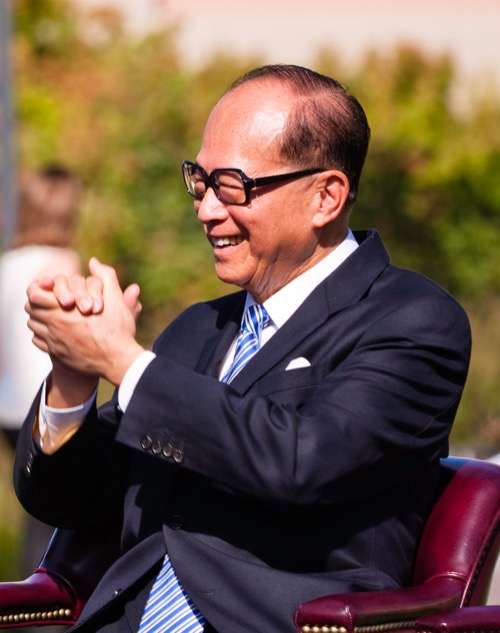
Founder, Cheung Kong Industries; former Chairman, CK Hutchison Holdings · b. 1928 · Chao'an, Chaozhou, Guangdong, China → Hong Kong
Two calls made by hand, not formulas. how we score →
Summary
A refugee at twelve, he lost his father to tuberculosis three years later and left school for a factory job an uncle arranged at his small Hong Kong watch-strap firm.
He bootstrapped a plastics company on savings and a family loan, then spent seven decades compounding real estate and acquisitions, including the first Chinese-run stake in an old British trading house, into a global conglomerate.
How it happened
He was twelve when the Japanese invasion pushed his family out of Chaozhou and into Hong Kong as refugees in 1940. His father, a school principal, died of tuberculosis about three years later. At fifteen Li left school for good.
A maternal uncle, Zhuang Jing'an, had already built a watch-strap trading firm in Hong Kong before the family arrived, and put the young Li to work there, then later at a plastics trading company where he sold goods sixteen hours a day. Li went on to marry the uncle's daughter, his first cousin, in 1962.
In 1950, at twenty-one, he started Cheung Kong Industries on his own savings plus money borrowed from relatives, and taught himself to mold plastic flowers from trade magazines. Within years he was Asia's largest supplier of them.
He bought his own factory site in 1958 rather than keep renting, then bought land cheaply from residents fleeing the 1967 riots, betting correctly that the panic driving prices down would pass. Cheung Kong Holdings went public on the Hong Kong exchange in 1972, oversubscribed more than sixty-five times.
In 1979 he bought a controlling stake in Hutchison Whampoa, one of Hong Kong's old British trading houses, from HSBC, becoming the first ethnic-Chinese businessman to control one. Over the next four decades the group traded ports, retail, telecom, and infrastructure in and out of the portfolio, including a 1999 sale of its Orange stake to Mannesmann for roughly $15 billion in profit.
He retired as chairman in 2018 after almost seventy years, handing control to his son Victor, and stayed on as senior advisor. Forbes puts his fortune near $49 billion. His foundation has given away more than HK$30 billion, about 80 percent of it inside mainland China and Hong Kong.
The coded evidence
Thirteen groups, every claim sourcedWikipedia describes his parents as Teochew, from the Chaoshan region of Guangdong.
↗ en.wikipedia.orgFirst generation. Arrived in Hong Kong from mainland China as a wartime refugee in 1940 at age 12.
↗ en.wikipedia.orgnot established
He is documented as a practicing Buddhist in adulthood, including funding a large monastery. What, if anything, he was raised in as a child in Chaozhou is not established in the sources reviewed.
↗ en.wikipedia.orgTeochew dialect, with Cantonese acquired after the family reached Hong Kong.
Inferred from the family's documented Teochew origin and Hong Kong's dominant Cantonese; not explicitly stated in any source reviewed.
↗ en.wikipedia.orgA maternal uncle, Zhuang Jing'an, was already established in Hong Kong running a watch-strap trading firm and took the family in on arrival, giving Li his first job. Beyond that, the family had no property or savings to fall back on.
Corroborated by the uncle's own biographical record on Baidu Baike.
↗ talkativeman.comHis own wages as a teenage plastics salesman, saved over several years, plus money borrowed from relatives, funded the 1950 founding. No family wealth existed as a backstop once that was committed.
↗ referenceforbusiness.comWas sending money home while building, so support flowed outward, not in.
He went to work at 12 specifically to help cover his family's rent after they fled to Hong Kong.
↗ talkativeman.comnot established
No personal debt is documented at the time of founding. Not established.
↗ en.wikipedia.orgnot established
No housing instability is documented specifically during the 1950 founding, by which point he had several years of wage employment behind him. The acute instability was earlier, in the 1940-43 refugee and bereavement years; see d3 and d4.
↗ en.wikipedia.orgThe hardship was chosen. There was a home to go back to if it failed.
Refers specifically to the founding years, not his childhood. As a young adult building the company he has said he skipped movies and shaved his head to stretch time between haircuts, a chosen austerity layered on top of the imposed poverty of his refugee childhood.
↗ talkativeman.comFather, Li Yun-ching, was a school principal in Chaozhou. Mother, Cheung Bik-chin, is not documented as having worked outside the home before the family fled.
↗ en.wikipedia.orgNeither parent was self-employed.
A school principal was a salaried, institutional role, not self-employment.
↗ en.wikipedia.orgnot established
Secondary profiles commonly describe younger siblings he helped support after his father's death, but an exact count is not established in the sources reviewed.
↗ en.wikipedia.orgA maternal uncle, Zhuang Jing'an (also transliterated Cheung Jing-on), had emigrated to Hong Kong in the 1930s and founded a watch-strap trading company there before the war. The family's flight in 1940 landed them inside that existing network.
Source is a translated Chinese-language tertiary biography of the uncle; treated as medium confidence.
↗ baike.baidu.comWent to work at 12 to help cover the family's rent, then became a primary earner after his father's death around age 15, supporting his mother and younger siblings.
↗ talkativeman.comRefugee flight from Chaozhou to Hong Kong in 1940, fleeing the Japanese invasion during the Second Sino-Japanese War.
↗ en.wikipedia.orgHis father, Li Yun-ching (1898-1943), died of tuberculosis roughly three years after the family reached Hong Kong, when Li was about 15, forcing him to leave school.
↗ en.wikipedia.orgChao'an, Chaozhou, Guangdong province, then wartime refugee housing in Hong Kong from 1940.
↗ en.wikipedia.orgLocal schooling in Chaozhou until forced to leave at 15; no further formal education of any kind.
↗ en.wikipedia.orgOne international move, Chaozhou to Hong Kong in 1940, fleeing the Japanese invasion.
↗ en.wikipedia.orgHis father held a respected, literate profession, running a school in Chaozhou. The family arrived in Hong Kong with nothing, and within three years a teenage Li was the household's main earner.
↗ referenceforbusiness.comA maternal uncle already established in Hong Kong, Zhuang Jing'an, running a watch-strap trading company, took the family in and gave the young Li his first job.
↗ baike.baidu.comThe Chaozhou/Teochew (Chaoshan) diaspora in Hong Kong, the same community his uncle later led as founding president of the Hong Kong Chao'an Fellow Townsmen Association.
↗ baike.baidu.comHis maternal uncle, Zhuang Jing'an, who ran a Hong Kong watch-strap trading firm and later became his father-in-law, gave him his first job on arrival as a refugee.
↗ baike.baidu.comA large foreign buyer visited his retooled plastics shop and placed a major order not long after founding, credited in company histories with launching the plastic-flower business.
↗ en.wikipedia.orgnot established
No co-founder is documented; Cheung Kong Industries was founded by Li alone.
↗ en.wikipedia.org12
Age he joined his uncle's watch-strap firm. He moved into the plastics trade as a teenage salesman some years later, before founding his own plastics company at 21.
↗ talkativeman.com10
Computed from age 12 (first paid work, 1940) to age 21-22 (Cheung Kong founding, 1950).
↗ en.wikipedia.orgWorked from about age 12 at his uncle's watch-strap company, then for a plastics trading firm as a salesman working 16-hour days, before founding his own plastics company at 21.
↗ en.wikipedia.orgAdvised Deng Xiaoping's government during the Sino-British talks that produced the 1984 Joint Declaration on Hong Kong's future, and served on the committee that drafted Hong Kong's Basic Law. Later reported to speak directly with Chinese presidents and premiers.
↗ referenceforbusiness.com2
His uncle's watch-strap firm, then a plastics trading company, before founding his own business.
↗ talkativeman.comNo credential beyond early secondary schooling. Left school at 15 after his father's death and never returned.
↗ en.wikipedia.orgPersonal savings from years of wages as a plastics salesman, reported around $6,500, plus money borrowed from relatives, funded Cheung Kong Industries' 1950 founding.
The exact currency and era-adjusted value of the "$6,500" figure varies by retelling; treated as approximate.
↗ forbes.comMoney borrowed from relatives supplemented his own savings to start the company in 1950.
↗ en.wikipedia.orgnot established
His father died of tuberculosis with no documented estate; the opposite of a financial inheritance.
↗ en.wikipedia.orgIt paid its own way from the start. Revenue came before any outside money.
↗ en.wikipedia.orgYears of wages as a teenage and young-adult salesman were saved and put directly into the 1950 company founding.
↗ forbes.comGrew through reinvested profits and, from 1972, public equity. Cheung Kong Holdings listed on the Hong Kong Stock Exchange with an IPO oversubscribed more than 65 times, giving Li a public capital base that funded the real estate expansion and, later, the Hutchison Whampoa acquisition.
↗ talkativeman.comIn 1979 he used Cheung Kong to buy a controlling stake in Hutchison Whampoa, an old but struggling British trading house, from HSBC, becoming the first ethnic-Chinese businessman to control one of Hong Kong's colonial-era hongs. Over the following four decades the combined group traded ports, retail, telecom, and infrastructure assets in and out of the portfolio, including selling a stake in Orange to Mannesmann in 1999 for roughly $15 billion in profit.
↗ en.wikipedia.orgnot established
His earnings as a preteen and teenager went to keeping the household afloat, not toward capital of his own.
↗ talkativeman.comReinvested proceeds from major asset sales, such as the roughly $15 billion Orange/Mannesmann deal in 1999 and a 2006 ports-stake sale to PSA Corporation for a $3.12 billion profit, back into the conglomerate rather than distributing them.
↗ en.wikipedia.orgBuilt a global portfolio of owned infrastructure: the world's largest private port operator by the mid-2000s, UK and Australian utilities, and retail real estate across dozens of countries.
↗ referenceforbusiness.comSelf-taught. He read trade publications such as Modern Plastics and is said to have engineered his own plastic-molding process using a Coca-Cola bottle and a straw as an injection model.
↗ talkativeman.comBought land cheaply from residents fleeing Hong Kong after the 1967 riots, betting correctly that the political panic driving prices down would pass.
↗ en.wikipedia.org0
No earlier failed ventures are documented; Cheung Kong was his first and only company.
↗ en.wikipedia.orgSelf. His own savings and money borrowed from relatives were on the line, with no family wealth as a backup.
↗ en.wikipedia.org51
The 1979 Hutchison Whampoa acquisition, the point the compounding- vehicle pattern of repeated acquisition and reinvestment began. Distinct from the 1950 founding at 21 (see ageAtEngineStart).
↗ en.wikipedia.orgPost-war Hong Kong's industrial boom fed the plastics years; the 1967 riots crashed property prices just as he had capital to buy; British trading houses grew financially vulnerable heading into the 1970s, letting an outside buyer take control for the first time; and Deng Xiaoping's opening of China after 1978 turned his Hong Kong base into a bridge for mainland investment few competitors could offer.
↗ en.wikipedia.orgHong Kong, then a British colony entering its final decades before the 1997 handover.
↗ en.wikipedia.orgBoth. Built the plastics company from nothing, then grew mainly by buying: land after 1967, Hutchison Whampoa in 1979, Hongkong Electric in 1985, and dozens of assets worldwide after.
↗ en.wikipedia.org68
1950 founding to the 2018 retirement announcement. He continued as senior advisor after, so the practical run is longer.
↗ en.wikipedia.orgDiversified conglomerate spanning real estate, ports, retail, telecommunications, energy, and infrastructure.
↗ en.wikipedia.org49200000000
Forbes real-time tracker figure as of 8 August 2026. Wikipedia's infobox cites a separate Forbes snapshot at $47 billion / rank 42; both are the same real-time index at slightly different moments.
↗ forbes.comJournalistic estimate
↗ forbes.com2026
↗ forbes.comEntirely ownership wealth in controlling stakes across publicly listed and private companies, not salary.
↗ en.wikipedia.orgBuilt the second-largest private philanthropic foundation in the world after the Gates Foundation, and functioned as a financial bridge between Hong Kong capital and mainland China during the Deng Xiaoping reform era.
↗ en.wikipedia.orgUncapped
↗ en.wikipedia.orgAustralia's tax office sought about A$370 million from his infrastructure arm, Cheung Kong Infrastructure, over a dispute tied to two Australian power-network acquisitions; the matter settled in 2015 with no penalty and a partial refund. Separately, UK water utility Northumbrian Water, majority-owned through CK Infrastructure, was fined £240,000 in 2022 for discharging untreated sewage.
↗ en.wikipedia.orgAfter
Both disputes arose decades after the 1950 and 1979 inflections, inside mature, already-large holdings.
↗ en.wikipedia.orgUnrelated
Neither dispute produced the fortune; both are downstream operational matters in businesses acquired long after the rise.
↗ en.wikipedia.orgFine absorbed
Northumbrian Water paid the £240,000 fine directly; the Australian dispute ended with no penalty and a refund.
↗ en.wikipedia.orgFrugal, Disciplined, Calculating, Patient
↗ en.wikipedia.orgPublic
Widely known by the "Superman" nickname in Hong Kong press and public discourse.
↗ en.wikipedia.orgBefore
The frugal, self-made "Superman" reputation predates the 2010s controversies over asset divestment.
↗ en.wikipedia.orgMixed
An asset in Hong Kong business circles for decades; briefly a liability with mainland Chinese state media in 2015.
↗ en.wikipedia.orgThe reputation was deliberately built, through books, press, and PR.
Decades of visible small choices, a cheap watch, plain shoes, the same house for decades, read by some observers as a deliberately maintained image rather than incidental habit.
↗ en.wikipedia.orgCelebrated in Hong Kong business circles and press as the self-made "Superman" of Asia. Targeted in 2015 by Chinese state media as disloyal to the mainland for reweighting assets toward Europe, a campaign that ended abruptly within weeks when official outlets shifted to a neutral tone.
↗ en.wikipedia.orgStructural context
The cost-of-failure score comes from this person's own money and circumstances. But who they were in America carried its own weight, the same way their household or income did, and it shaped how hard the path was just as much. That part isn't in the cost-of-failure number. It's here instead.
Men held about 90% of Fortune 500 CEO seats in 2023, and a wider majority of the rungs below. The ladder is widest for them the whole way up.
↗ forbes.comImmigrants and their children are overrepresented among America's biggest companies, as founders and as senior leaders. They got there through the visa, credential, and network hurdles that make the path harder to even start down.
↗ forbes.comAmong the people recorded here — men: 169 · Asian subjects: 11. Representation here is who reached these outcomes, not equal odds of reaching them.
Controlled comparisons
Each holds one thing constant and varies another, so the difference is the point. A list of similar names wouldn't tell you anything.