Madam C.J. Walker
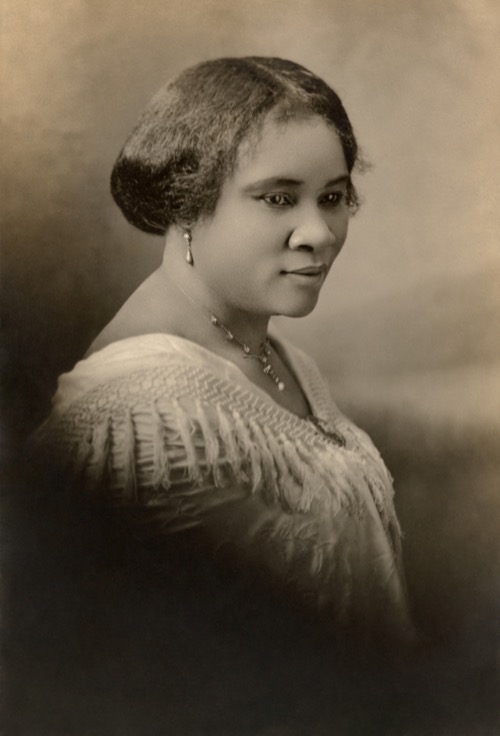
born Sarah Breedlove
Founder, Madam C.J. Walker Manufacturing Company · b. 1867–1919 · Delta, Louisiana
Two calls made by hand, not formulas. how we score →
Summary
She sold hair and scalp treatments to Black women the mainstream industry wouldn't touch, and built a network of trained, commissioned sales agents to move them instead of selling through anyone else's store.
She started with nothing but wage labor and no schooling. The "first self-made millionaire" line gets repeated more than her actual estate figure, a real fortune but a fraction of the legend.
How it happened
Born Sarah Breedlove near Delta, Louisiana, to Owen and Minerva Breedlove, who had been enslaved on the same plantation and were freed just before her birth. Her mother died around 1872 and her father not long after; sources disagree on the exact years. Orphaned by seven, she went to live with her sister Louvenia and brother-in-law in Vicksburg, Mississippi, and worked in the cotton fields and as a domestic servant. She married at fourteen and was a widow with an infant daughter by twenty.
She moved to St. Louis in 1888 because her brothers were already there, and spent close to two decades as a laundress and cook, earning around a dollar and a half a day. Almost all of it went toward keeping her daughter Lelia in school. She learned to read properly as an adult, through a church literacy program, not as a child.
Around 1904 she started losing her hair to a scalp condition, common among women doing manual work without regular access to running water. She began selling products on commission for Annie Malone's Poro Company during the 1904 World's Fair in St. Louis, an event that largely ignored Black attendees and Black consumers alike. That job taught her the direct-sales model before she broke off to sell a formula of her own.
In 1905 she moved to Denver and started her own line under the name Madam C.J. Walker, adopted after she married Charles Joseph Walker, a newspaper ad salesman who helped with branding and promotion before they divorced in 1912. Rather than sell wholesale through drugstores that wouldn't carry a Black-owned hair product anyway, she recruited and trained thousands of women as commissioned "Walker agents," selling door to door and through churches. She owned the distribution end to end, which is the part usually skipped when the story gets told as pure hustle.
By 1910 she had a factory, laboratory, and beauty school in Indianapolis; by 1917 her agents were holding a national convention with cash prizes. She gave to the NAACP's anti-lynching fund, Black colleges, and the Indianapolis YMCA, and built Villa Lewaro, an estate on the Hudson, in 1918. She died the following year at fifty-one. Her estate was reported at $600,000 to $700,000, and Guinness later credited her as the first self-made American woman millionaire. That title is contested by historians who note other Black entrepreneurs of the era whose finances just weren't as well documented, and the estate figure itself, even generously inflation-adjusted, comes to somewhere in the low eight figures today, not the ten-figure fortune the word "millionaire" now implies.
The coded evidence
Thirteen groups, every claim sourcedDescendant
Described in multiple sources as the first of her parents' children born into freedom, shortly after emancipation.
↗ encyclopedia.comHer documented church involvement (St. Paul AME) dates to her adult years in St. Louis; a specific childhood denomination is not established.
↗ encyclopedia.comnot established
After being orphaned she was taken in by her sister and brother-in-law, but that household is also the one she married young to get out of. Not a cushion in any real sense.
↗ madamcjwalker.comLaundress and cook wages of about $1.50 a day in St. Louis, for nearly two decades before she had a business of her own.
↗ encyclopedia.comRepeated relocation for work and opportunity: Louisiana to Mississippi as a child, then St. Louis, Denver, Pittsburgh, and Indianapolis as an adult, all before the business was established enough to be stable.
↗ en.wikipedia.orgThe hardship was imposed, not chosen. There was nothing to fall back on.
↗ encyclopedia.comOwen and Minerva Breedlove, both enslaved until the end of the Civil War on Robert W. Burney's plantation in Madison Parish, Louisiana, then sharecroppers on the same land after emancipation.
↗ en.wikipedia.org5
Described as the fifth of six children; exact birth order varies slightly by source.
↗ encyclopedia.comRaised after her parents' deaths by her older sister Louvenia and brother-in-law Jesse Powell in Vicksburg, Mississippi.
↗ en.wikipedia.orgFirst child in the family born after emancipation; both parents had been enslaved on the plantation where she was born.
↗ en.wikipedia.orgCustody effectively passed to her sister's household after both parents died by the time she was seven. Her biographer describes the brother-in-law's household as a harsh one; she married at fourteen, which multiple sources attribute at least partly to a wish to leave it.
↗ madamcjwalker.comSingle mother from age 20, after her first husband's death, raising her daughter alone while working.
↗ en.wikipedia.orgMultiple childhood and early-adult relocations driven by orphaning, marriage, and the search for work: Louisiana, Vicksburg, St. Louis, Denver.
↗ en.wikipedia.orgMother died around 1872, likely of cholera; father remarried and died roughly a year later. Sources give slightly different years (some say 1874/1875), but she was orphaned by about age seven either way.
Exact years are inconsistent across otherwise reliable sources.
↗ biography.comOrphaned as a child, she married at fourteen — by later accounts partly to leave a hard household — had her only child, Lelia, at about seventeen, and was widowed by her early twenties, left a single mother doing laundry for a living.
Public historical and genealogical record.
↗ en.wikipedia.orgRural, majority-Black Madison Parish, Louisiana, then Vicksburg, Mississippi.
↗ en.wikipedia.orgLouisiana to Vicksburg as a child; Vicksburg to St. Louis in 1888; St. Louis to Denver in 1905; Denver to Pittsburgh in 1908; Pittsburgh to Indianapolis in 1910; Indianapolis to New York in 1916, though operations stayed in Indianapolis.
↗ madamcjwalker.comMoved to St. Louis in 1888 because three of her brothers, barbers, already lived there.
↗ en.wikipedia.orgSt. Paul African Methodist Episcopal Church and the National Association of Colored Women in St. Louis, both of which shaped her later civic and philanthropic direction.
↗ encyclopedia.comThe 1904 St. Louis World's Fair largely ignored Black attendees and Black consumers. She sold hair products there on commission and then built a company on the same insight: an entire market the mainstream industry wasn't serving.
↗ encyclopedia.comAnnie Malone, who hired her as a commission sales agent for the Poro Company around 1904 and, whether she intended to or not, taught her the direct-sales model Walker later ran herself. The two became rivals once Walker started her own line.
↗ en.wikipedia.orgBlack women reached directly through door-to-door visits, churches, and community demonstrations in Denver, not through any existing retail relationship.
↗ encyclopedia.comnot established
No pre-existing customer base; she built the sales-agent network from nothing.
↗ madamcjwalker.comMainstream drugstores and cosmetics distribution largely wouldn't carry Black-owned hair products, so she skipped wholesale retail entirely and sold through her own agents and mail order instead.
↗ encyclopedia.comBuilt and trained a national network of thousands of commissioned "Walker agents," organized into clubs with annual conventions, recruiting bonuses, and sales prizes; by 1917 the company said it had trained close to 20,000 women in total.
↗ encyclopedia.comWorked as a commission sales agent for Annie Malone's Poro Company before founding her own line, which is where she learned the agent-commission distribution model.
↗ en.wikipedia.orgNo formal schooling beyond roughly three months of informal literacy instruction through a church Sunday school; learned to read properly as an adult in St. Louis.
↗ encyclopedia.comnot established
No specific seed-capital figure for the 1905 launch is established in the record; her only funds going in were laundress wages and Poro commissions, not a stated dollar amount.
↗ madamcjwalker.comIt paid its own way from the start. Revenue came before any outside money.
↗ encyclopedia.comNo outside investors at any point. Fully self-funded and family-owned; her daughter A'Lelia became company president after her death.
↗ madamcjwalker.comReinvested profits into manufacturing capacity, the agent-training infrastructure, and real estate rather than drawing them down personally; also gave substantially to Black colleges, the YMCA, and the NAACP's anti-lynching fund while still building the company.
↗ encyclopedia.comOwned her Indianapolis factory, laboratory, and beauty school outright by 1910, and built Villa Lewaro, her Irvington-on-Hudson estate, for about $250,000 in 1918.
↗ en.wikipedia.orgHer own hair loss from a scalp condition common among Black women doing manual labor without regular access to running water. She publicly described the formula as coming to her in a dream, a piece of marketing lore alongside the more prosaic account of refining it while selling Annie Malone's products.
↗ encyclopedia.comRetained full ownership and operating control throughout, unusual for a company of its scale in its era.
↗ madamcjwalker.comnot established
This was her only venture; no separate prior failed businesses are documented.
↗ madamcjwalker.comHerself, entirely, from laundress wages and sales commissions, across roughly two decades before the company existed.
↗ encyclopedia.comDomestic and laundry work, then commission sales for Annie Malone, before her own company was founded.
↗ en.wikipedia.orgPost-Reconstruction Jim Crow segregation, which produced both the exclusion that created her market and the constraint on how she could operate within it; a growing urban Black consumer base and Black press to advertise through.
↗ encyclopedia.comDenver, Colorado
↗ en.wikipedia.orgBuilt the product line, the brand, and the entire distribution network from nothing.
↗ madamcjwalker.comDeliberately relocated headquarters from Denver to Indianapolis in 1910, then a major inland manufacturing and rail center, to scale production and distribution.
↗ encyclopedia.comBeauty and hair care manufacturing
↗ en.wikipedia.org700000
Her biographer A'Lelia Bundles puts the estate at death at $600,000 to $700,000, roughly $8.9M-$10.4M in 2020 dollars by her site's own conversion, higher again by 2026. A separate, looser "over $1 million" figure (personal assets plus business value) is also widely repeated; band only, and well short of a modern nine- or ten-figure fortune.
↗ madamcjwalker.comJournalistic estimate
Biographer's synthesis of probate-era estate reporting, not a primary filing directly reviewed here.
↗ madamcjwalker.comWealth held mostly in a wholly owned private company and real estate (the Indianapolis factory, Villa Lewaro), not liquid cash. Company sales in its final full year exceeded $500,000; that is business revenue, not her personal net worth.
↗ encyclopedia.comWidely credited, via Guinness World Records, as the first self-made American woman millionaire; a title contested by historians who note other wealthy Black entrepreneurs of the era, including her own rival Annie Malone, whose finances are simply less documented. Built the largest Black-owned business of its time and became one of the most visible Black philanthropists in the country.
↗ madamcjwalker.com13
Approximate years from the 1905 founding to widely recognized wealth around 1917-1918; she herself told the New York Times in 1917 she was "not yet a millionaire."
↗ en.wikipedia.orgUncapped
↗ madamcjwalker.comSelf made, Tenacious, Disciplined, Philanthropic
↗ encyclopedia.comPublic
↗ madamcjwalker.comAfter
↗ madamcjwalker.comAsset
↗ madamcjwalker.comThe reputation was deliberately built, through books, press, and PR.
Adopted the "Madam" title deliberately, styled after French beauty industry convention, and used a well-known 1912 speech to frame her own story ("promoted myself into the business of manufacturing").
↗ en.wikipedia.orgPortrayed by Octavia Spencer in the 2020 Netflix series "Self Made." Her business rivalry with Annie Malone, including Malone's public accusation that Walker had stolen her formula, was never resolved in court and remains a live dispute among historians over who deserves credit for pioneering the model.
↗ madamcjwalker.comStructural context
The cost-of-failure score comes from this person's own money and circumstances. But who they were in America carried its own weight, the same way their household or income did, and it shaped how hard the path was just as much. That part isn't in the cost-of-failure number. It's here instead.
Startups founded only by women have drawn about 2% of US venture capital, a share that has barely moved in a decade. Raising money as a woman was harder than any one record shows.
↗ techcrunch.comBlack-founded startups got roughly 0.5% of US venture funding in 2023, while Black Americans are about 14% of the population. That gap holds no matter where a founder personally started.
↗ techcrunch.comAmong the people recorded here — women: 68 · Black subjects: 58. Representation here is who reached these outcomes, not equal odds of reaching them.
Controlled comparisons
Each holds one thing constant and varies another, so the difference is the point. A list of similar names wouldn't tell you anything.