Mark Zuckerberg
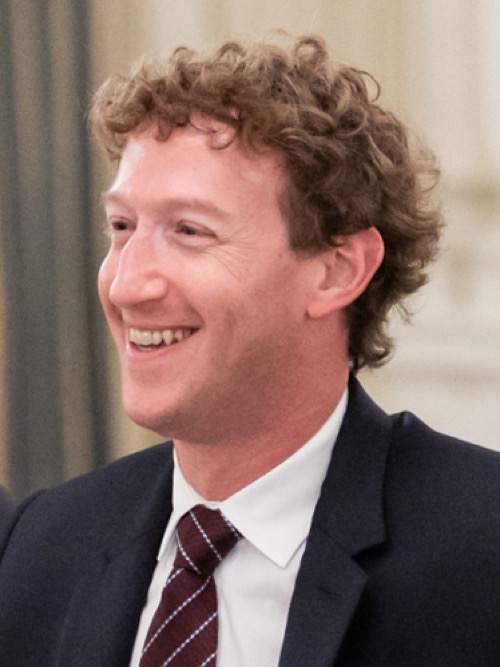
Cofounder and CEO, Meta Platforms · b. 1984 · White Plains, New York
Two calls made by hand, not formulas. how we score →
Summary
A dentist's son from an affluent New York suburb, privately tutored in code, walked into Harvard and got both an elite network and a captive first audience.
He lost almost nothing trying: family absorbed the dropout risk, investors absorbed the failure risk, and later the company absorbed the fines. This is the one record here with its own contemporaneous paper trail.
How it happened
Growing up in Dobbs Ferry, his father, a dentist who ran his own home practice, taught him to program on an Atari, then paid a software developer to tutor him privately once he'd outgrown what dad could teach. He transferred to Phillips Exeter for his last two years of high school, then enrolled at Harvard.
In his sophomore year he built Facemash, a site that ranked Harvard students' looks using ID photos pulled without permission from the university's own directories. The Harvard Crimson covered it while it was happening, and the Administrative Board investigated him for breaching security, copyright, and privacy. It's one of the only times in this file that misconduct was written down as it happened rather than reconstructed years later.
Thefacebook.com launched from his dorm room in February 2004, funded with $1,000 each from him and Eduardo Saverin, then Peter Thiel's $500,000 and a $12.7 million round from Accel a year later. Two disputes followed and both were settled rather than tried: prior collaborators who said he'd taken their idea, and Saverin himself, whose stake was diluted to a sliver before a confidential settlement restored it.
In 2006, at 22, Yahoo offered a billion dollars for the company. His own management team wanted to take it; the board, he's since said, tried to push him out for refusing. He could afford to say no because there was nothing underneath him that a failed company would have taken down with it.
Meta's dual-class shares let him keep roughly 61 percent of the vote on about 13 percent of the equity, so a $5 billion FTC penalty in 2019 landed on the company's balance sheet, not his. The image took longer to fix than the company did. A film he had no part in defined him for most of a decade, and he spent the years after deliberately building a different one.
The coded evidence
Thirteen groups, every claim sourcedStar Wars-themed bar mitzvah at Temple Beth Abraham, Tarrytown NY; Hebrew school; joined a Jewish fraternity at Harvard.
↗ forward.comA dentist father with his own home-based practice and a psychiatrist mother meant a household with no housing or income risk at any point; a Harvard dropout was reversible, not a gamble.
↗ scmp.comThe hardship was imposed, not chosen. There was nothing to fall back on.
No period of chosen or imposed austerity is established anywhere in the record.
↗ scmp.comFather Edward Zuckerberg, a dentist who has run his own general practice in Dobbs Ferry for decades; mother Karen Zuckerberg, a psychiatrist who left clinical practice to help run the office and raise the children.
↗ dentistrytoday.comA parent worked for themselves, the strongest known predictor of founding.
↗ dentistrytoday.comFather trained in dentistry at NYU; mother studied at Brooklyn College before her psychiatric career.
↗ scmp.comnot established
Three sisters are widely reported by name (Randi, Donna, Arielle) but an authoritative primary count/birth-order source wasn't found in this pass; not established to this record's sourcing standard.
↗ scmp.comDobbs Ferry, an affluent Westchester County suburb north of New York City.
↗ scmp.comArdsley High School, then transferred for his last two years to Phillips Exeter Academy, an elite New England boarding school, before Harvard.
↗ ingeniusprep.comThefacebook.com launched restricted to a harvard.edu address; the first users were Harvard undergraduates before it opened to other campuses.
↗ en.wikipedia.orgHarvard College, which supplied a captive, .edu-verified early user base and an elite investor and press network in the same physical place.
Used as a fallback source for this specific launch-mechanics detail after better alternatives (Britannica, AP) returned inaccessible pages.
↗ en.wikipedia.orgCredibility, Network
↗ en.wikipedia.orgFounded with fellow Harvard students Eduardo Saverin, Dustin Moskovitz, Andrew McCollum, and Chris Hughes.
↗ en.wikipedia.org17
By 17 he and a classmate had built Synapse, an MP3 player that learned listening habits; AOL and Microsoft separately pursued buying it, one offering around $950,000 plus a three-year job. He turned both down for Harvard.
↗ thecrimson.comEnrollment at Harvard functioned as instant credibility for the product itself: a stranger's site got no trust, a Harvard-only, real-name network got a real user base within a day of launch.
↗ en.wikipedia.orgHis parents hired software developer David Newman as a private weekly tutor once his father's early programming lessons had run their course; Newman called him a "prodigy."
↗ dawn-ellmore.medium.comAttended Harvard College 2002-2005 studying computer science; left after his sophomore year to run Facebook full-time from Palo Alto. Harvard awarded him an honorary doctorate in 2017.
↗ news.harvard.eduHe and Eduardo Saverin each put in $1,000 to launch thefacebook.com in January 2004.
↗ en.wikipedia.orgPeter Thiel put in $500,000 as the first outside money that summer for roughly a 10% stake; Accel Partners led a $12.7 million Series A in May 2005.
↗ forbes.comPeter Thiel, PayPal's co-founder, arrived as Facebook's first outside investor with operator credibility as well as capital, and other investors followed his signal.
↗ en.wikipedia.orgMeta's dual-class structure gives Zuckerberg's Class B shares ten votes each against one for public Class A shares. As of recent proxy filings he holds about 13% of the company's economic equity but roughly 61% of total shareholder voting power, enough to block any shareholder vote and choose the board unilaterally.
↗ corpgov.law.harvard.edu0
No failed prior venture is established; Synapse was declined-acquisition, not failure.
↗ thecrimson.comTurned down Yahoo's $1 billion offer to buy Facebook in 2006 over the objections of his own management team and board. Several executives left afterward, and he has said the board tried to remove him as CEO for refusing the deal.
↗ finance.yahoo.comLaunched as campus broadband and always-on internet use were becoming standard at American universities and just as MySpace and Friendster were proving social networking had a mainstream audience. Thefacebook.com's Harvard-only, real-name, .edu-verified design was a deliberate contrast to the pseudonymous, all-comers networks already live.
↗ en.wikipedia.orgSocial media and consumer internet
↗ forbes.com203300000000
Real-time estimate that moves daily with Meta's share price; band only, not a filing.
↗ forbes.comJournalistic estimate
↗ forbes.com2026
↗ forbes.comWealth, almost entirely unrealized Meta stock, not compensation. He owns about 13% of the company's economic equity.
↗ forbes.comUncapped
↗ forbes.comThe FTC fined Facebook $5 billion in July 2019, the largest privacy penalty on record at the time, for violating a 2012 consent order over user privacy controls (the Cambridge Analytica matter). Dissenting commissioners Rohit Chopra and Rebecca Slaughter objected that Zuckerberg and other executives got "blanket immunity" without investigation of their personal role.
↗ techcrunch.comCameron and Tyler Winklevoss and Divya Narendra sued him and Facebook in September 2004, alleging he took their HarvardConnection idea, code, and business plan while informally agreed to help build their site. The case settled in February 2008 for $65 million in cash and stock; a later reveal by a mediator put the exact split at $20M cash / $45M stock.
↗ techcrunch.comCo-founder Eduardo Saverin's roughly 30% early stake was diluted to about 0.03% through a 2004-2005 reincorporation and share issuance he sued over, alleging fraud and breach of fiduciary duty. A confidential 2009 settlement restored his stake to an estimated 4-5% and formally reinstated his co-founder title and credit.
Legal-explainer secondary source; underlying facts are widely corroborated but the settlement terms remain confidential.
↗ legalclarity.orgBuilt Facemash in his sophomore year by pulling ID photos without permission from Harvard's House online directories to build a "hot or not" ranking site. He described the ethical problem himself at the time: "Issues about violating people's privacy don't seem to be surmountable." Harvard's Administrative Board investigated him for breaching security, violating copyright, and violating privacy; he was allowed to remain enrolled.
Contemporaneous student-newspaper coverage and university disciplinary record, not a reconstruction after the fact — unusual in this file.
↗ thecrimson.comAfter
Characterizes the FTC penalty specifically, the largest and best- documented consequence in the record. The founding-era conduct (Facemash, ConnectU, Saverin) is coded separately above with its own dates.
↗ techcrunch.comIncidental
The privacy failures didn't produce Facebook's founding advantage; they surfaced years after the platform's dominance was already established.
↗ techcrunch.comCivil wrong
↗ techcrunch.comFine absorbed
$5B penalty paid by the company; no personal liability, and the board order left his voting control and CEO position untouched. The penalty landed on the company, not the person, which is the same shape a hard-landing founder's dispute takes at a far smaller scale.
↗ techcrunch.comDriven, Guarded, Image conscious
↗ fortune.comPublic
↗ fortune.comAfter
The Social Network (2010) formed most of the public's image of him six years after Facebook's 2004 founding.
↗ fortune.comMixed
↗ fortune.comThe reputation was deliberately built, through books, press, and PR.
URL resolves via TechCrunch's redirect for "Mark Zuckerberg Is Now A Dad, Pledges To Give Away 99% Of His Shares" (Dec 1, 2015).
↗ techcrunch.comThe Social Network (2010), which he had no part in making, defined his public image for years. He's pushed back on specific points since, saying at Harvard's 2017 commencement that the film overstated Facemash's importance to Facebook's creation and left out that the same night led him to meet his future wife, Priscilla Chan.
↗ fortune.comAfter the film and the 2016-2019 stretch of election-interference and privacy scandals, he pursued deliberate image repair: a December 2015 pledge to give away 99% of his Facebook shares through the Chan Zuckerberg Initiative, a 2017 personal challenge to visit every US state and meet people outside tech, and repeated congressional testimony framed as accountability.
↗ techcrunch.comStructural context
The cost-of-failure score comes from this person's own money and circumstances. But who they were in America carried its own weight, the same way their household or income did, and it shaped how hard the path was just as much. That part isn't in the cost-of-failure number. It's here instead.
Men founded the companies that took nearly all the venture funding and almost every top outcome, a tailwind that never shows up in one person's own circumstances.
↗ techcrunch.comWhite founders are heavily overrepresented among funded companies and top-tier wealth relative to their share of the population, an edge that has nothing to do with a person's own money.
↗ techcrunch.comAmong the people recorded here — men: 169 · White subjects: 114. Representation here is who reached these outcomes, not equal odds of reaching them.
Controlled comparisons
Each holds one thing constant and varies another, so the difference is the point. A list of similar names wouldn't tell you anything.