Charles Schwab
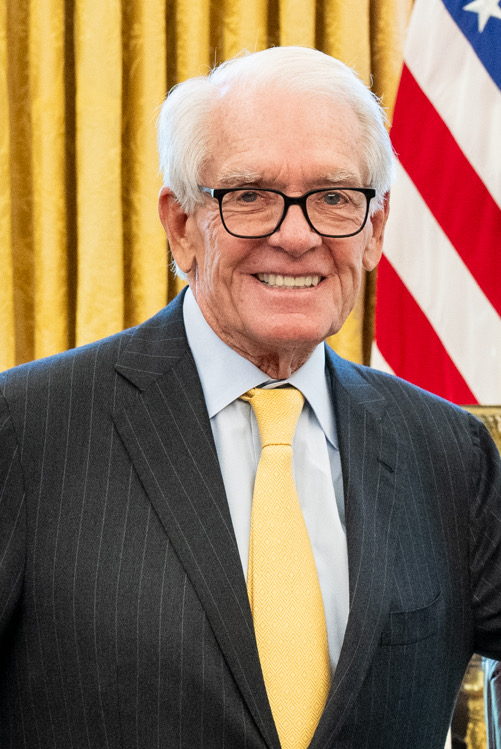
Founder and chairman, The Charles Schwab Corporation · b. 1937 · Sacramento, California
Two calls made by hand, not formulas. how we score →
Summary
Raised comfortably — his father a county district attorney — with a Stanford economics degree and MBA by 24.
He started his brokerage on $100,000 borrowed from an uncle, then in 1975 bet the firm on discount commissions the week fixed-rate pricing ended, opening stock trading to people who'd never had a broker. Undiagnosed dyslexia dogged him through school; he learned the name for it only at 40.
How it happened
Born July 29, 1937, in Sacramento, California, to Terrie and Lloyd Schwab. His father was a lawyer and the district attorney of Yolo County; his mother did not work outside the home. He grew up in Woodland, a farm town in the Sacramento Valley, and moved with his family to Santa Barbara at around age 12. He worked from an early age — selling ice cream, working a railroad switch job, caddying, and doing oilfield labor — and later played golf well enough to captain his high school team.
He has said he struggled with reading and language classes throughout school and college without knowing why, flunking English twice as an undergraduate and failing French outright, while doing well in math and subjects that didn't depend on decoding text on a page. He didn't learn the word "dyslexia" until he was about 40, when one of his sons was diagnosed with it and he recognized his own lifelong experience in the description.
He earned a bachelor's degree in economics from Stanford in 1959 and an MBA from the Stanford Graduate School of Business in 1961. In 1963 he co-founded an investment newsletter, Investment Indicator, which grew to roughly 3,000 subscribers paying $84 a year — his first sustained business and, later, the operating base he folded into a brokerage.
He and a group of associates bought a small existing brokerage shell, First Commander Corporation, incorporating it in California in April 1971; Schwab funded his stake partly with $100,000 borrowed from an uncle. He and his partners bought out the parent company's remaining interest by 1972, and the firm was renamed Charles Schwab & Co. in 1973. It operated as an ordinary full-commission retail brokerage for its first few years.
On May 1, 1975, SEC-mandated fixed brokerage commissions ended, following the Securities Acts Amendments of 1975, and firms were free to set their own rates. Schwab moved immediately: he cut commissions well below what full-service brokers charged, put brokers on salary instead of commission so they had no incentive to churn accounts or push proprietary products, and built a national toll-free order desk. The first discount branch opened in Sacramento that September. The bet was that a large population of investors would trade for themselves once the cost and the sales pressure were both removed, and it proved out: by the mid-1980s the firm had well over a million customers.
Bank of America took a partial stake in the growing brokerage starting in 1981 and acquired the rest by 1983 for roughly $55 million combined, running it as a largely autonomous subsidiary. By 1987, friction with the bank's culture and Bank of America's own financial troubles led Schwab and his management team to buy the company back for $280 million and take it public that September — a rare case of a founder selling his company outright and then repurchasing it before its value compounded much further.
The company built early leads in phone-based and then online discount trading — 24-hour quotes in 1980, 24/7 order entry in 1982, online stock and mutual fund trading in 1996 — and became the largest discount brokerage in the country. Schwab stepped back from day-to-day management in stages, returning briefly as sole CEO in 2004 after co-CEO David Pottruck was removed, then semi-retiring as CEO in 2008 while remaining chairman and the company's largest individual shareholder. The firm today holds client assets in the trillions of dollars.
In January 2011, two Schwab subsidiaries — Charles Schwab Investment Management and Charles Schwab & Co. — settled with the SEC, FINRA, and Illinois securities regulators over the marketing and risk disclosure of the Schwab YieldPlus Fund, an ultra-short bond fund that had suffered large losses in the 2008 mortgage-securities crash. Without admitting or denying the regulators' findings, the subsidiaries agreed to pay roughly $118 million combined toward fund shareholders, on top of a separate $200 million settlement of related civil litigation. Charles Schwab himself was not personally named or charged in the matter.
The coded evidence
Thirteen groups, every claim sourcedDescendant. No immigration event documented in the sources reviewed.
↗ en.wikipedia.orgHe attended Holy Rosary Academy, a Catholic school, in Woodland, and is described as a practicing Catholic as an adult, which together suggest but do not confirm a Catholic upbringing.
↗ en.wikipedia.orgEnglish
↗ en.wikipedia.orgA comfortable, professional two-parent household headed by a working lawyer and county district attorney. No account reviewed suggests the family home was ever at risk, or that Schwab risked losing housing during his twenties and thirties while building the newsletter and then the brokerage.
↗ en.wikipedia.orgnot established
No specific account of a salary, spousal income, or family stipend covering his personal expenses during the 1963-1975 build-up is established in the sources reviewed, though nothing suggests financial distress either.
↗ en.wikipedia.orgnot established
No personal non-dischargeable debt at the time of founding is documented.
↗ en.wikipedia.orgnot established
The brokerage itself operated on thin margins in its early discount years, but no personal housing, health, or food instability for Schwab is documented.
↗ en.wikipedia.orgnot established
No documented period of personal austerity to test against a fallback.
↗ en.wikipedia.orgFather Lloyd Schwab was a lawyer and served as district attorney of Yolo County, California. Mother Terrie Schwab did not work outside the home.
↗ en.wikipedia.orgNeither parent was self-employed.
District attorney is an elected public office, not self-employment; whether his father also held a private legal practice at any point is not established.
↗ en.wikipedia.orgFather held a law degree (unspecified institution). Mother's educational attainment is not established in the sources reviewed.
↗ en.wikipedia.orgnot established
A locally prominent family in a small Central Valley county through his father's legal career and elected office, but no documented multigenerational wealth, named family standing beyond that, or prominent relatives.
↗ en.wikipedia.orgnot established
No account of a parent taking on extra work specifically to fund his schooling is documented.
↗ en.wikipedia.orgSchwab has said on the record, repeatedly and over decades, that he is dyslexic and did not know it as a child — he has described flunking English twice in college and failing French outright while doing well in math, and has said, "I went through life until 40 before I knew about dyslexia," and, describing how he reads, "When I look at the words 'the cat crossed the street,' I have to sound it out to get meaning." He has said he first connected his own lifelong difficulty to the diagnosis when one of his sons was found to be dyslexic around 1989, when Schwab was in his early fifties. As a white man in a professional field, the condition did not carry the compounding misdiagnosis-and-discipline pattern documented for children of color, but it produced real, persistent friction in reading and formal schooling that had nothing to do with the intelligence or numeracy he showed in business.
Corroborated by Wikipedia's account (tracing to a 2003 USA Today profile) and by Schwab's own on-camera interviews for the Charles and Helen Schwab Foundation and other outlets. Age at his son's diagnosis is approximate.
↗ dyslexia.comnot established
No self-disclosed or well-documented survived trauma is established.
↗ en.wikipedia.orgBorn in Sacramento; raised mainly in Woodland, California, a farm town in Yolo County, then in Santa Barbara from around age 12.
↗ en.wikipedia.orgHoly Rosary Academy, a Catholic school in Woodland, followed by Santa Barbara High School, a public school, where he captained the golf team.
↗ en.wikipedia.orgWoodland to Santa Barbara around age 12 with his family; Santa Barbara to Palo Alto for Stanford undergraduate and business school (1955-61, approximately); later based in Sacramento, then the San Francisco Bay Area, for his business career.
↗ en.wikipedia.orgHe is generally described as the founder, though he assembled a group of associates to buy the First Commander Corporation shell in 1971; no single named co-founder with a defined ongoing role is documented.
↗ en.wikipedia.org26
Age when he co-founded the Investment Indicator newsletter in 1963, his first sustained venture in the financial industry.
↗ en.wikipedia.orgnot established
The discount-brokerage pivot exploited a newly opened regulatory window rather than bypassing an incumbent gatekeeper directly; coded separately under d9 regulatory arbitrage.
↗ en.wikipedia.orgMBA, Stanford Graduate School of Business, 1961; BA in economics, Stanford University, 1959.
↗ en.wikipedia.orgnot established
No student debt is documented; a comfortable professional family plausibly covered tuition, but this is not directly confirmed.
↗ en.wikipedia.orgDirect. Public high school to a Stanford undergraduate degree to a Stanford MBA, no transfer or non-traditional route.
↗ en.wikipedia.orgnot established
No specific named introduction or investor connection traced to Stanford is documented, though the degree itself carried general credibility.
↗ en.wikipedia.org$100,000 borrowed from an uncle, put toward his stake in what became Charles Schwab & Co. around its 1971 founding.
↗ forbes.comA loan, not a gift, from an uncle, reported at $100,000, at the company's founding.
↗ forbes.comIt paid its own way from the start. Revenue came before any outside money.
The business grew out of an already-paying newsletter subscription base and, as a brokerage, generated trading commissions from its earliest operations rather than running on investor capital before revenue.
↗ en.wikipedia.orgFounded on personal capital plus a family loan; Bank of America then bought a partial stake starting in 1981 and acquired the company outright by 1983, before Schwab and his management team repurchased it for $280 million in 1987 and took it public later that year. An unusual structure: full ownership was surrendered entirely for several years, then reclaimed before most of the company's value had compounded.
↗ en.wikipedia.orgnot established
↗ en.wikipedia.orgNo dual-class share structure is documented at the public company; his current stake is reported at roughly 5% or more of Charles Schwab Corporation, held as chairman and largest individual shareholder rather than through preserved supermajority voting control.
↗ forbes.com0
No documented failed venture prior to the newsletter or the brokerage; the newsletter business is described as successful and was folded into the later company rather than abandoned.
↗ en.wikipedia.orgnot established
↗ en.wikipedia.org37
Age when fixed commissions ended in May 1975 and he moved to a discount pricing model.
↗ en.wikipedia.orgThe Securities Acts Amendments of 1975 ended SEC-mandated fixed brokerage commissions effective May 1, 1975, opening a regulatory window in which any brokerage could compete on price for the first time; incumbents built around full-service commission revenue were structurally slow to follow.
↗ en.wikipedia.orgThe 1975 commission deregulation was the single opening the discount model depended on; it has not reversed, but it is also a one-time structural shift rather than a recurring window — a founder today cannot re-run the same arbitrage in stock brokerage, though similar one-time deregulations recur in other financial subsectors.
↗ en.wikipedia.orgBuilt. The discount brokerage model and its salaried-broker, toll-free order-desk operations were new to the industry in 1975.
↗ en.wikipedia.org55
1971 founding to 2026, interrupted by the 1983-1987 period of Bank of America ownership; he has remained chairman and a major shareholder throughout the company's public life since 1987.
↗ en.wikipedia.orgDiscount brokerage and retail investment services
↗ en.wikipedia.org15000000000
Forbes real-time net worth estimate, as of August 2026, based primarily on his Charles Schwab Corporation shareholding.
↗ forbes.comPublic equity
↗ forbes.com2026
↗ forbes.comnot established
A specific peak-year proxy-statement compensation figure was not established in the sources reviewed for this profile.
↗ en.wikipedia.orgOverwhelmingly ownership wealth in Charles Schwab Corporation stock, built over more than five decades, rather than income without an equity stake.
↗ forbes.comBuilt the discount brokerage model that reshaped how ordinary Americans buy and sell securities; the company he founded manages client assets reported in the trillions of dollars across tens of millions of accounts. Received the American Academy of Achievement's Golden Plate Award in 1989. Founded, with his wife Helen, the Charles and Helen Schwab Foundation, which funds learning-disability research and school programs.
↗ en.wikipedia.orgUncapped
↗ en.wikipedia.orgIn January 2011, two Schwab subsidiaries — Charles Schwab Investment Management and Charles Schwab & Co. — agreed to pay roughly $118 million combined to settle findings by the SEC, FINRA, and Illinois securities regulators that the firm had made misleading statements about the risk of its Schwab YieldPlus Fund and had not adequately disclosed changes to the fund's investment policy ahead of its 2008 losses; the subsidiaries settled without admitting or denying the findings. A separate $200 million settlement resolved related civil class-action claims. Charles Schwab was not personally named or charged. A 1988 SEC inquiry into possible insider trading by Schwab himself was also reported; no charges resulted.
Corroborated by SEC administrative release 33-9171 and by Wikipedia's account of the 1988 insider-trading inquiry, which cites Ingham and Feldman, Contemporary American Business Leaders.
↗ investorlawyers.comAfter
The YieldPlus matter arose more than three decades after the 1975 discount-pricing pivot that built the company.
↗ investorlawyers.comUnrelated
A single fixed-income fund's marketing and disclosure practices had no bearing on the founding advantage — the 1975 discount-commission model — that produced Schwab's position.
↗ investorlawyers.comCivil wrong
Settled securities-disclosure matter, resolved without admission or adjudication of wrongdoing.
↗ investorlawyers.comFine absorbed
Penalties and settlement funds were paid by the corporate subsidiaries; no personal liability for Charles Schwab is documented.
↗ investorlawyers.comGrew the company into a large financial-services employer; a detailed, sourced record of labor practices relative to industry peers is not established in the sources reviewed for this profile.
↗ en.wikipedia.orgCustomer focused, Innovative, Disciplined
↗ forbes.comPublic
↗ forbes.comAfter
His public reputation as a champion of the individual investor consolidated as the discount brokerage succeeded through the late 1970s and 1980s.
↗ en.wikipedia.orgAsset
Widely credited with democratizing retail stock trading; the 2011 YieldPlus settlement is a minor note against an otherwise strongly positive public profile.
↗ forbes.comStructural context
The cost-of-failure score comes from this person's own money and circumstances. But who they were in America carried its own weight, the same way their household or income did, and it shaped how hard the path was just as much. That part isn't in the cost-of-failure number. It's here instead.
Men founded the companies that took nearly all the venture funding and almost every top outcome, a tailwind that never shows up in one person's own circumstances.
↗ techcrunch.comWhite founders are heavily overrepresented among funded companies and top-tier wealth relative to their share of the population, an edge that has nothing to do with a person's own money.
↗ techcrunch.comAmong the people recorded here — men: 115 · White subjects: 74. Representation here is who reached these outcomes, not equal odds of reaching them.
Controlled comparisons
Each holds one thing constant and varies another, so the difference is the point. A list of similar names wouldn't tell you anything.