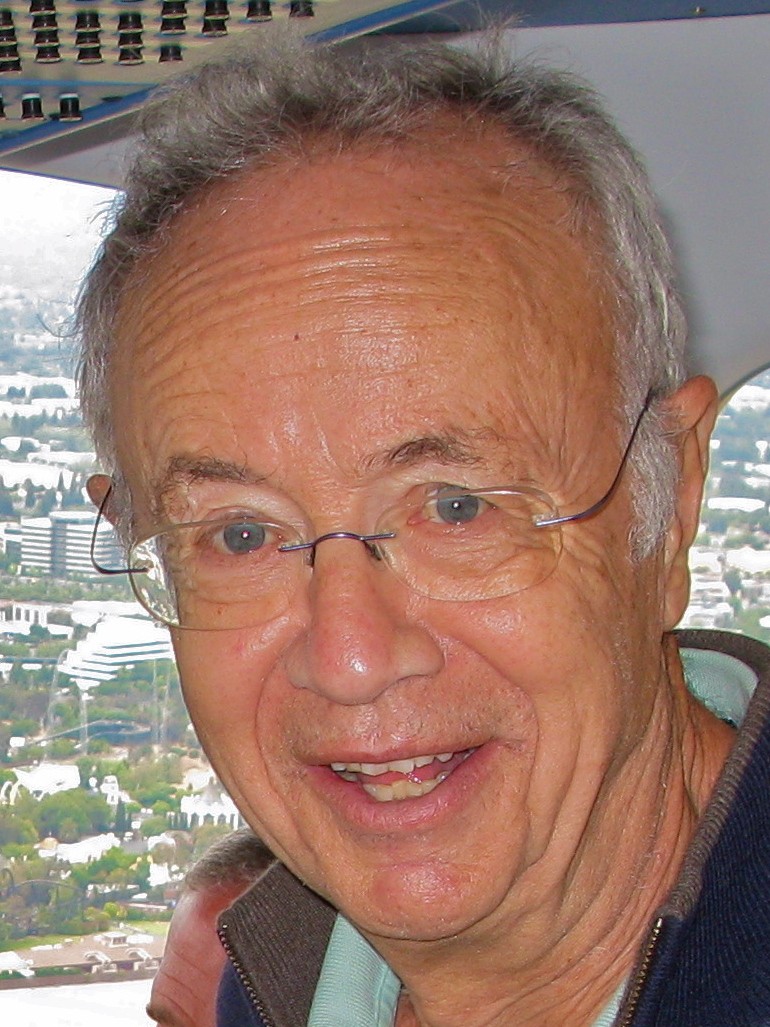
Dara Khosrowshahi
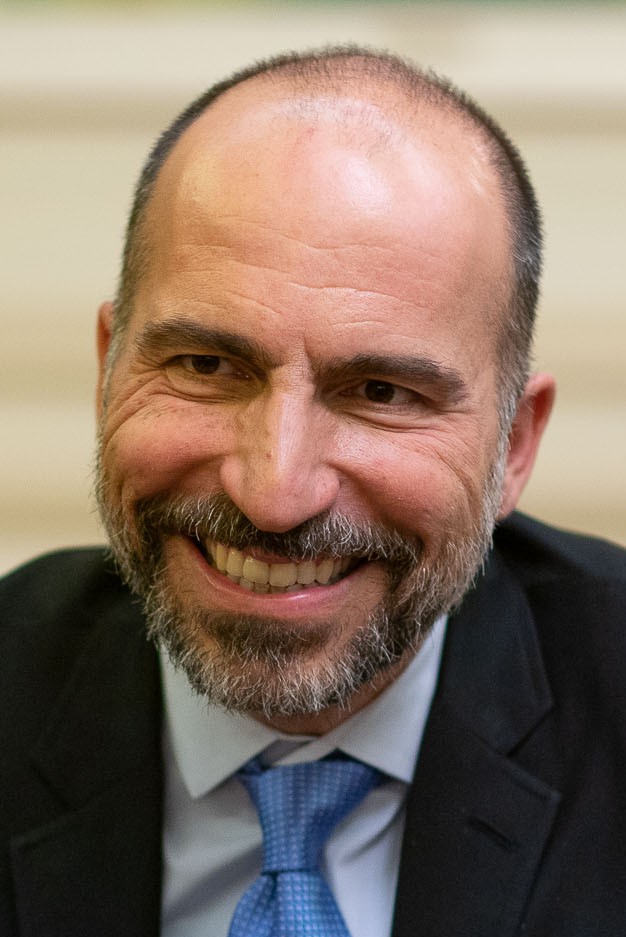
CEO of Uber; former CEO of Expedia Group · b. 1969 · Tehran, Iran
Two calls made by hand, not formulas. how we score →
Summary
Born in Tehran to a family that ran a national conglomerate, he fled Iran with his parents in 1978 and grew up comfortably outside New York City after the family rebuilt.
A Brown engineering degree led through Allen & Company and Barry Diller's companies to the CEO's chair at Expedia, then in 2017 to Uber, replacing a fired founder and steering it through an IPO to profitability.
How it happened
Born May 28, 1969, in Tehran, the youngest of three children of Lili and Asghar "Gary" Khosrowshahi. The family founded and ran Alborz Investment Company, a large Iranian conglomerate spanning pharmaceuticals, chemicals, food, and distribution, and the children grew up on a family compound. It was, by any account, a wealthy and prominent household.
In 1978, months before the Iranian Revolution, the family left Iran as the business that had defined them was headed toward nationalization. They stopped first in the south of France, then moved to the United States and settled in Tarrytown, New York with an uncle. His mother, who had never worked in Iran, took a full-time job to help support the children's schooling. In 1982 his father went back to Iran to look after a relative and was barred from leaving the country again for about six years, splitting the family through much of Khosrowshahi's adolescence.
He attended the Hackley School, a private prep school in Tarrytown, graduating in 1987, then earned a bachelor's degree in electrical and electronics engineering from Brown University in 1991. The family had lost its Iranian holdings, but by the time he reached college the household had re-established itself as solidly upper-middle-class, with an elite prep-school and Ivy League education intact.
He joined the investment bank Allen & Company as an analyst out of Brown in 1991, then moved in 1998 to Barry Diller's USA Networks, rising to senior vice president for strategic planning and eventually president, and later becoming chief financial officer of Diller's IAC. Diller became his patron and mentor across two decades of media and travel-industry deals.
IAC spun off Expedia, and Khosrowshahi became its CEO in August 2005, at 36. Over twelve years he took the company through the acquisitions of Travelocity, Orbitz, and HomeAway, expansion into more than 60 countries, and a large run-up in gross bookings and earnings. In 2015 the board granted him roughly $90 million in stock options tied to staying through 2020, the deal that made him one of the highest-paid executives in the country.
Uber's board pushed founder Travis Kalanick out as CEO in June 2017 after a wave of harassment, culture, and legal controversies. Khosrowshahi was a late, "dark horse" entrant in the search — Jeff Immelt and Meg Whitman were the front-runners — and initially turned the job down before Spotify co-founder Daniel Ek helped talk him into it. He took over in August 2017, forfeiting roughly $184 million in unvested Expedia options to do it. He replaced Kalanick's list of values with a shorter set built around "we do the right thing," led Uber through its May 2019 IPO, and by 2023 had the company reporting its first full-year GAAP profit. This is the role that produced the bulk of his current wealth and by far his highest public profile, well past what Expedia had given him.
In January 2017, while still Expedia's CEO, he wrote a company-wide memo condemning President Trump's travel ban, telling employees that Trump had "reverted to the short game" and that with the order, "ours is a nation of immigrants... all erased with the stroke of a pen." He described his own family's flight from Iran in 1978 and the relief of finally getting a green card.
In a November 2019 interview he compared the murder of journalist Jamal Khashoggi to a pedestrian fatality involving an Uber self-driving car, saying "people make mistakes... it doesn't mean that they can never be forgiven." The remark drew immediate backlash; two days later he told Uber staff he had been "plain wrong" to make the comparison and apologized publicly.
His 2024 total compensation from Uber, per the company's proxy statement, was about $39.4 million; his 2025 compensation was about $35.6 million. As of Uber's March 2026 proxy he beneficially owned roughly 2.38 million shares, worth on the order of $170 million at Uber's late-September 2026 share price — a figure built entirely from salary, bonus, and equity grants at companies he did not found.
The coded evidence
Thirteen groups, every claim sourcedCoarse public-record coding; race is a noisy, interpretive category.
↗ en.wikipedia.orgCoarse public-record coding; ethnicity is a noisy, interpretive category.
↗ en.wikipedia.org1.5 generation: born in Tehran and brought to the United States by his parents at around age 9, rather than born in the U.S. or immigrating as an adult. Naturalized American citizen.
↗ en.wikipedia.orgnot established
Likely Farsi in early childhood in Tehran, but not explicitly documented for the household after the 1978 move to the U.S.
↗ en.wikipedia.orgThe family had no home of their own on arrival in the U.S. in 1978; they stayed first in the south of France, then settled with an uncle in Tarrytown, New York. That extended-family landing spot, and the family's remaining social capital as prominent Iranian expatriates, gave them a floor most refugee families didn't have.
↗ en.wikipedia.orgContinuously salaried across his adult career, from his 1991 entry at Allen & Company through decades at Diller's companies, Expedia, and Uber. He never risked personal capital on a venture of his own.
↗ en.wikipedia.orgnot established
No homelessness, food insecurity, or comparable instability is documented at any point in his adult career; the severe disruption of 1978 belongs to childhood migration, captured under d2 through d4 instead.
↗ en.wikipedia.orgThe hardship was imposed, not chosen. There was nothing to fall back on.
The 1978 flight was forced by the political situation in Iran, not chosen. By the time of his career build, though, there was no scarcity of any kind to speak of — private school, an Ivy League degree, and a straight line into Wall Street.
↗ en.wikipedia.orgHis father, Asghar "Gary" Khosrowshahi, ran the family's Alborz Investment Company in Iran, a conglomerate in pharmaceuticals, chemicals, food, and distribution. His mother, Lili, had not worked outside the home in Iran but took a full-time job after the family resettled in the U.S. to help pay for the children's education.
↗ en.wikipedia.orgA parent worked for themselves, the strongest known predictor of founding.
More than self-employment: the family owned and ran a large conglomerate in Iran before its assets were effectively nationalized after the family left.
↗ en.wikipedia.orgAn uncle hosted the family in Tarrytown, New York on arrival in the U.S. A wider Khosrowshahi family network remained prominent: a cousin, Amir Khosrowshahi, co-founded Nervana Systems, later acquired by Intel for about $408 million, and another cousin, Golnar Khosrowshahi, founded the music-publishing company Reservoir Media.
↗ en.wikipedia.orgThe Khosrowshahi family was prominent enough in Iranian business circles, and remained prominent enough among Iranian-Americans afterward, that the U.S. Virtual Embassy Iran listed Dara among "Prominent Iranian-Americans." That is standing carried past the loss of the family's Iranian wealth, not equivalent to it.
↗ en.wikipedia.orgHis mother went to work specifically to help fund private schooling (Hackley) after the family's Iranian wealth was lost.
↗ en.wikipedia.orgAt least two international relocations before adulthood: Tehran to the south of France, then to Tarrytown, New York, all within 1978, around age 9.
↗ en.wikipedia.orgKhosrowshahi has spoken and written about his family fleeing Iran in 1978, describing his parents as having left everything behind to rebuild, and about the relief of his father finally securing a green card. Separately, his father returned to Iran in 1982 to care for a relative and was barred from leaving again for about six years, splitting the family for much of Khosrowshahi's teenage years. No third party is named or implicated in either account.
↗ geekwire.comnot established
↗ en.wikipedia.orgTehran, Iran, until about age 9, then Tarrytown, New York.
↗ en.wikipedia.orgHackley School, a private university-preparatory school in Tarrytown (graduated 1987), then Brown University, an Ivy League research university, for a B.S. in electrical and electronics engineering (1991).
↗ en.wikipedia.orgLeft Tehran with his parents and siblings in 1978, months before the Iranian Revolution, as the family's Alborz Investment Company was moving toward nationalization. The family stayed briefly in the south of France, then immigrated to the United States and settled in Tarrytown, New York with an uncle. In 1982 his father returned to Iran to care for a relative and was barred from leaving again for about six years, reuniting with the family only once that exit restriction lifted.
↗ en.wikipedia.orgThe family ran a national conglomerate in Iran and arrived in the U.S. with essentially none of that wealth transferable; his mother, who had never worked, took employment to help support the household. Within a decade, though, the family had re-established itself as comfortably upper-middle-class, with private schooling and an Ivy League education for the children — a real reset, but a soft landing by U.S. standards rather than a lasting downgrade.
↗ en.wikipedia.orgAn Iranian immigrant building a career in American finance and technology across the post-1979 hostage-crisis era and the post-2001 period, when Middle Eastern identity carried heightened suspicion in the U.S.; in 2017, as Expedia's CEO, he was himself a national of one of the countries named in the Trump administration's travel ban. No specific documented incident of professional exclusion against him personally is established in sources reviewed; his career advanced without an obvious ceiling.
↗ geekwire.comBarry Diller brought him into USA Networks in 1998 and kept him close through two decades of media and travel-industry deals, at IAC and then at Expedia, which IAC spun off with Khosrowshahi installed as CEO.
↗ en.wikipedia.orgAllen & Company, the boutique investment bank he joined as an analyst in 1991 straight out of Brown, then Barry Diller's USA Networks and IAC, which supplied the credibility, financial training, and network that led to the Expedia CEO role.
↗ en.wikipedia.orgHe was a late "dark horse" entrant in Uber's 2017 CEO search, behind front-runners Jeff Immelt and Meg Whitman, and initially turned the job down; Spotify co-founder Daniel Ek reportedly helped persuade him to take it.
Per reporting cited on Wikipedia, drawn substantially from Mike Isaac's "Super Pumped."
↗ en.wikipedia.orgB.S. in electrical and electronics engineering, Brown University (1991).
↗ en.wikipedia.orgDirect — private prep school to an Ivy League engineering degree to Wall Street.
↗ en.wikipedia.orgnot established
Not applicable in the founder sense; his income has always come from employee salary, bonus, and equity grants, never a venture he personally financed.
↗ en.wikipedia.orgSalary, bonus, and large equity grants from a sequence of employers (Allen & Company, IAC, Expedia, Uber), not any investment vehicle or venture he personally controlled.
↗ sec.govTo become Uber's CEO in 2017 he forfeited roughly $184 million in unvested Expedia stock options, trading a large certain payout for an uncertain, higher-profile bet on turning Uber around.
↗ en.wikipedia.org0
No independent venture attempted; a continuous executive climb across four employers.
↗ en.wikipedia.orgA salary from one employer or another throughout his adult life. There were no gaps to sustain.
↗ en.wikipedia.orgTook over Uber in 2017 amid a board-driven crisis of confidence after Travis Kalanick's ouster, ahead of the company's 2019 IPO and the subsequent multi-year push to reach GAAP profitability, which arrived in 2023.
↗ en.wikipedia.org36
Age when he became Expedia CEO in August 2005, his first large-company chief-executive role.
↗ en.wikipedia.orgOnline travel (Expedia) and ride-hailing/mobility technology (Uber)
↗ en.wikipedia.org170000000
Computed here, not an aggregator figure: Uber's March 2026 proxy discloses his beneficial ownership at 2,380,203 shares (982,544 held directly, plus RSUs and options vesting or exercisable within 60 days); at Uber's September 21, 2026 close of $70.84 (stockanalysis.com, retrieved 2026-09-22), that block is worth roughly $169-170 million. This is a floor, not a full net worth — it excludes cash from any past Expedia or Uber share sales and other assets. No Forbes profile exists for him; third-party aggregator estimates (GuruFocus, Benzinga, Celebrity Net Worth) range roughly $110-560 million using varying, undisclosed methods, consistent with this band.
↗ sec.govPublic equity
↗ sec.gov2026
↗ sec.gov39408629
Total FY2024 compensation from Uber's 2026 proxy Summary Compensation Table: $1,000,000 salary, $26,654,091 stock awards, $7,902,378 option awards, $2,878,200 non-equity incentive, $973,960 all other compensation. His FY2025 total was $35,595,826 and FY2023 was $24,248,208. Excludes his 2015 Expedia option grant, reported at roughly $90 million but not disclosed here on a comparable annual basis.
↗ sec.govProxy statement
↗ sec.govHis current Uber position is mostly unrealized (RSUs and options against a public, liquid stock); he forfeited a large realized-value Expedia option package in 2017 to take the Uber job rather than cashing it out.
↗ en.wikipedia.orgHigh salaried and equity-based income as a hired executive at two public companies, not ownership of anything he founded. He holds no dual-class stock or control block at either company.
↗ sec.govLed Uber through its May 2019 IPO and to its first full-year GAAP profit in 2023; earlier, expanded Expedia into more than 60 countries and through the acquisitions of Travelocity, Orbitz, and HomeAway.
↗ en.wikipedia.orgCapped
A salaried, board-compensated executive rather than a founder with open-ended ownership — an unusually high ceiling for that path, given the size of his Expedia and Uber equity grants, but a ceiling set by a board all the same.
↗ sec.govmeasured, low-drama operator, Culture focused, occasionally tone-deaf in public remarks (critics, after the 2019 Khashoggi comment)
↗ digitaltrends.comPress
↗ en.wikipedia.orgAfter
His public reputation as a steady operator formed mainly after the 2017 Uber appointment, replacing the sharply different reputation Kalanick had built by then.
↗ en.wikipedia.orgMixed
Mostly an asset — a calmer, more conventional CEO was exactly what Uber's board wanted after 2017, and he is generally credited with steadying the company's culture and getting it to profitability. The November 2019 comment comparing the Khashoggi killing to an Uber self-driving-car death was a real, self-inflicted liability moment; he apologized within days, calling himself "plain wrong."
↗ digitaltrends.comHe publicly retracted and apologized for the Khashoggi comparison within about 48 hours, and it does not appear to have materially affected his standing with Uber's board; unlike Kalanick, he is broadly credited in press coverage with having disclosed, rather than concealed, the company's 2016 data-breach cover-up after taking over.
↗ en.wikipedia.orgStructural context
The cost-of-failure score comes from this person's own money and circumstances. But who they were in America carried its own weight, the same way their household or income did, and it shaped how hard the path was just as much. That part isn't in the cost-of-failure number. It's here instead.
Men held about 90% of Fortune 500 CEO seats in 2023, and a wider majority of the rungs below. The ladder is widest for them the whole way up.
↗ forbes.comImmigrants and their children are overrepresented among America's biggest companies, as founders and as senior leaders. They got there through the visa, credential, and network hurdles that make the path harder to even start down.
↗ forbes.comAmong the people recorded here — men: 169 · Middle Eastern / Persian; classified as "White" under U.S. Census categories, though treated as distinct in practice, especially after 1979 and after 2001. subjects: 1. Representation here is who reached these outcomes, not equal odds of reaching them.
Controlled comparisons
Each holds one thing constant and varies another, so the difference is the point. A list of similar names wouldn't tell you anything.