Jan Koum
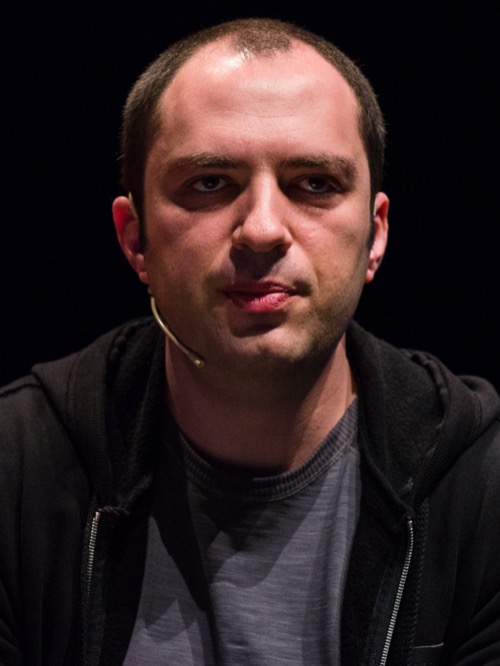
Co-founder, WhatsApp · b. 1976 · Fastiv, near Kyiv, Ukraine → Mountain View, California
Two calls made by hand, not formulas. how we score →
Summary
A teenager who fled anti-Jewish hostility in Ukraine landed on food stamps in Mountain View, and a phone call from Yahoo's co-founder pulled him out of a college lecture hall into nine years of paid, in-demand engineering work.
That job funded and staffed WhatsApp more than the hardship did. He signed the $19 billion Facebook deal at the building where his family once collected food stamps.
How it happened
He was born near Kyiv and grew up in Fastiv, where his father managed construction crews building hospitals and schools and the family had no hot water and didn't trust the phone. Rising antisemitism as the Soviet Union broke apart pushed his mother to leave for Mountain View when he was sixteen; his father meant to follow later and never did. Within weeks the family was on food stamps and public assistance, his mother taking in babysitting and cleaning while he swept floors at a grocery store.
He taught himself computer networking from manuals he bought at a used bookstore and returned once he'd learned them, and fell in with a hacker collective called w00w00. In 1997, while he was working as a security tester at Ernst & Young and taking classes at San Jose State, Yahoo co-founder David Filo called him mid-lecture and told him to quit class and get into the office. Koum dropped out that day. He spent close to nine years there as an infrastructure engineer, working alongside Brian Acton, who he later said he trusted because "neither of us has an ability to bullshit."
He and Acton left Yahoo in 2007, spent a year traveling South America, and both applied to Facebook. Both were turned down; Acton later called it "the Facebook reject club." In January 2009, after buying an iPhone, Koum got interested in what the new App Store could do and started sketching an app that would show a status next to each name in a phone's address book: on a call, at the gym, battery low.
He built the first version with a contract developer, and once Apple added push notifications that summer, people started replying to each other's statuses like they were messages. Five former Yahoo colleagues put in $250,000 so Acton could join as a formal cofounder. Sequoia's Jim Goetz backed the company with $8 million in 2011 and $50 million more in 2013, and the founders kept the team small: around fifty people were running WhatsApp for two hundred million users.
Facebook bought WhatsApp for close to $19 billion in February 2014. Koum and Goetz signed the papers at a disused building in Mountain View that used to be the county's North County Social Services office, the same kind of place where he'd once stood in line for food stamps as a teenager. He kept around 45 percent of the company, an unusually large stake for something that had taken two full venture rounds. Four years later he left Facebook's board over disagreements about ads and encryption, though he stayed on as an employee long enough to collect roughly $450 million more in stock.
The coded evidence
Thirteen groups, every claim sourcedFirst generation immigrant; arrived in the US at 16
↗ en.wikipedia.orgnot established
Likely Russian or Ukrainian given the family's Kyiv-region background, but not explicitly confirmed on the record. Not established.
↗ en.wikipedia.orgnot established
No family home or family wealth to fall back on is documented at any point; his parents had none to offer. Absence of evidence.
↗ forbes.comPersonal savings from nearly nine years of Yahoo salary funded his early living costs and WhatsApp's first development work; there was no family income or wealth behind him if it failed.
↗ forbes.comNone documented during the WhatsApp years. He and Acton spent a pre-founding year traveling South America by choice, which is the opposite of instability, and is the clearest sign the Yahoo years had already changed his financial position.
↗ en.wikipedia.orgThe hardship was imposed, not chosen. There was nothing to fall back on.
The food-stamp years were imposed, not chosen. There was no family home to return to.
↗ forbes.comFather a construction manager who built hospitals and schools in Ukraine; mother a homemaker there, who became a babysitter and housecleaner after they emigrated.
↗ forbes.comNeither parent was self-employed.
His father was employed managing construction crews, not self-employed.
↗ forbes.comHis grandmother emigrated with him and his mother in 1992 and was part of the household in Mountain View.
↗ en.wikipedia.orgHis father, who stayed behind in Ukraine, died in 1997 without ever rejoining the family. His mother died of cancer in 2000, leaving him without either parent by age 24.
↗ jta.orgFastiv, near Kyiv, then a small two-bedroom apartment in Mountain View secured through a government social-assistance program.
↗ forbes.comOne international move in 1992: Koum, his mother, and his grandmother to Mountain View. His father stayed in Ukraine.
↗ en.wikipedia.orgHis father held a stable, skilled trade managing construction crews in Ukraine. The family arrived in California with no income and went straight onto food stamps and public assistance, a household that had been working but not wealthy becoming one with nothing at all.
↗ forbes.comYahoo co-founder David Filo called him directly and told him to leave class and come work at Yahoo; Koum dropped out of San Jose State that day.
↗ forbes.comYahoo, where he spent close to nine years as an infrastructure engineer after Ernst & Young. It supplied the technical seniority, the savings, and the ex-colleague network that WhatsApp ran on.
↗ forbes.comSkill, Network, Capital
Yahoo supplied the engineering skill, the ex-colleague network that funded the seed round, and, through nine years of salary, personal capital. No evidence it supplied credibility with investors on its own; Sequoia's involvement came later, through product traction.
↗ forbes.comBrian Acton, met in 1997 while both worked at Ernst & Young, then a Yahoo colleague for nine years. Acton joined as formal cofounder in late 2009 after raising the initial seed money.
↗ forbes.comWhatsApp matched users through phone numbers already in their address book rather than a separate friend list, so it spread through people users already knew. It first caught on among a circle of Fishman's Russian-speaking friends before spreading further, with no advertising budget for most of its life.
↗ en.wikipedia.orgSelf-taught networking from manuals bought at a used bookstore and returned after use, then joined w00w00, an informal computer-security collective where he met future Napster creators Shawn Fanning and Jordan Ritter.
↗ en.wikipedia.orgBoth Koum and Acton applied to Facebook after leaving Yahoo in 2007 and were turned down. Acton later called it "the Facebook reject club." WhatsApp, built instead, was the company Facebook eventually paid $19 billion for.
↗ en.wikipedia.orgNo degree. Attended San Jose State University while working full time at Ernst & Young; dropped out in 1997 to join Yahoo.
↗ en.wikipedia.orgFull time, as a security tester at Ernst & Young, while enrolled.
↗ en.wikipedia.orgnot established
No family capital is documented anywhere in the record; his parents had none to give.
↗ forbes.comSavings accumulated from nearly nine years of Yahoo salary funded his living costs and WhatsApp's earliest development before any outside money came in.
↗ forbes.comSequoia Capital, led by partner Jim Goetz, put in about $8 million in a 2011 Series A and $50 million more in a February 2013 Series B that valued the company at $1.5 billion.
↗ en.wikipedia.orgFive former Yahoo colleagues invested $250,000 in seed money in 2009, which let Brian Acton join as a formal cofounder.
↗ en.wikipedia.orgRoughly $58 million raised across two rounds before a $19 billion exit. Koum still held about 45% of the company at sale, an unusually large stake for a company that had taken two full venture rounds.
↗ forbes.comBuilt a personal investment vehicle, Newlands, which still holds a large Meta stock position alongside a startup portfolio, and became one of the largest individual Jewish philanthropic donors in the US, including a $200 million hospital gift in Jerusalem.
↗ forbes.comPersonal observation of his own phone address book. He wanted a status next to each contact's name -- on a call, at the gym, battery low -- and hired a contract developer through a friend, Alex Fishman, to build it. The status feature turned into real-time messaging once Apple added push notifications in mid-2009.
↗ forbes.comSelf, from personal savings built up over nearly nine years at Yahoo.
↗ forbes.comLeft WhatsApp and Facebook's board in April 2018 over disagreements about advertising and weakening end-to-end encryption. It was initially reported he was forfeiting close to $1 billion in unvested stock, but he continued as a Facebook employee under a "rest and vest" arrangement and ultimately collected roughly $450 million more.
The clean "walked away from a billion dollars" version is complicated by the later reporting that he kept vesting stock for months afterward.
↗ cnbc.comApple's App Store was seven months old when he bought his first iPhone, and Apple added push notifications that June, which is what turned WhatsApp's status feature into real-time messaging. International SMS fees were still high, which helped drive adoption among immigrant communities texting relatives abroad.
↗ en.wikipedia.orgMountain View / Silicon Valley, where he had lived since 1992.
↗ forbes.comBuilt. Wrote the first backend himself and hired a contractor for the client.
↗ forbes.comConsumer software and mobile messaging
↗ forbes.comJournalistic estimate
Forbes' real-time estimate, built substantially around known Meta stock holdings through his investment firm Newlands plus other assets.
↗ forbes.com2026
↗ forbes.comnot established
No salary-based peak income is documented. His wealth is almost entirely asset-based, not earned as pay. Not established.
↗ forbes.comPartly realized. He sold a portion of his Facebook stock in the years after the deal while retaining a large remaining position, later diversified through Newlands.
↗ forbes.comWealth in owned equity, not salary. The Facebook deal itself was reported as roughly $4 billion cash, $12 billion in Facebook shares, and $3 billion in restricted stock for the founders.
↗ en.wikipedia.orgBecame one of the largest individual Jewish philanthropic donors in the US by the early 2020s, giving nearly $140 million to roughly seventy Jewish charities in 2019-2020 alone.
↗ jta.orgUncapped
↗ en.wikipedia.orgReclusive, Private, principled on privacy
↗ jta.orgPress
↗ jta.orgAfter
The reputation for privacy conviction largely formed around the 2018 departure from Facebook's board, years after the acquisition made him famous.
↗ cnbc.comMixed
An asset among privacy- and security-minded observers, complicated by later reporting that he kept vesting Facebook stock for months after the "principled exit."
↗ cnbc.comThe reputation accrued from behaviour rather than being manufactured.
Has "granted very few interviews" and largely avoids public life.
↗ jta.orgStructural context
The cost-of-failure score comes from this person's own money and circumstances. But who they were in America carried its own weight, the same way their household or income did, and it shaped how hard the path was just as much. That part isn't in the cost-of-failure number. It's here instead.
Men founded the companies that took nearly all the venture funding and almost every top outcome, a tailwind that never shows up in one person's own circumstances.
↗ techcrunch.comWhite founders are heavily overrepresented among funded companies and top-tier wealth relative to their share of the population, an edge that has nothing to do with a person's own money.
↗ techcrunch.comImmigrants and their children are overrepresented among America's biggest companies, as founders and as senior leaders. They got there through the visa, credential, and network hurdles that make the path harder to even start down.
↗ forbes.comAmong the people recorded here — men: 169 · White subjects: 114. Representation here is who reached these outcomes, not equal odds of reaching them.
Controlled comparisons
Each holds one thing constant and varies another, so the difference is the point. A list of similar names wouldn't tell you anything.