Jensen Huang
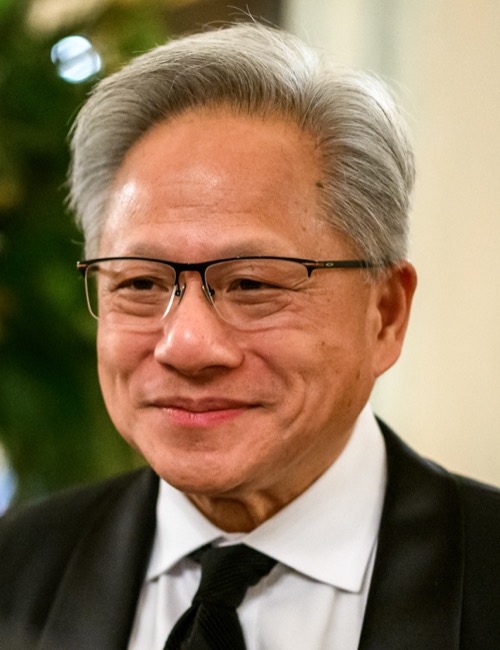
Co-founder, President, and CEO, Nvidia · b. 1963 · Taipei, Taiwan → United States
Two calls made by hand, not formulas. how we score →
Summary
Sent to the US at nine, he was mistakenly enrolled in a rough Kentucky reform school where he cleaned toilets for teenage boys.
He rebuilt through an engineering degree and nine years designing chips at AMD and LSI Logic, then founded Nvidia at thirty with venture capital he closed within months. Thirty-three years later he still runs it, having never given up his stake.
How it happened
His father was a chemical engineer, his mother a schoolteacher who taught her sons ten English words a day from the dictionary. At nine he and his older brother were sent to live with an uncle in Tacoma, and from there their aunt and uncle mistakenly enrolled them at Oneida Baptist Institute, a Kentucky reform school for troubled teenagers, believing it was a prep school. His brother worked a tobacco farm. Too young for classes there, Huang was sent to the local public elementary school and cleaned the dorm bathrooms for about a hundred teenage boys every day.
Two years later his parents settled in Beaverton, Oregon, and the brothers rejoined them. Huang skipped two grades, worked the graveyard shift at Denny's from fifteen, and studied electrical engineering at Oregon State because the in-state tuition was cheap. He spent the next nine years designing chips at AMD and then LSI Logic, finishing a Stanford master's degree through night classes while raising two small children. At LSI he met Chris Malachowsky and Curtis Priem on a contract with Sun Microsystems.
The three of them founded Nvidia in 1993 with $40,000 in the bank. LSI's CEO introduced Huang to Sequoia's Don Valentine, whose firm and Sutter Hill Ventures put in $20 million within months. Huang was thirty and the youngest of the three, but the other two deferred to him as CEO from day one.
Nvidia's first chip bet on the wrong graphics standard and Microsoft backed the other one. In 1996 Huang cut the company from a hundred employees to forty and rebuilt around a new chip, the RIVA 128. By the time it shipped in August 1997 there was one month of payroll left. A Sega executive who'd already picked a different vendor believed in the company anyway and got Sega to invest $5 million, which is what kept the lights on.
The RIVA 128 sold about a million units in four months and the company never came that close to the edge again. Nvidia went public in 1999 and Huang stayed CEO through every cycle after, including the pivot toward general-purpose parallel computing years before anyone was paying for AI training. He still holds roughly 3.6% of the company, worth close to $200 billion, and he's never had a different job.
The coded evidence
Thirteen groups, every claim sourced1.5 generation; emigrated from Taiwan at age nine
He is the immigrant himself, arriving as a child rather than being born in the US to immigrant parents.
↗ en.wikipedia.orgTaiwanese Hokkien. His mother taught him English by drilling ten dictionary words a day before the family emigrated.
↗ en.wikipedia.orgAt the time he founded Nvidia he was a director at LSI Logic with a stable marriage and a strong technical reputation; immediately re-employable in chip design if the venture failed.
↗ fortune.comLeft a senior salaried role to found the company, but outside investors closed a $20 million round within months of the 1993 founding, so the exposure window was short.
↗ forbes.comNot personal instability, but the company nearly failed: in 1996 Huang cut headcount from 100 to 40, and by August 1997 Nvidia had about one month of payroll left before a $5 million investment from Sega kept it running.
↗ en.wikipedia.orgThe hardship was imposed, not chosen. There was nothing to fall back on.
The 1996-97 near-bankruptcy was a real existential threat to the company, not a chosen austerity.
↗ en.wikipedia.orgFather a chemical engineer at an oil refinery; mother a schoolteacher. A middle-class Taiwanese family that relocated often for his father's career.
↗ en.wikipedia.orgHis parents sold nearly all their possessions to afford the Oneida tuition, believing they were paying for an elite boarding school.
↗ en.wikipedia.orgSent at nine to live with an uncle in Tacoma, then boarded at a Kentucky school, separated from both parents for about two years until they resettled in Oregon.
↗ en.wikipedia.orgAt least five relocations before age twelve: Taipei, then Bangkok (about four years), then Tacoma, then a Kentucky boarding school, then Beaverton, Oregon.
↗ en.wikipedia.org4
Ruamrudee International School (Bangkok), Oneida Elementary (Kentucky), then Oregon schools through Aloha High.
↗ en.wikipedia.orgOneida Baptist Institute, a religious reform academy in Clay County, Kentucky for troubled youth, was where his aunt and uncle enrolled him believing it was a prep school. Too young for its classes, he attended the local public elementary school and cleaned the dorm bathrooms for about a hundred teenage boys daily; his roommate was a 17-year-old with knife scars he taught to read in exchange for weightlifting lessons. He was bullied and beaten as one of the only Asian students. Two years later he transferred to Aloha High School in Oregon, skipped two grades, and graduated at sixteen.
↗ oneidaschool.orgTaipei to Bangkok around age five (father's refinery career), Bangkok to Tacoma at nine (Thai social unrest), Tacoma to rural Kentucky within the same year, then Kentucky to Beaverton, Oregon around age eleven.
↗ en.wikipedia.orgFirst routed through an aunt and uncle, recent immigrants themselves in Tacoma, Washington, who searched for a school for him and his brother and picked Oneida by mistake.
↗ en.wikipedia.orgLSI Logic, where he rose to director of the CoreWare division. LSI held the contract with Sun Microsystems on which he met Chris Malachowsky and Curtis Priem while building the "GX" graphics engine.
↗ en.wikipedia.orgSkill, Network, Credibility
Nine years of chip-design and management experience, the co-founders, and standing good enough that LSI's own CEO personally introduced him to Sequoia.
↗ en.wikipedia.orgChris Malachowsky (Sun Microsystems engineer) and Curtis Priem (former IBM and Sun graphics chip designer), both met through the LSI-Sun contract in the late 1980s.
↗ en.wikipedia.orgNine years designing chips at AMD and LSI Logic before starting anything of his own, including finishing a graduate degree at night while working full time.
↗ en.wikipedia.orgBS electrical engineering, Oregon State University (1984, highest honors); MS electrical engineering, Stanford University (1992, earned through night classes while employed full time).
↗ engineering.oregonstate.eduWorked full time as a chip designer at AMD, then LSI Logic, throughout the Stanford master's program.
↗ en.wikipedia.orgChose Oregon State specifically for its low in-state tuition rather than a more prestigious option.
↗ en.wikipedia.orgNvidia was incorporated in April 1993 with $40,000 in the bank, contributed by the three founders.
↗ fortune.comThe initial capital came from the founders' own funds, built up over nine years of senior engineering salaries at AMD and LSI Logic.
↗ en.wikipedia.org$20 million from Sequoia Capital and Sutter Hill Ventures, closed within months of founding. LSI Logic's CEO personally introduced Huang to Sequoia's Don Valentine.
↗ forbes.comDon Valentine of Sequoia invested on the strength of Wilfred Corrigan's (LSI's CEO) personal backing, despite Huang's own pitch reportedly going badly.
↗ en.wikipedia.orgSingle class of common stock; no dual-class or super-voting structure. Huang's influence over the board rests on his founder-CEO position and standing, not on enhanced voting rights.
↗ sec.govPrior employer and personal experience: a vision, formed while working the Sun Microsystems graphics contract at LSI, that 3D graphics chips would be the next big consumer computing market.
↗ en.wikipedia.orgBeneficially owns about 3.58% of Nvidia's outstanding shares (870.6 million of 24.3 billion), mostly through family trusts, as of the March 2026 proxy. Voting power matches economic stake; there is no structural control premium.
↗ sec.gov0
No separate ventures before Nvidia; a single continuous engineering career, then one company.
↗ en.wikipedia.orgThe 1996-97 near-collapse was absorbed by laid-off employees (headcount cut from 100 to 40) and by Sega, whose $5 million investment covered the gap after Nvidia's own money ran down to about a month of payroll.
↗ en.wikipedia.orgRode three successive computing waves on one architecture bet: PC graphics in the 1990s, the 2006 CUDA push into general-purpose parallel computing years before there was a market for it, then the AI training boom from roughly 2016 onward that made Nvidia's chips the scarce input for the entire industry.
↗ en.wikipedia.orgBuilt. The first product bet on the wrong graphics standard and failed; the company rebuilt around the RIVA 128 rather than acquiring an existing position.
↗ en.wikipedia.orgSemiconductors and AI computing infrastructure
↗ forbes.com193300000000
Forbes real-time estimate, August 8, 2026; moves daily with Nvidia's share price. Band only.
↗ forbes.com2026
↗ forbes.com49866251
Total fiscal-2025 compensation from the proxy summary table: salary, stock awards, non-equity incentive, and other compensation combined.
↗ sec.govProxy statement
↗ sec.govOverwhelmingly wealth, not salary. His fortune is almost entirely his equity stake; his cash compensation is a rounding error against it.
↗ sec.govNvidia became the first company to reach a $5 trillion market capitalization in October 2025. Huang was named alongside other AI researchers in Time's 2025 "Architects of AI" Person of the Year and received the IEEE Medal of Honor in January 2026.
↗ en.wikipedia.orgUncapped
↗ sec.govNvidia has drawn recurring antitrust and export-control scrutiny as it grew: a 2006 DOJ subpoena over the graphics-card market, a September 2023 French Competition Authority raid on its French offices tied to a cloud-computing inquiry, a June 2024 DOJ antitrust probe into its conduct in the AI chip market, and export-control fights over China, including an October 2022 restriction on its advanced data-center chips and an August 2025 agreement with AMD to pay the US government 15% of revenue from certain China chip sales as a condition of export licenses. None has produced a public finding of wrongdoing against the company as of last review.
↗ forbes.comAfter
All of the regulatory scrutiny followed Nvidia's rise to market dominance, not its founding.
↗ en.wikipedia.orgIncidental
The scrutiny is a function of Nvidia's market position and the geopolitics of AI chips, not evidence that the position was produced by the conduct under examination.
↗ en.wikipedia.orgNone
No personal liability for Huang and no adjudicated corporate wrongdoing established as of last review; the China revenue-share arrangement is a negotiated licensing cost, not a penalty.
↗ forbes.comDemanding, Relentless, technically hands-on
↗ fortune.comInsiders
Runs a flat structure with around 60 direct reports and no standing one-on-ones; he says senior people "require the least amount of pampering."
↗ fortune.comBefore
The intensity is described as consistent with his engineering-era personality, not a persona built after Nvidia's AI-era fame.
↗ fortune.comMixed
Read by many as the discipline behind three decades of compounding execution, and by some former staff as simply harsh; both readings appear in the coverage.
↗ en.wikipedia.orgThe reputation accrued from behaviour rather than being manufactured.
↗ fortune.comStructural context
The cost-of-failure score comes from this person's own money and circumstances. But who they were in America carried its own weight, the same way their household or income did, and it shaped how hard the path was just as much. That part isn't in the cost-of-failure number. It's here instead.
Men founded the companies that took nearly all the venture funding and almost every top outcome, a tailwind that never shows up in one person's own circumstances.
↗ techcrunch.comImmigrants and their children are overrepresented among America's biggest companies, as founders and as senior leaders. They got there through the visa, credential, and network hurdles that make the path harder to even start down.
↗ forbes.comAmong the people recorded here — men: 169 · Asian subjects: 11. Representation here is who reached these outcomes, not equal odds of reaching them.
Controlled comparisons
Each holds one thing constant and varies another, so the difference is the point. A list of similar names wouldn't tell you anything.