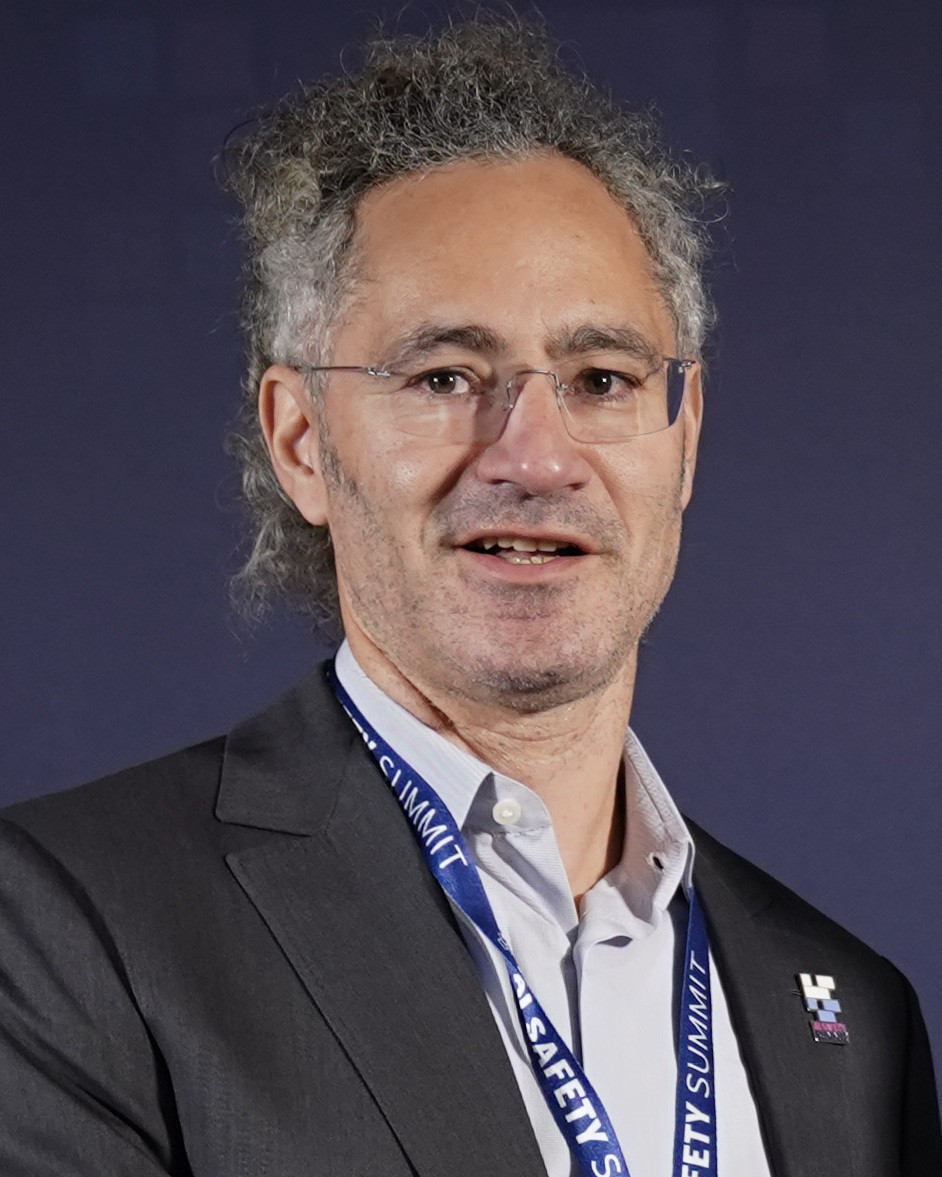
Kevin Mandia
Founder of Mandiant (originally Red Cliff Consulting); later CEO of FireEye/Mandiant through its acquisition by Google · b. 1970 · Rochester, New York → Pittsburgh, Pennsylvania
Two calls made by hand, not formulas. how we score →
Summary
Raised middle-class in Rochester and Pittsburgh, he took a funded route into a young field — an Air Force commission investigating computer intrusions — then built a decade of consulting credibility before self-funding Mandiant on its own revenue.
A 2013 report naming a Chinese army unit made the firm famous; FireEye's $1 billion purchase of it turned that credibility into a public-company stake.
How it happened
Kevin Mandia was born around 1970 and grew up middle-class, attending high school in Rochester, New York. His father worked as a human resources specialist and his mother sold Mary Kay cosmetics. When his parents divorced during his senior year of high school, he moved to Pittsburgh to live with his father. No housing or financial precarity is documented at any point in his childhood.
He earned a Bachelor of Science in computer science from Lafayette College, graduating in 1992, and was commissioned into the U.S. Air Force the same year. He served as a computer security officer at the Pentagon before becoming a special agent in the Air Force Office of Special Investigations, investigating computer intrusions at a time when almost no civilian career path in that specialty existed. He later earned a Master of Science in forensic science from George Washington University.
After the Air Force he spent two years as director of training at Sytex (later acquired by Lockheed Martin), then three years as director of computer forensics at Foundstone, a vulnerability-management firm McAfee bought in 2004. He co-authored the widely used security manual "Incident Response: Investigating Computer Crime," building the professional reputation that let him start his own firm.
In 2004 he founded Red Cliff Consulting, a digital-forensics and incident-response consultancy funded from consulting revenue and his own savings rather than outside investment. Renamed Mandiant in 2006, it grew profitably and self-funded to roughly 500 employees and more than $100 million in revenue before taking any outside capital — a 2011 investment from Kleiner Perkins Caufield & Byers and One Equity Partners came after the business was already established.
In February 2013 Mandiant published a report publicly attributing a large, sustained hacking campaign against U.S. companies to a specific unit of China's People's Liberation Army, "APT1" (PLA Unit 61398). It was one of the first times a private company had named a nation-state military unit by designation and location, and it reshaped how publicly attributed cyberattacks were discussed.
FireEye acquired Mandiant in December 2013 for roughly $1 billion in cash and stock. Mandia became FireEye's senior vice president and chief operating officer, then president in 2015, then chief executive officer in June 2016. This is the moment his ownership of a private consulting firm converted into a stake in, and eventually leadership of, a Nasdaq-listed company — the first time his work produced durable, disclosed wealth rather than consulting income.
In December 2020, FireEye disclosed that its own red-team tools had been stolen by sophisticated attackers. Investigating its own breach led the company to uncover the broader SolarWinds supply-chain campaign, which had compromised numerous U.S. government agencies and corporations. The company's decision to disclose its own compromise publicly was widely credited within the industry as unusually transparent for a security vendor.
In June 2021 FireEye sold its product business, name, and much of its staff to Symphony Technology Group for about $1.2 billion, keeping the threat-intelligence and incident-response business under the Mandiant name with Mandia still as CEO. Google announced its acquisition of Mandiant in March 2022 for about $5.4 billion, closing that September — by far the largest deal of his career, though by then his own stake was a small fraction of the total: SEC filings from May 2022 show him holding about 3.56 million shares, 1.52% of the company, worth roughly $82 million at Google's $23.00-per-share offer.
He continued running Mandiant inside Google Cloud until stepping down as CEO on May 31, 2024, moving into a strategic-advisor role and a seat on the Google Public Sector board. He is now co-founder and general partner at Ballistic Ventures, a cybersecurity-focused venture firm, and serves on government advisory bodies including the National Security Telecommunications Advisory Committee and CISA's Cybersecurity Advisory Committee.
The coded evidence
Thirteen groups, every claim sourcednot established
No source reviewed documents specific national-origin or ancestry detail. His surname is consistent with Italian-American heritage, but nothing in the sourced record confirms this, so coded.ethnicities uses the broader "European American" bucket rather than a more specific tag.
↗ ballisticventures.comDescendant, multi-generational American
No documented recent-immigration history; coded from absence of evidence.
↗ ballisticventures.comA stable family home through childhood; when his parents divorced during his senior year of high school he moved with his father to Pittsburgh rather than facing any housing gap. No housing precarity is documented at any point in his life.
↗ fortune.comWhen he founded Red Cliff Consulting in 2004 he had already spent twelve years building a paid track record — an Air Force officer's salary, then director-level roles at Sytex and Foundstone — and the firm was a consulting business generating revenue from its first clients rather than one requiring outside salary support to survive.
↗ ballisticventures.comnot established
No period of documented hardship, chosen or imposed, appears in the record.
↗ fortune.comFather worked as a human resources specialist; mother sold Mary Kay cosmetics as a direct-sales consultant.
↗ fortune.comA parent worked for themselves, the strongest known predictor of founding.
Mary Kay consultants operate as independent contractors selling on commission; counted here as self-employment in the strict sense, though it was a single-parent side income rather than a family business.
↗ fortune.comnot established
No documented multigenerational wealth or institutional standing.
↗ ballisticventures.comHis parents divorced during his senior year of high school in Rochester, New York, and he relocated to Pittsburgh, Pennsylvania to live with his father.
↗ fortune.comCommissioned into the U.S. Air Force in 1992 upon graduating from Lafayette College; served as a computer security officer at the Pentagon, then as a special agent in the Air Force Office of Special Investigations investigating computer intrusions.
↗ ballisticventures.comRochester, New York through most of childhood and adolescence, then Pittsburgh, Pennsylvania for his final year of high school.
↗ fortune.comnot established
Public or private schooling in Rochester or Pittsburgh is not documented.
↗ fortune.comNeither Rochester nor Pittsburgh in the 1970s-80s was a notable computing or cybersecurity cluster; his path into the field ran through a military commission rather than childhood proximity to the industry.
↗ ballisticventures.comRochester, NY (childhood) → Pittsburgh, PA (senior year of high school) → Easton, PA (Lafayette College) → the Washington, D.C. area (Air Force, Sytex, Foundstone, George Washington University, and eventually Mandiant's Alexandria/Reston, Virginia headquarters).
↗ ballisticventures.comTwelve years across the Air Force Office of Special Investigations, Sytex (later Lockheed Martin), and Foundstone (later McAfee) supplied the technical skill, case history, and professional reputation — he co-authored a widely used incident-response manual — that let him start his own forensics consultancy in 2004.
↗ news.lafayette.eduSkill, Credibility, Network
His prior employers supplied technical training, a published professional reputation, and referral relationships rather than capital or the underlying business idea, which he developed himself.
↗ news.lafayette.edunot established
No co-founder is documented; Red Cliff Consulting/Mandiant is described as a solo founding.
↗ en.wikipedia.orgnot established
No documented sustained apprenticeship under a single named mentor.
↗ ballisticventures.comMaster of Science in forensic science, George Washington University; Bachelor of Science in computer science, Lafayette College (1992).
↗ ballisticventures.comnot established
Not established — how Lafayette College and the George Washington University master's were financed (scholarship, ROTC, employer, family, or loans) is not documented in the sources reviewed. coded credentialFunding is coded "military" at low confidence as the best available inference from the direct undergraduate-to-commission pathway, not from a confirmed ROTC scholarship or tuition-assistance record.
↗ news.lafayette.eduDirect — a private undergraduate computer-science degree into an immediate military commission, with a graduate forensic-science degree layered on afterward rather than a community-college or transfer route.
↗ ballisticventures.comLafayette College is not documented as a specific pipeline into cybersecurity; his professional network formed afterward, inside the Air Force Office of Special Investigations and then Sytex and Foundstone.
↗ ballisticventures.comnot established
The specific amount or source of his first invested dollar into Red Cliff Consulting is not documented.
↗ en.wikipedia.orgIt paid its own way from the start. Revenue came before any outside money.
Red Cliff Consulting/Mandiant operated as a fee-generating incident-response and consulting business from its 2004 founding, reaching roughly 500 employees and over $100 million in revenue while still privately held, before any outside investment.
↗ ballisticventures.comFounded in 2004 from consulting revenue and his own savings after twelve years of paid Air Force and private-sector security work, rather than from family capital or outside investors.
↗ ballisticventures.comKleiner Perkins Caufield & Byers and One Equity Partners invested in Mandiant in 2011, seven years after founding, to expand its incident response and security-consulting operations — the company's first documented outside capital, coming after it was already large and profitable.
Specific amount raised in the 2011 round is not documented in the sources reviewed.
↗ en.wikipedia.orgSelf-funded and profitable to roughly 500 employees and over $100 million in annual revenue before its first outside investment in 2011, then acquired by FireEye for about $1 billion in cash and stock in December 2013 — ending independent ownership in exchange for a stake in, and later leadership of, a public company.
↗ ballisticventures.comRather than cashing out of the 2013 FireEye deal and leaving, he stayed on as an executive at the combined company — senior vice president and chief operating officer, then president, then CEO in 2016 — effectively reinvesting his time and remaining equity into growing the larger public company rather than converting the acquisition into liquid wealth immediately.
↗ en.wikipedia.orgPrior professional experience — years of hands-on computer-intrusion investigation for the Air Force and then in private-sector forensics convinced him there was a standalone market for incident-response and threat-intelligence consulting.
↗ ballisticventures.comAs of the proxy statement filed May 27, 2022 — shortly before Google's all-cash acquisition at $23.00 per share, announced that March — Mandia beneficially owned about 3,556,753 shares of Mandiant, Inc. common stock, roughly 1.52% of the company. That stake would have been worth approximately $82 million at the deal price, though it excludes any shares sold earlier in FireEye's public-company history (2013-2022) and any options or RSUs that vested or accelerated at the close of the Google acquisition in September 2022.
↗ sec.gov0
No documented failed venture prior to Red Cliff Consulting/Mandiant, which was profitable from its early years.
↗ en.wikipedia.orgFounded in 2004 as enterprise incident-response and forensics were becoming distinct disciplines, and grew through a decade of high-profile, publicized nation-state and criminal breaches (RSA in 2011, the wave of retail and government intrusions through the 2010s) that pushed corporate and government demand toward the kind of attribution and response work Mandiant specialized in.
↗ en.wikipedia.orgWashington, D.C. area (Mandiant was headquartered in Alexandria, Virginia).
↗ ballisticventures.comBuilt — Red Cliff Consulting/Mandiant was created from scratch, not acquired.
↗ en.wikipedia.org20
From the 2004 founding to his May 2024 departure as CEO, continuously at the same organization through its FireEye and Google ownership periods.
↗ cybersecuritydive.comBuilt in the Washington, D.C./Northern Virginia corridor rather than Silicon Valley — a real center of federal cybersecurity and defense contracting, but a different hub than the venture-capital and consumer tech centers most founder profiles in this set are built around.
↗ ballisticventures.comCybersecurity (digital forensics, incident response, and threat intelligence)
↗ ballisticventures.comnot established
No disclosed aggregate net-worth figure exists; he is not tracked by Forbes or a comparable real-time wealth tracker. coded.magnitude (band 4, $100M-1B) is built up rather than sourced from a single figure: his SEC-disclosed May 2022 stake (see d7.controlVsOwnership) was worth roughly $82 million at Google's acquisition price alone, and his reported total compensation ran $7.4-7.8 million a year from 2019-2021 (see peakAnnualIncome), almost all in equity, across roughly nine years as a public-company executive before the Google deal and nearly two more after it. That combination plausibly clears $100 million but there is no basis to place it more precisely, and it should not be read as a disclosed net-worth figure.
↗ sec.gov7780218
Total compensation reported in FireEye/Mandiant's Summary Compensation Table for fiscal year 2021: $440,000 salary, $6,946,880 in stock awards, $391,820 non-equity incentive compensation, and $1,518 other compensation. Comparable totals were reported for 2020 ($7,454,718) and 2019 ($7,728,166), a consistent pattern of heavily equity-weighted CEO pay.
↗ sec.govProxy statement
↗ sec.govHis cash salary stayed flat at $440,000 a year while nearly all of his reported compensation, and by extension his wealth, came from stock awards and the appreciation of his Mandiant/FireEye equity rather than cash pay.
↗ sec.govNamed Ernst & Young Entrepreneur of the Year for the Greater Washington region in 2011; co-authored the widely used manual "Incident Response: Investigating Computer Crime"; the 2013 APT1 report is credited with changing how publicly attributed nation-state cyberattacks are discussed, and the 2020 disclosure of FireEye's own breach in the course of uncovering the SolarWinds campaign was widely cited as an unusually transparent moment for a security vendor.
↗ news.lafayette.edu9
From founding Red Cliff Consulting in 2004 to FireEye's acquisition of Mandiant in December 2013.
↗ en.wikipedia.orgUncapped
Public-company equity compensation and, since 2024, a venture-partner role rather than a salaried or credentialed ceiling.
↗ sec.govnot established
No personal regulatory, criminal, or civil action against Mandia is documented. FireEye's stock and business performance were sometimes volatile as a public company (a common pattern for cybersecurity vendors through 2018-2019), which is an ordinary business-performance matter rather than a conduct finding, and no shareholder litigation naming Mandia personally was located in the sources reviewed.
↗ en.wikipedia.orgFireEye publicly disclosed in December 2020 that its own systems had been breached and its red-team tools stolen, rather than concealing the intrusion — a self-initiated disclosure that led directly to uncovering the broader SolarWinds campaign.
↗ en.wikipedia.orgwidely regarded as a pioneer of modern incident response and threat intelligence, credited with popularizing nation-state cyberattack attribution, praised industry-wide for FireEye's transparent disclosure of its own 2020 breach
↗ news.lafayette.eduPress
↗ news.lafayette.edu5
Wikipedia, Lafayette College, Ballistic Ventures, SEC filings, and Cybersecurity Dive, among others reviewed.
↗ en.wikipedia.orgBefore
His reputation as a leading incident-response practitioner predates both the FireEye and Google acquisitions.
↗ news.lafayette.eduThe reputation accrued from behaviour rather than being manufactured.
His reputation grew from documented technical achievements — the APT1 report, published incident-response work, and the SolarWinds discovery — rather than a deliberate personal-brand campaign.
↗ news.lafayette.eduStructural context
The cost-of-failure score comes from this person's own money and circumstances. But who they were in America carried its own weight, the same way their household or income did, and it shaped how hard the path was just as much. That part isn't in the cost-of-failure number. It's here instead.
Men founded the companies that took nearly all the venture funding and almost every top outcome, a tailwind that never shows up in one person's own circumstances.
↗ techcrunch.comWhite founders are heavily overrepresented among funded companies and top-tier wealth relative to their share of the population, an edge that has nothing to do with a person's own money.
↗ techcrunch.comAmong the people recorded here — men: 169 · White subjects: 114. Representation here is who reached these outcomes, not equal odds of reaching them.
Controlled comparisons
Each holds one thing constant and varies another, so the difference is the point. A list of similar names wouldn't tell you anything.