Larry Ellison
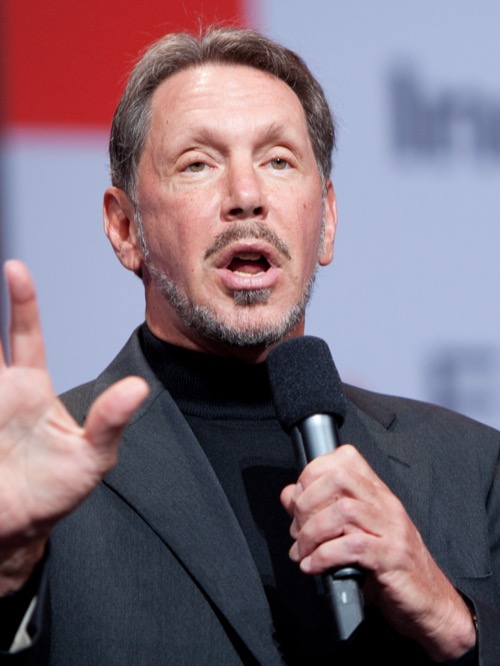
Co-founder, Oracle · b. 1944 · The Bronx, New York → Chicago, Illinois
Two calls made by hand, not formulas. how we score →
Summary
His nineteen-year-old birth mother couldn't raise him, so her aunt and uncle adopted him into a middle-class Chicago household.
He dropped out of two colleges, put $1,200 of his own savings into a database company built on technology IBM hadn't shipped yet, and held onto the stock for almost fifty years while it compounded into one of the largest fortunes alive.
How it happened
Born in the Bronx to Florence Spellman, a 19-year-old unmarried mother. After he caught pneumonia at nine months old, she sent him to her aunt and uncle in Chicago, Lillian and Louis Ellison, who adopted him. He didn't learn he was adopted until he was twelve. Louis was distant and authoritarian, and Ellison has said he attributes more of his outlook to that relationship than to the adoption itself. He left the University of Illinois when Lillian died partway through his sophomore year, tried the University of Chicago for one term, and left that too.
He moved to California in 1966 with barely enough money for gas, taught himself programming, and worked his way through Amdahl, Ampex, and Omex. At Ampex he crossed paths with Bob Miner, who ran a database project for the CIA nicknamed Oracle and later became his boss. In 1977 Ellison, Miner, and Ed Oates pooled about $2,000 to start Software Development Laboratories; $1,200 of it was Ellison's. They built a commercial version of the relational database Edgar Codd had described in an academic paper years earlier, before IBM had one on the market.
For most of the 1980s the company doubled revenue almost every year and went public in 1986. Then in 1990 the sales force had been booking future license value as current-quarter revenue, the actual cash didn't show up, and the stock lost more than half its value in a day. Oracle restated earnings twice, cut a tenth of its staff, and got through it on a $250 million bank credit line and, later, outside financing that included an investment from a Japanese steel company. Ellison called it an incredible business mistake. Nobody personally absorbed the loss; the company did.
He ran Oracle as CEO for 37 years, stepped back to chairman and chief technology officer in 2014, and kept a stake that's held between roughly a quarter and 40 percent of the company for decades. Forbes puts his net worth at $187.7 billion as of this writing, almost all of it Oracle stock. He's also known for a genuinely combative public style, a contested insider-trading settlement, hiring investigators who went through a rival advocacy group's trash, two America's Cup wins, and owning most of a Hawaiian island.
The coded evidence
Thirteen groups, every claim sourcedRaised by an adoptive father he has described as a Russian immigrant.
In his own Academy of Achievement interview, Ellison describes his father as "a Russian immigrant" and a WWII bomber pilot. Other biographical accounts (Wikipedia, Business Insider) instead describe his biological father as an Italian-American Army Air Corps pilot, and his adoptive father Louis as taking the surname "Ellison" for Ellis Island without specifying his birth country. The record is genuinely mixed here; coded from Ellison's own on-record account.
↗ achievement.orgA stable, middle-class adoptive home existed, but Ellison has described his relationship with his adoptive father as distant and unsupportive. Whether it functioned as a usable fallback by the time he founded Oracle in 1977 is not established.
↗ achievement.orgA re-employable skill, not a person. He worked salaried programming jobs at Amdahl, Ampex, and Omex through the early-to-mid 1970s in a Silicon Valley computer industry with strong demand for that skill.
↗ fundinguniverse.com0
His first marriage (to Adda Quinn) had ended in 1974; his first child wasn't born until 1983, with his third wife. No dependents at founding.
↗ en.wikipedia.orgAdoptive father Louis Ellison was a government employee who had made and then lost a real-estate fortune in Chicago during the Depression; one other account describes him as an accountant. Adoptive mother Lillian Spellman Ellison is described as warm and loving; her occupation isn't established.
The Guardian, drawing on Mike Wilson's biography, describes Louis as "an accountant" rather than a government employee; the two accounts trace to the same underlying biography and the exact occupation isn't settled.
↗ en.wikipedia.orgHis birth mother, Florence Spellman, was 19 and unmarried and "really was unable to care for" him, in his words. She tried until he was nine months old, then he was adopted by her aunt and uncle, Lillian and Louis Ellison, in Chicago. He didn't know he was adopted until he was twelve.
Ellison's own on-record account, Academy of Achievement interview.
↗ achievement.orgNot established as sanction. Ellison describes his adoptive father as authoritarian and unsupportive of questioning authority, which reads as the opposite of the kind of active permission this field is meant to capture.
↗ achievement.orgTransferred from birth mother to adoptive aunt and uncle at nine months old, following a bout of pneumonia.
↗ britannica.comChicago's South Shore, a majority-white neighborhood with a Jewish population estimated around 20 percent in the early 1950s. One biographer, pushing back on a poorer version of the story, has written that the family "was not poor" and the neighborhood "was once one of the south side's most desirable."
The Wilson-biography quote is reported via a Guardian profile (theguardian.com/g2/story/0,3604,215072,00.html); direct re-fetch of that page was blocked in this session, so it's cited as a secondary characterization rather than independently re-verified here.
↗ en.wikipedia.orgBorn in the Bronx; moved to Chicago at nine months via adoption; moved to California (Berkeley) in 1966 after leaving college, which is where his technology career and Oracle both began.
↗ en.wikipedia.orgMoved as an infant to live with, and be raised by, his mother's aunt and uncle in Chicago rather than a random adoptive placement.
↗ achievement.orgAmpex Corporation, where accounts describe him working on a database project for the CIA nicknamed "Oracle," alongside Bob Miner, who supervised him and later co-founded the company with him.
Contested in the primary record. A 2007 Computer History Museum oral history with an early Oracle employee quotes co-founder Bob Miner describing the CIA relational-database contract as one of two options the already-founded Software Development Laboratories chose between by coin flip in 1977 — which would place the CIA "Oracle" work after founding, not at Ampex before it. The Ampex version is the one repeated in most secondary profiles (Wikipedia, Britannica-linked accounts, Guardian); flagged here rather than silently resolved.
↗ en.wikipedia.orgNetwork, Idea
Ampex/Omex supplied the professional network that became his co-founders and early exposure to database engineering and Codd's relational model, not capital or an existing customer base.
↗ fundinguniverse.comBob Miner and Ed Oates, both met through prior Silicon Valley jobs; Bruce Scott joined shortly after as a third technical co-founder. Miner had been Ellison's supervisor at Ampex.
One primary account (Computer History Museum oral history) suggests Miner founded Software Development Laboratories first and the others joined within months, rather than all founding simultaneously.
↗ maxim.comProfessional-grade access to IBM-compatible mainframe development at Amdahl and advanced database engineering at Ampex, at a time when that equipment and training were not broadly available outside a handful of firms.
↗ fundinguniverse.comNo degree. Attended the University of Illinois Urbana-Champaign (1962–1964, pre-med, left after his adoptive mother's death) and the University of Chicago (one term in 1966, physics and math) without completing either.
↗ britannica.comAbout $2,000 pooled among the three founders to start Software Development Laboratories in June 1977; $1,200 of it was Ellison's own savings, for 60% ownership. Miner and Oates put in $400 each for 20% apiece.
One other source (FundingUniverse) gives the pooled total as $1,500 rather than $2,000.
↗ maxim.comIt paid its own way from the start. Revenue came before any outside money.
The company's first work was a roughly $50,000 CIA database contract, not outside investment.
↗ fundinguniverse.comGrew on revenue through the mid-1980s with no confirmed institutional venture round before its March 1986 IPO, though venture capitalist Donald L. Lucas joined the board as chairman in 1980. After the 1990 near-collapse, the company took a $250 million bank credit line, a further $100 million financing in October 1991, and an $80 million investment from Nippon Steel in December 1991. Ellison has held roughly a quarter to 40% of Oracle for decades.
No confirmed figure exists for what Lucas himself invested, and Ellison's exact ownership percentage at the 1986 IPO isn't established from public sourcing.
↗ en.wikipedia.orgBuilt on Edgar F. Codd's academic paper describing the relational database model. Ellison tracked IBM's own published research and moved to ship a commercial relational database before IBM did; IBM refused to share System R's error codes when he sought compatibility.
↗ en.wikipedia.orgOracle's 1990 near-collapse was absorbed by the company itself, through a bank credit line and later outside financing, restated earnings, and layoffs — not by Ellison personally.
↗ fundinguniverse.comCodd's relational model was published in academic form but not yet commercialized; IBM was still developing its own relational products. Oracle shipped a commercial relational database roughly two years ahead of IBM's SQL/DS.
↗ fundinguniverse.comBuilt. Created the first commercial relational database product rather than acquiring an existing one.
↗ fundinguniverse.com49
From the 1977 founding through 2026; he stepped down as CEO in 2014 but has remained chairman, CTO, and a major shareholder throughout.
↗ en.wikipedia.orgEnterprise software
↗ forbes.com187700000000
Forbes "Real Time Net Worth," reflecting change since 5pm ET of the prior trading day. This figure moves substantially with Oracle's stock price; Wikipedia separately cites $201–203B for "early 2026" and a brief peak near $393B on Sept 10, 2025. Band only, not a fixed number.
↗ forbes.comPublic equity
Derived from his disclosed roughly 40% stake in publicly-traded Oracle Corporation at market price.
↗ forbes.com2026
↗ forbes.comNearly all of it is Oracle stock, an appreciating owned asset, not salary or other income.
↗ forbes.comTwo America's Cup wins with Oracle Team USA (2010 and 2013); acquired roughly 98% of the Hawaiian island of Lānaʻi in 2012.
↗ en.wikipedia.orgUncapped
↗ forbes.comA Delaware Chancery Court ruled in 2003 that Ellison and then-CFO Jeffrey Henley were not liable for insider trading over his January 2001 sale of nearly $900 million in Oracle stock, made shortly before a March 2001 earnings warning that cut the stock's value roughly in half. A related shareholder derivative suit was separately settled in September 2005, when Ellison agreed to donate $100 million of his own money over five years to charity in Oracle's name, without admitting wrongdoing; a judge separately blocked Oracle from reimbursing about $24 million of his legal fees.
↗ web.archive.orgIn 2000, during Oracle's public campaign against Microsoft, the company hired investigators who examined the trash of Microsoft-aligned advocacy groups, reportedly including a $1,200 offer to janitors at one group's office. Ellison publicly defended it, calling it "unsavory, yucky — kind of. But legal," and framed it as a public service exposing how Microsoft was shaping opinion through front groups.
Quotes corroborated across Wikipedia's Oracle Corporation article and this Business Insider retrospective, both citing contemporaneous 2000 Fortune and AP interviews; the original interview text itself wasn't independently re-fetched in this session.
↗ businessinsider.comUnrelated
The stock sale and settlement had no bearing on how Oracle was founded or built.
↗ web.archive.orgCivil wrong
↗ web.archive.orgPersonal liability
Structured as a charitable pledge rather than a fine, and paid from his own assets rather than Oracle's, with no admission of wrongdoing.
↗ web.archive.orgCombative, Competitive, Flamboyant, Controlling
A Time-quoted industry figure describes his competitor language as consistently violent: "the metaphors when he's speaking of competitors are always violent... he sees this as personal combat."
↗ theguardian.comPress
↗ theguardian.comBefore
Described as part of Oracle's sales culture well before his current wealth level.
↗ theguardian.comMixed
Read as an asset in competitive business terms (feared, taken seriously) and as a liability in public and regulatory scrutiny.
↗ theguardian.comStructural context
The cost-of-failure score comes from this person's own money and circumstances. But who they were in America carried its own weight, the same way their household or income did, and it shaped how hard the path was just as much. That part isn't in the cost-of-failure number. It's here instead.
Men founded the companies that took nearly all the venture funding and almost every top outcome, a tailwind that never shows up in one person's own circumstances.
↗ techcrunch.comWhite founders are heavily overrepresented among funded companies and top-tier wealth relative to their share of the population, an edge that has nothing to do with a person's own money.
↗ techcrunch.comImmigrants and their children are overrepresented among America's biggest companies, as founders and as senior leaders. They got there through the visa, credential, and network hurdles that make the path harder to even start down.
↗ forbes.comAmong the people recorded here — men: 169 · White subjects: 114. Representation here is who reached these outcomes, not equal odds of reaching them.
Controlled comparisons
Each holds one thing constant and varies another, so the difference is the point. A list of similar names wouldn't tell you anything.