Larry Page
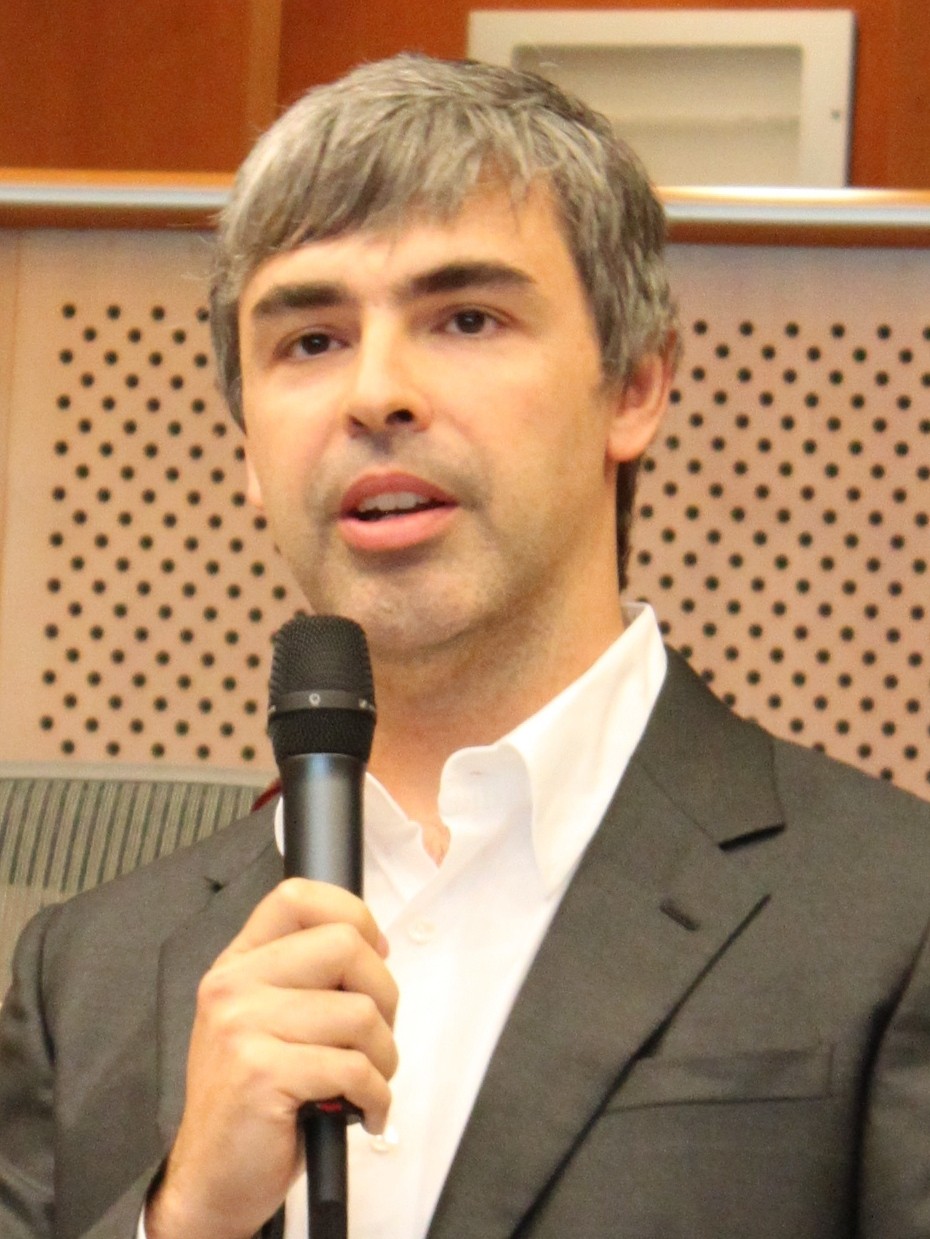
born Lawrence Edward Page
Co-founder, Google / Alphabet · b. 1973 · East Lansing, Michigan
Two calls made by hand, not formulas. how we score →
Summary
Two computer-science academics raised their son around an early home computer and free rein to take things apart.
A funded Stanford PhD program supplied the algorithm, the co-founder, and the investor introductions. A $100,000 check written to a company that didn't yet legally exist got Google incorporated in 1998, and a dual-class structure let him keep the vote for two decades after.
How it happened
Page was born in 1973 in East Lansing, Michigan, to Carl Victor Page Sr., a computer science PhD who taught at Michigan State University, and Gloria Page, who taught computer programming at MSU's Lyman Briggs College. He attended a Montessori school from age two to seven, and at six his father brought home an Exidy Sorcerer, one of the family's first personal computers; the house was reportedly always cluttered with electronics and technology magazines. His father died of pneumonia in May 1996, while Page was in his first year at Stanford.
He earned a computer engineering degree with honors from the University of Michigan, then went to Stanford for a PhD, where he met Sergey Brin at new-student orientation in 1995. Working under advisor Terry Winograd on a research project about the web's link structure, the two turned an idea about ranking pages by citation into PageRank, then built an early search engine on Stanford's own servers.
In August 1998, Sun Microsystems co-founder Andy Bechtolsheim, brought in through Stanford professor David Cheriton, wrote a $100,000 check made out to "Google Inc." before the company legally existed, which is what pushed Page and Brin to incorporate that September so it could be cashed. A roughly $1 million friends-and-family round followed, then Kleiner Perkins and Sequoia Capital each put in $12.5 million in June 1999 after both insisted on investing together.
Google went public in 2004 under a dual-class structure that let the founders keep control of the vote as their economic stake diluted, a structure that carried through Alphabet's 2015 reorganization and a 2012 stock split that added a third, non-voting share class. Page ran the company as CEO from 1998 to 2001, then as President of Products under Eric Schmidt, then as CEO again from 2011, and as Alphabet's first CEO from 2015 once Google was restructured under a holding company.
Page stepped down as Alphabet's CEO in December 2019, handing the role to Sundar Pichai and staying on only as a board member and controlling shareholder. Since then he has largely stayed out of public view, backing aviation projects including Kitty Hawk and Opener, founding an AI-focused manufacturing startup called Dynatomics in 2023, and living much of the time outside the US, including New Zealand and Fiji.
The coded evidence
Thirteen groups, every claim sourcedMulti-generation American on both sides; no international immigration into his own household is documented. His maternal grandfather's move TO Israel (aliyah) is the only cross-border move noted in the family record, and it did not involve Page himself.
↗ en.wikipedia.orgGrew up in a stable, two-income academic household in East Lansing — a tenured university professor and a college instructor — with no housing precarity documented at any point before Google's founding.
↗ en.wikipedia.orgFull-time Stanford computer-science graduate student when Google began, supported through the university rather than an outside job; no personal debt is documented at the time of founding.
No specific stipend or funding figure for his own graduate years was located.
↗ en.wikipedia.orgnot established
No debt is documented at either degree or at founding. Not established.
↗ en.wikipedia.orgNone documented around Google's 1998 founding. His father's death from pneumonia in May 1996 was a real loss during his first year at Stanford, but it did not disrupt his enrollment or create financial instability; his mother remained employed.
↗ maxim.comThe hardship was imposed, not chosen. There was nothing to fall back on.
No period of chosen or imposed austerity is documented during the build itself.
↗ en.wikipedia.orgFather Carl Victor Page Sr., a PhD in communications science from the University of Michigan (1965) who became a computer-science professor at Michigan State University; mother Gloria Page taught computer programming at MSU's Lyman Briggs College.
↗ maxim.comNeither parent was self-employed.
Both parents held university teaching positions, not self-employment.
↗ en.wikipedia.orgFather held a University of Michigan PhD; mother held a college-level teaching post in computer programming. Exact degree for his mother is not specified in available sources.
↗ maxim.comNone documented. He grew up in East Lansing through high school, then moved directly to Ann Arbor for college and Palo Alto for graduate school — an orderly, single-state upbringing with no displacement.
↗ en.wikipedia.orgHis father, Carl Page, died of pneumonia in May 1996 at 58, after a lifetime living with the after-effects of childhood polio. Page was in his first year of graduate school at Stanford at the time.
↗ maxim.comPage's left vocal cord became paralyzed in 1999, shortly after Google's founding, and his right vocal cord was later affected by an illness contracted in 2012; both have been attributed to Hashimoto's thyroiditis, an autoimmune thyroid condition. Reporting has linked the resulting soft, strained voice to his reduced public-speaking appearances in later years.
↗ en.wikipedia.orgHis father's death in 1996, during Page's first year of graduate school, is well documented across multiple biographical accounts as a formative loss; one account describes Page later being moved by finding his father's decades-old valedictory speech. The family's financial security was not disrupted by it.
↗ maxim.comEast Lansing, Michigan, adjacent to the Michigan State University campus.
↗ en.wikipedia.orgMontessori school (Okemos Montessori School) from age two to seven, then East Lansing public schools through high school, graduating in 1991.
↗ en.wikipedia.orgNone. He stayed in Michigan through his undergraduate degree, then moved once, to Stanford, for graduate school — no displacement or cross-border migration in his own life.
↗ en.wikipedia.orgStanford professor David Cheriton, a friend of Sun Microsystems co-founder Andy Bechtolsheim, connected the two; Bechtolsheim wrote the first $100,000 check on the strength of a brief early-morning demo.
↗ en.wikipedia.orgStanford's computer science PhD program, where he worked on a research project studying how to rank web pages by their link structure. It supplied the technical foundation, the co-founder, and, through faculty connections, the first outside investor.
↗ en.wikipedia.orgIdea, Network, Skill, Credibility
Stanford supplied the research problem that became PageRank, the co-founder, the technical training, and enough institutional standing that a professor's introduction reached a Silicon Valley angel directly.
↗ en.wikipedia.orgSergey Brin, met at Stanford new-student orientation in 1995.
↗ en.wikipedia.orgBuilt and hosted early versions of the search engine on Stanford's own servers and network infrastructure as a graduate researcher, ahead of what an outside hobbyist could access.
↗ en.wikipedia.orgB.S. with honors in computer engineering, University of Michigan (1995); M.S. in computer science, Stanford University (1998). Entered Stanford's computer-science PhD program in 1995 and remained on leave from it after founding Google in 1998, never completing it.
↗ forbes.comnot established
No debt is documented at either degree. Stanford computer-science graduate students in this era were typically supported through department fellowships or research/teaching assistantships, but no specific funding source for Page's own program was located.
↗ en.wikipedia.orgDirect pathway: an in-state public university for the bachelor's degree, then straight into an elite PhD program with no gap or employer in between.
↗ en.wikipedia.orgAndy Bechtolsheim wrote a $100,000 check made out to "Google Inc." in August 1998, before the company was legally incorporated, which forced Page and Brin to formally incorporate that September so the check could be deposited.
↗ en.wikipedia.orgnot established
A roughly $1 million "friends and family" round is documented as part of the earliest funding, but no source itemizes how much, if any, came specifically from Page's own family rather than Brin's or outside acquaintances.
↗ en.wikipedia.orgKleiner Perkins and Sequoia Capital each put in $12.5 million in a $25 million round announced June 7, 1999, after both firms initially balked at co-investing and were persuaded by the founders' insistence on having both.
↗ en.wikipedia.orgRam Shriram, an early Netscape and Amazon-adjacent executive, invested early and later joined Google's board, bringing operating experience alongside capital.
↗ en.wikipedia.orgVenture-backed from 1998, public since 2004. A 2012 stock split added a third, non-voting share class on top of the original two, letting the founders' voting power decline much more slowly than their economic stake as they sold and diluted over two decades.
↗ en.wikipedia.orgFounded the Carl Victor Page Memorial Fund, named for his father, and gave through it and directly, including $15 million toward the 2014 West Africa Ebola response and over $20 million to voice-nerve research at Boston's Voice Health Institute — a cause connected to his own vocal cord condition.
↗ forbes.comGrew out of a Stanford research project, initially framed around digital libraries, studying how to rank web pages using their link structure rather than keyword matching alone — an academic research question, not an observed commercial gap.
↗ en.wikipedia.orgAlphabet's Class B stock carries ten votes to Class A's one. As of the company's April 2026 proxy statement, Page and Brin together control 52% of Alphabet's total voting power while owning less than 11% of outstanding voting stock, a gap maintained since Google's 2004 IPO.
Figure is reported jointly for Page and Brin; the proxy does not break out Page's voting share alone in the sections retrieved.
↗ sec.gov0
No separate venture before Google is documented; a single continuous path from graduate research to founding.
↗ en.wikipedia.orgBefore incorporation, the cost was mostly his and Brin's own time as funded graduate students; once the company existed, angel and venture investors carried the financial risk.
↗ en.wikipedia.orgFounded during the 1998-1999 dot-com boom, when venture capital was abundant and web search was fragmented among several players (AltaVista, Excite, and others), none of which had made ranking quality their core product bet.
↗ en.wikipedia.orgStanford campus, then a rented garage belonging to future Google/YouTube executive Susan Wojcicki in Menlo Park.
↗ en.wikipedia.orgBuilt the search engine from their own research rather than acquiring or licensing an existing product.
↗ en.wikipedia.orgInternet search and online advertising; since 2019, aviation and AI-driven manufacturing ventures outside Alphabet
↗ forbes.com287600000000
Forbes real-time estimate as of September 22, 2026; moves daily with Alphabet's share price. Band only. Wikipedia cites a higher Bloomberg Billionaires Index figure (~$334.1 billion) for the same period; Forbes's own profile page is used here for consistency with the Brin record.
↗ forbes.comPublic equity
Built substantially around his disclosed Alphabet Class A/B/C holdings per SEC beneficial-ownership filings, not a private estimate.
↗ sec.gov2026
↗ forbes.com1
Page set his own base salary at $1 a year starting in 2004 and kept it there through his CEO tenures, per Google/Alphabet proxy statements; his real compensation was almost entirely his existing equity appreciating, not pay.
↗ sec.govWealth is almost entirely realized through his controlling Alphabet equity stake rather than any compensation package or liquidity event separate from the stock itself.
↗ forbes.comWealth in owned and voting-controlled equity, not salary. His fortune tracks Alphabet's share price directly rather than any pay package.
↗ forbes.comBacked Kitty Hawk and Opener, flying-vehicle startups later folded into the Wisk Aero joint venture with Boeing in 2022, and founded Dynatomics, an AI-driven manufacturing-optimization startup, in 2023.
↗ en.wikipedia.orgUncapped
↗ forbes.comA federal judge ruled in August 2024 that Google illegally maintained a monopoly in general search and search advertising; a September 2025 remedies order barred exclusive default-search contracts and required data sharing with rivals, but did not order a breakup of Chrome or Android. Both rulings came nearly five years after Page had stepped down from any Alphabet executive role.
↗ en.wikipedia.orgA jury found for Epic Games on all counts in December 2023, ruling that Google's Play Store practices were anticompetitive; a 2024 injunction forced Google to allow rival Android app stores, and the companies settled on reduced Play Store fees in March 2026.
↗ en.wikipedia.orgAfter
Both cases concern conduct built on top of Google's already-established market dominance, decades after founding and years after Page's own executive tenure ended.
↗ en.wikipedia.orgIncidental
The founding advantage came from the PageRank algorithm and its early funding, not from the later distribution deals the courts examined.
↗ en.wikipedia.orgCivil wrong
↗ en.wikipedia.orgNone
Both cases produced corporate behavioral remedies and a negotiated fee settlement; no personal liability or fine against Page individually is documented, and his board seat and voting control were unaffected.
↗ en.wikipedia.orgVisionary, Moonshot oriented, intensely private, Media averse
Forbes and other coverage describe him as having largely avoided public appearances since Sundar Pichai became Google's CEO in 2015 and especially since he left Alphabet's board role in 2019.
↗ forbes.comPress
↗ forbes.comBefore
His reputation as a technical visionary dates to the PageRank research itself, before the antitrust coverage of the 2020s.
↗ en.wikipedia.orgMixed
An asset as Google's chief technologist and product visionary; a liability in later years insofar as his near-total public withdrawal drew criticism as Alphabet faced antitrust scrutiny with its controlling shareholder largely unreachable.
↗ en.wikipedia.orgThe reputation accrued from behaviour rather than being manufactured.
Gives few interviews and has not built a public narrative through memoirs or media the way some peers have.
↗ forbes.comStructural context
The cost-of-failure score comes from this person's own money and circumstances. But who they were in America carried its own weight, the same way their household or income did, and it shaped how hard the path was just as much. That part isn't in the cost-of-failure number. It's here instead.
Men founded the companies that took nearly all the venture funding and almost every top outcome, a tailwind that never shows up in one person's own circumstances.
↗ techcrunch.comWhite founders are heavily overrepresented among funded companies and top-tier wealth relative to their share of the population, an edge that has nothing to do with a person's own money.
↗ techcrunch.comAmong the people recorded here — men: 169 · White subjects: 114. Representation here is who reached these outcomes, not equal odds of reaching them.
Controlled comparisons
Each holds one thing constant and varies another, so the difference is the point. A list of similar names wouldn't tell you anything.