Mark Cuban
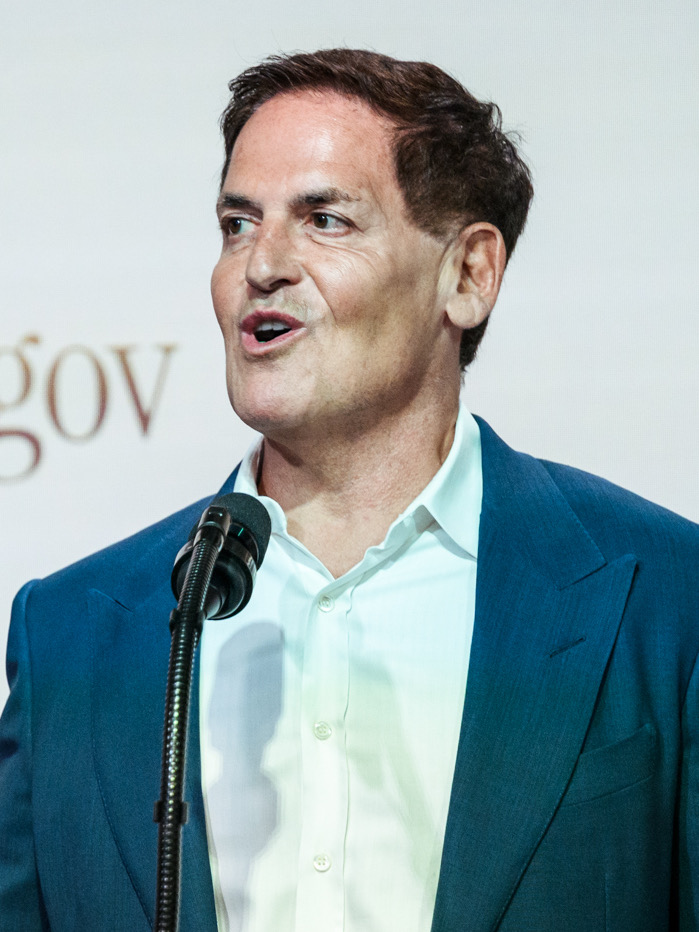
Co-founder, Broadcast.com; owner, Dallas Mavericks; "Shark Tank"; Cost Plus Drugs · b. 1958 · Pittsburgh, Pennsylvania
Two calls made by hand, not formulas. how we score →
Summary
Working-class Pittsburgh, no capital, no elite degree.
He built two companies mostly on customer relationships and his own paychecks, sold the first for a few million, and sold the second to Yahoo for $5.7 billion in stock. What actually protected the money was a hedge he put on with Goldman Sachs six months later, which ended up paying out more than the sale itself once Yahoo's stock collapsed.
How it happened
Raised in Mount Lebanon, an affluent Pittsburgh suburb his family didn't quite match financially. His father worked as an automobile upholsterer; his mother moved between jobs. At twelve he sold garbage bags door to door to pay for a pair of basketball shoes, and later ran newspapers between Cleveland and Pittsburgh during a press strike. He picked Indiana University over other business schools mainly because it had the cheapest tuition on the list, and paid his own way through with a bar, disco lessons, and a chain letter.
After college he sold PC software in Dallas and got fired within a year for going to close a sale instead of opening the store. He started MicroSolutions with some of his former customers as early clients, built it into a systems-integration business with Perot Systems as its biggest account, and sold it to CompuServe in 1990 for about $6 million, roughly $2 million to him after taxes.
In 1995 he and Indiana classmate Todd Wagner took over a small internet radio operation and rebuilt it as AudioNet, later Broadcast.com. It raised some outside money along the way — angel funding, then a Series A led by Motorola — but Cuban kept a large stake. The July 1998 IPO popped roughly 250% on its first day, a record at the time, and in April 1999 Yahoo bought the company for stock reported at $5.7 billion.
Locked out of selling for six months under the deal terms, Cuban had Goldman Sachs build him a zero-cost collar on his Yahoo shares — puts that put a floor under his losses, calls that capped his upside, one paying for the other. When Yahoo's stock fell from its 2000 peak to a fraction of that within two years, the collar was the thing standing between him and the same wipeout that hit most dot-com paper billionaires who didn't hedge.
He bought the Dallas Mavericks in January 2000 for $285 million, won an NBA title in 2011, and sold a majority stake to the Adelson-Dumont family in a deal that closed in December 2023. He's invested through "Shark Tank" since 2011 and co-founded Cost Plus Drugs in 2022 to sell generic drugs near manufacturing cost. Forbes puts his net worth around $6 billion.
The coded evidence
Thirteen groups, every claim sourcedPaternal grandfather emigrated from the Russian Empire (present-day Ukraine) and changed the family name from Chabenisky to Cuban; maternal grandparents were Bessarabian and Lithuanian Jewish immigrants.
↗ en.wikipedia.orgDescendant; multi-generation US-born on both sides
↗ en.wikipedia.orgHe has said being Jewish "allowed me to be more empathetic"; denomination not established from the public record.
↗ en.wikipedia.orgnot established
Not established either way. His parents kept a stable working-class household in Pittsburgh throughout his twenties, but no source confirms or rules out whether he could have moved back in had Dallas failed.
↗ en.wikipedia.orgnot established
↗ en.wikipedia.orgEarly in Dallas he worked as a bartender and then a PC-software salesman, at one point sharing a small apartment with several roommates. He was fired from the software job within a year for going to close a sale instead of opening the store, which is the story he credits with pushing him to start MicroSolutions.
↗ forbes.comnot established
No documented family fallback either confirms or rules out whether the early Dallas years were chosen or imposed austerity. Treated as not established rather than scored either way.
↗ en.wikipedia.orgFather Norton Cuban was an automobile upholsterer. Mother Shirley Feldman moved between jobs; Cuban has described her as having "a different job or different career goal every other week."
↗ en.wikipedia.orgnot established
Not established whether his father owned the upholstery shop or was employed at one.
↗ en.wikipedia.orgMount Lebanon, an affluent Pittsburgh suburb, though the family itself was working-class relative to their neighbors.
↗ en.wikipedia.orgCustomers from his prior sales job who followed him to MicroSolutions and became its early accounts, including Perot Systems, which became its largest client.
↗ en.wikipedia.orgPre-existing relationships carried over from his prior sales job.
↗ en.wikipedia.orgYour Business Software, an early Dallas PC-software retailer, where he worked sales before being fired.
↗ en.wikipedia.orgSkill, Network
Supplied product knowledge and customer relationships; several of his former customers became MicroSolutions' first clients.
↗ en.wikipedia.orgNo agent or introduction into either venture. He bought into an existing tiny internet-radio operation for $10,000 in 1994 and rebuilt it into Broadcast.com rather than being recruited or funded in.
↗ en.wikipedia.orgTodd Wagner, an Indiana University classmate, restructured AudioNet with him in September 1995 into what became Broadcast.com.
↗ en.wikipedia.orgB.S. in management, Indiana University Bloomington, 1981. Started at the University of Pittsburgh for one year before transferring.
↗ en.wikipedia.orgRan a campus bar, taught disco dance lessons, and sold a chain letter to cover costs while enrolled.
↗ en.wikipedia.orgDirect four-year path with one transfer. Chose Indiana specifically because it had the lowest tuition among the top-ranked business schools he considered.
↗ en.wikipedia.orgMicroSolutions started with little formal capital, built instead on carried-over customer relationships from his prior sales job; an exact starting amount isn't established. Separately, he put $10,000 into a 2% stake in a small internet-radio operation in 1994, which became Broadcast.com.
↗ en.wikipedia.orgIt paid its own way from the start. Revenue came before any outside money.
Both MicroSolutions and the AudioNet/Broadcast.com rebuild were funded from client revenue, not upfront capital.
↗ en.wikipedia.orgAudioNet/Broadcast.com raised about $1 million in angel funding in 1996 and a $5 million Series A led by Motorola in 1997, then went public in 1998. Despite the outside money, Cuban's stake was still worth roughly $300 million at the IPO close, implying he retained a large ownership share rather than being diluted to a minority position.
↗ en.wikipedia.orgMicroSolutions' roughly $2 million in after-tax proceeds (1990) funded his years building AudioNet before it raised any outside money. The much larger Yahoo windfall in 1999 was partly cashed out through the hedge described below and later redeployed into the Dallas Mavericks ($285 million, 2000).
↗ en.wikipedia.orgnot established
No evidence he liquidated retirement savings or maxed credit to fund either venture; both were revenue-funded.
↗ en.wikipedia.org3
Took ownership or founder-level equity, rather than only a fee, across at least three unrelated categories: professional sports (Mavericks), television investing ("Shark Tank" portfolio companies), and consumer healthcare (Cost Plus Drugs).
↗ forbes.comnot established
Various small college ventures (bar, disco lessons, chain letter) and being fired from his first Dallas sales job aren't clearly distinct venture failures; no documented count of failed businesses before MicroSolutions.
↗ en.wikipedia.orgSelf, from wage jobs (bartending, sales) before MicroSolutions turned a profit.
↗ forbes.com40
Yahoo's acquisition of Broadcast.com was announced April 1, 1999; born July 1958.
↗ en.wikipedia.orgLaunched into the mid-to-late-1990s dot-com IPO boom; Broadcast.com's July 1998 IPO popped roughly 250% on its first day, a record at the time, and Yahoo's all-stock offer nine months later came near the top of the internet-stock market before its 2000–2002 collapse.
↗ en.wikipedia.orgBought a $10,000 stake in an existing small operation (Cameron Audio Networks) in 1994, then rebuilt it from near-scratch into Broadcast.com rather than acquiring an already-proven asset.
↗ en.wikipedia.orgInternet media, professional sports, and consumer healthcare
↗ forbes.com6000000000
↗ forbes.com2026
↗ forbes.comMostly realized. The Goldman Sachs collar converted most of the Yahoo stock windfall to protected, largely liquid value rather than leaving it exposed as paper wealth through the 2000–2002 crash, and the 2023 Mavericks stake sale was a cash transaction.
↗ celebritynetworth.comWealth built from two outright company sales and a diversified portfolio (sports team, media investments, a pharmacy company), not salary income.
↗ forbes.comOwned the Mavericks through their 2011 NBA championship; became a long-running "Shark Tank" investor from 2011; co-founded Cost Plus Drugs in 2022, which by 2023 had a Dallas manufacturing facility and thousands of drugs listed, and by 2025 had partnered with major health systems and insurers.
↗ en.wikipedia.orgUncapped
↗ forbes.comThe SEC filed a civil insider-trading suit in November 2008 alleging Cuban sold his stake in Mamma.com (later Copernic) in June 2004 after being told confidentially about a stock offering that would dilute shares, avoiding a reported loss of about $750,000. A district court dismissed the case in 2009; an appeals court revived it in 2010; a federal jury in Dallas found in Cuban's favor after about three and a half hours of deliberation on October 16, 2013. Cuban maintained throughout that he never agreed to keep the information confidential.
↗ en.wikipedia.orgAfter
The 2004 trade came five years after the Broadcast.com sale that built his fortune.
↗ en.wikipedia.orgUnrelated
A personal stock trade in a company he was not operating, unconnected to how MicroSolutions or Broadcast.com were built.
↗ en.wikipedia.orgBlunt, Combative, Hands on, Self made
↗ en.wikipedia.orgPublic
↗ en.wikipedia.orgBefore
His outspoken, hands-on public persona was well established by the Broadcast.com/dot-com era, before the Mavericks and "Shark Tank."
↗ en.wikipedia.orgMixed
An asset for his media and investing career (built "Shark Tank" fame into deal flow, including the cold-pitch that became Cost Plus Drugs), a liability with the NBA, which fined him at least $1.665 million across 13 incidents, mostly for criticizing officiating.
↗ en.wikipedia.orgThe reputation was deliberately built, through books, press, and PR.
Long-running television presence ("Shark Tank"), frequent media appearances, and active public commentary.
↗ en.wikipedia.orgStructural context
The cost-of-failure score comes from this person's own money and circumstances. But who they were in America carried its own weight, the same way their household or income did, and it shaped how hard the path was just as much. That part isn't in the cost-of-failure number. It's here instead.
Men founded the companies that took nearly all the venture funding and almost every top outcome, a tailwind that never shows up in one person's own circumstances.
↗ techcrunch.comWhite founders are heavily overrepresented among funded companies and top-tier wealth relative to their share of the population, an edge that has nothing to do with a person's own money.
↗ techcrunch.comAmong the people recorded here — men: 115 · White subjects: 74. Representation here is who reached these outcomes, not equal odds of reaching them.
Controlled comparisons
Each holds one thing constant and varies another, so the difference is the point. A list of similar names wouldn't tell you anything.