Martha Stewart
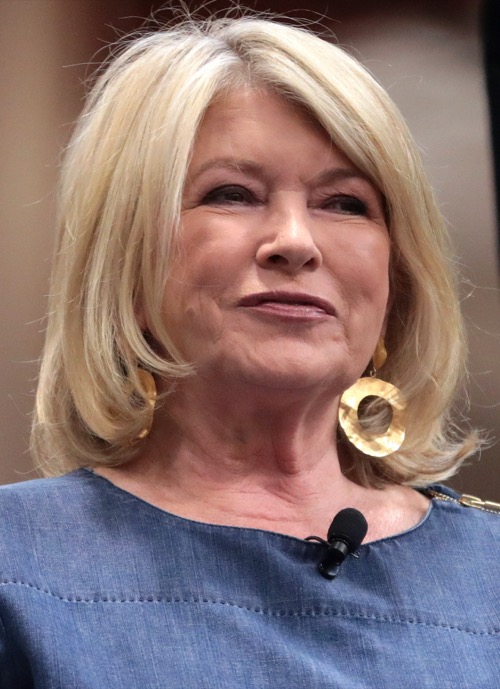
Founder, Martha Stewart Living Omnimedia · b. 1941 · Jersey City, New Jersey
Two calls made by hand, not formulas. how we score →
Summary
A stockbroker turned basement caterer, she turned catering clients and her own domestic skill into a bestselling book, then a magazine, then a media company.
Going public in 1999 brought outside capital from Time Inc. and Kleiner Perkins, but a dual-class structure kept 96 percent of the vote in her hands. A small, unrelated stock sale then cost her five months in prison. She rebuilt from there.
How it happened
Second of six children in a working-class Polish-American family in Nutley, New Jersey. Her father taught school before becoming a pharmaceutical salesman; her mother was also a teacher. She modeled through college to help cover what a partial scholarship to Barnard didn't.
She worked as a stockbroker starting in 1967, her father-in-law's profession, learning to read a balance sheet and pitch a stock. She left when the market slumped in the early 1970s and moved with her husband, a book-publishing executive, to a run-down farmhouse in Connecticut.
In 1976 she started a catering business out of her own basement. It grew into roughly a million dollars of annual business within a decade, largely on referrals among the Manhattan and Connecticut clients she cooked for. One of them, publishing executive Alan Mirken, offered her a cookbook deal that became Entertaining in 1982.
By 1997 she had folded the magazine, television, and merchandising businesses into one company and brought in outside growth capital from Time Inc. and the venture firm Kleiner Perkins. When Martha Stewart Living Omnimedia went public in October 1999, a dual-class share structure let her keep 96 percent of the vote even as her economic stake diluted, and the stock's first-day jump made her a paper billionaire.
In December 2001 she sold a small personal stake in a friend's biotech company on a tip that had nothing to do with her own business. She was never convicted of trading on it; a jury found her guilty in 2004 of conspiracy, obstruction of justice, and lying to federal investigators about the sale, and she served five months in federal prison.
She rejoined her company's board once a federal bar on holding public-company office expired in 2011, and the brand recovered through television, retail licensing, a long-running show with Snoop Dogg, and a 2024 Netflix documentary. Her net worth today is estimated at a few hundred million dollars, a fraction of the paper billion the IPO briefly produced.
The coded evidence
Thirteen groups, every claim sourcedDescribed consistently across sources as of Polish heritage on both sides.
↗ achievement.orgnot established
Not established. Sources describe "Polish heritage" without stating whether her parents were immigrants or US-born descendants of earlier immigrants.
↗ en.wikipedia.orgnot established
Not established in the sourced profiles reviewed. A Polish-American upbringing of this era is often Catholic, but that is an inference, not a sourced fact, so it is left null.
↗ en.wikipedia.orgA stable, working-class two-parent household in Nutley through childhood, though no evidence she drew on it as an adult once she was married and building the catering business from her own home.
↗ achievement.orgHer husband, Andrew Stewart, built a career in book publishing, eventually becoming president of Harry N. Abrams, Inc., during the years she was building the catering business from their home. His income was a floor under a venture with no salary of its own.
The article does not date his executive roles precisely against the 1976–1990 catering years, so the overlap is inferred rather than confirmed year by year.
↗ en.wikipedia.orgnot established
No debt overhang at the start of the catering business is documented.
↗ en.wikipedia.orgNone documented. The catering business ran out of a home she and her husband owned and restored, with his income behind the household throughout.
↗ en.wikipedia.orgThe hardship was imposed, not chosen. There was nothing to fall back on.
No austerity narrative applies either way; there was steady household income throughout.
↗ en.wikipedia.orgFather Edward Kostyra taught school before becoming a pharmaceutical salesman; mother Martha Ruszkowski Kostyra was also a teacher.
↗ achievement.orgNeither parent was self-employed.
Both parents worked as salaried teachers or, for her father later, a salesman, not as business owners.
↗ achievement.org5
Described as the second of six children. One other profile (achievement.org) says "four siblings," which would total five children; the more commonly repeated figure across sources is six.
↗ en.wikipedia.orgNutley, New Jersey, a working- to middle-class suburb; family moved there when she was three.
↗ achievement.orgNutley High School, a public school.
↗ en.wikipedia.orgJersey City to Nutley, New Jersey at age three; Nutley to Manhattan for Barnard College; and, as a married adult in the early 1970s, from New York to a farmhouse in Westport, Connecticut.
↗ en.wikipedia.orgAlan Mirken, a Crown Publishing executive and a catering client, saw her work firsthand at his own parties and offered her a book deal that became Entertaining (1982) — the origin of her media career.
↗ achievement.orgWord of mouth among wealthy Manhattan and Connecticut clients she cooked for, one of whom turned out to work in publishing.
↗ achievement.orgBuilt the catering business door to door from her own home with no industry credential or prior food-service employer; the publishing connection came later, through a client, not an application.
↗ en.wikipedia.orgnot established
No public profile before the 1982 book; the book itself built the initial audience rather than drawing on one.
↗ achievement.org1
Modeling was freelance gig work rather than a single employer. Her one conventional employer before founding her own business was the stockbroker firm Monness, Williams and Sidel, from 1967 to around 1972.
↗ biography.comBA, Barnard College, Columbia University — double major in history and architectural history.
Exact graduation year is not consistently stated across sources.
↗ achievement.orgA partial scholarship covered part of tuition; she supplemented the rest through modeling income during college rather than debt.
↗ en.wikipedia.orgModeled for brands including Chanel, Breck, and Clairol throughout college; sources give differing hourly rates ($15 to $50) depending on the job and year, but agree it materially offset her tuition costs.
↗ en.wikipedia.orgDirect four-year liberal-arts degree; no transfer or delayed enrollment.
↗ en.wikipedia.orgStarted the catering business from her own basement in 1976, funded from household savings. No specific starting amount is documented.
↗ en.wikipedia.orgIt paid its own way from the start. Revenue came before any outside money.
The catering business grew into roughly a $1 million annual business within about a decade, on client revenue, before any outside capital was involved.
↗ achievement.orgAhead of the 1999 IPO, Martha Stewart Living Omnimedia brought in growth equity from Time Inc., its longtime magazine-publishing partner, and from venture firm Kleiner Perkins Caufield & Byers.
SEC S-1/A principal-stockholders table lists Time Inc. at 18.0% and Kleiner Perkins Caufield & Byers (via partner L. John Doerr) at 14.0% of Class A common stock immediately after the offering.
↗ sec.govKleiner Perkins partner L. John Doerr is listed individually as a director and beneficial owner alongside the firm's stake, suggesting board involvement and Silicon Valley credibility rather than a passive check.
↗ sec.govDual-class structure at the IPO: Stewart held all 34,126,831 shares of Class B stock (ten votes each) through a family limited partnership. That represented 70.0% of Class A-equivalent economic ownership but 96.0% of total voting power after the offering — outside capital came in without her losing control.
↗ sec.govPersonal experience and domestic skill — gardening, cooking, and entertaining she was taught by her parents and grandparents — became the content of the books, magazine, and shows directly.
↗ achievement.orgEconomic stake and voting control diverged deliberately: roughly 70% economic ownership on an as-converted basis, 96% of the vote, through the Class A/Class B share structure engineered before the IPO.
↗ sec.govnot established
No independent venture failure is documented. Her first catering partnership, with modeling colleague Norma Collier, dissolved over business disagreements in the late 1970s; Stewart bought out Collier's share rather than the venture failing outright.
↗ en.wikipedia.orgWent public in October 1999, near the peak of the dot-com-era IPO boom. The stock moved from an $18 offer price to a $38 close on its first day, consistent with the era's frothy reception for newly public consumer and media brands.
↗ en.wikipedia.orgNew York City, where the company was headquartered at the time of the IPO.
↗ en.wikipedia.orgBuilt. Created a new lifestyle-media and merchandising category out of her own catering and writing work rather than acquiring an existing company.
↗ achievement.org49
Dated to the 1990 launch of Martha Stewart Living magazine, the platform the later media company was built around.
↗ achievement.org36
Roughly 1990 to the present, through the magazine, IPO, licensing deals, and brand's later ownership changes.
↗ achievement.orgMedia and consumer products
↗ en.wikipedia.org400000000
Aggregator estimate with no disclosed methodology; band only. A significant decline from her brief 1999 paper-billionaire peak — see paperVsRealized.
↗ celebritynetworth.comAggregator
↗ celebritynetworth.comOn the IPO's first trading day, her 34,126,831-share stake at the $38 closing price was worth roughly $1.3 billion on paper, for one day making her the first female self-made billionaire in the US. By February 2002 the stock had fallen to about $16 a share, below half that value, before the ImClone case pushed it lower still.
Share count and voting structure are SEC-sourced (tier A); the $16 February 2002 price point comes from a lower-confidence aggregator account.
↗ en.wikipedia.orgWealth held mostly in company equity and brand and IP value — the magazine, TV rights, and product-licensing royalties — rather than a large fixed salary.
↗ achievement.orgFirst self-made female billionaire in the US (October 1999, on paper); multiple Daytime Emmy wins for The Martha Stewart Show; oldest woman to appear on the cover of the Sports Illustrated Swimsuit Issue, at 81, in 2023; subject of the 2024 Netflix documentary Martha.
↗ en.wikipedia.orgUncapped
↗ sec.govThe SEC brought a civil action over the same ImClone stock sale. Stewart settled without admitting wrongdoing and was barred from serving as an officer or director of a public company until August 2011, effectively closing her out of formal company leadership for roughly five years even after her criminal sentence was served.
↗ en.wikipedia.orgIndicted in June 2003 on charges including securities fraud, obstruction of justice, conspiracy, and making false statements. The securities-fraud count — tied to her public statements defending her own company's stock — did not result in conviction; she was never charged with insider trading in the ImClone shares themselves. A jury convicted her in March 2004 of conspiracy, obstruction of justice, and two counts of making false statements to federal investigators.
↗ achievement.orgAfter
The stock sale was in December 2001, more than two years after the October 1999 IPO that made her famous and wealthy.
↗ en.wikipedia.orgUnrelated
A personal trade in a friend's unrelated biotech company; it played no role in building the media and merchandising business.
↗ en.wikipedia.orgCrime
↗ achievement.orgIncarceration
Served five months at Federal Prison Camp Alderson (October 2004–March 2005), plus a $30,000 fine and two years of supervised release including five months of electronic monitoring. Unlike many corporate-conduct cases here where the consequence is a fine absorbed by the company, this one was borne personally. What her capital and public platform bought was not escape from that consequence but a fast recovery afterward — the company, the audience, and eventually the boardroom seat were all still there when she got out.
↗ achievement.orgPublic
↗ en.wikipedia.orgBefore
Her reputation as an exacting domestic-expertise authority was built through the 1980s and 1990s, well before the 2004 case.
↗ achievement.orgMixed
An asset to her core brand and audience throughout; became a liability and a target of tabloid and comedic mockery during and immediately after the criminal case, before recovering.
↗ en.wikipedia.orgThe reputation was deliberately built, through books, press, and PR.
The "Martha Stewart" persona of exacting domestic authority was built deliberately as a media brand, not an incidental byproduct of the business.
↗ achievement.orgRebuilt visibly and quickly. Rejoined her company's board in 2011 once the SEC's officer/director bar lapsed and became chairwoman again in 2012; co-hosted the VH1 series Martha & Snoop's Potluck Dinner Party from 2016 to 2020, which recast her image through self-aware comedy; became the oldest woman to appear on the Sports Illustrated Swimsuit Issue cover in 2023 at 81; and was the subject of the 2024 Netflix documentary Martha.
↗ en.wikipedia.orgStructural context
The cost-of-failure score comes from this person's own money and circumstances. But who they were in America carried its own weight, the same way their household or income did, and it shaped how hard the path was just as much. That part isn't in the cost-of-failure number. It's here instead.
Startups founded only by women have drawn about 2% of US venture capital, a share that has barely moved in a decade. Raising money as a woman was harder than any one record shows.
↗ techcrunch.comWhite founders are heavily overrepresented among funded companies and top-tier wealth relative to their share of the population, an edge that has nothing to do with a person's own money.
↗ techcrunch.comAmong the people recorded here — women: 68 · White subjects: 114. Representation here is who reached these outcomes, not equal odds of reaching them.
Controlled comparisons
Each holds one thing constant and varies another, so the difference is the point. A list of similar names wouldn't tell you anything.