Mary Wells Lawrence
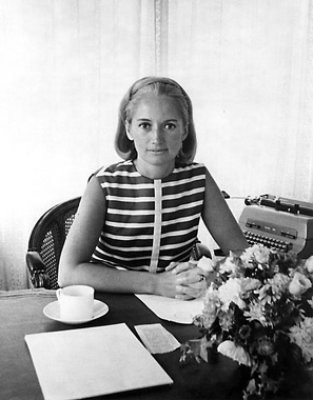
born Mary Georgene Berg
Founder and CEO, Wells Rich Greene; first woman to lead a company listed on the New York Stock Exchange · b. 1928–2024 · Youngstown, Ohio
Two calls made by hand, not formulas. how we score →
Summary
An only child of a furniture salesman in working-class Youngstown, Ohio, she took elocution and drama lessons as a child to cure her shyness, then spent fifteen years climbing through copywriting jobs at stores and agencies.
In 1966, passed over for a promotion, she quit and started her own agency with two colleagues on savings and a bank loan. It made her the first woman CEO of an NYSE company.
How it happened
Born Mary Georgene Berg in 1928, an only child of a furniture salesman and a homemaker in working-class Youngstown, Ohio. She was a shy child, and her mother enrolled her in elocution, music, dance, and drama lessons starting at age five to draw her out. After high school she studied at the Neighborhood Playhouse School of the Theatre in New York, then spent two years at the Carnegie Institute of Technology in Pittsburgh without finishing a degree.
She started writing bargain-basement copy for a Youngstown department store, then moved through Macy's, McCann-Erickson, and seven years at Doyle Dane Bernbach, rising to vice president and copy chief by 1963. In 1964 she joined Jack Tinker & Partners, where she helped create the Alka-Seltzer campaigns and the Braniff International "End of the Plain Plane" makeover that made the airline's colorful new look famous.
Passed over for the presidency at Jack Tinker despite having been the creative force behind its most visible work, she left within weeks. In April 1966 she founded Wells Rich Greene with two Tinker colleagues, Richard Rich and Stewart Greene. Each partner put in $30,000 of their own money, backed by a $100,000 bank loan, and Braniff came with her as the first account. Billings hit $30 million within six months.
The agency's campaigns became some of the most recognized in American advertising: "Plop, plop, fizz, fizz" for Alka-Seltzer, "I can't believe I ate the whole thing," "Quality is Job 1" for Ford, and later "I Love New York." When Wells Rich Greene went public in 1968, she became the first woman to serve as CEO of a company listed on the New York Stock Exchange. By the late 1980s the agency was billing over $800 million a year, and she was widely reported as the highest-paid executive, of any gender, in advertising.
She took the company private again in 1974 and ran it for another sixteen years. In 1990 she stepped down as CEO and sold her stake to the French agency group BDDP, in a deal reported at roughly $160 million for the firm; it was renamed Wells Rich Greene BDDP and wound down by 1998. She retired to a château in the south of France with her husband, former Braniff president Harding Lawrence, and published a memoir, "A Big Life (in Advertising)," in 2002. She died in London on May 11, 2024, at 95.
The coded evidence
Thirteen groups, every claim sourcednot established
No immigration event for either parent is documented in sources consulted.
↗ encyclopedia.comNo move was made for a partner's career.
She moved to New York for her career well before meeting Harding Lawrence in 1966-67; if anything the agency resigned the Braniff account after their marriage to avoid a conflict of interest, rather than her relocating for him.
↗ en.wikipedia.orgA stable, employed two-parent household in Youngstown; no documented family wealth or property beyond that.
↗ bobonbooks.comBy the time she founded Wells Rich Greene in 1966 she had a decade and a half of steady, rising agency salaries behind her (reported at $40,000 at Doyle Dane Bernbach by 1963 and $60,000 at Jack Tinker), which funded her share of the founding capital.
↗ encyclopedia.comCo-founders Richard Rich and Stewart Greene split the founding workload and capital with her as treasurer and secretary of the new firm, each contributing $30,000 alongside her.
↗ encyclopedia.comnot established
Sources list children (James, Stacy, Deborah, Kathryn, Pamela) associated with her marriage to Harding Lawrence, but do not establish whether these were her biological children or his from an earlier marriage, or whether any were dependents at the time of the 1966 founding. Left null rather than guessed.
↗ encyclopedia.comThe three founding partners borrowed $100,000 from a bank on top of their own $30,000 contributions each to launch Wells Rich Greene.
↗ encyclopedia.comnot established
No housing loss, eviction, or comparable instability is documented in any source consulted.
↗ bobonbooks.comnot established
No period of visible hardship is documented to code as chosen or imposed.
↗ bobonbooks.comFather Waldemar Berg worked as a furniture salesman; mother Violet (Meltz) Berg kept the household. Some accounts describe the father as a furniture maker rather than a salesman; the exact trade is not fully settled across sources, but both agree on a working-class, steadily employed household.
↗ bobonbooks.comnot established
Whether the furniture trade was salaried employment or self-employment is not clearly established.
↗ bobonbooks.comWas treated for uterine and breast cancer during the 1980s, while still running Wells Rich Greene, and kept the diagnoses private at the time to protect client confidence in her stewardship of the agency.
Occurred well after the agency's founding and while she was already established and resourced as its CEO, so weighted lightly as a headwind relative to conditions present during the climb itself.
↗ forbes.comThe Youngstown, Ohio area (accounts differ on Youngstown proper versus the nearby suburb of Poland, Ohio), a working-class steel manufacturing region.
↗ bobonbooks.comLocal Youngstown-area schooling, followed by the Neighborhood Playhouse School of the Theatre in New York and two years at the Carnegie Institute of Technology in Pittsburgh, without completing a degree.
↗ encyclopedia.comNone. Youngstown was a steel-manufacturing town with no advertising or media industry nearby; her path in began at a local department store, not through any industry cluster.
↗ bobonbooks.comA job writing bargain-basement copy for McKelvey's, a Youngstown department store, gave her the first entry into advertising before she ever reached Madison Avenue.
↗ davedye.comJack Tinker & Partners, where she was already the visible creative lead on the Braniff account, supplied both the reputation and the client relationship that became Wells Rich Greene's first account when she left to found her own agency.
↗ encyclopedia.comCredibility, Network
↗ encyclopedia.comRichard Rich and Stewart Greene, both colleagues from Jack Tinker & Partners, co-founded Wells Rich Greene with her in 1966, each contributing $30,000 in capital.
↗ encyclopedia.comPassed over for the top job at Jack Tinker & Partners despite having led its most visible creative work, she left within weeks and started her own agency rather than wait for the next opening somewhere else.
↗ encyclopedia.com5
McKelvey's, Macy's, McCann-Erickson, Doyle Dane Bernbach, and Jack Tinker & Partners, before founding Wells Rich Greene.
↗ davedye.comStudied at the Neighborhood Playhouse School of the Theatre in New York after high school, training in performance and presentation she later drew on in client pitches and agency showmanship.
↗ encyclopedia.comNo completed degree. Two years at the Carnegie Institute of Technology (1946-48) plus theatre training at the Neighborhood Playhouse School in New York.
↗ encyclopedia.comDirect entry into department-store and agency copywriting jobs rather than a credentialed pipeline.
↗ davedye.com$30,000 of her own money, one of three equal partner contributions, to found Wells Rich Greene in April 1966.
↗ encyclopedia.comIt paid its own way from the start. Revenue came before any outside money.
The Braniff account, worth about $6.5 million, came with the firm from day one; billings reached $30 million within six months.
↗ encyclopedia.comThe three founders' personal contributions and standing supported a $100,000 bank loan used to launch the agency.
Sources report the loan amount but not its specific collateral terms.
↗ encyclopedia.comHer founding capital came from a decade and a half of rising agency salaries, including a reported $40,000 at Doyle Dane Bernbach by 1963 and $60,000 at Jack Tinker & Partners by 1966 — elite pay for a woman in advertising at the time.
↗ encyclopedia.comWells Rich Greene went public on the NYSE in 1968, then was returned to private ownership in 1974 through a bond-for-stock exchange. She remained the controlling owner and CEO until 1990, when she sold her stake to the French group BDDP in a deal reported at roughly $160 million for the agency.
↗ en.wikipedia.orgAt the 1968 IPO she received about $1.2 million in cash and retained stock reported at over $4 million, and stayed on to run the company rather than cashing out and leaving.
↗ encyclopedia.comHer own. The agency's signature style, built around a single attention-grabbing creative idea per client rather than a research-led pitch, was the approach she had already developed at Doyle Dane Bernbach and Jack Tinker before founding her own shop.
↗ davedye.comAfter the 1968 public listing diluted ownership among outside shareholders, she took the company private again in 1974, reclaiming full control rather than continuing to answer to public investors.
↗ encyclopedia.com0
No failed prior venture is documented; her career before 1966 was continuous employment at a series of agencies.
↗ encyclopedia.comShe and her two co-founders, from personal savings and a bank loan; no outside investor absorbed risk at founding.
↗ encyclopedia.comFounded during the 1960s "creative revolution" in American advertising, an industry-wide shift toward concept-driven, personality creative work led by agencies like Doyle Dane Bernbach, against a backdrop of postwar consumer growth and expanding airline and packaged-goods advertising budgets.
↗ davedye.comNew York City.
↗ encyclopedia.comBuilt. Founded a new agency from nothing rather than acquiring or joining an existing shop.
↗ encyclopedia.comAdvertising and marketing; agency ownership and executive leadership.
↗ en.wikipedia.orgnot established
No source consulted gives a specific personal net-worth figure for Lawrence herself, distinct from the roughly $160 million reported sale price for the whole agency in 1990. Left null rather than guessed.
↗ forbes.com300000
Reported salary figure from the mid-to-late 1970s and again around 1988; almost certainly understates her total compensation as the agency's controlling owner, which also included profit distributions not itemized in sources consulted.
↗ forbes.comJournalistic estimate
↗ forbes.comThe 1968 IPO cash-out (about $1.2 million) was realized; the retained stock (over $4 million at issue) and the 1990 BDDP sale proceeds (agency valued around $160 million) are reported company-level or point-in-time figures, not a confirmed personal realized total.
↗ encyclopedia.comWealth built through ownership of the agency she co-founded and controlled for 24 years, not from a fixed salary alone; the reported salary figures are a floor, not the full picture of what ownership was worth to her.
↗ forbes.comBecame the first woman to serve as CEO of a company listed on the New York Stock Exchange when Wells Rich Greene went public in 1968. Inducted into the Copywriters Hall of Fame in 1969 as its youngest member, and named Advertising Woman of the Year by the American Advertising Federation in 1971. Widely reported to have been an inspiration for the Peggy Olson character on AMC's "Mad Men," though this has never been confirmed by the show's creators.
↗ mediapost.comUncapped
↗ encyclopedia.comVisionary, Charismatic, Glamorous, Demanding, Perfectionist
↗ encyclopedia.comPress
↗ forbes.comAfter
↗ encyclopedia.comAsset
Her glamour and showmanship were part of the agency's pitch itself; she and her husband entertained clients and figures like Princess Grace of Monaco at their château in the south of France.
↗ forbes.comThe reputation was deliberately built, through books, press, and PR.
↗ forbes.comFrequently cited, without confirmation from the show itself, as an inspiration for Peggy Olson on AMC's "Mad Men."
↗ mediapost.comStructural context
The cost-of-failure score comes from this person's own money and circumstances. But who they were in America carried its own weight, the same way their household or income did, and it shaped how hard the path was just as much. That part isn't in the cost-of-failure number. It's here instead.
Startups founded only by women have drawn about 2% of US venture capital, a share that has barely moved in a decade. Raising money as a woman was harder than any one record shows.
↗ techcrunch.comWhite founders are heavily overrepresented among funded companies and top-tier wealth relative to their share of the population, an edge that has nothing to do with a person's own money.
↗ techcrunch.comAmong the people recorded here — women: 54 · White subjects: 74. Representation here is who reached these outcomes, not equal odds of reaching them.
Controlled comparisons
Each holds one thing constant and varies another, so the difference is the point. A list of similar names wouldn't tell you anything.