Michael Dell
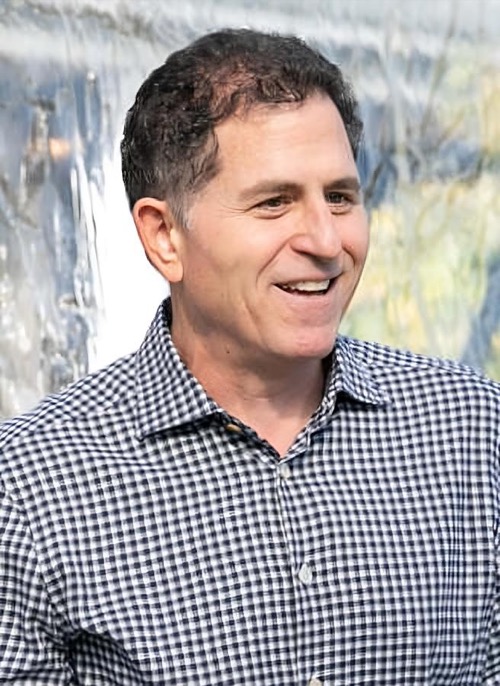
Founder, Chairman and CEO, Dell Technologies · b. 1965 · Houston, Texas
Two calls made by hand, not formulas. how we score →
Summary
An orthodontist's son from an affluent Houston family, he resold PC upgrade kits from his University of Texas dorm room, registered PC's Limited on about $1,000 of his own savings, and dropped out at 19 once it outgrew campus.
The family could absorb any failure. What built the fortune was the build-to-order model, and refusing to cede control at two later moments the company needed outside money.
How it happened
Born in Houston in 1965 to Alexander Dell, an orthodontist, and Lorraine Charlotte Dell, a stockbroker. As a boy he worked odd jobs to fund a stamp collection, and as a teenager he used demographic data on likely newlyweds and new movers to sell Houston Post subscriptions, clearing around $18,000 in a year. His parents wanted him to become a doctor and enrolled him in pre-med at the University of Texas at Austin in 1983.
From his room at Dobie Center he started buying surplus IBM PCs, upgrading them with extra memory and drives, and reselling them directly, at a fraction of retail, undercutting the dealer markup entirely. In January 1984 he registered the business as PC's Limited, capitalized with about $1,000 of his own savings. By his freshman year he was grossing tens of thousands of dollars a month; that May, with his parents' blessing, he dropped out at 19 to run it full time.
The advantage was never the shoestring start. It was building each computer only after the order and payment came in, which meant Dell never carried the unsold dealer inventory that sank slower-moving competitors, and it let the company undercut IBM and Compaq on price while collecting cash before it had to pay for parts. Renamed Dell Computer Corporation, it went public in June 1988 at $8.50 a share, and by 1992, at 27, he was the youngest CEO ever to run a Fortune 500 company.
By 2013 the PC business was shrinking and Wall Street was pricing Dell like a company in decline. He teamed with Silver Lake Partners and a $2 billion loan from Microsoft to take the company private for about $24.4 billion, after raising the price once to see off a rival bid from Carl Icahn. The deal closed that October, and Michael Dell came out holding roughly a 75% stake, free to rebuild the business outside quarterly public scrutiny.
Rather than a conventional IPO, Dell returned to public markets in December 2018 by buying back the tracking stock (DVMT) that had been created to represent its majority stake in VMware, after the 2016 EMC acquisition. Icahn, then holding about 9.3% of the tracking stock, sued over the original terms and forced a richer payout. The share structure that resulted gives Class A stock ten votes each against one for public Class C stock; per Dell Technologies' 2026 proxy, Michael Dell alone holds 89.2% of Class A stock, enough for roughly 41% of the company's economic value but the effective ability, with family entities, to control 77.5% of the vote.
The coded evidence
Thirteen groups, every claim sourcedSources establish "born to a Jewish family" directly; the Ashkenazi tag is the author's inference from family surnames (Dell, Langfan) and the absence of any Sephardic/Mizrahi record, following the same low-confidence convention used elsewhere on this site for ethnicity coding.
↗ jewishvirtuallibrary.orgDescendant. No immigration event for Michael Dell or his parents established in the sources reviewed.
↗ en.wikipedia.orgAn orthodontist father and stockbroker mother in Houston meant a financially stable two-income household throughout his childhood and through the 1983-84 dorm-room start; dropping out of a pre-med program at 19 carried no housing or income risk.
↗ biography.comNo family salary or allowance is documented as funding the business itself; he financed it from his own savings and reinvested early profits. The floor was the household behind him, not direct income support during the build.
↗ biography.comnot established
No documented period of chosen or imposed austerity; the dorm-room build was cash-generative almost immediately.
↗ en.wikipedia.orgFather Alexander Dell, an orthodontist; mother Lorraine Charlotte (Langfan) Dell, a stockbroker. Both wanted him to become a physician.
↗ en.wikipedia.orgA parent worked for themselves, the strongest known predictor of founding.
An orthodontist's practice is typically self-owned; not separately confirmed for Alexander Dell specifically.
↗ en.wikipedia.org1
A younger brother, Adam Dell, later a venture capitalist; no other siblings established in the sources reviewed.
↗ en.wikipedia.orgMixed. His parents pushed him toward medicine and enrolled him in pre-med, but let him drop out at 19 once the business was already outearning any plausible summer job.
↗ biography.comHouston, Texas, in the Memorial-area neighborhood; an affluent part of the city.
↗ en.wikipedia.orgMemorial High School, a public high school in an affluent Houston neighborhood (Spring Branch ISD).
↗ en.wikipedia.orgIndividual PC buyers reached first around the University of Texas at Austin campus and through local classified ads, then nationally by mail and phone order as PC's Limited grew.
↗ en.wikipedia.orgnot established
Sole founder; no co-founder is established in the sources reviewed.
↗ en.wikipedia.org0
No prior employer in the computer industry established; went directly from teenage side businesses to founding his own company.
↗ en.wikipedia.orgAttended the University of Texas at Austin as a pre-med student, 1983-1984; no degree. Dropped out after his freshman year at 19.
↗ en.wikipedia.orgnot established
No student debt is established; an affluent family had no documented need for loans over one year of tuition.
↗ en.wikipedia.orgDirect. Public flagship university, no transfer or non-traditional route, left after one year.
↗ en.wikipedia.orgAbout $1,000, which he has been reported to have drawn from his own savings account, used to register and capitalize PC's Limited in January 1984. One Wikipedia paraphrase of the founding describes it as "expansion capital from his family" rather than personal savings; the two accounts aren't fully reconciled in the sources reviewed.
↗ biography.comIt paid its own way from the start. Revenue came before any outside money.
Build-to-order model collected payment before building and shipping each machine; no venture funding was raised to found the company.
↗ en.wikipedia.orgGrew on reinvested profits from a revenue-first, build-to-order model through the 1980s and 90s; IPO'd on NASDAQ in June 1988 at $8.50 a share. Went private in 2013 via a $24.4 billion buyout with Silver Lake Partners and a $2 billion loan from Microsoft, then returned to public markets in December 2018 by buying back VMware tracking stock (DVMT) for $21.7 billion in cash and stock rather than running a conventional IPO.
↗ en.wikipedia.orgPersonal observation: as a teenager he noticed IBM-compatible PCs sold at large dealer markups over their component cost, and started buying, upgrading, and reselling them directly to undercut that markup.
↗ en.wikipedia.orgDell Technologies runs a multi-class structure: Class A and Class B common stock each carry ten votes per share, Class C carries one. Per the company's May 2026 DEF 14A proxy, Michael Dell alone held 89.2% of outstanding Class A stock and 5.8% of Class C, about 40.9% of total outstanding common stock; he and other "MD stockholders" (including a family trust) together held about 45.7% of outstanding shares but approximately 77.5% of total voting power. Economic ownership and voting control diverge by roughly 32 points in his favor.
↗ sec.govnot established
No documented funding rejections; the company never sought early-stage outside capital to found or launch.
↗ en.wikipedia.org0
PC's Limited was his first and only venture. Teenage side businesses (stamp-funding dishwashing, newspaper subscription sales, stock and coin trading) were profitable, not failures.
↗ en.wikipedia.orgSelf. The roughly $1,000 start was his own money, and no outside investor or family transfer is documented at founding.
↗ biography.com19
Age at the January 1984 founding of PC's Limited and the May 1984 decision to leave school and run it full time.
↗ en.wikipedia.orgThe early-1980s IBM PC-compatible clone market was expanding fast, and dealer markups on assembled machines were large enough that a direct-to-buyer, build-to-order reseller could undercut retail significantly while still profiting.
↗ en.wikipedia.org42
1984 founding to 2026; he has remained CEO or chairman continuously except a 2004-2007 gap, and never left the company.
↗ en.wikipedia.orgPersonal computer hardware and enterprise technology
↗ forbes.comJournalistic estimate
↗ forbes.com2026
↗ forbes.comAlmost entirely equity, held through Class A and Class C stock and the family office DFO Management (formerly MSD Capital); his disclosed base salary as chairman and CEO in fiscal 2026 was $950,000.
↗ sec.govCo-founded the Michael & Susan Dell Foundation in 1999, focused on children's health and education; by his wife Susan's account they have given away more than $3 billion over 26 years. In December 2025 the couple announced a $6.25 billion commitment to seed investment accounts for roughly 25 million children in lower- and middle-income ZIP codes.
↗ en.wikipedia.orgUncapped
↗ forbes.comIn July 2010, Dell Inc. agreed to pay a $100 million penalty to settle SEC charges of disclosure and accounting fraud, over undisclosed exclusivity payments from Intel (2001-2006) that Dell used to help meet earnings targets without telling investors the income's true source. Michael Dell and then-CEO Kevin Rollins each personally paid a $4 million penalty; former CFO James Schneider paid $3 million. As is standard in SEC settlements, the defendants neither admitted nor denied the findings.
↗ en.wikipedia.orgAfter
The conduct at issue (2001-2006 earnings disclosure) occurred nearly two decades after the 1984 founding, long after Dell was an established public company.
↗ en.wikipedia.orgIncidental
The undisclosed Intel payments concerned managing already-established public-company earnings, not the original founding advantage.
↗ en.wikipedia.orgCivil wrong
↗ en.wikipedia.orgPersonal liability
The $100 million company penalty was absorbed corporately, but Michael Dell also personally paid $4 million, distinct from a purely company-absorbed fine.
↗ en.wikipedia.orgStructural context
The cost-of-failure score comes from this person's own money and circumstances. But who they were in America carried its own weight, the same way their household or income did, and it shaped how hard the path was just as much. That part isn't in the cost-of-failure number. It's here instead.
Men founded the companies that took nearly all the venture funding and almost every top outcome, a tailwind that never shows up in one person's own circumstances.
↗ techcrunch.comWhite founders are heavily overrepresented among funded companies and top-tier wealth relative to their share of the population, an edge that has nothing to do with a person's own money.
↗ techcrunch.comAmong the people recorded here — men: 169 · White subjects: 114. Representation here is who reached these outcomes, not equal odds of reaching them.
Controlled comparisons
Each holds one thing constant and varies another, so the difference is the point. A list of similar names wouldn't tell you anything.