Peter Thiel
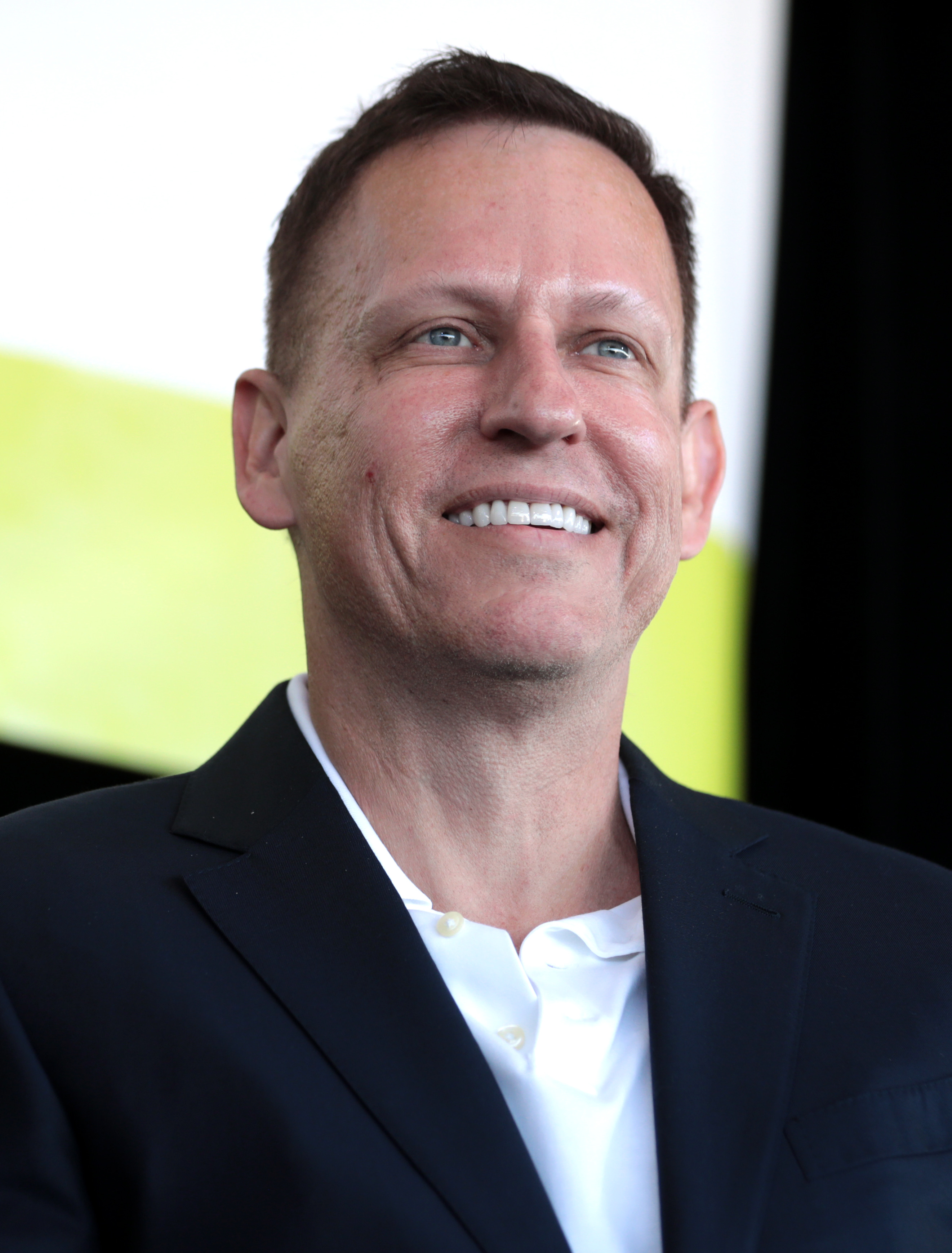
born Peter Andreas Thiel
Co-founder of PayPal and Palantir Technologies; co-founder of Founders Fund; Facebook's first outside investor · b. 1967 · Frankfurt, West Germany
Two calls made by hand, not formulas. how we score →
Summary
Born in Frankfurt to an engineer father whose work moved the family through Ohio and Namibia before it settled in Foster City, California.
Stanford twice, then law and finance jobs he left, before co-founding what became PayPal. The $55 million from its 2002 sale seeded a hedge fund, a data-analytics company, and a $500,000 bet on a college network that alone returned over a billion.
How it happened
Peter Andreas Thiel was born October 11, 1967, in Frankfurt am Main, West Germany. His father, Klaus, was a chemical engineer who moved the family for work: to Cleveland, Ohio when Peter was about a year old, then in 1971 to South African-administered South West Africa, now Namibia, where his father worked for a mining company. Thiel attended a German-language school in the coastal town of Swakopmund. The family returned to the United States in 1977 and settled in Foster City, California, by which point he had changed elementary schools seven times. He graduated valedictorian of San Mateo High School in 1985.
He majored in philosophy at Stanford, co-founding the conservative and libertarian student paper The Stanford Review in 1987, and graduated in 1989. He stayed for a JD at Stanford Law School, finishing in 1992, then clerked for a Ninth Circuit judge, practiced securities law at Sullivan & Cromwell for under a year, traded derivatives at Credit Suisse, and wrote speeches for Reagan-era Education Secretary William Bennett. In 1995 he co-wrote The Diversity Myth, a critique of multiculturalism on campus drawn largely from his Stanford Review years.
In 1996 he started Thiel Capital Management with about $1 million raised from friends and family. Two years later he co-founded Confinity with Max Levchin and Luke Nosek, putting in $100,000 of his own money; the company built what became PayPal and Thiel served as CEO. EBay bought it in October 2002 for $1.5 billion, and Thiel's 3.7% stake was worth about $55 million at the close. It's the single event everything after was built on: not a company he kept, but the capital that funded every company and fund that came next.
He put $10 million of the PayPal proceeds into Clarium Capital, a global-macro hedge fund he started in 2003 that called the dollar's 2003 decline correctly and returned better than 57% in 2005, before shrinking from a $7 billion peak to around $350 million by 2011. The same year he incorporated Palantir Technologies, funding it initially with about $30 million of his own money alongside a $2 million check from the CIA's venture arm, In-Q-Tel; he has chaired its board since. In August 2004 he put $500,000 into a college social network for a 10.2% stake, becoming its first outside investor and joining its board. In 2005 he co-founded Founders Fund with former PayPal colleagues Ken Howery and Luke Nosek.
That $500,000 became the largest return of his career. He sold 16.8 million Facebook shares for about $638 million around its 2012 IPO, then sold most of what remained for another $395.8 million later that year, together more than a billion dollars against a $500,000 check. He stayed on Facebook's board until February 2022, when he left to back pro-Trump candidates ahead of that year's midterms.
Gawker published an article outing him as gay in 2007 without his consent; he has said the exposure complicated business dealings and family relationships at the time. He married Matt Danzeisen in 2017. In May 2016 he confirmed reporting that he had secretly financed Hulk Hogan's invasion-of-privacy suit against Gawker, spending roughly $10 million on the litigation; a jury awarded Hogan $140 million and Gawker closed that August. Thiel called it "one of my greater philanthropic things," framing it as deterrence rather than personal revenge. Two months later, on July 21, 2016, he became the first speaker to acknowledge being gay from the stage of a Republican National Convention, telling the crowd, "I am proud to be gay. I am proud to be a Republican. But most of all I am proud to be an American."
Palantir went public via direct listing on the NYSE in 2020; Thiel remains chairman. He, Alex Karp, and Stephen Cohen hold their shares in a voting trust whose Class F stock is fixed at just under half of the company's total voting power, regardless of their combined economic stake. Forbes put his net worth at $36.2 billion as of September 17, 2026, built across Facebook proceeds, Founders Fund's carry (including early stakes in Stripe and SpaceX), and his Palantir holdings. He wrote Zero to One in 2014, funds the Thiel Fellowship paying young people to skip or leave college, and has backed proteges including Sam Altman's first fund and J.D. Vance's Narya Capital and Senate campaign.
The coded evidence
Thirteen groups, every claim sourcedBorn in Frankfurt to German parents; naturalized as a US citizen with his mother as a child, while his father did not naturalize.
↗ en.wikipedia.orgFirst-generation immigrant, arriving in the US at about age one; the family also lived abroad again (South African-administered Namibia, 1971-1977) before permanently resettling in California.
↗ en.wikipedia.orgLikely German in early childhood and during the family's years in Namibia, where he attended a German-language school; English predominant after the 1977 move to California.
Inferred from the family's German origin and schooling, not directly documented.
↗ en.wikipedia.orgA stable, professionally employed two-parent household throughout a childhood that moved repeatedly for his father's engineering career; no housing precarity or financial hardship is documented at any point.
↗ en.wikipedia.orgA JD and a run of finance and law jobs (clerkship, Sullivan & Cromwell, Credit Suisse) preceded Thiel Capital Management, which itself launched on about $1 million raised from friends and family rather than his own unfunded risk.
↗ en.wikipedia.orgnot established
No housing or income instability during PayPal, Clarium, or Palantir's founding is documented.
↗ en.wikipedia.orgnot established
No period of visible austerity, chosen or imposed, is documented at any point in the record.
↗ en.wikipedia.orgFather Klaus Friedrich Thiel was a chemical engineer who worked for several mining companies, including a posting in South African- administered Namibia. Mother Susanne Thiel's occupation is not established in the sources reviewed. Younger brother Patrick Thiel is a physician.
↗ en.wikipedia.orgNeither parent was self-employed.
Described as employed by mining companies rather than self-employed.
↗ en.wikipedia.orgFather held an engineering degree (unspecified institution); mother's education is not established.
↗ en.wikipedia.orgnot established
No documented family sacrifice or second income specifically aimed at tuition; the family's professional income appears to have covered it directly.
↗ en.wikipedia.orgMoved internationally multiple times before age ten — Frankfurt to Cleveland to Namibia to Foster City — and changed elementary schools seven times. Career-driven rather than a product of eviction or poverty, but a real disruption to any single peer group or place.
↗ en.wikipedia.orgFoster City, California, an affluent San Francisco Peninsula suburb, from 1977 through high school.
↗ en.wikipedia.orgA German-language school in Swakopmund, South West Africa (Namibia) during the family's years there, then public schools in Foster City, graduating valedictorian from San Mateo High School in 1985.
↗ en.wikipedia.orgFrankfurt (birth) to Cleveland, Ohio (about age one) to South African- administered Namibia (1971, his father's posting) back to the US and Foster City, California (1977), then Stanford for undergraduate and law school, then Silicon Valley for his entire career.
↗ en.wikipedia.orgNone documented — the family held a comparable professional-engineer standing at each stop, unlike immigrant families who move down a class rung on arrival.
↗ en.wikipedia.orgA run of finance and law employers before he founded anything: a Ninth Circuit clerkship, under a year at the law firm Sullivan & Cromwell, derivatives trading at Credit Suisse, and speechwriting for Education Secretary William Bennett. None supplied capital or a co-founder network the way a tech-company launch platform typically does; the credibility came mainly from the Stanford JD itself.
↗ en.wikipedia.orgCredibility, Skill
↗ en.wikipedia.orgMax Levchin and Luke Nosek co-founded Confinity/PayPal with him in 1998. Alex Karp and Stephen Cohen co-founded Palantir with him in 2003. Ken Howery and Luke Nosek co-founded Founders Fund with him in 2005.
↗ en.wikipedia.org30
Founded Thiel Capital Management in 1996, his first venture, at around age 28-29; entered technology proper with Confinity/PayPal in 1998 around age 30-31.
↗ en.wikipedia.org3
A federal clerkship, Sullivan & Cromwell, and Credit Suisse, before he began founding his own ventures.
↗ en.wikipedia.orgJD, Stanford Law School (1992); BA in Philosophy, Stanford University (1989).
↗ en.wikipedia.orgnot established
Not documented either way; no scholarship, loan, or family-funding detail for either Stanford degree is established in the sources reviewed.
↗ en.wikipedia.orgDirect — undergraduate straight into law school at the same institution, with no gap, transfer, or detour.
↗ en.wikipedia.orgStanford was the hub for nearly everything that followed: PayPal co-founders and early hires, Founders Fund partners, and a broad Silicon Valley peer network all trace back to his undergraduate and law years there.
↗ en.wikipedia.orgThiel Capital Management launched in 1996 on about $1 million raised from friends and family; he put in $100,000 of his own money to co-found Confinity (PayPal's predecessor) in 1998.
↗ en.wikipedia.orgIt needed capital up front, before it earned anything.
PayPal, Palantir, and Founders Fund were all capital-raised ventures from early on rather than revenue-funded from day one.
↗ en.wikipedia.orgClarium Capital (2003) and much of Palantir's initial funding (about $30 million) came directly from the roughly $55 million he took out of PayPal's sale to eBay in 2002.
↗ en.wikipedia.orgPalantir's certificate of incorporation created Class A, Class B, and Class F common stock. All Class F shares are held in a voting trust established by the three co-founders — Thiel, Alex Karp, and Stephen Cohen — under a trustee, and per the company's 2026 proxy statement the Class F stock's voting power is fixed at just under 50% of the company's total voting power, independent of the founders' combined economic stake.
↗ sec.govFounders Fund, co-founded in 2005 with Ken Howery and Luke Nosek, is a venture partnership that has held early stakes in companies including Stripe and SpaceX; a share of Thiel's current fortune runs through the fund's carried interest rather than through any single company he built directly.
↗ forbes.comRather than consuming the PayPal proceeds, he redirected them into Clarium Capital, Palantir's founding capital, the $500,000 Facebook angel check, and Founders Fund's initial fund — turning one exit into four separate ventures.
↗ en.wikipedia.orgPayPal grew from an interest in cryptography and secure digital money-transfer, developed with Max Levchin. Palantir's data-analysis approach drew on techniques PayPal had used to detect fraud, extended to intelligence and defense applications with a National Security Agency and CIA-adjacent client base from the outset.
↗ en.wikipedia.orgBecause Class F voting power is capped near 50% of the total regardless of the founders' underlying share count, Thiel, Karp, and Cohen jointly retain outsized control over Palantir relative to their combined economic ownership of the public company — a structure engineered before the 2020 direct listing and preserved since.
↗ sec.govnot established
No failed venture prior to PayPal is documented; his pre-PayPal record is a sequence of finance and law jobs rather than founded businesses.
↗ en.wikipedia.orgSalaried legal and finance work (clerkship, Sullivan & Cromwell, Credit Suisse, speechwriting) sustained him between his 1992 JD and founding Thiel Capital Management in 1996; no gap or return to wage labor is documented after that point.
↗ en.wikipedia.orgPayPal survived the dot-com crash and a wave of payment fraud by pivoting toward merchant processing, then sold into a market still skeptical of consumer internet companies generally. The Facebook investment came in 2004, ahead of the wider late-2000s social-media venture boom, and Palantir was founded into post-9/11 demand for intelligence-analysis software.
↗ en.wikipedia.orgSilicon Valley, where he had lived and worked since his Stanford years.
↗ en.wikipedia.orgBuilt — PayPal, Clarium, Palantir, and Founders Fund were each founded from scratch rather than acquired.
↗ en.wikipedia.org28
Founded Thiel Capital Management in 1996, the first entity that began compounding his capital.
↗ en.wikipedia.org30
From 1996 through 2026, across Thiel Capital, Clarium, Palantir, Founders Fund, and his personal portfolio, without a reset.
↗ en.wikipedia.orgnot established
The opposite pattern applies — every venture was built directly inside Silicon Valley.
↗ en.wikipedia.orgTechnology entrepreneurship, venture capital, and hedge fund investing
↗ en.wikipedia.orgJournalistic estimate
↗ forbes.com2026
↗ forbes.comnot established
Per Palantir's 2026 proxy, Thiel receives no cash or equity compensation as a director; his wealth is not salary-based, and no proxy-statement-style income figure applies to him.
↗ sec.govA mix: the roughly $55 million PayPal exit and the more than $1 billion in Facebook share sales in and after its 2012 IPO were realized; his Palantir and Founders Fund holdings remain largely unrealized, marked to market.
↗ en.wikipedia.orgAlmost entirely wealth rather than income: appreciation and realized gains on a chain of equity stakes (PayPal, Facebook, Palantir, Founders Fund's portfolio) rather than any salary, since he draws no compensation from Palantir's board.
↗ sec.govWrote Zero to One (2014), a bestseller on startups drawn from his Stanford lecture notes. Founded the Thiel Fellowship in 2010, which pays young people to skip or leave college. Chairs Palantir's board. In July 2016 became the first speaker to acknowledge being gay from a Republican National Convention stage. Sponsored Sam Altman's first venture fund and J.D. Vance's venture fund and 2022 Senate campaign. Holds German, American, and New Zealand citizenship, the last granted in 2011 and made public in 2017.
↗ en.wikipedia.orgUncapped
↗ en.wikipedia.orgIn May 2016, after Forbes reported it, Thiel confirmed he had secretly financed Terry Bollea's (Hulk Hogan's) invasion-of-privacy lawsuit against Gawker Media, spending roughly $10 million on the litigation in the years after Gawker had outed him as gay in 2007 without his consent. A jury awarded Bollea $140 million in March 2016 and Gawker closed in August 2016. Thiel called funding the case "one of my greater philanthropic things," framing his motive as deterring similar reporting rather than personal revenge against Gawker.
↗ en.wikipedia.orgAfter
The Gawker funding and its 2016 disclosure came more than a decade after PayPal's sale and years after the Facebook investment that built most of his fortune.
↗ en.wikipedia.orgUnrelated
Funding a third party's lawsuit years after his defining wealth events did not produce his wealth or business standing.
↗ en.wikipedia.orgLegal gray
Secretly financing another person's litigation is a legal practice (third-party litigation funding), though undisclosed funding aimed at destroying a media outlet drew criticism as an abuse of the legal system to suppress press activity.
↗ en.wikipedia.orgNone
No fine, sanction, or personal legal liability resulted for Thiel; Gawker Media itself was the losing party and closed.
↗ en.wikipedia.orgContrarian, Provocateur, Secretive, libertarian ideologue, Strategic
↗ en.wikipedia.orgPress
↗ en.wikipedia.org5
Wikipedia, Forbes, Palantir's own SEC filings, and reporting on the Gawker case and 2016 RNC speech, among others reviewed.
↗ en.wikipedia.orgBefore
His reputation as a contrarian, ideologically driven operator dates to the Stanford Review and Diversity Myth years, before PayPal.
↗ en.wikipedia.orgMixed
↗ en.wikipedia.orgPalantir's government and defense customers, and much of the venture and libertarian-right political world, treat Thiel's strategic judgment and long time horizon as an asset. Privacy and civil-liberties advocates and much of the mainstream press have reported critically on Palantir's government surveillance and immigration-enforcement contracts and on Thiel's role funding the Gawker litigation and right-wing political candidates, treating the same record as evidence of an authoritarian-leaning approach to power. Reaction to Thiel himself splits sharply along that same line.
↗ en.wikipedia.orgnot established
Not applicable in the usual sense — no single reputational collapse and rebuild; segmented, durable views have run in parallel for close to two decades.
↗ en.wikipedia.orgStructural context
The cost-of-failure score comes from this person's own money and circumstances. But who they were in America carried its own weight, the same way their household or income did, and it shaped how hard the path was just as much. That part isn't in the cost-of-failure number. It's here instead.
Men founded the companies that took nearly all the venture funding and almost every top outcome, a tailwind that never shows up in one person's own circumstances.
↗ techcrunch.comWhite founders are heavily overrepresented among funded companies and top-tier wealth relative to their share of the population, an edge that has nothing to do with a person's own money.
↗ techcrunch.comImmigrants and their children are overrepresented among America's biggest companies, as founders and as senior leaders. They got there through the visa, credential, and network hurdles that make the path harder to even start down.
↗ forbes.comAmong the people recorded here — men: 169 · White subjects: 114. Representation here is who reached these outcomes, not equal odds of reaching them.
Controlled comparisons
Each holds one thing constant and varies another, so the difference is the point. A list of similar names wouldn't tell you anything.