Ray Dalio
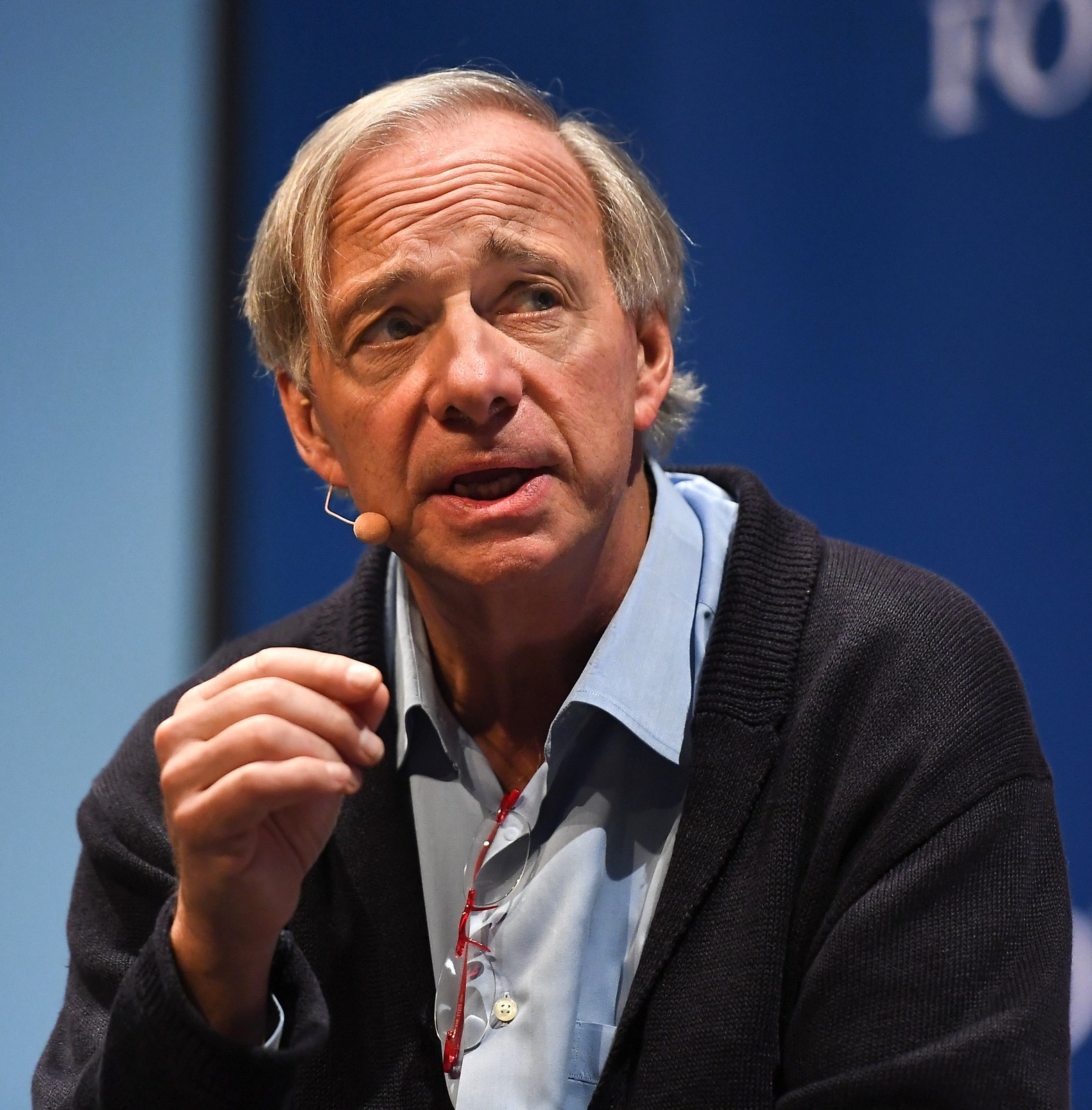
born Raymond Thomas Dallolio
Founder of Bridgewater Associates, the world's largest hedge fund; author of "Principles" · b. 1949 · Jackson Heights, Queens, New York City
Two calls made by hand, not formulas. how we score →
Summary
Son of a working jazz musician in Queens, he caddied at a Long Island golf club, picked up stock tips from members, and bought his first shares at 12.
A Long Island University degree and a Harvard MBA opened Wall Street's door. He founded Bridgewater from his apartment in 1975 as an advisory shop; a 1987 World Bank mandate turned it into the manager that became the world's largest hedge fund.
How it happened
Born August 8, 1949, in Jackson Heights, Queens, as Raymond Thomas Dallolio — the family name was later anglicized to Dalio. His father, Marino Dalio, was a jazz musician who played clarinet and saxophone in Manhattan clubs; his mother, Ann, was a homemaker. The family moved to Manhasset, on Long Island, when he was about eight. It was a stable two-parent household on a musician's income — comfortable enough, with no documented financial hardship, but with no family wealth or Wall Street connections behind him either.
As a boy he delivered papers, mowed lawns, and shoveled snow for neighbors, then from around age 12 caddied at a Long Island golf club whose members included Wall Street investors. Picking up stock tips from the members he caddied for, he bought his first shares, in Northeast Airlines, and roughly tripled his money when the company merged. It was an early, self-directed entry into markets funded by his own odd-job earnings rather than family money.
He earned a bachelor's degree in finance from C.W. Post College (Long Island University), then an MBA from Harvard Business School in 1973. The Harvard credential, reached from a state-university starting point rather than a prep-school pipeline, was the door into Wall Street employment that his family's own network didn't supply.
After Harvard he worked as a clerk on the New York Stock Exchange floor and traded commodity futures, then advised farmers on hedging risk at Shearson Hayden Stone. He has said on the record that he was fired from Shearson after punching his boss during a drunken argument at a 1974 New Year's Eve party — an account he has told publicly himself rather than one reported against him.
In 1975, at 26, he founded Bridgewater Associates out of his own two-bedroom Manhattan apartment. It began as a corporate advisory practice — consulting on currency and interest-rate risk for clients including Nabisco and McDonald's — financed out of his own consulting fee income rather than outside capital, savings, or a partner's stake.
Bridgewater's first major institutional account came in 1987, when Hilda Ochoa-Brillembourg of the World Bank invested $5 million on the firm's behalf. The mandate turned an advisory shop serving corporate clients into an institutional asset manager serving pensions and sovereign investors — the shift that set up everything the firm later became.
Bridgewater launched its flagship Pure Alpha fund in 1991 and the All Weather fund in 1996, popularizing the "risk parity" approach to portfolio construction. The firm's assets under management passed $100 billion by November 2010 and reached roughly $150 billion by 2016, making it the world's largest hedge fund. His 2017 book "Principles" became a bestseller, codifying the firm's "radical transparency" management style of recorded meetings and public performance ratings.
He stepped down as co-CEO in 2017, ceded his majority voting rights to the board in September 2022, and sold his remaining shares and left the board by 2025, completing a multi-year transition out of Bridgewater entirely. A 2023 book by journalist Rob Copeland, "The Fund," alleged that the firm's transparency culture produced paranoia and internal surveillance and questioned how much of its investing success was a systematic process versus Dalio's own calls; Dalio and Bridgewater have disputed the book's account as fiction.
Forbes put his personal net worth at roughly $18.9 billion as of September 28, 2026 — a figure distinct from Bridgewater's own assets under management, which belong to its pension, sovereign, and institutional clients, not to him. He has since focused on philanthropy, having donated more than $1 billion through Dalio Philanthropies to causes including microfinance and public education.
The coded evidence
Thirteen groups, every claim sourcedNot established as second-generation: his father was US-born (1911), so any immigration from Italy happened at least one generation earlier. Coded as no migration-linked headwind rather than guessed at a specific generation.
↗ en.wikipedia.orgEnglish
Inferred from a US-born, English-speaking family; not separately documented.
↗ en.wikipedia.orgRaised in a stable, owned family home — first in Jackson Heights, Queens, then in Manhasset, Long Island, from about age eight — on a working jazz musician's income. No source documents housing instability or a fallback need at any point.
↗ achievement.orgFinanced Bridgewater's 1975 founding out of his own consulting-fee income from existing corporate clients rather than savings, a salary floor, or investor capital; he has said clients from his Shearson days "were going to pay me" to keep advising them once he went independent.
↗ achievement.orgnot established
He married Barbara Dalio; her role, if any, during Bridgewater's 1975 founding period isn't documented in sources consulted.
↗ en.wikipedia.orgnot established
He and Barbara later had four sons, but none are documented as born before or during the 1975 founding.
↗ en.wikipedia.orgnot established
No housing, income, or comparable instability is documented around the 1975 founding.
↗ en.wikipedia.orgnot established
No period of chosen austerity is separately documented in sources consulted.
↗ en.wikipedia.orgFather Marino Dalio was a professional jazz musician (clarinet and saxophone) who played Manhattan night clubs; mother Ann was a homemaker.
↗ achievement.orgA parent worked for themselves, the strongest known predictor of founding.
A working musician's income is coded as self-employment/gig-based rather than salaried.
↗ achievement.orgNo documented family wealth, business, or professional standing behind him — a musician's household on Long Island, not an old-money or business-owning family. His later fortune was self-built rather than inherited or continued from a family enterprise.
↗ achievement.orgnot established
Sources consulted don't itemize who paid for his C.W. Post or Harvard Business School tuition. No scholarship, employer, military, or family funding is documented, and no student debt is documented either, so coded.credentialFunding defaults to self-funded as the best fit for a family without spare capital and no reported aid — a judgment call flagged here rather than a sourced fact.
↗ en.wikipedia.orgJackson Heights, Queens, until about age eight, then Manhasset, Long Island — a middle-class New York suburb, not an elite enclave.
↗ achievement.orgnot established
His father's music career supplied no documented pathway into finance.
↗ en.wikipedia.orgHis only documented early proximity to Wall Street was incidental: caddying from around age 12 at a Long Island golf club whose members included investors who gave him stock tips. This was informal exposure picked up on the job, not a family or social network into finance.
↗ en.wikipedia.orgCaddying at a golf club patronized by Wall Street investors gave him his first exposure to markets and his first stock tip around age 12; the Harvard MBA later opened the door to Wall Street employment itself.
↗ en.wikipedia.org12
First stock purchase (Northeast Airlines) at age 12, funded from his own caddying and odd-job earnings.
↗ en.wikipedia.org2
From his 1973 Harvard MBA to the 1975 founding of Bridgewater, via NYSE and Shearson Hayden Stone.
↗ achievement.orgnot established
No documented political or institutional access preceded Bridgewater's founding; institutional relationships (e.g. the World Bank) came after, as clients won on results.
↗ en.wikipedia.org2
NYSE floor clerk/commodities trader, then Shearson Hayden Stone, before founding Bridgewater in 1975.
↗ en.wikipedia.orgMBA, Harvard Business School, 1973; BS in finance, C.W. Post College (Long Island University).
↗ en.wikipedia.orgStarted at a state-system Long Island University campus, not an elite undergraduate feeder school, then reached Harvard Business School for the graduate credential that opened Wall Street.
↗ achievement.orgnot established
No documented Harvard classmate or alumni connection is credited with his early hires or clients.
↗ en.wikipedia.orgOwn consulting-fee income from corporate clients he'd advised at Shearson Hayden Stone, who followed him when he went independent in 1975.
↗ achievement.orgnot established
No family capital transfer is documented at Bridgewater's founding.
↗ en.wikipedia.orgIt paid its own way from the start. Revenue came before any outside money.
Bridgewater began as a fee-for-advice consultancy with paying corporate clients from the outset, not a fund raising capital first.
↗ achievement.orgFounded and initially ran Bridgewater on consulting fees from corporate clients (Nabisco, McDonald's, and others) rather than savings, a salary, or outside investment.
↗ en.wikipedia.orgGrew from a fee-based corporate advisory practice into an institutional asset manager after the 1987 World Bank mandate, without taking on outside equity investors in the firm itself; Bridgewater remained privately held throughout his tenure.
↗ en.wikipedia.orgOriginated Bridgewater's macro-investing approach and, later, the "risk parity" concept behind the All Weather fund (1996) and the Pure Alpha fund (1991), building both inside the firm he founded rather than licensing or importing an existing strategy.
↗ en.wikipedia.orgHeld majority control of Bridgewater for decades before a deliberate, multi-year transition: he stepped down as co-CEO in 2017, ceded majority voting rights to the board in September 2022, and sold his remaining shares and left the board by 2025.
↗ en.wikipedia.org1
Some accounts describe an earlier, short-lived version of Bridgewater before the 1975 relaunch from his apartment; sources consulted don't detail it further, so this is coded cautiously.
↗ en.wikipedia.orgHe carried the founding risk himself, financed by his own consulting income rather than savings under threat or a partner's capital.
↗ achievement.org37
Born August 1949; the World Bank's $5 million institutional mandate came in 1987.
↗ en.wikipedia.orgBridgewater built its institutional business through the 1980s bond and currency markets, ahead of the 1990s and 2000s expansion of pension and sovereign allocations to hedge funds that later fueled its growth to the world's largest hedge fund.
↗ en.wikipedia.orgWestport, Connecticut (Bridgewater's headquarters by the time of its institutional growth).
↗ en.wikipedia.org50
From the 1975 founding to his final 2025 exit from Bridgewater's board and ownership.
↗ en.wikipedia.orgHedge fund management / global macro investing (Bridgewater Associates)
↗ forbes.com18900000000
Forbes real-time billionaires-tracker figure as of 2026-09-28. This is Dalio's PERSONAL net worth, not Bridgewater's assets under management ($102 billion per the same profile) — AUM is client capital (pensions, sovereign funds, institutions) that Bridgewater manages for a fee, not Dalio's own wealth, and the two should never be conflated.
↗ forbes.comJournalistic estimate
Bridgewater is privately held; no public filing establishes his exact ownership stake following the 2022–2025 exit.
↗ forbes.com2026
↗ forbes.comAuthor of the bestselling "Principles" (2017); donated more than $1 billion through Dalio Philanthropies to causes including microfinance and public education.
↗ forbes.comUncapped
↗ forbes.comnot established
No regulatory agency action against Dalio personally is documented in sources consulted.
↗ en.wikipedia.orgnot established
No adverse civil judgment against him personally is documented in sources consulted.
↗ en.wikipedia.orgHe has said on the record that he was fired from Shearson Hayden Stone after punching his boss during a drunken argument at a 1974 New Year's Eve party — his own account of the episode, told publicly well after Bridgewater's success, not a contemporaneous finding against him.
↗ en.wikipedia.orgIncidental
The firing pushed him toward independence but isn't established as having produced Bridgewater's success, which rested on the later institutional business he built.
↗ en.wikipedia.orgCivil wrong
A workplace physical altercation, self-reported; no criminal charge or civil judgment is documented.
↗ en.wikipedia.orgNone
He lost that job but faced no further documented legal or financial consequence.
↗ en.wikipedia.orgIntense, Demanding, a systemizer
↗ en.wikipedia.orgPress
↗ en.wikipedia.orgBefore
His reputation as a macro investor and firm-builder predates both "Principles" (2017) and the later critical coverage.
↗ en.wikipedia.orgMixed
An asset among institutional clients and readers of "Principles," who credit Bridgewater's returns and his management philosophy; contested by critics of the firm's internal culture, most prominently Rob Copeland's 2023 book "The Fund," which reportedly alleged that "radical transparency" fostered paranoia and internal surveillance and questioned how much of Bridgewater's investing success reflected a systematic process versus Dalio's own individual calls. Dalio and Bridgewater have disputed the book's account. These remain contested, attributed claims about internal conduct, not established fact.
↗ en.wikipedia.orgPublic image (through "Principles" and extensive media coverage) is of a rigorous, transparency-driven investing culture; some former employees and Copeland's reporting have alleged, by contrast, a more controlling and surveillance-heavy internal reality — a divergence Bridgewater disputes.
↗ en.wikipedia.orgnot established
Too recent and too contested to assess any settled reputational outcome from "The Fund" as of this review.
↗ en.wikipedia.orgStructural context
The cost-of-failure score comes from this person's own money and circumstances. But who they were in America carried its own weight, the same way their household or income did, and it shaped how hard the path was just as much. That part isn't in the cost-of-failure number. It's here instead.
Men founded the companies that took nearly all the venture funding and almost every top outcome, a tailwind that never shows up in one person's own circumstances.
↗ techcrunch.comAmong the people recorded here — men: 169 · white subjects: 12. Representation here is who reached these outcomes, not equal odds of reaching them.
Controlled comparisons
Each holds one thing constant and varies another, so the difference is the point. A list of similar names wouldn't tell you anything.