Sergey Brin
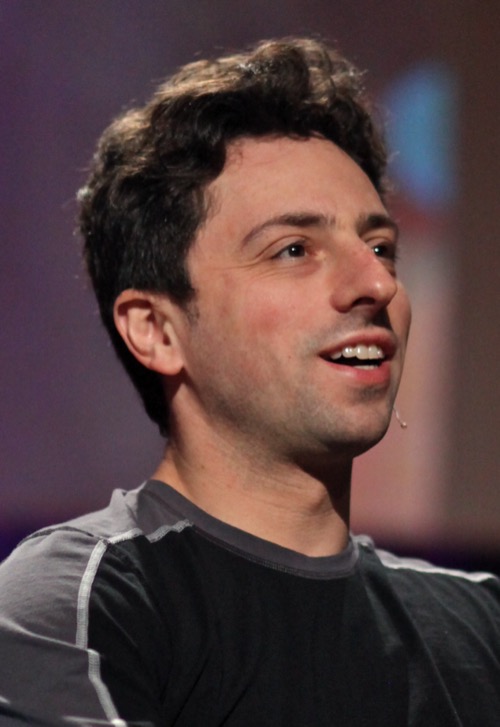
Co-founder, Google / Alphabet · b. 1973 · Moscow, USSR → College Park, Maryland
Two calls made by hand, not formulas. how we score →
Summary
A six-year-old refugee from Soviet antisemitism landed in a household that turned professional within a few years: his father a University of Maryland math professor, his mother a NASA researcher.
A funded Stanford PhD program supplied the algorithm, the co-founder, and the investor introductions. A $100,000 check written to a company that didn't exist yet got Google incorporated.
How it happened
His father Mikhail returned from a math conference in Warsaw in 1977 and told the family that antisemitism in the Soviet Union meant it was time to leave. After they formally applied for exit visas in September 1978, he was fired from his job and his wife Eugenia had to leave hers too. The family spent months in Vienna and Paris, supported by the Hebrew Immigrant Aid Society, before reaching Maryland in October 1979, when Sergey was six. His father found a teaching post in the University of Maryland's math department with help from another émigré mathematician; his mother became a researcher at NASA's Goddard Space Flight Center.
He graduated with high honors in mathematics and computer science from the University of Maryland, then went to Stanford for a PhD, where he met Larry Page at orientation in 1995. Working out of a research project on ranking web pages by their link structure, the two built an early search engine, first hosted on Stanford's own servers.
In August 1998, Sun Microsystems co-founder Andy Bechtolsheim, introduced through Stanford professor David Cheriton, wrote a $100,000 check made out to "Google Inc." before the company legally existed, which is what pushed Page and Brin to incorporate that September so the check could be cashed. A roughly $1 million friends-and-family round followed, then Kleiner Perkins and Sequoia Capital put in $12.5 million apiece in June 1999 after both firms insisted on going in together.
Google went public in 2004 under a share structure the founders described as built "for stability over long time horizons," and it carried through Alphabet's 2015 reorganization and a 2012 stock split that added a third, non-voting share class. It let Brin and Page keep command of the company's votes even as their economic stake in it fell over two decades of dilution and stock sales.
Brin stepped back from day-to-day roles at Alphabet in 2019 but stayed on the board and, by his own account, came back into the office regularly in 2023 to work hands-on on Gemini, the company's AI model. He has put more than a billion dollars into Parkinson's research since his mother's diagnosis, and in March 2026 was appointed to the President's Council of Advisors on Science and Technology.
The coded evidence
Thirteen groups, every claim sourced1.5 generation immigrant; arrived in the US at age six
↗ en.wikipedia.orgInferred from his father's stated reason for emigrating (antisemitism) and the family's later support of Jewish resettlement charities; no denomination-level detail found.
↗ en.wikipedia.orgnot established
Almost certainly Russian in Moscow and during the family's transit through Vienna and Paris, but not explicitly stated on the record. Not established.
↗ en.wikipedia.orgBy the time Google was founded in 1998, his parents were an established University of Maryland professor and a NASA researcher, a stable two-income professional household nineteen years removed from the family's refugee arrival and available as a fallback if the venture failed.
↗ en.wikipedia.orgFull-time Stanford computer-science PhD student when Google began, with no outside job or personal debt documented; his parents' income was available if the project went nowhere.
No specific stipend or funding figure for his own PhD years was located.
↗ en.wikipedia.orgnot established
No debt is documented at either degree or at founding. Not established.
↗ en.wikipedia.orgNone documented at the time of Google's founding. The family's genuine hardship — refugee resettlement, reliance on an aid agency, a fired father — belongs to 1978-1981, roughly two decades before the company existed, and had fully resolved by then.
↗ en.wikipedia.orgThe hardship was imposed, not chosen. There was nothing to fall back on.
No period of chosen or imposed austerity is documented during the build itself.
↗ en.wikipedia.orgFather Mikhail (Michael) Brin, a mathematician who became a professor at the University of Maryland, College Park after emigrating; mother Eugenia Brin, a researcher at NASA's Goddard Space Flight Center.
↗ en.wikipedia.orgNeither parent was self-employed.
Both parents held institutional positions (university, federal research lab), not self-employment.
↗ en.wikipedia.orgBoth parents graduated from Moscow State University.
↗ en.wikipedia.orgAt least four moves before age seven: Moscow, then Vienna, then Paris during the 1978-1979 emigration process, then College Park, Maryland.
↗ en.wikipedia.orgCollege Park / Adelphi area of Maryland, near the University of Maryland campus.
↗ en.wikipedia.orgOne international emigration in 1979, at age six: Moscow to Vienna to Paris to Maryland, prompted by his father's loss of his job after applying for a Soviet exit visa the year before.
↗ en.wikipedia.orgHis father was a working mathematician in the USSR, fired specifically for applying to leave, and the family arrived in the US needing resettlement assistance. Within a few years his father held a university professorship and his mother a NASA research post, so the household's professional standing was recovered, and then some, within roughly the first half of Sergey's childhood rather than lost for a generation.
↗ en.wikipedia.orgThe Hebrew Immigrant Aid Society (HIAS) supported the family during their transit through Vienna and Paris and their resettlement in the US; Brin later donated to HIAS through his family foundation.
↗ en.wikipedia.orgStanford professor David Cheriton, a friend of Sun Microsystems co-founder Andy Bechtolsheim, connected the two; Bechtolsheim wrote the first $100,000 check on the strength of a brief early-morning meeting.
↗ en.wikipedia.orgStanford's computer science PhD program, where he worked on a research project studying how to rank web pages by their link structure. It supplied the technical foundation, the co-founder, and, through faculty connections, the first outside investor.
↗ en.wikipedia.orgIdea, Network, Skill, Credibility
Stanford supplied the research problem that became PageRank, the co-founder, the technical training, and enough institutional standing that a professor's introduction reached a Silicon Valley angel directly.
↗ en.wikipedia.orgLarry Page, met at Stanford orientation in 1995 while both began CS PhD programs.
↗ en.wikipedia.org0
No employer between graduate school and founding Google is documented; he moved directly from PhD research into the company.
↗ en.wikipedia.orgBuilt and hosted early versions of the search engine on Stanford's own servers and network infrastructure as a graduate researcher, ahead of what an outside hobbyist could access.
↗ en.wikipedia.orgB.S. with high honors in mathematics and computer science, University of Maryland, College Park (1993); M.S. in computer science, Stanford University (1995). Began Stanford's computer science PhD program in 1993 and has remained on leave from it since founding Google in 1998, never completing it.
↗ forbes.comnot established
No debt is documented at either degree. Stanford computer-science PhD students in this era were typically supported through department fellowships or research/teaching assistantships rather than out-of-pocket payment, but no specific funding source for Brin's own program was located.
↗ en.wikipedia.orgDirect pathway: in-state public university for the bachelor's degree, then straight into an elite PhD program with no gap or employer in between.
↗ en.wikipedia.orgAndy Bechtolsheim wrote a $100,000 check made out to "Google Inc." in August 1998, before the company was legally incorporated, which forced Page and Brin to formally incorporate that September so the check could be deposited.
↗ en.wikipedia.orgnot established
A roughly $1 million "friends and family" round is documented as part of the earliest funding, but no source itemizes how much, if any, came specifically from Brin's own family rather than Page's or outside acquaintances.
↗ en.wikipedia.orgKleiner Perkins and Sequoia Capital each put in $12.5 million in a $25 million round announced June 7, 1999, after both firms initially balked at co-investing and were persuaded by the founders' insistence on having both.
↗ en.wikipedia.orgRam Shriram, an early Netscape and Amazon-adjacent executive, invested early and later joined Google's board, bringing operating experience alongside capital.
↗ en.wikipedia.orgVenture-backed from 1998, public since 2004. A 2012 stock split added a third, non-voting share class on top of the original two, and the structure has let the founders' voting power decline much more slowly than their economic stake as they sold and diluted over two decades.
↗ en.wikipedia.orgDirected a large share of his wealth toward Parkinson's disease research after his mother's diagnosis, giving more than $1 billion over time, and co-founded a family foundation supporting that work alongside immigrant-resettlement and other causes.
↗ en.wikipedia.orgGrew out of a Stanford research project, initially framed around digital libraries, studying how to rank web pages using their link structure rather than keyword matching alone — an academic research question, not an observed commercial gap.
↗ en.wikipedia.orgAlphabet's Class B stock carries ten votes to Class A's one. As of the company's April 2026 proxy statement, Page and Brin together control 52% of Alphabet's total voting power while owning less than 11% of outstanding voting stock, a gap maintained since Google's 2004 IPO.
Figure is reported jointly for Page and Brin; the proxy does not break out Brin's voting share alone in this passage.
↗ sec.gov0
No separate venture before Google is documented; a single continuous path from PhD research to founding.
↗ en.wikipedia.orgBefore incorporation, the cost was mostly his and Page's own time as funded graduate students; once the company existed, angel and venture investors carried the financial risk.
↗ en.wikipedia.orgFounded during the 1998-1999 dot-com boom, when venture capital was abundant and web search was fragmented among several players (AltaVista, Excite, and others) none of which had made ranking quality their core product bet.
↗ en.wikipedia.orgStanford campus, then a rented garage belonging to future Google/YouTube executive Susan Wojcicki in Menlo Park.
↗ en.wikipedia.orgBuilt the search engine from their own research rather than acquiring or licensing an existing product.
↗ en.wikipedia.orgInternet search, online advertising, and (since 2023) AI research
↗ forbes.com261000000000
Forbes real-time estimate as of August 15, 2026; moves daily with Alphabet's share price. Band only.
↗ forbes.comPublic equity
Built substantially around his disclosed Alphabet Class A/B/C holdings per SEC beneficial-ownership filings, not a private estimate.
↗ sec.gov2026
↗ forbes.comnot established
No salary-based peak income is documented; he has not been a named executive officer since stepping down as Alphabet's president in 2019, and his wealth is almost entirely equity, not pay. Not established.
↗ sec.govWealth in owned and voting-controlled equity, not salary. His fortune tracks Alphabet's share price directly rather than any compensation package.
↗ forbes.comAppointed to the President's Council of Advisors on Science and Technology (PCAST) in March 2026; returned to hands-on work on Google's Gemini AI models in 2023 after years in a reduced role.
↗ en.wikipedia.orgUncapped
↗ forbes.comA federal judge ruled in August 2024 that Google illegally maintained a monopoly in general search and search advertising; a September 2025 remedies order barred exclusive default-search contracts and required data sharing with rivals, but did not order a breakup of Chrome or Android.
↗ en.wikipedia.orgA jury found for Epic Games on all counts in December 2023, ruling that Google's Play Store practices were anticompetitive; a 2024 injunction forced Google to allow rival Android app stores, and the companies settled on reduced Play Store fees in March 2026.
↗ en.wikipedia.orgAfter
Both the search and Play Store cases concern conduct built on top of Google's already-established market dominance, decades after founding.
↗ en.wikipedia.orgIncidental
The founding advantage came from the PageRank algorithm and its early funding, not from the later distribution deals the courts examined.
↗ en.wikipedia.orgCivil wrong
↗ en.wikipedia.orgNone
Both cases produced corporate behavioral remedies and a negotiated fee settlement; no personal liability or fine against Brin individually is documented, and his board seat and voting control were unaffected.
↗ en.wikipedia.orgintensely technical, Hands on, media-shy relative to Page and Pichai
Based on reporting that he returned to working late in the office on Gemini in 2023 and generally keeps a lower public profile than Alphabet's other leaders.
↗ en.wikipedia.orgPress
↗ en.wikipedia.orgBefore
His reputation as a hands-on technologist dates to the PageRank research itself, before the antitrust and personal-life coverage of later decades.
↗ en.wikipedia.orgMixed
↗ en.wikipedia.orgThe reputation accrued from behaviour rather than being manufactured.
Forbes lists a low philanthropy-visibility score relative to peers, and he has given comparatively few interviews or memoirs building a public narrative.
↗ forbes.comStructural context
The cost-of-failure score comes from this person's own money and circumstances. But who they were in America carried its own weight, the same way their household or income did, and it shaped how hard the path was just as much. That part isn't in the cost-of-failure number. It's here instead.
Men founded the companies that took nearly all the venture funding and almost every top outcome, a tailwind that never shows up in one person's own circumstances.
↗ techcrunch.comWhite founders are heavily overrepresented among funded companies and top-tier wealth relative to their share of the population, an edge that has nothing to do with a person's own money.
↗ techcrunch.comImmigrants and their children are overrepresented among America's biggest companies, as founders and as senior leaders. They got there through the visa, credential, and network hurdles that make the path harder to even start down.
↗ forbes.comAmong the people recorded here — men: 169 · White subjects: 114. Representation here is who reached these outcomes, not equal odds of reaching them.
Controlled comparisons
Each holds one thing constant and varies another, so the difference is the point. A list of similar names wouldn't tell you anything.