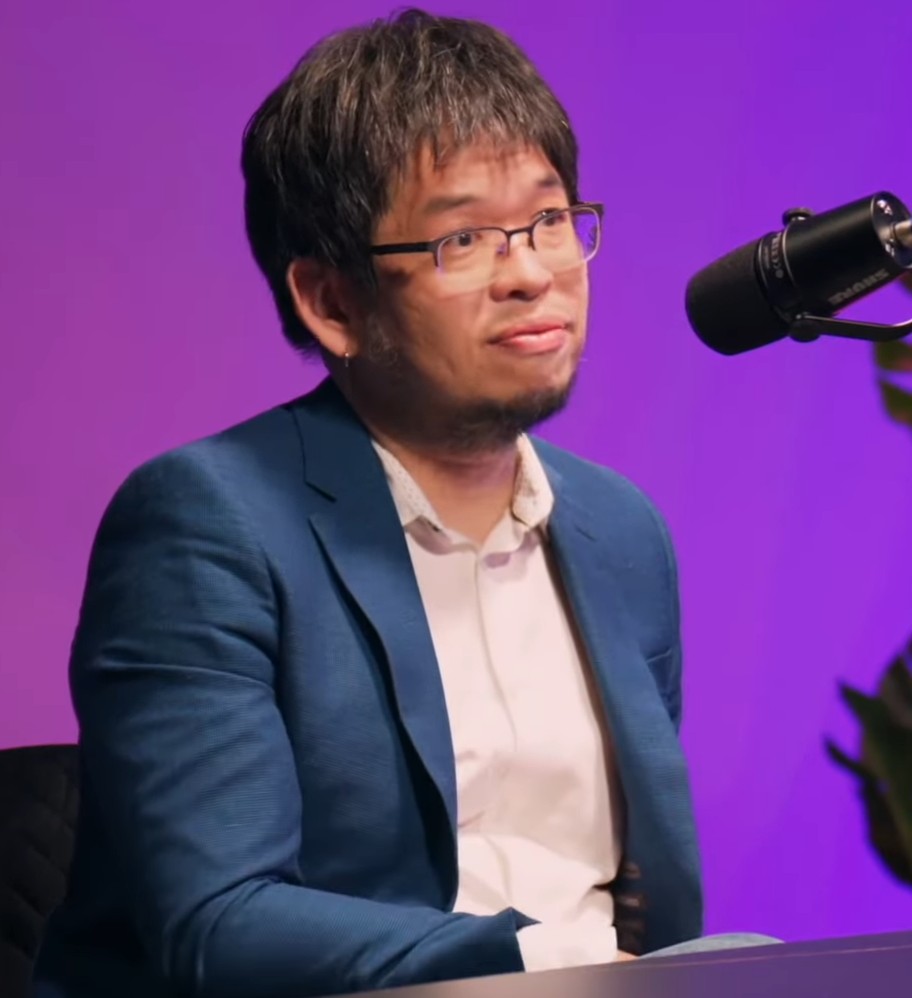
Steve Chen
born Chen Shih-chün
Co-founder and former Chief Technology Officer of YouTube · b. 1978 · Taipei, Taiwan
Two calls made by hand, not formulas. how we score →
Summary
Chen's family left Taipei for suburban Chicago when he was about seven, and he tested into one of Illinois's most selective public science academies.
A University of Illinois classmate who co-founded PayPal hired him as an engineer, and two PayPal colleagues became his YouTube co-founders. Eighteen months after the three registered the domain, Google bought the company for $1.65 billion in stock.
How it happened
Chen was born in Taipei on August 25, 1978, and immigrated with his family to the Chicago suburbs in 1986, at about age seven, settling in Arlington Heights, Illinois. He went through Thomas Middle School and a year at John Hersey High School before transferring to the Illinois Mathematics and Science Academy, a selective public residential school for academically gifted students in Aurora, and worked at a local 7-Eleven after school to help pay for college.
At the University of Illinois at Urbana-Champaign he studied computer science alongside Max Levchin, who went on to co-found PayPal. Levchin hired him, and Chen left school in 1999 without finishing his degree to join the company in Silicon Valley as a software engineer, working there through 2005 and spending his final stretch on PayPal's China launch.
In February 2005, with fellow PayPal alumni Chad Hurley and Jawed Karim, Chen co-founded YouTube and became its chief technology officer, after a brief stint at Facebook that same year. The founders later acknowledged that the popular dinner-party origin story had been polished for the press; other accounts point to a shortage of online video from the 2004 Super Bowl halftime-show controversy and the Indian Ocean tsunami, and to early inspiration from the dating site Hot or Not. Sequoia Capital led the company's venture funding between late 2005 and early 2006.
Google announced its purchase of YouTube on October 9, 2006, an all-stock deal worth about $1.65 billion that closed that November, roughly eighteen months after the site registered its domain. Chen's own stake — 625,366 Google shares plus 68,721 held in trust — was worth on the order of $300 million at the time. That sale, not the founding itself, is what converted a salaried engineer into a wealthy founder.
Chen worked at Google for a stretch after the sale, then co-founded AVOS Systems with Hurley in 2011, which bought the bookmarking site Delicious from Yahoo before folding into the video app MixBit, which shut down in 2018. He was an entrepreneur-in-residence at Google Ventures starting in 2014 and founded the food-livestreaming startup Nom in 2016, which closed the following year. He moved to Taipei in 2019 and has since invested in Taiwan's startup scene.
The coded evidence
Thirteen groups, every claim sourcedCoarse public-record coding; race is a noisy, interpretive category.
↗ en.wikipedia.org1.5 generation; immigrated with his family at about age seven, in 1986
↗ en.wikipedia.orgnot established
Not directly documented. Mandarin Chinese is plausible given a Taipei childhood, but no source states it explicitly, so left null rather than inferred.
↗ en.wikipedia.orgNo housing precarity is documented at any point. The family settled in Arlington Heights, a middle-class Chicago suburb, after immigrating in 1986.
↗ ilctr.orgSalaried PayPal engineer through 2005, with a brief stretch at Facebook, before joining YouTube; Sequoia's first funding closed within the same year YouTube launched. No documented reliance on family support during the roughly eighteen-month build to the Google sale.
↗ grainger.illinois.edunot established
No period of documented hardship, chosen or imposed, appears in the record.
↗ en.wikipedia.orgnot established
Not established in any source reviewed. His parents' occupations and the family's specific financial circumstances, in Taipei or after immigrating, are not documented in the public record.
↗ en.wikipedia.orgnot established
Only Chen's own after-school earnings toward college are documented (see d6.workedDuringStudy); no parental income-for-schooling detail is established.
↗ ilctr.orgArlington Heights, Illinois, a Chicago suburb
↗ ilctr.orgPublic schools — Thomas Middle School and a year at John Hersey High School — followed by the Illinois Mathematics and Science Academy, a selective public residential magnet school for gifted students in Aurora, Illinois.
↗ en.wikipedia.orgMoved with his family from Taipei, Taiwan to Arlington Heights, Illinois in 1986, at about age seven.
↗ en.wikipedia.orgnot established
Not established — the family's occupational standing in Taiwan before the move is not documented, so no before/after comparison can be made.
↗ en.wikipedia.orgMax Levchin, a University of Illinois classmate who went on to co-found PayPal, hired him into the company.
↗ ebsco.comPayPal, where he worked as a software engineer from 1999 to 2005, including a stretch on the company's China launch; he met future YouTube co-founders Chad Hurley and Jawed Karim there.
↗ en.wikipedia.orgNetwork, Skill
PayPal supplied engineering training and the co-founder network; no capital or idea directly.
↗ ebsco.comChad Hurley and Jawed Karim, both PayPal colleagues.
↗ en.wikipedia.org2
PayPal (1999–2005) and a brief stretch at Facebook in 2005 before founding YouTube; he later worked at Google itself after it acquired YouTube.
↗ grainger.illinois.eduAttended the University of Illinois at Urbana-Champaign as a computer science major but left in 1999 without completing a degree.
↗ en.wikipedia.orgWorked at a local 7-Eleven store during high school to help pay for college.
↗ ilctr.orgDirect — selective public magnet school (Illinois Mathematics and Science Academy) into a flagship state university computer-science program, cut short by a job offer.
↗ en.wikipedia.orgUniversity of Illinois computer science put him in the same cohort as Max Levchin, whose PayPal became his entry point into Silicon Valley.
↗ ebsco.comRoughly six years of PayPal engineering salary, plus any vested PayPal equity from the company's 2002 IPO and subsequent eBay acquisition, gave him personal financial stability heading into YouTube's 2005 founding, though no specific dollar figure for personal savings invested is documented.
↗ en.wikipedia.orgSequoia Capital led YouTube's venture funding, with Artis Capital Management also participating, across rounds between November 2005 and April 2006; specific dollar amounts for each round are not detailed in the sources reviewed.
↗ en.wikipedia.orgReceived 625,366 Google shares plus 68,721 shares held in trust at the November 2006 close. No detailed public account of how the proceeds were subsequently spent, saved, or reinvested.
↗ en.wikipedia.orgMultiple, partly conflicting accounts. A widely told story describes the idea coming from difficulty sharing video after a dinner party, which Chen himself later said had been "strengthened by marketing ideas" for the press. Other accounts point to a scarcity of online video of the 2004 Super Bowl halftime-show controversy and the Indian Ocean tsunami, and to early inspiration from the dating site Hot or Not.
↗ en.wikipedia.org0
No documented venture attempt before YouTube; his career through 2005 was as a salaried engineer.
↗ en.wikipedia.orgBroadband adoption, cheap Flash-based video encoding, and the early Web 2.0 wave of user-generated-content platforms were all accelerating in 2005–2006, while Google was separately looking to buy its way into online video after its own Google Video product struggled to gain traction.
↗ en.wikipedia.orgSan Mateo, California, where YouTube's first office sat above a pizzeria and Japanese restaurant.
↗ en.wikipedia.orgBuilt — YouTube was created from scratch by the three founders, not acquired.
↗ en.wikipedia.orgOnline video and internet technology; later consumer-internet ventures (bookmarking, food live-streaming) and startup investing.
↗ en.wikipedia.org500000000
No Forbes real-time tracker exists for Chen (forbes.com/profile/steve-chen 404s), unlike some peer tech founders. Current aggregator estimates for 2025–2026 cluster around $500M, with one outlier (Growth Hackers, ~$2.6B) excluded as unsupported. Separately, his actual November 2006 Google stock — 625,366 shares plus 68,721 in trust — was worth on the order of $300–330M near the time of the sale, based on Google's stock price in that window; that figure, not the $1.65B deal price, is the basis for the magnitude band below. Wikipedia (citing further reporting) states those same shares, if entirely unsold, would have been worth almost $1.77B by September 2021 — which would only be realized wealth if he never diversified, and is not treated as his current net worth here. Both the documented sale-era figure and current aggregator estimates land in the same $100M–1B band, which is why the band is coded with more confidence than the point figure.
↗ celebritynetworth.comAggregator
↗ celebritynetworth.comHis 2006 Google shares were paper wealth until sold or vested. How much of that stake he diversified out of Google/Alphabet stock over the following two decades is not documented, which is part of why current estimates of his wealth vary so widely.
↗ en.wikipedia.orgYouTube itself: the platform he helped build and run as CTO became one of the most-visited sites in the world within about a year of launch and remains one of the dominant video platforms globally under Google/Alphabet.
↗ en.wikipedia.org2
From founding in February 2005 to the Google deal closing in November 2006, about twenty-one months.
↗ en.wikipedia.orgUncapped
↗ en.wikipedia.orgViacom filed a $1 billion copyright suit against YouTube and Google in March 2007, months after the Google sale closed, alleging massive unauthorized use of its programming. The suit was brought against YouTube and Google as companies, not against Chen personally. It settled out of court in March 2014 with no payment exchanged, after earlier rulings had gone in Google's favor on DMCA safe-harbor grounds.
↗ en.wikipedia.orgUnrelated
Filed against the company, not Chen personally, after the wealth-defining sale had already occurred; it did not produce his advantage.
↗ en.wikipedia.orgNone
No personal liability for Chen is documented; the case settled corporately with no payment.
↗ en.wikipedia.orgfast-shipping, hands-on engineer, credited with YouTube's early infrastructure and scaling work
↗ grainger.illinois.eduPress
↗ en.wikipedia.org5
Wikipedia, Immigrant Learning Center, EBSCO Research Starters, University of Illinois Grainger College alumni page, and Biography.com reviewed.
↗ en.wikipedia.orgAfter
His broad public reputation formed with YouTube's fame; an internal engineering reputation at PayPal predates it but is only thinly documented.
↗ en.wikipedia.orgAsset
↗ en.wikipedia.orgThe reputation accrued from behaviour rather than being manufactured.
Reputation appears to derive from documented achievement — YouTube, the Google sale, university and state honors — rather than a deliberate PR campaign, though he has since done occasional press and alumni features.
↗ grainger.illinois.eduStructural context
The cost-of-failure score comes from this person's own money and circumstances. But who they were in America carried its own weight, the same way their household or income did, and it shaped how hard the path was just as much. That part isn't in the cost-of-failure number. It's here instead.
Men founded the companies that took nearly all the venture funding and almost every top outcome, a tailwind that never shows up in one person's own circumstances.
↗ techcrunch.comImmigrants and their children are overrepresented among America's biggest companies, as founders and as senior leaders. They got there through the visa, credential, and network hurdles that make the path harder to even start down.
↗ forbes.comAmong the people recorded here — men: 169 · Asian (Taiwanese) subjects: 1. Representation here is who reached these outcomes, not equal odds of reaching them.
Controlled comparisons
Each holds one thing constant and varies another, so the difference is the point. A list of similar names wouldn't tell you anything.