Whitney Wolfe Herd
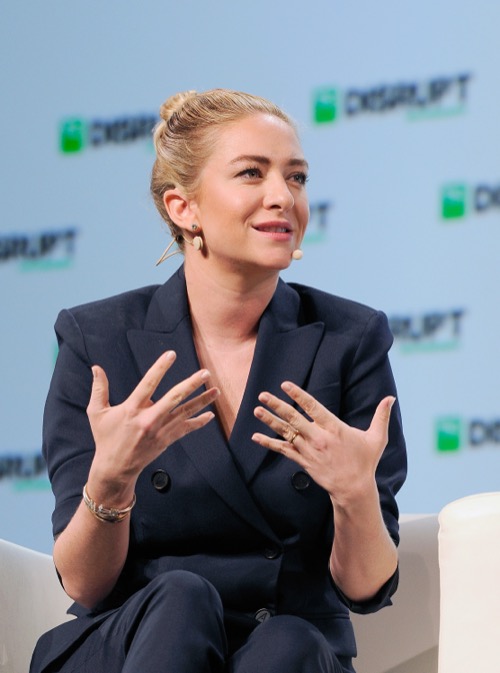
Founder and CEO, Bumble Inc. · b. 1989 · Salt Lake City, Utah
Two calls made by hand, not formulas. how we score →
Summary
She was stripped of her Tinder co-founder title and sued the company for sexual harassment in 2014, settling for over a million dollars under an NDA.
That same year a rival dating-app founder handed her ten million dollars to build a women-first alternative. It made her a paper billionaire at thirty-one when Bumble went public in 2021, a title the stock's collapse has since cut by more than half.
How it happened
Her father, Michael, was a real estate developer in Salt Lake City; her mother, Kelly, stayed home. The family was comfortable enough to move to Paris for a couple of years when she was eleven, and she attended a private Catholic high school back in Utah. When she pitched her father on funding a post-college microloan business, he told her to get a job instead.
She joined the Hatch Labs incubator in 2012 at twenty-two, moved onto the team building what became Tinder, and was later named vice president of marketing. She is credited with naming the app and driving its early growth on college campuses.
In 2014 she was stripped of her co-founder title after a relationship with fellow co-founder Justin Mateen ended, and text messages cited in her complaint showed him sending threatening, demeaning messages. She sued Tinder and its majority owner IAC for sexual harassment and discrimination and settled that September for more than a million dollars under a nondisclosure agreement. She has said the experience shaped the company she built next: a dating app where women message first.
Andrey Andreev, the entrepreneur behind the dating site Badoo, approached her directly after her Tinder exit became public and offered to bankroll a new venture. He put in ten million dollars and Badoo's existing engineering and moderation infrastructure for seventy-nine percent of the new company; she took the other twenty percent and the CEO title. Bumble launched in Austin in December 2014.
Blackstone bought Andreev's majority stake in 2019 at a three-billion- dollar valuation, and Bumble went public in February 2021 at forty-three dollars a share, trading above seventy-six within hours and pushing the company's value past thirteen billion. At thirty-one she became the youngest woman to take a US company public and, on paper, the youngest self-made female billionaire — a title Forbes says she held for about ten months before the stock fell far enough to end it. By 2024 her stake was worth closer to four hundred million, and Blackstone, not she, still held the votes that controlled the company.
The coded evidence
Thirteen groups, every claim sourcednot established
No immigrant-origin history is documented in the sources reviewed; the family reads as multi-generational American on both sides.
↗ en.wikipedia.orgA financially comfortable two-parent household on a secluded, wooded property outside Salt Lake City, with means enough to relocate the family to Paris for a couple of years in her childhood.
↗ atxwoman.comA Tinder VP of Marketing salary through April 2014, then a lawsuit settlement of more than $1M by that September, then Andrey Andreev's $10M investment funding Bumble from day one. She never built without money under her.
↗ papermag.com0
Unmarried and without children when she founded Bumble in December 2014; married 2017, first child 2019.
↗ en.wikipedia.orgnot established
No personal debt is documented at any point in the record reviewed.
↗ en.wikipedia.orgnot established
No housing, food, or income instability is documented at any stage.
↗ en.wikipedia.orgThe hardship was imposed, not chosen. There was nothing to fall back on.
No scarcity narrative, chosen or imposed, appears anywhere in the record.
↗ atxwoman.comFather Michael Wolfe was a real estate developer in Salt Lake City; mother Kelly Wolfe stayed home. A younger sister, Danielle, later also went into real estate development.
↗ elle.comA parent worked for themselves, the strongest known predictor of founding.
Real estate development is typically an owner-operator business; not independently confirmed as self-employment versus a salaried role at a firm.
↗ elle.com1
One full younger sister, Danielle. She has also referenced older half-siblings from her father's first marriage, not separately counted here.
↗ atxwoman.comHer father declined to fund a post-college microloan business idea, telling her to get a job instead — the inverse of the chauffeuring sanction seen elsewhere in this dataset. She took a job at Hatch Labs within months.
↗ atxwoman.comA secluded, wooded property outside Salt Lake City, by her own description.
↗ atxwoman.comJudge Memorial Catholic High School, a private school in Salt Lake City.
↗ en.wikipedia.orgThe family relocated to Paris for about two years starting when she was eleven, then moved back to Salt Lake City.
↗ atxwoman.comFiled suit against Tinder and its majority owner IAC in July 2014 alleging sexual harassment and gender discrimination after being stripped of her co-founder title; text messages cited in the complaint showed co-founder Justin Mateen sending threatening and demeaning messages. Settled in September 2014 for a reported $1M-plus under an NDA.
↗ techcrunch.comBumble's core mechanic — women message first — is a direct answer to the power imbalance she said defined her time at Tinder. She has spoken publicly about wanting the app to enforce the kindness and respect she felt were missing there.
↗ papermag.comAndrey Andreev, founder of the dating site Badoo, approached her directly after her Tinder departure became public and offered to back a new venture — an opportunity that came to her rather than one she had to build.
↗ en.wikipedia.orgTinder (2012 to 2014), where she was vice president of marketing before co-founding Bumble.
↗ sec.govCredibility, Network, Skill
↗ papermag.comHer father refused to fund a post-college microloan business and told her to get a job; she landed at the Hatch Labs incubator soon after, which put her in the room that produced Tinder.
↗ atxwoman.comBA in International Studies, Southern Methodist University.
↗ sec.govnot established
No student debt is documented; the family appears to have had the means to cover private schooling throughout.
↗ en.wikipedia.orgDirect — bachelor's degree straight into a startup incubator role.
↗ papermag.comnot established
Bumble's founding capital came directly as an equity investment from Andrey Andreev, not from her personal savings; her own income at founding came from a Tinder salary and the 2014 settlement.
↗ en.wikipedia.orgIt needed capital up front, before it earned anything.
Capital-first — Andreev's $10M investment funded Bumble before it had meaningful revenue.
↗ en.wikipedia.orgAndrey Andreev supplied $10M and Badoo's existing engineering, moderation, and infrastructure in exchange for 79% of the new venture — an active operator-angel, not a passive check.
↗ en.wikipedia.orgOutside capital at every stage: Andreev's investment in 2014, Blackstone's majority buyout in 2019 at a $3B valuation, then public markets in 2021. She has never held majority economic ownership of the company she founded.
↗ sec.govPersonal experience. The "women message first" design grew directly out of her account of the harassment and power imbalance she said she faced at Tinder.
↗ papermag.comBumble's charter gives "Principal Stockholders" outsized voting rights, and her own shares carry ten votes each while she remains an employee or director. But at the IPO, Blackstone held about 87% of combined voting power to her roughly 12-17%, depending on the measure — Blackstone controlled the company, not its founder.
↗ sec.gov0
Two modest college-era ventures — a charitable tote-bag project and a clothing line with a stylist partner — preceded Tinder; neither is documented as a failure or a meaningful financial risk.
↗ smudailycampus.comA hot 2021 IPO market that had already sent Airbnb and DoorDash to outsized debut valuations; Bumble priced at $43 and traded above $76 within hours of opening.
↗ bbc.comAustin, Texas
↗ papermag.com7
Founding (Dec 2014) to IPO (Feb 2021); the company continued operating after, including her return as CEO in March 2025.
↗ en.wikipedia.orgTechnology — online dating and social networking
↗ sec.gov1000000000
Forbes' peak figure at the February 2021 IPO, age 31 ("the world's youngest self-made female billionaire"). By Forbes' 2024 self-made- women list (as of 5/28/24) her net worth was estimated around $400M as Bumble's stock fell — roughly a 60% decline. Forbes says she held the billionaire title for about ten months before losing it.
↗ forbes.comJournalistic estimate
↗ forbes.com2021
↗ forbes.comAlmost entirely paper wealth held as Common Units in Bumble Holdings, convertible to public shares. No large realized sale is documented, so the decline in Bumble's stock price has moved directly through her net worth.
↗ sec.govOwnership wealth in volatile public equity, not primarily salary.
↗ sec.govYoungest woman to take a US company public, at 31. Testified before the Texas House Criminal Jurisprudence Committee in March 2019 on unsolicited explicit images sent through dating apps.
↗ bbc.comUncapped
↗ sec.govSelf made, Mission driven, Polarizing
↗ forbes.comPublic
↗ forbes.comBefore
The "feminist tech founder" framing was established by press coverage of the 2014 lawsuit, well before the 2021 IPO.
↗ bbc.comAsset
The harassment lawsuit and "women-first" framing became a core marketing asset for Bumble's brand rather than a liability, unusually for this kind of dispute.
↗ bbc.comThe reputation was deliberately built, through books, press, and PR.
A decade of consistent press positioning around feminism and "kindness" language suggests a deliberately maintained narrative, though this is inference rather than a documented PR strategy.
↗ papermag.com"Swiped," a 2025 Hulu biographical drama starring Lily James, dramatizes her Tinder departure and the founding of Bumble.
Her level of creative control over the film is not established in the sources reviewed.
↗ en.wikipedia.orgStructural context
The cost-of-failure score comes from this person's own money and circumstances. But who they were in America carried its own weight, the same way their household or income did, and it shaped how hard the path was just as much. That part isn't in the cost-of-failure number. It's here instead.
Startups founded only by women have drawn about 2% of US venture capital, a share that has barely moved in a decade. Raising money as a woman was harder than any one record shows.
↗ techcrunch.comWhite founders are heavily overrepresented among funded companies and top-tier wealth relative to their share of the population, an edge that has nothing to do with a person's own money.
↗ techcrunch.comAmong the people recorded here — women: 68 · White subjects: 114. Representation here is who reached these outcomes, not equal odds of reaching them.
Controlled comparisons
Each holds one thing constant and varies another, so the difference is the point. A list of similar names wouldn't tell you anything.