Bill Maher
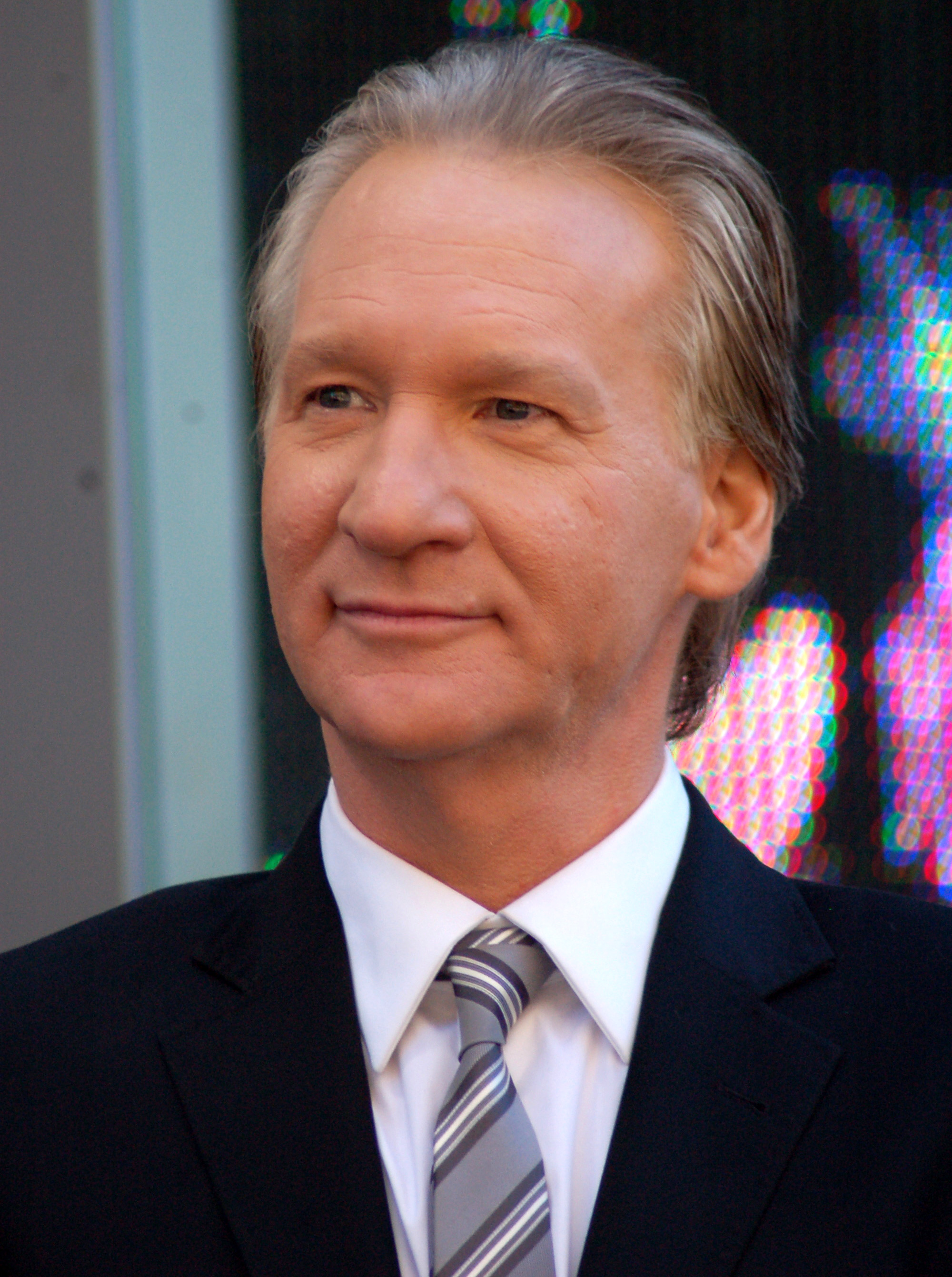
Political satirist; host, "Real Time with Bill Maher" (HBO, 2003–present) · b. 1956 · New York City
Two calls made by hand, not formulas. how we score →
Summary
Raised by a network news editor and a nurse in an ordinary New Jersey household, he sold marijuana at Cornell to pay his way through school and used the money to start doing stand-up, by his own account.
Comedy Central and then ABC gave him a national show for nearly a decade; when ABC dropped him in 2002 over an on-air remark, HBO handed him a longer one he still partly owns and hosts today.
How it happened
His father, William Aloysius Maher Jr., was a network news editor and radio announcer; his mother, Julie, was a nurse. They raised him Catholic in River Vale, New Jersey, and he didn't learn until his early teens that his mother's side of the family was Jewish. It was an ordinary suburban household — steady jobs, no family wealth, and no documented hardship either.
He double-majored in English literature and history at Cornell, and has said on the record for more than a decade that selling marijuana on campus in the mid-1970s paid for the rest of college and "the beginning of my career as a comic." He was never caught and has spoken about it openly and without consequence ever since — a level of legal immunity the same conduct has rarely extended to people without his background.
He became the host of the New York club Catch a Rising Star in 1979, worked the circuit through the early '80s, and started appearing on Johnny Carson's and David Letterman's shows in 1982. By 1993 he had his own panel show, "Politically Incorrect," on Comedy Central; ABC picked it up in 1997 and ran it for five more years, drawing ten Emmy nominations along the way.
Six days after the September 11 attacks, Maher agreed on air with a guest that the hijackers weren't cowardly — "we have been the cowards," he said, comparing them to American cruise-missile strikes. FedEx and Sears pulled their advertising, and ABC declined to renew the show the following June.
About eight months later, HBO gave him "Real Time" — a longer leash than any broadcast network had offered, produced and co-written through his own production company (Kid Love Productions, renamed Bill Maher Productions in 2007) rather than a straight hosting-for-fee job. It has been renewed continuously since 2003, most recently through 2028, and it's the platform that actually set his ceiling — not the joke that got him fired, but the one that immediately replaced it.
In June 2017, during a live exchange with Senator Ben Sasse, who joked Maher would be welcome to visit Nebraska and "work in the fields," Maher responded using a racial slur about himself. HBO called the remark "inexcusable and tasteless" and cut it from reruns; Maher apologized the next day, saying he regretted the word and was "very sorry." He kept hosting the show throughout.
"Real Time" has run more than two decades. Net-worth estimates cluster around $140 million, built from hosting income, a production stake in his own show, decades of stand-up touring, and a minority stake in the New York Mets he bought in 2012. He's said he plans to retire from touring; he has kept hosting.
The coded evidence
Thirteen groups, every claim sourcedMulti-generational American on both sides; no immigration within living memory documented.
↗ en.wikipedia.orgnot established
Not documented; English was almost certainly the home language, but this isn't explicitly sourced.
↗ en.wikipedia.orgStable two-parent household in River Vale, New Jersey. His father held a steady job as a network news editor and radio announcer; his mother worked as a nurse. A comfortable, ordinary-professional home to return to — no documented family wealth, but no instability either.
↗ web.archive.orgnot established
No documented family income floor for his post-college years in New York. By his own repeated account, proceeds from selling marijuana at Cornell funded "the beginning of my career as a comic," not family money.
↗ web.archive.org0
Never married; no documented children. Described himself in a 2004 legal filing as "a confirmed bachelor."
↗ en.wikipedia.orgnot established
No student debt is documented; he has said cannabis sales, not loans, got him through Cornell.
↗ web.archive.orgnot established
No housing instability, homelessness, or comparable hardship during his early stand-up years is documented.
↗ en.wikipedia.orgnot established
No period of visible poverty is documented to code as chosen or imposed.
↗ en.wikipedia.orgFather William Aloysius Maher Jr. worked as a network news editor and radio announcer. Mother Julie Maher (née Berman) was a nurse.
↗ web.archive.orgNeither parent was self-employed.
Both parents held salaried positions (news/radio; nursing) rather than running a business.
↗ web.archive.org1
A sister is referenced (his father stopped taking "Maher and his sister" to Mass); no other siblings are documented.
↗ en.wikipedia.orgnot established
No extended-family mentor, capital source, or competence exposure is documented.
↗ en.wikipedia.orgnot established
No documented multigenerational family standing or notable relatives beyond his parents.
↗ en.wikipedia.orgnot established
No account describes his parents generating extra income to fund his schooling; by his own account, he funded the later part of Cornell himself, through cannabis sales.
↗ web.archive.orgnot established
No documented account of his parents actively facilitating or opposing his move into comedy after college.
↗ en.wikipedia.orgPascack Hills High School, a public high school in Montvale, New Jersey; graduated 1974.
↗ en.wikipedia.orgMoved from New Jersey to New York City after graduating Cornell in 1978 to pursue stand-up comedy.
↗ en.wikipedia.orgnot established
No single named individual is credited with his entry into comedy; he built stage time through the New York club circuit after college.
↗ en.wikipedia.orgCatch a Rising Star, a New York City comedy club; he became its host in 1979, which put him on stage nightly and in front of industry audiences.
↗ en.wikipedia.orgnot established
No public profile before comedy; his audience built gradually through club sets and appearances on Carson and Letterman starting in 1982.
↗ en.wikipedia.org3
Sequential network homes across his hosting career: Comedy Central (1993–1997), ABC (1997–2002), HBO (2003–present).
↗ en.wikipedia.orgBA, English literature and history (double major), Cornell University, 1978.
↗ en.wikipedia.orgnot established
No student-debt figure is documented; he has said cannabis sales funded the rest of his time at Cornell.
↗ web.archive.orgSold marijuana while enrolled at Cornell in the mid-1970s to help pay for college, by his own repeated account.
↗ web.archive.orgDirect — enrolled at Cornell immediately after high school.
↗ en.wikipedia.orgProceeds from selling marijuana as a Cornell undergraduate, which he has said paid for the rest of college and "the beginning of my career as a comic."
↗ web.archive.orgIt paid its own way from the start. Revenue came before any outside money.
Paid from club sets and TV-appearance fees from early on; no investment capital was ever raised.
↗ en.wikipedia.org"Real Time" is produced through his own production company (Kid Love Productions, renamed Bill Maher Productions in 2007) in partnership with HBO, rather than as a pure work-for-hire hosting job. No outside equity investors are involved.
↗ en.wikipedia.orgIn June 2012 he purchased a minority ownership stake in the New York Mets, one of twelve roughly 4%, $20 million blocks the Wilpon/Katz ownership family sold after a prior deal with a hedge-fund investor collapsed. He declined to disclose the exact size of his stake.
↗ espn.comSold marijuana while an undergraduate at Cornell in the mid-1970s; has described this on the record repeatedly, across interviews spanning more than a decade, as what funded college and the earliest years of his stand-up career.
Self-admitted only, per the schema's guardrail — never inferred or alleged. He has spoken about this openly for decades and was never charged. Read against the schema's enforcement-asymmetry finding, that immunity is itself informative: a Cornell undergraduate in the 1970s took on a legal risk that, for people without his background, far more often ends in an actual record — and a record closes doors this activity never closed for him.
↗ celebstoner.com1
Income is concentrated in one field, TV political commentary and stand-up, rather than personal fame traded for equity stakes across unrelated industries. The Mets purchase was a cash investment of earnings, not a fame-for-equity exchange.
↗ en.wikipedia.orgWhen ABC canceled "Politically Incorrect" in 2002 after FedEx and Sears withdrew their advertising, the financial loss fell on ABC and its affiliates rather than on him personally. He had been continuously employed by a television network since 1993, first Comedy Central and then ABC, and HBO hired him for "Real Time" about eight months after the cancellation.
↗ web.archive.org"Politically Incorrect" ended June 16, 2002; "Real Time" premiered February 21, 2003 — roughly an eight-month gap, with no other TV hosting job in between.
↗ en.wikipedia.orgPremium cable was expanding original programming and building prestige political and comedy franchises in the early 2000s; HBO had the appetite and slate room to immediately back a host ABC had just dropped.
↗ en.wikipedia.orgLos Angeles — "Real Time" tapes at Television City.
↗ en.wikipedia.org23
Real Time has run continuously from 2003 to 2026, most recently renewed through 2028.
↗ en.wikipedia.orgPolitical satire and television hosting
↗ en.wikipedia.org140000000
Aggregator estimate; no Forbes profile exists for him and no filing or disclosed valuation is available for a private individual paid via hosting fees and production income. Other aggregator estimates range as high as $200 million; treated as tier-C per SCHEMA.md and not used as a precise figure.
↗ celebritynetworth.comAggregator
↗ celebritynetworth.com10000000
Aggregator estimate of his reported annual HBO hosting fee; no proxy statement or contract figure is publicly disclosed.
↗ celebritynetworth.comAggregator
↗ celebritynetworth.comPredominantly earned income (hosting fees, production income from his own company, and stand-up touring revenue) rather than equity in a scaled company. The Mets stake adds a modest appreciating asset outside his core career.
↗ en.wikipedia.orgLong-standing PETA board member since 1997 and NORML/Marijuana Policy Project advisory-board member; recipient of the 2026 Mark Twain Prize for American Humor from the Kennedy Center, the industry's top career honor for comedy.
↗ cnn.comCapped
Earnings are dominated by periodically renewed hosting/production contracts rather than a scalable equity position, even though his production company holds a stake in the show itself.
↗ en.wikipedia.orgIn 2013, after Maher joked on air that he'd give $5 million to charity if Donald Trump could prove he wasn't "the spawn of his mother having sex with an orangutan" by producing his birth certificate, Trump produced the certificate and then filed a $5 million breach-of-contract suit claiming the offer was binding. Trump withdrew the suit himself about eight weeks later; no judgment was ever entered.
↗ reuters.comIn June 2017, during a live exchange on "Real Time" in which Senator Ben Sasse joked Maher would be welcome to visit Nebraska and "work in the fields," Maher responded using a racial slur about himself. HBO called the remark "inexcusable and tasteless" and removed it from future airings; Maher apologized the next day, saying "I regret the word I used in the banter of a live moment. The word was offensive, and I regret saying it and am very sorry."
↗ theguardian.comAfter
↗ theguardian.comUnrelated
The 2017 incident occurred 14 years into an already-established show and did not produce any part of his career advantage.
↗ theguardian.comNone
No fine or legal liability; the segment was cut from reruns and he continued hosting the show without interruption.
↗ theguardian.comAcerbic, Provocative, Polarizing
↗ en.wikipedia.orgPublic
↗ en.wikipedia.orgBefore
His reputation as a sharp political satirist was established by "Politically Incorrect" (1993–2002), before "Real Time" began.
↗ en.wikipedia.orgMixed
↗ en.wikipedia.orgHis reputation splits by constituency. Some audiences and industry peers treat him as an established, credentialed political-comedy institution — reflected in the 2026 Mark Twain Prize. Others, particularly following his commentary on Islam, his 2017 use of a racial slur, and later criticism of "woke" politics, have called for boycotts or his removal from HBO. He has kept the show throughout.
↗ theguardian.comHe kept his HBO platform continuously through and after the 2017 incident, and the show has been renewed repeatedly since, most recently through 2028 — the controversy did not end his career, though a segment of his audience remains critical of him over it and over his commentary on religion.
↗ en.wikipedia.orgStructural context
The cost-of-failure score comes from this person's own money and circumstances. But who they were in America carried its own weight, the same way their household or income did, and it shaped how hard the path was just as much. That part isn't in the cost-of-failure number. It's here instead.
Men hold most of the ownership and gatekeeping across the creative and media industries, the default that recognition and deals flow toward.
↗ assets.uscannenberg.orgAmong the people recorded here — men: 115 · white subjects: 3. Representation here is who reached these outcomes, not equal odds of reaching them.
Controlled comparisons
Each holds one thing constant and varies another, so the difference is the point. A list of similar names wouldn't tell you anything.