Dave Chappelle
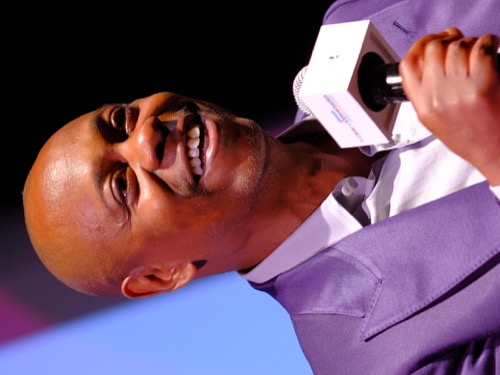
Stand-up comedian; creator, "Chappelle's Show" · b. 1973 · Washington, D.C.
Two calls made by hand, not formulas. how we score →
Summary
His parents were professors with real standing and no real money, a household that could sanction stand-up comedy at fourteen but not fund it.
He reached the same fame as people who got rich from it, signed away streaming rights to his biggest show without knowing what that would cost, and spent the next fifteen years getting paid for it after the fact.
How it happened
Two parents with more standing than money. His father taught voice and served as dean of students at Antioch College; his mother held a doctorate and was ordained in 1981 as the first Black woman Unitarian Universalist minister. He was named for his great-grandfather, who was born enslaved in South Carolina and later became president of Allen University. None of it produced savings, but it produced permission — when he started doing stand-up at fourteen, his mother drove him to the D.C. clubs and stayed as his legal guardian so he could work rooms that served alcohol.
An ABC sitcom canceled after four episodes in 1996. Then "Half Baked" in 1998, panned badly enough that his co-writer remembers a news network declaring his career over on air. His father died around the same time. He seriously considered leaving entertainment and bought a small farm in Ohio instead.
Broke and about to become a father, he signed the deal for "Chappelle's Show" the way he later said any broke, expecting comic in his late twenties would — without much room to negotiate terms for a streaming business that didn't exist yet. The show became Comedy Central's biggest hit and set a record for TV-on-DVD sales. None of the streaming revenue that followed was contractually his.
In 2005, mid-season, he turned down a reported $50 million renewal and left for South Africa. He told Oprah Winfrey the following year that he wasn't walking away from the money, he was walking away from the feeling of being controlled by people with a financial stake in him. Comedy Central finished the season without him.
Netflix paid him $60 million in 2016 for three specials, on terms he negotiated himself this time, and he has since won six Grammys for Best Comedy Album. The underlying rights dispute over "Chappelle's Show" took fifteen years and a public boycott campaign to resolve, settling in 2021 for an amount neither side disclosed.
The coded evidence
Thirteen groups, every claim sourcedHis mother was ordained a Unitarian Universalist minister in 1981; his father's own religious upbringing of him is not established.
↗ en.wikipedia.orgBoth parents held stable academic and ministerial positions throughout his childhood — his father at Antioch College, his mother at Howard University and later Prince George's Community College. Neither produced significant savings, but both were a genuine, if modest, floor to fall back to.
↗ en.wikipedia.org1
He has said he signed the original Comedy Central contract "the way that a 28-year-old expecting father that was broke signs a contract" — placing one dependent on the way around the time of signing. His first son's exact birth date relative to the signing isn't independently established.
↗ techcrunch.comAfter "Half Baked" was panned in 1998 and his father died the same year, he seriously considered leaving entertainment and bought a small farm in Ohio rather than staying in New York or Los Angeles.
↗ ultimateclassicrock.comnot established
No imposed poverty and no documented chosen austerity. The household was a real if unspectacular cushion rather than a hardship story.
↗ encyclopedia.comFather William David Chappelle III taught vocal performance and served as dean of students at Antioch College in Yellow Springs, Ohio. Mother Yvonne Seon held a doctorate in African and African American humanities from the Union Institute (1974), taught at Howard University and Prince George's Community College, worked in Patrice Lumumba's Congolese government in the early 1960s, and later served as secretary of a major U.S. delegation to UNESCO.
↗ en.wikipedia.orgFather: B.A. in music, Antioch College, after attending Brown University. Mother: Ph.D., Union Institute, 1974, one of the first Black Studies doctoral programs in the country.
↗ en.wikipedia.org2
Most accounts describe an older brother and sister; at least one biographical summary instead describes him as the oldest of three. Exact birth order isn't independently confirmed.
↗ legit.ngHis mother's academic, ministerial, and Pan-African political circles — including her time in the Congolese government and at the UN — put him near Black intellectual and diplomatic life in Washington from childhood, independent of any family wealth.
↗ en.wikipedia.orgNamed for his great-grandfather William D. Chappelle, born enslaved in Winnsboro, South Carolina in 1857, who became an AME bishop and served as president of Allen University, a historically Black college, from 1897 to 1899 (and again 1908–1912), chairing its board from 1916 to 1925. The family carried multigenerational institutional standing in Black education and religious life with no corresponding wealth.
↗ en.wikipedia.orgnot established
Duke Ellington School of the Arts is a selective public magnet school with no tuition; no family sacrifice for schooling costs is established or would be expected.
↗ ellingtonschool.orgStarted performing stand-up in Washington, D.C. clubs at fourteen; his mother, an ordained minister, accompanied him as his required legal guardian so he could work venues that served alcohol, rather than steering him toward a more conventional path.
↗ notablebiographies.comHis parents separated when he was six. He subsequently split time between his mother's home in Silver Spring, Maryland, and his father's in Yellow Springs, Ohio, through the rest of childhood.
↗ encyclopedia.comDuke Ellington School of the Arts, a selective public arts magnet high school in Washington, D.C.; he studied theater and graduated in 1991.
↗ washingtonpost.comRegular moves between Washington/Silver Spring and Yellow Springs, Ohio through childhood after his parents' separation, then a move to New York City after high school in 1991 to pursue comedy full time.
↗ encyclopedia.comAfter moving to New York out of high school, he learned street performing and crowd work from comedian Charles Barnett in Greenwich Village while working the Boston Comedy Club circuit.
↗ encyclopedia.comBy the time "Chappelle's Show" launched in 2003 he already had a decade of stand-up behind him, an HBO special ("Killin' Them Softly," 2000), an appearance on "Def Comedy Jam" (1992), and a cult following from "Half Baked" — a modest but real base rather than a cold start.
↗ encyclopedia.comBooed off the stage during amateur night at Harlem's Apollo Theater early in his New York years. He later described it as ultimately useful — it toughened him for the club circuit rather than driving him out of comedy.
Sources disagree on his exact age at the time — accounts range from 14 to 19.
↗ thethings.comAttended Duke Ellington School of the Arts, a selective audition-based public arts high school, studying theater.
↗ washingtonpost.comNo college. Graduated Duke Ellington School of the Arts in 1991 and moved to New York City to pursue comedy rather than enrolling anywhere.
↗ encyclopedia.comIt paid its own way from the start. Revenue came before any outside money.
Paid from club sets and TV appearances from the start; no capital was ever raised.
↗ encyclopedia.comRather than staying near the industry, he put his money into a home and farmland in rural Yellow Springs, Ohio, near where his father had taught, and has lived there since.
↗ celebritynetworth.comSigned the original "Chappelle's Show" contract with Comedy Central in the early 2000s without a share of future digital/streaming licensing, a category that barely existed at signing. In his own words, he signed it "the way that a 28-year-old expecting father that was broke signs a contract." When ViacomCBS licensed the show to Netflix and HBO Max in 2020 without paying him, he said: "When I left that show, I never got paid. They didn't have to pay me because I signed the contract," and asked Netflix to pull it, calling the licensing "fencing stolen goods." Netflix complied. The dispute settled on undisclosed terms in February 2021, after which the show returned to both platforms.
↗ techcrunch.com"Chappelle's Show" grew out of his and co-creator Neal Brennan's own stand-up material and observational writing about race, built on roughly fifteen years of club and TV work rather than an acquired format or franchise.
↗ ultimateclassicrock.com1
His income is fee-for-work concentrated in one field — stand-up specials and one television show — rather than equity stakes traded across unrelated industries.
↗ celebritynetworth.com2
The ABC sitcom "Buddies," canceled in 1996 after four of thirteen episodes aired, and "Half Baked" (1998), panned badly enough that co-writer Neal Brennan recalled a news network declaring his career over on air.
↗ ultimateclassicrock.comThe studios bore the direct financial losses on "Buddies" and "Half Baked"; he absorbed the reputational cost and, by his own and his collaborators' account, came close to leaving the industry afterward.
↗ ultimateclassicrock.comAfter "Half Baked" and his father's death in 1998, he pulled back from Hollywood for several years before "Chappelle's Show" premiered in January 2003.
↗ ultimateclassicrock.comIn May 2005, mid-production on season three, he turned down a reported $50 million renewal from Comedy Central and left for South Africa. He told Oprah Winfrey in 2006, "I wasn't walking away from the money, I was walking away from the circumstances" — describing discomfort with how much control others had over someone generating that much revenue. Comedy Central released the unfinished season as "The Lost Episodes" without him. He rebuilt from there: a $60 million Netflix deal followed in November 2016.
↗ cbsnews.com29
"Chappelle's Show" premiered on Comedy Central in January 2003; he was born August 1973.
↗ encyclopedia.comLaunched during cable's ratings rise and the mid-2000s DVD boom. "Chappelle's Show: Season One" became the best-selling TV-on-DVD title of its time at roughly 3 million copies, and the Season Two release sold nearly 500,000 copies on its first day in May 2005.
↗ movieweb.comSettled permanently in small-town Yellow Springs, Ohio rather than Los Angeles or New York. He has described it as finding "an altitude I was comfortable with," trading industry proximity for a lower-profile life near his kids.
↗ cbsnews.comStand-up comedy and television
↗ grammy.com100000000
Aggregator estimate; other outlets place him closer to $60–70 million. No filing or disclosed valuation exists for a private individual whose income is largely per-project fees.
↗ celebritynetworth.comJournalistic estimate
↗ celebritynetworth.comIncome, not equity. Nearly all documented earnings are per-project fees — $60 million for three Netflix specials in 2016, a reported $20 million for 2023's "The Dreamer" — rather than an ownership stake in a company, studio, or catalog he controls.
↗ thegrio.comCapped
Compensation comes as negotiated per-special fees rather than equity that can compound, unlike peers who own their production companies or libraries outright.
↗ thegrio.comFearless, Uncompromising, Polarizing
↗ npr.orgPublic
↗ npr.orgBefore
His reputation as a sharp, socially observant comic was established by "Chappelle's Show" (2003–2005), well before the 2021 controversy.
↗ grammy.comMixed
↗ wtop.comSplit sharply after his 2021 Netflix special "The Closer." Grammy voters and his core audience kept rewarding him — he won Best Comedy Album in four of the next five years — while Netflix's trans employee group staged a walkout on October 20, 2021 calling the special transphobic, and GLAAD and other advocacy groups condemned it publicly. At his own former high school, Duke Ellington School of the Arts, student protests over the special led him to decline having its new theater named after him in June 2022, unveiling it instead as "The Theater for Artistic Freedom and Expression."
↗ wtop.comHe never lost commercial standing with Netflix or with Grammy voters — the split is with a specific constituency (trans advocates, some former colleagues, some students at his alma mater), not with his broader audience or industry gatekeepers.
↗ grammy.comStructural context
The cost-of-failure score comes from this person's own money and circumstances. But who they were in America carried its own weight, the same way their household or income did, and it shaped how hard the path was just as much. That part isn't in the cost-of-failure number. It's here instead.
Men hold most of the ownership and gatekeeping across the creative and media industries, the default that recognition and deals flow toward.
↗ assets.uscannenberg.orgIn the creative and media industries, recognition comes far more easily to underrepresented creators than the ownership it should turn into. Among 2023's top-grossing film directors, for one measure, eight were Black.
↗ assets.uscannenberg.orgAmong the people recorded here — men: 169 · Black subjects: 58. Representation here is who reached these outcomes, not equal odds of reaching them.
Controlled comparisons
Each holds one thing constant and varies another, so the difference is the point. A list of similar names wouldn't tell you anything.