Carlos Santana
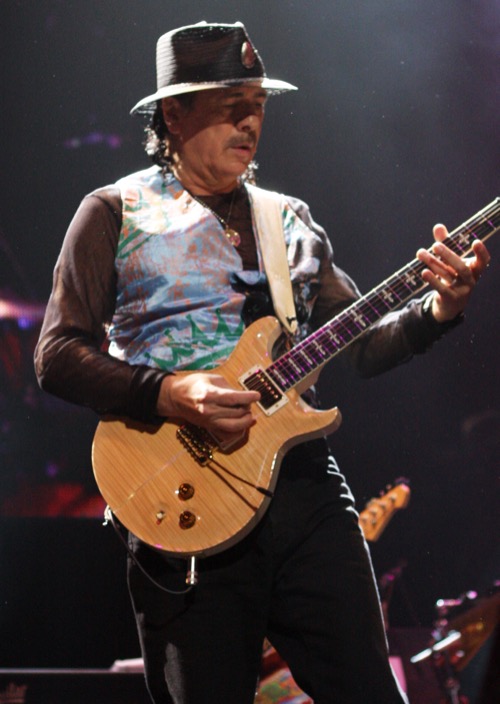
Guitarist and bandleader, Santana · b. 1947 · Autlán de Navarro, Jalisco, Mexico
Two calls made by hand, not formulas. how we score →
Summary
A mariachi violinist's son, left in Tijuana at thirteen to support himself on bar gigs while his family moved to San Francisco without him.
He rejoined them, dropped out of high school, and was still unrecorded when a promoter put his band on the Woodstock stage before the debut album shipped. Decades of touring followed, then a licensing business built on the name once it was worth something.
How it happened
Born in Autlán de Navarro, Mexico, the son of José Santana, a professional mariachi violinist who started teaching him violin at five and guitar at eight. The family moved to Tijuana in 1955, when Carlos was eight. At twelve his mother took him to see a local rock band, Los TJ's, playing in a city park; he talked his way into being their roadie, then their bass player, then left to lead his own bar band on the Tijuana Strip.
Around 1961 his father found steady work in San Francisco and moved the rest of the family there. Carlos, who disliked the US at first, stayed behind in Tijuana on his own, supporting himself playing bars and strip clubs. He didn't rejoin the family for good until late 1963, at sixteen.
In San Francisco he washed dishes at a diner and busked on the street to save for a Gibson SG after his first guitar was destroyed. He left Mission High School in 1965 without graduating, was later accepted to two state universities, and chose not to go to either. In October 1966 he co-founded the Santana Blues Band with organist Gregg Rolie and bassist David Brown, street musicians like himself. That same year, promoter Bill Graham picked the unknown group to fill in for an intoxicated Paul Butterfield at the Fillmore, and Santana's playing caught his attention.
Graham got the still-unsigned, unrecorded band a slot at Woodstock on August 16, 1969. Their eleven-minute instrumental "Soul Sacrifice" became one of the festival's surprises. Their debut album didn't ship until six days later. When the "Woodstock" film and soundtrack came out the following year, a band with one record out was suddenly known nationally.
"Abraxas" hit No. 1 in 1970. Sales declined through the 1980s, and by the mid-1990s he had no major-label deal. In 1998 Clive Davis signed him to Arista and built "Supernatural" around guest collaborators like Rob Thomas and Lauryn Hill. It shipped over 15 million copies in the US, and he won nine Grammys in one night in 2000, more than any artist before him.
He put the second act's income into things he could own outright: a footwear line in 2001, licensed to Brown Shoe Co.; a Mexican restaurant chain in 2007; a cannabis brand in 2020. When Caleres dropped the footwear license in 2019, he brought the brand back in-house himself in 2022 through his own company rather than re-licensing it. He's held a standing residency at House of Blues in Las Vegas since 2012.
The coded evidence
Thirteen groups, every claim sourcedCoarse public-record coding; race is a noisy, interpretive category.
↗ en.wikipedia.orgFirst-generation immigrant
↗ encyclopedia.comnot established
Not established from the public record beyond his own later, syncretic spiritual statements as an adult.
↗ en.wikipedia.orgSpanish
Inferred from a Mexican immigrant household; not independently confirmed as a direct quote.
↗ encyclopedia.comA family home became available once he rejoined his parents in San Francisco permanently in late 1963; his father had found steady work there by then. There was no equivalent home during the roughly two years before that, when he lived on his own in Tijuana as a young teenager.
↗ encyclopedia.comnot established
No family income floor is documented for the years he was on his own in Tijuana; he supported himself entirely from paid club gigs.
↗ en.wikipedia.orgStayed behind alone in Tijuana as a young teenager, roughly age thirteen to sixteen, supporting himself playing bars and strip clubs on the Tijuana Strip while his parents and siblings relocated to San Francisco without him.
↗ encyclopedia.comThe hardship was imposed, not chosen. There was nothing to fall back on.
↗ encyclopedia.comFather José Santana was a professional mariachi violinist; mother Josefina ran the household.
↗ encyclopedia.comA parent worked for themselves, the strongest known predictor of founding.
A working musician paid per performance rather than salaried.
↗ encyclopedia.comnot established
A younger brother, Jorge Santana, also became a professional guitarist. Full sibling count and birth order aren't established across sources.
↗ en.wikipedia.orgHis father taught him violin at five and guitar at eight, and his mother took him to see the Tijuana rock band Los TJ's play in the local park, the outing that led to his first roadie job. The family trade was music, so a path into it carried no stigma even though it produced no capital.
↗ en.wikipedia.orgHas said on the record, including in interviews and his 2014 memoir "The Universal Tone," that he was sexually abused as a boy, between roughly ages ten and twelve, by an American man who brought him across the border. He has spoken about carrying and later working through it.
Self-disclosed on the record across decades; the man he described has never been publicly named and is not named here.
↗ web.archive.orgMission High School in San Francisco's Mission District; left in 1965 without graduating. Later accepted to California State University, Northridge and Humboldt State University but chose not to enroll at either.
↗ en.wikipedia.orgLanded in San Francisco's Mission District as the mid-1960s rock and hippie scene was forming around bands like the Grateful Dead and Jefferson Airplane, and around Bill Graham's Fillmore Auditorium, one of the most concentrated live-music scenes in the country at that moment.
↗ en.wikipedia.orgBorn in Autlán de Navarro, Jalisco. Family moved to Tijuana in 1955, age eight. His father found steady work in San Francisco around 1961 and relocated the rest of the family; Carlos initially stayed behind in Tijuana and supported himself as a club musician before rejoining the family in San Francisco permanently in late 1963, age sixteen. Naturalized as a US citizen in 1965.
↗ encyclopedia.comHis father worked as a paid professional musician in Mexico; in San Francisco the family started over on wage income, his father's day work and Carlos's own dishwashing and busking, before either re-established themselves. A modest reset rather than the elite-to-working-class drop seen in professional-class immigrant cases.
↗ encyclopedia.comIn 1966, promoter Bill Graham picked Santana's ad hoc group from musicians he knew to fill in for an intoxicated Paul Butterfield at a Sunday matinee at the Fillmore Auditorium. Santana's playing caught Graham's attention and the band's profile with it.
↗ en.wikipedia.orgBecame a roadie for the Tijuana band Los TJ's at twelve after his mother took him to see them play in a city park, then worked his way onto bass and later guitar in local bar bands on the Tijuana Strip, access built through direct proximity and persistence rather than a family connection to the industry.
↗ en.wikipedia.orgCo-founded the Santana Blues Band in October 1966 with organist and vocalist Gregg Rolie and bassist David Brown, fellow street and club musicians in San Francisco.
↗ en.wikipedia.orgLearned directly from Javier Bátiz and Los TJ's on the Tijuana Strip starting at twelve, and later named guitarist Michael Bloomfield, whom he met in San Francisco, a direct mentor.
↗ en.wikipedia.orgStarted as an unpaid roadie for Los TJ's before being allowed to play, first bass then guitar, inside the band's orbit.
↗ en.wikipedia.orgNo college. Left Mission High School in 1965 without a diploma; accepted to Cal State Northridge and Humboldt State University but chose touring and gigging over enrolling.
↗ en.wikipedia.orgWorked as a dishwasher at the Tic Tock Drive-In and busked on San Francisco streets while still a teenager, before leaving school entirely.
↗ en.wikipedia.orgWages from paid club and bar gigs on the Tijuana Strip as a young teenager, then dishwashing pay and street-busking money in San Francisco, saved up to buy a Gibson SG after his first guitar was destroyed.
↗ en.wikipedia.orgIt paid its own way from the start. Revenue came before any outside money.
Paid from live performance from adolescence on; no capital was ever raised.
↗ en.wikipedia.orgEarned wages from paid performances on the Tijuana Strip starting around twelve or thirteen, his first income of any kind.
↗ en.wikipedia.orgPut the cash flow and fame from "Supernatural" and the touring that followed into a licensing business alongside music: a footwear line in 2001, a Mexican restaurant chain ("Maria Maria") in 2007, and a cannabis brand ("Mirayo") in 2020, rather than relying on performance fees alone.
↗ en.wikipedia.orgHis recording catalog stayed with major labels throughout: Columbia from 1969, Polygram from 1990, Arista for "Supernatural" in 1999. No source establishes he owns his masters. His footwear line ran the opposite path: licensed to Brown Shoe Co./Caleres from 2001, then reclaimed outright when he brought it in-house through his own company, Jubilation LLC, after Caleres dropped the brand in 2019.
↗ santana.comHis sound came from his own life: his father's mariachi tradition, American blues heard in the border culture of Tijuana as a boy, and the San Francisco psychedelic scene he landed in as a teenager, not from an acquired format.
↗ en.wikipedia.org3
Footwear (2001, later reclaimed outright in 2022), a Mexican restaurant chain (2007), and a cannabis brand (2020): three industries outside music where his name was converted into a licensing or ownership stake rather than a performance fee.
↗ santana.comBy the mid-1990s he had no major-label recording contract, and album sales had been declining through the 1980s and early '90s, before Clive Davis signed him to Arista for "Supernatural" in 1998.
↗ en.wikipedia.orgContinuous touring rather than a restart from zero; he kept performing and recording through the fallow stretch of the late 1980s and early 1990s.
↗ en.wikipedia.orgLanded in San Francisco as the late-1960s rock and hippie scene reached its commercial and cultural peak, and broke through via the single highest-visibility mass-media event of that scene, the Woodstock film.
↗ en.wikipedia.orgPlayed Woodstock on August 16, 1969, before the band's debut album existed; it shipped six days later, on August 22. The eleven-minute "Soul Sacrifice" set, captured in the 1970 "Woodstock" film and soundtrack, made an unrecorded band nationally known almost overnight.
↗ en.wikipedia.orgBuilt. Original band, original sound blending blues, rock and Latin percussion; nothing acquired.
↗ en.wikipedia.org60
Continuous touring and recording career from the band's 1966 founding through an ongoing Las Vegas residency at House of Blues, Mandalay Bay, running since 2012.
↗ en.wikipedia.orgMusic
↗ en.wikipedia.org120000000
Aggregator estimate; other outlets place him closer to $100 million. No filing or disclosed valuation exists for a private individual whose income is largely per-project fees and licensing royalties.
↗ celebritynetworth.comJournalistic estimate
↗ celebritynetworth.comA sixty-year mix of touring and recording income across major labels, supplemented since 2001 by licensing and equity stakes in unrelated consumer brands (footwear, restaurants, cannabis) rather than ownership of a single company or catalog.
↗ celebritynetworth.comRock and Roll Hall of Fame inductee (1998), 10 Grammy Awards and 3 Latin Grammy Awards, International Latin Music Hall of Fame inductee (2002), and a Kennedy Center Honoree (2013).
↗ en.wikipedia.org3
From co-founding the band in October 1966 to the Woodstock breakthrough in August 1969.
↗ en.wikipedia.orgUncapped
↗ en.wikipedia.orgVirtuosic, Spiritual, relentless work ethic, Genre blending
↗ en.wikipedia.orgPublic
↗ en.wikipedia.orgBefore
His reputation as a guitar virtuoso was set by the original band's run (1969-1972), well before the 1999 "Supernatural" comeback.
↗ en.wikipedia.orgAsset
↗ en.wikipedia.orgStructural context
The cost-of-failure score comes from this person's own money and circumstances. But who they were in America carried its own weight, the same way their household or income did, and it shaped how hard the path was just as much. That part isn't in the cost-of-failure number. It's here instead.
Men hold most of the ownership and gatekeeping across the creative and media industries, the default that recognition and deals flow toward.
↗ assets.uscannenberg.orgImmigrants and their children are overrepresented among America's biggest companies, as founders and as senior leaders. They got there through the visa, credential, and network hurdles that make the path harder to even start down.
↗ forbes.comAmong the people recorded here — men: 169 · Hispanic/Latino subjects: 3. Representation here is who reached these outcomes, not equal odds of reaching them.
Controlled comparisons
Each holds one thing constant and varies another, so the difference is the point. A list of similar names wouldn't tell you anything.