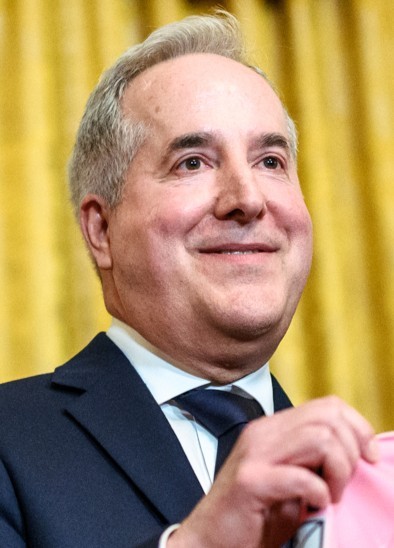
Ken Langone
born Kenneth Gerard Langone
Co-founder and financier of The Home Depot; founder of Invemed Associates; namesake of NYU Langone Health · b. 1935 · Roslyn Heights, Long Island, New York
Two calls made by hand, not formulas. how we score →
Summary
A plumber's son on Long Island, he dug ditches, caddied, and worked as a butcher's assistant to get through Bucknell on a mortgage his parents took out.
A Wall Street career led him to found his own bank, Invemed. In 1978 he raised the $2 million that financed The Home Depot for Bernie Marcus and Arthur Blank, keeping a 5 percent stake — nearly all his fortune traces back to it.
How it happened
Born September 16, 1935, in Roslyn Heights, on Long Island. His father worked as a plumber, paid by the hour and laid off at the end of each job, and is also described in a published profile as having struggled with manic depression; his mother worked in the cafeteria of the public school across the street from their house. Both parents were themselves children of Italian immigrants, so the family had already been in the US for at least a generation by the time he was born. It was a large extended family on a tight budget, with no money to spare and nothing to transfer.
His high school principal advised against sending him to college at all. His parents mortgaged their house anyway to send him to Bucknell University, and he worked through it himself — as a ditch digger, a golf caddy, and a butcher's assistant — to cover what the mortgage didn't. He finished a bachelor's degree in economics in three and a half years.
He went to work at the Equitable Life Assurance Society in 1957 while studying for an MBA at night at NYU's business school, completing it in 1960 (NYU later named its part-time MBA program for him). After military service, he joined the Wall Street firm R.W. Pressprich & Co. in 1961, rising to executive vice president and then, by 1969, president.
At Pressprich he arranged the 1968 initial public offering of Ross Perot's Electronic Data Systems, a deal that made him a name on Wall Street as a financier who could get something done — well before Home Depot existed as an idea.
In 1974 he founded his own investment bank, Invemed Associates, built on the Wall Street relationships and reputation he had spent more than a decade assembling rather than on family money or an inherited client book.
In 1978, after Bernard Marcus was fired as CEO of the Handy Dan home-improvement chain — a company Langone knew as an investor — and teamed up with Arthur Blank, Langone used Invemed to put together roughly $2 million in outside financing so the two could open the first Home Depot stores. Outside investors took half the new company for that $2 million; Langone kept 5 percent for himself for assembling the group. That stake, compounding with Home Depot's growth into one of the world's largest retailers, is the foundation of nearly all his later wealth.
He chaired the New York Stock Exchange's compensation committee from 1999 to 2003, and in that role helped set the roughly $139.5 million pay package awarded to then-NYSE chairman Richard Grasso. New York Attorney General Eliot Spitzer sued over the package in 2004 and named Langone alongside Grasso, alleging the committee hadn't been given full information about the package's size. A New York court dismissed the claims against Langone in 2008, after the exchange's conversion from a nonprofit to a for-profit company changed the legal basis for the suit. Langone fought the case publicly for years and maintained he had done nothing wrong; no judgment or penalty was ever entered against him.
He and his wife, Elaine, gave more than $200 million to NYU's medical school and hospital system, which was renamed NYU Langone Health in recognition, and pledged another $100 million in 2018 toward free tuition for its medical students. He has also given tens of millions to his alma mater, Bucknell. In 2018 he published a memoir, "I Love Capitalism! An American Story," and has long been an outspoken, frequently quoted Republican donor and commentator on the record against single-payer health care and free college tuition.
Forbes put his personal net worth at about $9.9 billion as of October 1, 2026, almost all of it traceable to his Home Depot stake and Invemed. He remained active in business and public commentary into his nineties.
The coded evidence
Thirteen groups, every claim sourcedDrawn from a search-indexed summary of this biography; the page itself blocked direct automated fetch, so treat with some caution despite the detail being specific and consistent with other sources on his Italian-American background.
↗ horatioalger.orgThird-generation at least: both parents were US-born children of Italian immigrants, so coded as no migration-linked headwind for Langone himself rather than second-generation.
↗ horatioalger.orgHe remained a devout, practicing Catholic as an adult (made a Knight of the Order of St. Gregory the Great; longtime board member of St. Patrick's Cathedral), consistent with a Catholic upbringing.
↗ niaf.orgEnglish
Inferred from a US-born, English-speaking household; not separately documented.
↗ en.wikipedia.orgA stable, family-owned home on Long Island, but one his parents mortgaged to pay for his Bucknell tuition — real financial exposure for the family, not a cushion behind him.
↗ niaf.orgNo inherited income floor. Invemed was founded on his own banking income and Wall Street reputation after more than a decade at Equitable Life and R.W. Pressprich, not on savings set aside for the purpose or a family cushion.
↗ leadersmag.comnot established
His wife Elaine's role, if any, during his early career and Invemed's founding isn't documented in sources consulted.
↗ en.wikipedia.orgnot established
He and Elaine had three sons; none are documented as dependents during his early career buildup.
↗ en.wikipedia.orgHis parents carried a mortgage taken out specifically to pay for his Bucknell tuition — debt exposure sitting on the family, not personal student debt documented against him.
↗ niaf.orgnot established
No housing or income instability is documented around Invemed's 1974 founding or the 1978 Home Depot financing.
↗ en.wikipedia.orgThe hardship was imposed, not chosen. There was nothing to fall back on.
The ditch-digging, caddying, and butcher's-assistant jobs were necessity-driven to supplement a mortgaged tuition, not chosen austerity.
↗ niaf.orgFather was a plumber, an hourly union laborer laid off at the end of each job, also described as having struggled with manic depression; mother worked in the cafeteria of the public school across the street from their house.
The manic-depression detail comes from a search-indexed summary of this biography; direct fetch of the page was blocked.
↗ horatioalger.orgNeither parent was self-employed.
Hourly union laborer and school-cafeteria employee, not self-employed.
↗ horatioalger.orgnot established
Not established in sources consulted, beyond a general description of a large extended family.
↗ en.wikipedia.orgNo documented family wealth, business, or Wall Street connections. Both parents were children of Italian immigrants from large families on Long Island, with no capital or professional standing to transfer.
↗ horatioalger.orgHis parents mortgaged their house to pay for Bucknell despite his high school principal's advice against sending him to college; he covered additional costs himself working as a ditch digger, golf caddy, and butcher's assistant.
↗ niaf.orgRoslyn Heights, on Long Island — a working- and middle-class suburb, not an elite enclave.
↗ en.wikipedia.orgnot established
Neither parent's work supplied a documented pathway into finance or business.
↗ en.wikipedia.orgnot established
No documented early social or family network into Wall Street; his entry came through an entry-level insurance job and night school rather than a pre-existing connection.
↗ en.wikipedia.orgAn entry-level position at Equitable Life Assurance in 1957, combined with a part-time NYU MBA, got him into finance; years later, his own investment stake in the Handy Dan home-improvement chain put him in the room when CEO Bernard Marcus was fired and needed backing.
↗ niaf.orgNot applicable in the usual sense — his venture was financier work, not a product company — but the Home Depot financing traced to a pre-existing investor relationship with Bernard Marcus from the Handy Dan investment.
↗ niaf.orgnot established
No documented political or institutional access preceded his Wall Street career or Invemed's founding.
↗ en.wikipedia.orgMBA, NYU School of Business (part-time, at night), completed 1960; BA in economics, Bucknell University, completed in three and a half years.
↗ niaf.orgnot established
No personal student debt is documented; the family's financing vehicle was a mortgage on the parents' house, not a loan in his name.
↗ en.wikipedia.orgWorked full time at Equitable Life Assurance while attending NYU at night to complete his MBA.
↗ niaf.orgA regional private undergraduate college followed by a part-time graduate credential earned while working full time — not an elite prep-school or feeder pipeline.
↗ niaf.orgNYU's part-time MBA program was later renamed the Langone Program in his honor, but that recognition came decades after his success, not as a pre-existing network advantage.
↗ en.wikipedia.orgInvemed's 1974 founding was funded from his own banking-career earnings and Wall Street reputation — built over more than a decade at Equitable Life and R.W. Pressprich, including arranging the 1968 Ross Perot/EDS IPO — rather than from family money or inherited capital.
↗ leadersmag.comNo family transfer into any venture. The one documented family financial commitment was his parents mortgaging their house for his Bucknell tuition, decades earlier.
↗ niaf.orgIt paid its own way from the start. Revenue came before any outside money.
Invemed operated as a fee- and deal-based investment bank from the outset rather than raising outside capital to fund itself; not itemized in detail in sources consulted.
↗ leadersmag.comFounded and initially ran Invemed Associates on his own banking income and reputation rather than outside investment in the firm itself.
↗ leadersmag.comFor Home Depot's 1978 launch, he assembled roughly $2 million from outside investors rather than funding the company himself; those investors took half the new company for that $2 million.
↗ en.wikipedia.orgTook a 5 percent "promoter's" stake in Home Depot for assembling the investor group, rather than contributing all the capital himself or taking an operating role; Marcus and Blank ran the company day to day.
↗ en.wikipedia.orgHis Home Depot stake, compounding with the company's growth into a global retailer, became the base of his fortune, later deployed into Invemed's ongoing operations and into large-scale philanthropy, chiefly NYU Langone Health and Bucknell University.
↗ en.wikipedia.orgHeld an equity stake and a long-time board seat at Home Depot rather than operating control; stayed on as a director for decades while Marcus and Blank ran the business.
↗ en.wikipedia.orgnot established
No prior failed venture of his own is documented before Invemed's 1974 founding.
↗ en.wikipedia.orgOutside investors bore the roughly $2 million in direct financial risk on Home Depot's 1978 launch; Langone's personal exposure was reputational, as the dealmaker who assembled and vouched for the group.
↗ en.wikipedia.orgThe late-1970s emergence of large-format, warehouse-style home improvement retail, a new category at the time with little established big-box competition.
↗ en.wikipedia.orgAtlanta, Georgia, where the first Home Depot stores opened in 1979, while Langone remained based in New York.
↗ en.wikipedia.orgInvestment banking and retail finance (Invemed Associates; The Home Depot)
↗ forbes.com9900000000
Forbes real-time billionaires-tracker figure, timestamped October 1, 2026, 6:30 AM EDT. Largely a mark on his Home Depot equity (a public company) plus Invemed and other holdings; a different Wikipedia infobox figure cites roughly $10.3 billion at a nearby date — both estimates, not a filed personal balance sheet.
↗ forbes.comJournalistic estimate
No public filing establishes his exact current holdings; estimated from his known Home Depot stake and other disclosed interests.
↗ forbes.com2026
↗ forbes.comAuthor of the bestselling 2018 memoir "I Love Capitalism! An American Story"; namesake, with his wife Elaine, of NYU Langone Health following more than $200 million in gifts; a prominent Republican donor and political commentator for decades.
↗ amazon.comUncapped
↗ forbes.comnot established
No regulatory-agency action (distinct from the attorney general's civil suit below) against Langone personally is documented.
↗ en.wikipedia.orgNew York Attorney General Eliot Spitzer sued Langone in 2004, alongside former NYSE chairman Richard Grasso, over Grasso's roughly $139.5 million pay package, alleging the compensation committee Langone chaired hadn't been given full information about its size. A New York court dismissed the claims against Langone in 2008, after the NYSE's conversion from a nonprofit to a for-profit entity changed the legal basis for the suit.
↗ en.wikipedia.orgnot established
No self-admitted wrongdoing is documented; he has consistently maintained on the record that he did nothing wrong in the Grasso matter.
↗ en.wikipedia.orgAfter
The 2004 lawsuit came 26 years after the 1978 Home Depot financing that built his fortune.
↗ en.wikipedia.orgUnrelated
The NYSE compensation-committee role played no part in building his core fortune, which rests on the Home Depot stake and Invemed.
↗ en.wikipedia.orgCivil wrong
An alleged civil claim only; it was dismissed, so no wrong was ever established against him.
↗ en.wikipedia.orgNone
The claims against him were dismissed in 2008; no judgment, fine, or penalty was ever entered.
↗ en.wikipedia.orgCombative, Outspoken, a dealmaker, Generous
↗ en.wikipedia.orgPress
↗ en.wikipedia.orgBefore
His reputation as a Wall Street dealmaker and Home Depot financier predates the 2004 Grasso controversy by decades.
↗ en.wikipedia.orgMixed
An asset among business and philanthropic audiences who credit the Home Depot story and his giving; the Grasso episode and his blunt, heavily partisan political commentary have made him a recurring target of criticism in other circles, even though the Grasso claims against him were dismissed.
↗ en.wikipedia.orgCelebrated in business and conservative-media circles for the rags- to-riches Home Depot story and his philanthropy; criticized by corporate-governance commentators over the Grasso pay episode and by political opponents over his blunt partisan commentary.
↗ en.wikipedia.orgHis public standing in business and philanthropic circles shows no lasting damage from the Grasso episode: the claims against him were dismissed in 2008, and NYU's 2008 renaming of its medical center in his honor came in that same period.
↗ en.wikipedia.orgStructural context
The cost-of-failure score comes from this person's own money and circumstances. But who they were in America carried its own weight, the same way their household or income did, and it shaped how hard the path was just as much. That part isn't in the cost-of-failure number. It's here instead.
Men founded the companies that took nearly all the venture funding and almost every top outcome, a tailwind that never shows up in one person's own circumstances.
↗ techcrunch.comAmong the people recorded here — men: 169 · white subjects: 12. Representation here is who reached these outcomes, not equal odds of reaching them.
Controlled comparisons
Each holds one thing constant and varies another, so the difference is the point. A list of similar names wouldn't tell you anything.