Lee Iacocca
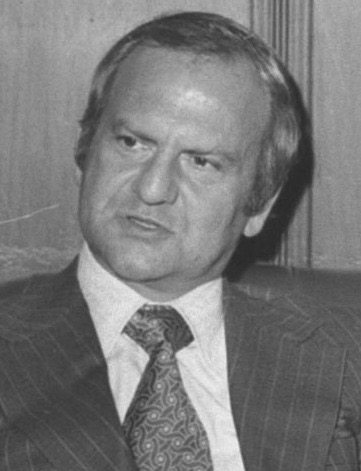
born Lido Anthony Iacocca
Architect of the Ford Mustang; chairman and CEO who led Chrysler through its 1979-80 federally guaranteed turnaround · b. 1924–2019 · Allentown, Pennsylvania
Two calls made by hand, not formulas. how we score →
Summary
His father, an Italian immigrant, lost a restaurant in the Depression and rebuilt into a real-estate business that paid for an engineering degree with no debt attached.
That took Iacocca to Ford, where he rose to president and was fired anyway. What made him famous wasn't Ford. It was walking into a nearly bankrupt Chrysler, talking Congress into a loan guarantee, and paying it back early.
How it happened
Born October 15, 1924, in Allentown, Pennsylvania, to Nicola Iacocca and Antonietta Perrotta, both Italian immigrants with only a few years of grade school between them. Nicola had sailed for America alone at twelve. By the time Lee was born, his father owned a hot dog stand called the Orpheum Wiener House, and the family lost it in the Depression. Nicola rebuilt anyway: a movie theater next, then a real-estate and home-building business that came to develop a good part of Allentown. Lee grew up the son of a man who kept starting over and mostly winning, in a Pennsylvania Dutch town where being Italian still got him teased and occasionally worse.
He graduated from Allentown's public high school with honors in 1942, three years after a bout of rheumatic fever kept him in bed for six months and later kept him out of the wartime draft. His father's recovered fortune paid for an industrial engineering degree at Lehigh, finished in three years, and a fellowship carried him through a master's in mechanical engineering at Princeton. He had a technical credential from a respected school and no debt attached to it.
He joined Ford as an engineer in August 1946 and moved quickly into sales, where a financing gimmick he built for the Philadelphia district, "56 for '56," got him noticed in Dearborn. He became a vice president in 1960, executive vice president in 1967, and president in 1970, and was one of the executives credited with pushing the Mustang into production in 1964. He later said the Ford family never let him forget where he came from: "Nobody was gonna say, 'There's a nice Italian boy, I'd like to take care of him.'" Henry Ford II fired him as president in July 1978, reportedly telling him only that he didn't like him.
Chrysler hired him as president that November, with the company weeks from running out of cash. He spent 1979 lobbying Congress directly for federal loan guarantees, got roughly $1.5 billion approved, and took a symbolic $1-a-year salary while he did it. Chrysler repaid the guaranteed loans in July 1983, seven years ahead of schedule, on the strength of the K-cars and then the minivan. He fronted the company's own television ads through the decade, telling buyers "if you can find a better car, buy it," and became a genuine national figure out of a company that had nearly ceased to exist.
His 1984 memoir, "Iacocca: An Autobiography," became the best-selling nonfiction hardcover book in American publishing to that point. Ronald Reagan put him in charge of restoring the Statue of Liberty and Ellis Island in 1982, and he flirted seriously with a 1988 presidential run before dropping the idea. His pay peaked in 1986 at roughly $20.5 million, mostly in stock options, which made him the country's highest-paid executive that year. He retired from Chrysler at the end of 1992, backed Kirk Kerkorian's failed 1995 bid to take over the company he'd saved, and settled a resulting dispute over his own canceled stock options for $53 million in 1996. He died on July 2, 2019, at his home in Bel Air, California, of complications from Parkinson's disease.
The coded evidence
Thirteen groups, every claim sourcedSecond generation. Both parents, Nicola Iacocca and Antonietta Perrotta, emigrated from Italy; Lee was born in Pennsylvania.
↗ n-magazine.comInferred from an Italian-American upbringing and his funeral mass at St. Hugo of the Hills Catholic Church; not separately confirmed for his childhood practice.
↗ news.lehigh.eduHis father's businesses failed and were rebuilt more than once, but the family home itself was never at risk in any documented account. By Lee's teenage years his father's real-estate and home-building business was substantial enough to fund Lehigh outright.
↗ n-magazine.comA Ford, then Chrysler, salary from age 21 onward. His entire career was salaried employment inside two large manufacturers; he never personally financed a venture or drew down savings to fund one.
↗ en.wikipedia.orgnot established
Both degrees were paid without debt, by family money and a Princeton fellowship.
↗ encyclopedia.comnot established
Chrysler itself was near bankruptcy when he joined, but that was a corporate liquidity crisis, not personal instability; his own housing, health coverage, and standing were never shown to be at risk.
↗ en.wikipedia.orgnot established
No documented period of personal austerity to test against a fallback.
↗ en.wikipedia.orgFather Nicola Iacocca ran a hot dog stand, the Orpheum Wiener House, then after losing it in the Depression owned a movie theater and later a real-estate and home-building business that developed a substantial part of Allentown. Mother Antonietta Perrotta kept the home.
↗ n-magazine.comA parent worked for themselves, the strongest known predictor of founding.
↗ n-magazine.comBoth parents had only a few years of primary schooling in Italy; Nicola emigrated alone at twelve with what one family account describes as a fourth- or fifth-grade education.
↗ n-magazine.comNo specific sacrifice is documented; Lehigh was funded from his father's recovered real-estate income rather than from a purpose-built savings effort.
↗ encyclopedia.comContracted rheumatic fever at 15 in 1939 and spent roughly six months in bed recovering. The condition later made him medically ineligible for the World War II draft, which he has said left him self-conscious among peers who served.
↗ biography.comAllentown, Pennsylvania, a majority Pennsylvania Dutch town in the Lehigh Valley.
↗ exhibits.lib.lehigh.eduAllentown's public high school (now William Allen High School), graduated with honors in 1942.
↗ news.lehigh.eduGrowing up Italian-American in a heavily Pennsylvania Dutch town, he "endured some teasing and was a victim of bigotry," per a Lehigh University archival account of his early life. As an adult executive he said the Ford family never treated him as an equal: "The Ford family practiced the divine right of kings. They were a cut above even WASPs... they wouldn't even socialize with you."
The Ford-family quote is his own on-record account, given in the 1984 NBC documentary "Iacocca: An American Profile" and reported contemporaneously by UPI.
↗ exhibits.lib.lehigh.eduFord Motor Company, joined as an engineer-trainee in August 1946 and never worked anywhere else until Chrysler hired him in 1978.
↗ en.wikipedia.orgnot established
He rose through line sales and marketing results rather than a documented staff role beside a specific decision-maker.
↗ en.wikipedia.org2
Ford (1946-1978), then Chrysler (1978-1992); the whole career ran through two employers.
↗ en.wikipedia.orgMS mechanical engineering, Princeton University (1946); BS industrial engineering, Lehigh University (1945).
↗ encyclopedia.comNone. Lehigh was paid from his father's recovered business income; the Princeton master's was covered by a Wallace Memorial Fellowship.
↗ en.wikipedia.orgDirect. Public high school straight to a funded engineering degree and a graduate fellowship, no transfer or non-traditional route.
↗ encyclopedia.com0
No personal venture to fail; his career was a continuous employed climb inside two companies.
↗ en.wikipedia.org54
Age when Chrysler named him chairman and CEO in September 1979, the year the loan guarantee passed Congress.
↗ en.wikipedia.orgChrysler was days from bankruptcy amid the late-1970s oil shocks and Big Three competitiveness crisis. Congress passed the Chrysler Corporation Loan Guarantee Act of 1979, an unprecedented federal backstop for a single private manufacturer, rather than letting the company fail or fully nationalizing it.
↗ en.wikipedia.orgAutomotive manufacturing and executive management
↗ en.wikipedia.org150000000
An aggregator estimate at death with no disclosed methodology; no Forbes profile exists for him (Forbes never listed him among the wealthy, consistent with a highly paid executive and author rather than an owner of equity). Treat as a rough band, not a precise figure.
↗ celebritynetworth.comAggregator
↗ celebritynetworth.com20500000
1986 total compensation, mostly stock options, which Forbes ranked highest among U.S. executives that year. Pre-EDGAR filing; not independently verifiable against a proxy statement.
↗ forbes.comJournalistic estimate
↗ forbes.comHigh salaried and option-based compensation, not an owned appreciating asset base. His stock options and stock appreciation rights were ultimately canceled in a 1996 settlement rather than exercised into ownership.
↗ sec.govCredited as a driving force behind the Ford Mustang; led the unprecedented federal rescue of Chrysler and its early repayment; chaired the Statue of Liberty-Ellis Island Foundation restoration under a Reagan appointment; wrote the best-selling nonfiction hardcover book in the country in 1984 and 1985; elected to the National Academy of Engineering in 1986.
↗ nationalacademies.orgCapped
A salaried and option-compensated executive throughout; he never owned equity control of either company he ran.
↗ en.wikipedia.orgAfter backing Kirk Kerkorian's unsuccessful 1995 bid to take over Chrysler, Iacocca disputed the company's position that his stock options and stock appreciation rights were not exercisable. The matter settled in February 1996: Kerkorian's Tracinda Corporation paid him $32 million and Chrysler paid him $21 million, his options and SARs were canceled, both sides released all claims, and Iacocca signed a five-year standstill and non-disparagement agreement with Chrysler.
A negotiated settlement with mutual releases, not an adjudicated finding against either party.
↗ sec.govAfter
Arose in 1995-96, three years after his 1992 Chrysler retirement and well after the 1979-80 turnaround that defines him.
↗ sec.govUnrelated
A post-retirement compensation dispute; it did not produce the Chrysler turnaround that made him famous.
↗ sec.govnot established
Not codeable. Resolved entirely by negotiated settlement with no admission or finding of wrongdoing by either side.
↗ sec.govVisionary, Combative, Blunt, Self promoting
Newsweek's retrospective also carries a sharper insider critique after his Chrysler tenure: colleagues described him as hogging credit, blaming subordinates, and more focused on his own celebrity than on product quality by the early 1990s.
↗ newsweek.comInsiders
↗ newsweek.comAfter
His national reputation formed as a direct result of the Chrysler rescue succeeding, not before it.
↗ en.wikipedia.orgMixed
An unambiguous asset during and after the 1979-80 turnaround, when his television persona was inseparable from Chrysler's recovery; more of a liability by the mid-1990s, when Newsweek wrote that "the public's valuation of Lee Iacocca had sunk as low as Chrysler's share price."
↗ newsweek.comThe reputation was deliberately built, through books, press, and PR.
He starred in Chrysler's own television advertising, published a best-selling autobiography, and weighed a 1988 presidential run.
↗ en.wikipedia.orgHis standing cooled through the mid-1990s Kerkorian episode and the options dispute, but the earlier Chrysler-rescue legend remained the dominant public memory of him by the time of his 2019 death.
↗ newsweek.comStructural context
The cost-of-failure score comes from this person's own money and circumstances. But who they were in America carried its own weight, the same way their household or income did, and it shaped how hard the path was just as much. That part isn't in the cost-of-failure number. It's here instead.
Men held about 90% of Fortune 500 CEO seats in 2023, and a wider majority of the rungs below. The ladder is widest for them the whole way up.
↗ forbes.comWhite executives hold most Fortune 500 CEO seats relative to their share of the population, an edge that adds up at every rung of the climb.
↗ finance.yahoo.comImmigrants and their children are overrepresented among America's biggest companies, as founders and as senior leaders. They got there through the visa, credential, and network hurdles that make the path harder to even start down.
↗ forbes.comAmong the people recorded here — men: 115 · White subjects: 74. Representation here is who reached these outcomes, not equal odds of reaching them.
Controlled comparisons
Each holds one thing constant and varies another, so the difference is the point. A list of similar names wouldn't tell you anything.