Satya Nadella
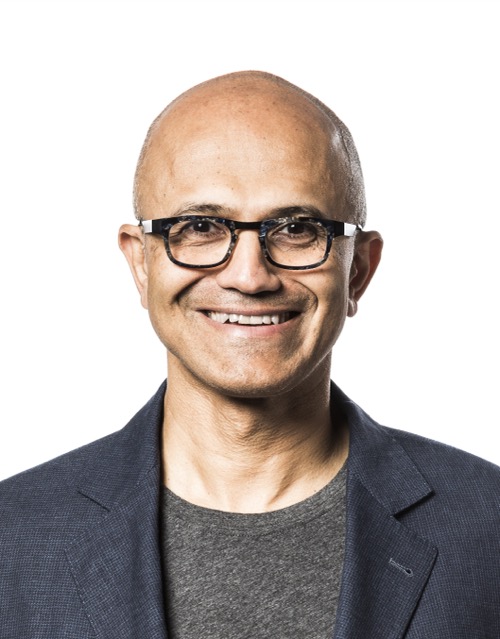
Chairman and CEO, Microsoft · b. 1967 · Hyderabad, India
Two calls made by hand, not formulas. how we score →
Summary
His father was a career civil servant and his mother taught Sanskrit: a stable, comfortable Hyderabad household, not a rich one.
He left for American grad school as thousands of Indian engineers of his generation did, joined Microsoft in 1992, and spent two decades inside one company before the board gave him the top job. The fortune after came from equity pay, not from owning anything he built.
How it happened
His father, B.N. Yugandhar, was a 1962-batch Indian Administrative Service officer; his mother, Prabhavati, lectured in Sanskrit. It was a household with standing and a government salary behind it, not savings or business wealth. He went to Hyderabad Public School in Begumpet and played cricket, which he has since credited with teaching him how to work inside a team rather than around one.
He got his engineering degree through Manipal's entrance exam, the same competitive, broadly open route thousands of Indian students took that decade, with the degree itself conferred by Mangalore University under Manipal's affiliation at the time. From there he did what a large share of his engineering cohort did next: left for American graduate school, earning a master's in computer science at the University of Wisconsin–Milwaukee in 1990.
He worked briefly at Sun Microsystems, then joined Microsoft in 1992 and never left. He finished an MBA at the University of Chicago while already working there. Over the next two decades he moved through Windows NT, the Business Division, and online services, then took over the Server and Tools division in 2011 just as the industry was turning toward the cloud.
The board named him CEO in February 2014, the third in Microsoft's history, and he pushed the company harder into Azure and a "growth mindset" culture shift. Weeks into the job, at a women-in-computing event, he said women shouldn't ask for raises and should trust the system to reward them. The backlash was immediate; he apologized publicly within a day and called himself flatly wrong in a memo to staff. It didn't cost him the job, and Microsoft's stock had already started the climb that would define his tenure.
He became chairman in 2021. Microsoft's market value rose roughly tenfold over his time as CEO, and his fiscal-year-2025 pay, mostly stock, came to about $96.5 million by the company's own proxy filing. He owns under a tenth of a percent of Microsoft, and Forbes puts his net worth near $1.4 billion, built almost entirely from three decades of compensation rather than ownership of anything he founded. He has also spoken publicly, at some length and on his own terms, about raising his late son Zain, who had cerebral palsy, and about how that shaped his interest in accessible technology.
The coded evidence
Thirteen groups, every claim sourcedFirst generation. Left India at 21 for graduate school in the US in 1988 and built his career there. Multiple profiles report he gave up a green card at one point for personal reasons and had to restart the process, though the exact timeline and immigration category are not spelled out in the sources reviewed.
↗ en.wikipedia.orgTelugu
Inferred from the family's stated Telugu background; not explicitly confirmed as the home language.
↗ en.wikipedia.orgnot established
No documented career interruption; a continuous employment record from 1990 onward.
↗ en.wikipedia.orgnot established
Not established. His wife Anupama moved to the US around their 1992 marriage; whether this counts as relocation for his career or hers isn't detailed in the sources reviewed.
↗ en.wikipedia.orgA government-service family with a stable income and standing, though not property or savings wealth on the record. A civil servant's pension and social position were a real, if modest, backstop.
↗ en.wikipedia.orgContinuous salaried employment from his first job at Sun Microsystems onward, then Microsoft from 1992. There was no period of unemployment or self-funded risk-taking; the climb happened entirely on an employer's payroll.
↗ en.wikipedia.orgnot established
No housing or income instability appears anywhere in the public record.
↗ en.wikipedia.orgThe hardship was imposed, not chosen. There was nothing to fall back on.
No documented period of imposed or chosen austerity at any stage.
↗ en.wikipedia.orgFather B.N. Yugandhar, an Indian Administrative Service officer of the 1962 batch; mother Prabhavati, a lecturer in Sanskrit.
↗ en.wikipedia.orgNeither parent was self-employed.
Both parents held salaried government and institutional posts.
↗ en.wikipedia.orgnot established
Not stated directly. An IAS officer would have held at least a bachelor's degree to sit the civil service exam, and a Sanskrit lecturer would have needed a degree in the subject, but neither is confirmed in the sources reviewed.
↗ en.wikipedia.orgnot established
No account of special sacrifice for schooling costs; a government salary appears to have covered a private school as a matter of course, not as a stretch.
↗ en.wikipedia.orgHyderabad, then the princely-state capital of Telangana, India.
↗ en.wikipedia.orgHyderabad Public School, Begumpet, an established private school.
↗ en.wikipedia.orgHyderabad to Manipal, Karnataka for his engineering degree, then to Milwaukee, Wisconsin in 1988 for graduate school, followed by a move into the Seattle area with his first US tech job.
↗ en.wikipedia.orgMicrosoft. He joined in 1992 after a short stint at Sun Microsystems and built his entire career inside the one company for more than three decades.
↗ en.wikipedia.orgGot into Manipal through a competitive entrance exam open to any qualifying student, then into a US graduate program and a US tech job through ordinary application and hiring processes, without a family contact inside the industry.
↗ en.wikipedia.org22
Approximate, based on his 1990 master's degree and first job at Sun Microsystems before the 1992 move to Microsoft.
↗ en.wikipedia.org2
Sun Microsystems, then Microsoft; the entire rise to CEO happened inside the second employer.
↗ en.wikipedia.orgMBA, University of Chicago Booth School of Business (1997); MS computer science, University of Wisconsin–Milwaukee (1990); bachelor's in electrical engineering, Manipal Institute of Technology, with the degree conferred by Mangalore University under Manipal's affiliation at the time (1988).
↗ en.wikipedia.orgnot established
Not established. International computer-science master's students at US public universities in this period were commonly funded through teaching or research assistantships that waived tuition; whether that applied to him specifically isn't confirmed in the sources reviewed.
↗ en.wikipedia.orgCompleted his MBA at Chicago Booth in 1997 while already working full time at Microsoft, commonly cited as a part-time, working-professional route rather than a break from his career.
↗ en.wikipedia.orgDirect: an entrance-exam engineering degree in India, a funded-style graduate program in the US, then a standard industry hire. No minority, veteran, or first-generation pipeline program is documented.
↗ en.wikipedia.orgTook over Server and Tools just as enterprise computing was turning toward the cloud, with Amazon Web Services already forcing incumbents to respond, and became CEO as Microsoft needed a credible bet on Azure over its legacy Windows and Office franchises.
↗ en.wikipedia.orgRedmond, Washington, already inside Microsoft's headquarters when named CEO.
↗ en.wikipedia.orgNeither built nor bought a new venture. Redirected the strategy of an already-dominant company toward cloud and AI, and made large acquisitions (LinkedIn, GitHub, Activision Blizzard) rather than starting anything from scratch.
↗ en.wikipedia.orgEnterprise software and cloud computing
↗ en.wikipedia.org1400000000
Forbes real-time estimate, built primarily from decades of Microsoft equity compensation and roughly $700M in disclosed share sales, not founder ownership. His direct current stock holding, per Microsoft's 2025 proxy statement, is 900,572 shares (about $450M at the June 30, 2025 closing price of $497.41) — a smaller, filing-based figure than the broader Forbes estimate, which also counts money already taken off the table.
↗ forbes.comJournalistic estimate
↗ forbes.com2026
↗ forbes.com96496790
Total fiscal-year-2025 compensation per Microsoft's 2025 proxy statement: $2.5M salary, $84.2M stock awards, $9.6M non-equity incentive, $196K other. Up from $79.1M in FY2024 and $48.5M in FY2023.
↗ sec.govProxy statement
↗ sec.govAlmost entirely compensation, not ownership. His pay is overwhelmingly stock awards granted for the job rather than an equity stake he founded or bought; he holds well under one percent of Microsoft.
↗ sec.govThird CEO in Microsoft's history, later chairman; Padma Bhushan (2022), India's third-highest civilian honor; Financial Times Person of the Year (2019); named to Time's 100 list in 2018 and 2024.
↗ en.wikipedia.orgUncapped
Not founder ownership, but not a fixed salary either — the bulk of his pay is stock awards and performance shares whose value scales directly with Microsoft's market capitalization, which rose roughly tenfold over his tenure. A hired executive's version of uncapped: no ownership stake, but no hard ceiling on the compensation either.
↗ sec.govThe FTC sued in December 2022 to block Microsoft's $75.4B acquisition of Activision Blizzard; a federal judge denied the FTC's request for an injunction in July 2023, the deal closed that October, and the FTC dropped its case entirely in May 2025 after losing on appeal. Separately, the EU Commission opened a formal antitrust investigation in July 2023 into whether Microsoft used its Office dominance to push Teams, leading Microsoft to unbundle Teams from Microsoft 365 in the EEA and Switzerland that August; the Commission formally charged Microsoft in June 2024, and the matter's final resolution isn't established in the sources reviewed.
↗ en.wikipedia.orgAfter
↗ en.wikipedia.orgIncidental
Both matters concern conduct of an already-dominant company built long before his rise; neither produced his personal outcome.
↗ en.wikipedia.orgnot established
Mixed and partly unresolved. The Activision matter ended with no penalty and no injunction. The EU Teams case had reached only a formal charge as of the last source reviewed, with no confirmed fine or settlement — not established.
↗ en.wikipedia.orgCollaborative, Empathetic, Growth minded
↗ en.wikipedia.orgPress
↗ en.wikipedia.orgAfter
The "growth mindset" leadership brand formed after 2014, explicitly contrasted in coverage with the prior Ballmer era.
↗ en.wikipedia.orgAsset
↗ en.wikipedia.orgThe reputation was deliberately built, through books, press, and PR.
A 2017 memoir, "Hit Refresh," and heavy press and conference engagement built the leadership brand alongside the underlying business results.
↗ en.wikipedia.orgHis October 2014 comment that women shouldn't ask for raises drew sharp, immediate criticism, particularly from women in tech and gender-equity advocates, distinct from his broader reputation as a turnaround CEO, which was largely unaffected once he apologized.
↗ en.wikipedia.orgApologized on social media within about a day and sent a company-wide email calling himself "completely wrong." The episode did not visibly dent his standing with the board or investors.
↗ en.wikipedia.orgStructural context
The cost-of-failure score comes from this person's own money and circumstances. But who they were in America carried its own weight, the same way their household or income did, and it shaped how hard the path was just as much. That part isn't in the cost-of-failure number. It's here instead.
Men held about 90% of Fortune 500 CEO seats in 2023, and a wider majority of the rungs below. The ladder is widest for them the whole way up.
↗ forbes.comImmigrants and their children are overrepresented among America's biggest companies, as founders and as senior leaders. They got there through the visa, credential, and network hurdles that make the path harder to even start down.
↗ forbes.comAmong the people recorded here — men: 169 · Asian subjects: 11. Representation here is who reached these outcomes, not equal odds of reaching them.
Controlled comparisons
Each holds one thing constant and varies another, so the difference is the point. A list of similar names wouldn't tell you anything.