Lisa Su
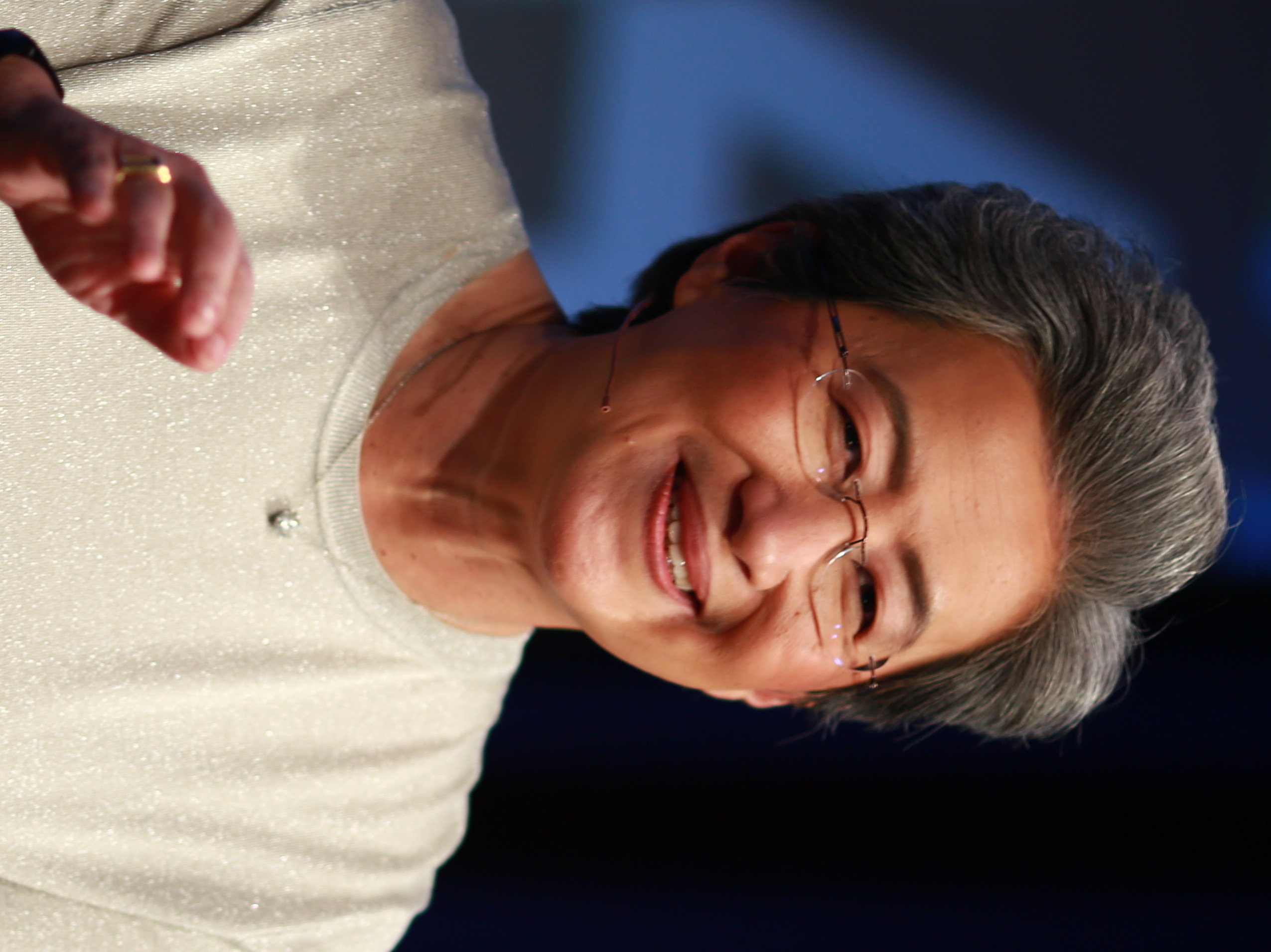
born Lisa Tzwu-Fang Su
Chair and CEO, AMD (Advanced Micro Devices) · b. 1969 · Tainan, Taiwan
Two calls made by hand, not formulas. how we score →
Summary
Her family left Taiwan when she was three, for a two-income Queens household with no money trouble on record.
Three degrees from MIT led to two decades as a working engineer, not a founder. AMD made her CEO in 2014 with the stock near three dollars and four straight years of losses behind it. She bet the company on an unproven chip architecture instead of managing the decline, and it worked.
How it happened
Born in Tainan in November 1969, she immigrated with her parents to Queens, New York around age three. Her father worked as a statistician for New York City government; her mother was an accountant who later became an entrepreneur in her mid-forties. It was a two-income professional household, not a wealthy one, and nothing in the record suggests financial precarity during her childhood.
She tested into Bronx High School of Science, one of New York's selective exam schools, then went to MIT for all three of her degrees in electrical engineering: a bachelor's in 1990, a master's in 1991, and a PhD in 1994 on silicon-on-insulator transistors. It gave her a technical credential that needed no one to vouch for it.
A year at Texas Instruments, then twelve at IBM, where she worked her way from device physicist to vice president of the semiconductor R&D center, led the team that brought copper interconnects to commercial chips, and spent a stretch as technical assistant to CEO Lou Gerstner. Four years at Freescale followed, first as CTO, then running its networking chip business ahead of an IPO. By the time she reached AMD in 2012, she had two decades of engineering credibility and had never run a company.
AMD made her COO in mid-2014 and CEO that October, replacing Rory Read. The stock was trading near three dollars, the company had posted four straight years of losses, cash reserves had fallen from roughly $1 billion to under $800 million, and it was carrying about $2 billion in debt. Rather than retreat toward a smaller, safer PC business, she told her engineers to build a CPU roughly 40 percent faster than its predecessor and committed the company to a new architecture, Zen, built around a modular "chiplet" design nobody had proven at scale.
Ryzen shipped in 2017 and EPYC brought AMD back into data centers the same year. AMD passed Intel in market capitalization for the first time in 2022, on its way from a market cap near $3 billion when she took over to several hundred billion dollars since. In 2019 she was the highest-paid CEO in the S&P 500 at $58.5 million, almost entirely stock. Forbes puts her net worth near $2.7 billion, tied to AMD's share price rather than to anything she owns outright. She has twice been Time's CEO of the Year and in 2021 became the first woman to receive the IEEE Robert N. Noyce Medal.
The coded evidence
Thirteen groups, every claim sourcedCoarse public-record coding; race is a noisy, interpretive category. Headwinds here are coded conservatively — gender in a male-dominated field is a documented resistance factor, but being an Asian-American woman in a "model minority" framed industry is a more complicated, less clearly disadvantaging factor and is not treated as an equivalent headwind.
↗ en.wikipedia.org1.5 generation. Born in Tainan, Taiwan and immigrated with her parents to the United States around age three.
The Taiwanese American Archives biographical entry lists her family's arrival year as 1972 against a 1969 birth year, consistent with the "age 3" figure widely reported by Wikipedia and Forbes.
↗ taiwaneseamericanhistory.orgnot established
Likely Mandarin or Taiwanese Hokkien given her parents' origin, but not documented on the record reviewed.
↗ en.wikipedia.orgNo documented housing precarity. She was raised in a stable two-income professional household in Queens; nothing in the record suggests the family lacked a home to fall back on.
↗ wired.comA continuous salaried engineering and executive income from her first job in 1994 onward. She never risked personal capital or income to found or fund anything; the "build" here is a corporate climb, not a venture.
↗ en.wikipedia.orgThe hardship was imposed, not chosen. There was nothing to fall back on.
No period of visible austerity, chosen or otherwise, is documented at any point in her life.
↗ wired.comHer father worked for New York City government as a statistician. Her mother worked as an accountant and later became an entrepreneur in her mid-forties.
↗ wired.comA parent worked for themselves, the strongest known predictor of founding.
Her mother's shift from accountant to entrepreneur came in her mid-forties, timing relative to Su's own age is not established.
↗ wired.comnot established
Occupations (statistician, accountant) imply post-secondary training, but specific degrees aren't documented.
↗ wired.comQueens, New York.
↗ wired.comBronx High School of Science, a selective New York City public exam school admitting by competitive test rather than tuition or address.
↗ en.wikipedia.orgOne international move — Tainan, Taiwan to Queens, New York, around 1972, at approximately age three.
↗ taiwaneseamericanhistory.orgAMD's board made her COO in mid-2014 and, by her own account, called her about the CEO role about six months later with "It's time, Lisa" — a board decision rather than a single named sponsor.
↗ wired.comIBM, where she spent twelve years (1995-2007) building the technical credibility — device physics, copper interconnects, a stint beside the CEO — that made her a credible executive hire everywhere afterward.
↗ en.wikipedia.org24
First industry job at Texas Instruments in 1994, the year she completed her PhD.
↗ en.wikipedia.orgTechnical assistant to IBM CEO Lou Gerstner around 2000, a staff role beside the top decision-maker that turned deep technical work into executive visibility.
↗ en.wikipedia.org4
Texas Instruments, IBM, Freescale, then AMD — every step a hired role, not a founding one.
↗ en.wikipedia.orgAdmission to Bronx High School of Science by competitive exam, one of New York's specialized public high schools.
↗ en.wikipedia.orgPhD, electrical engineering, MIT (1994); MS, electrical engineering, MIT (1991); BS, electrical engineering, MIT (1990). Dissertation on silicon-on-insulator MOSFETs, advised by Dimitri Antoniadis.
↗ dspace.mit.edunot established
Not established. No loan figure is documented in the sources reviewed.
↗ en.wikipedia.orgDirect academic track: a selective public high school, then all three degrees at one institution, straight into industry with no gap.
↗ en.wikipedia.orgMIT's electrical engineering department, a dense node for people who later ran or founded major chip and computing companies.
No documented instance of this network directly producing a job or introduction for her; noted as background density rather than a proven mechanism.
↗ en.wikipedia.org0
No venture of her own to fail. A single, continuous employed climb across four companies.
↗ en.wikipedia.orgAMD's turnaround rode two successive demand shifts: the move of compute to data centers and cloud providers from roughly 2017 onward, then the AI training and inference boom from around 2023, both of which favored the high-performance chip architecture she had committed the company to years before either wave arrived.
↗ en.wikipedia.org12
Continuous CEO tenure from October 2014 through last review, added the chair title in 2022.
↗ en.wikipedia.orgSemiconductors
↗ forbes.com2700000000
Forbes real-time estimate as of August 26, 2026, based on her disclosed AMD stock holdings; moves with AMD's share price.
↗ forbes.comPublic equity
↗ forbes.com2026
↗ forbes.com58534288
Total fiscal-2019 compensation from AMD's 2020 proxy Summary Compensation Table: $1,026,442 salary, $53,176,357 stock awards, $3,087,749 option awards, $1,228,476 non-equity incentive, $15,264 other. Made her the highest-paid CEO in the S&P 500 that year. Fetched via the Wayback Machine copy of the SEC filing (sec.gov blocks automated fetches); the source URL above is the original filing.
↗ sec.govProxy statement
↗ sec.govMost of her reported net worth is unrealized — unvested or unsold AMD stock — rather than cash taken off the table.
↗ forbes.comAlmost entirely equity compensation and its appreciation, not a founder's ownership stake. She holds a small fraction of AMD's shares outstanding; her wealth tracks the stock price of a company she runs but does not own.
↗ forbes.comFirst woman to receive the IEEE Robert N. Noyce Medal (2021); Time CEO of the Year in 2014 and again in 2024, the first two-time winner; elected to the National Academy of Engineering (2018); serves on Cisco's board and the US Semiconductor Industry Association board, and was appointed to the President's Council of Advisors on Science and Technology under both the Biden and Trump administrations.
↗ corporate-awards.ieee.orgCapped
A board-set compensation package, not founder equity — even though its scale, driven by AMD's stock performance, rivals founder-level outcomes.
↗ sec.govAMD, alongside the rest of the US advanced-chip industry, has been subject to export controls on AI accelerators sold to China, including an August 2025 arrangement under which AMD and Nvidia agreed to pay the US government 15 percent of revenue from certain China chip sales as a condition of export licenses. No finding of wrongdoing against AMD or Su personally is established.
Reported in coverage of the parallel Nvidia arrangement; treated here as an industry-wide regulatory condition, not misconduct.
↗ en.wikipedia.orgAfter
↗ en.wikipedia.orgIncidental
A function of AMD's post-turnaround position in a geopolitically sensitive market, not something that produced her rise.
↗ en.wikipedia.orgDemanding, Hands on, Understated, plays the long game
↗ time.comPress
Characterizations come from journalist profiles (Time, Wired) drawing on colleagues and industry observers rather than a single named source.
↗ time.comBefore
Her technical reputation was built over two decades at IBM and Freescale, before the CEO role that made her famous.
↗ en.wikipedia.orgAsset
↗ time.comThe reputation accrued from behaviour rather than being manufactured.
↗ time.comStructural context
The cost-of-failure score comes from this person's own money and circumstances. But who they were in America carried its own weight, the same way their household or income did, and it shaped how hard the path was just as much. That part isn't in the cost-of-failure number. It's here instead.
Women ran 10.4% of Fortune 500 companies in 2023, an all-time high and still only a tenth of the seats. A 'broken rung' thins their numbers at every level below the top.
↗ forbes.comImmigrants and their children are overrepresented among America's biggest companies, as founders and as senior leaders. They got there through the visa, credential, and network hurdles that make the path harder to even start down.
↗ forbes.comAmong the people recorded here — women: 54 · Asian subjects: 11. Representation here is who reached these outcomes, not equal odds of reaching them.
Controlled comparisons
Each holds one thing constant and varies another, so the difference is the point. A list of similar names wouldn't tell you anything.