Hector Ruiz
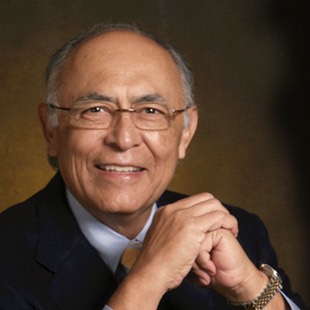
born Hector de Jesus Ruiz
Former CEO and chairman, AMD · b. 1945 · Piedras Negras, Coahuila, Mexico
Two calls made by hand, not formulas. how we score →
Summary
A missionary taught him English, a border-town high school made him valedictorian, and a Texas scholarship paid for the degree.
Everything after was salaried: Texas Instruments, 22 years at Motorola, then AMD's top job. It is a path that needs no capital and no family money, and it pays in salary and stock grants rather than ownership of the thing he ran.
People in this set who share a company with Hector Ruiz.
Where they worked
How it happened
He was born in Piedras Negras, a coal-mining town across the Rio Grande from Eagle Pass, Texas. He has said on the record that his family was poor and that he shined shoes as a boy. His parents hadn't been to college. He expected to become an auto mechanic.
A Methodist missionary told him a good mechanic would need English, and taught him in exchange for help with chores. She later pushed him to attend high school across the border in Eagle Pass. He crossed daily, and graduated as valedictorian three years after he started learning English.
The valedictorian standing earned him a scholarship to the University of Texas, where he started in mechanical engineering and switched to electrical. He finished a bachelor's and master's there, then a PhD at Rice. How the graduate years were paid for isn't established in the sources found.
He started in research at Texas Instruments, moved into manufacturing, and then went to Motorola, where he spent 22 years. He opened a fab in Scotland, fixed the factory making the 68000 microprocessor, and rose to president of the Semiconductor Products Sector.
In 2000 Jerry Sanders recruited him to AMD as president and chief operating officer. He became CEO in 2002 and chairman in 2004. AMD filed its antitrust case against Intel on his watch and settled it in 2009 for $1.25 billion. He backed the 2006 purchase of ATI, which the press tied to years of losses, and he resigned as CEO in July 2008.
He led the move to spin AMD's factories out as GlobalFoundries and chaired it in 2009, resigning in November that year.
The coded evidence
Thirteen groups, every claim sourcedBorn in Mexico; moved to the US for university
Coded first-gen on the adult-arrival rule. He commuted daily across the border for high school, so 1.5-gen is arguable; his immigration status and move date are not established.
↗ computerhistory.orgA salary from the first job at Texas Instruments onward. The risk was losing a job, not the roof.
↗ computerhistory.orgThe hardship was imposed, not chosen. There was nothing to fall back on.
↗ wwno.orgNeither parent attended college
↗ wwno.orgHe shined shoes as a boy to help the family; college was covered by a valedictorian scholarship.
The scholarship detail is from the Computer History Museum profile.
↗ wwno.orgHigh school in Eagle Pass, Texas, reached by crossing the border daily from Piedras Negras
↗ en.wikipedia.orgDaily border commute for high school, then the University of Texas at Austin
↗ en.wikipedia.orgA Methodist missionary in Piedras Negras taught him English and urged him to attend high school in Eagle Pass and try a year of university. Jerry Sanders later recruited him to AMD.
↗ wwno.orgTexas Instruments research labs, then Motorola's semiconductor operations
↗ computerhistory.orgnot established
He finished the PhD in 1973; the TI start date is not stated in the sources opened.
↗ en.wikipedia.orgPhD in electrical engineering, Rice University (1973); BS (1968) and MS (1970), University of Texas at Austin
↗ en.wikipedia.orgnot established
Undergraduate was covered by a scholarship; graduate funding is not established.
↗ computerhistory.orgA valedictorian scholarship to the University of Texas
↗ computerhistory.orgRose through the US semiconductor industry of the 1970s to 1990s and led AMD through the PC-processor price war with Intel.
↗ en.wikipedia.orgSemiconductors
↗ en.wikipedia.orgnot established
Not established. forbes.com/profile/hector-ruiz/ returns 404. The March 2009 proxy lists about 6.16 million AMD shares beneficially owned, including 1.6 million options, which isn't a net worth.
↗ en.wikipedia.org10249685
Total 2006 compensation in the summary table, versus about $8.09M in 2007 and $2.97M in 2008. Earlier proxies (FY2002 to 2005) were not checked, so this is the highest of the three years reviewed.
↗ sec.govProxy statement
↗ sec.govSalary, stock awards and options, not a founder's ownership. Magnitude is coded 3 on career pay; no net-worth figure is established.
↗ sec.govLed AMD for the 2005 antitrust case against Intel, which settled in 2009 for $1.25 billion. Wrote the memoir Slingshot. Named a UT Distinguished Alumnus in 2012.
↗ en.wikipedia.orgCapped
↗ sec.govAMD's antitrust complaint against Intel, filed during his tenure, settled in November 2009 with Intel paying $1.25 billion. AMD was the plaintiff.
↗ en.wikipedia.orgPress
↗ en.wikipedia.orgMixed
An analyst credited him with taking AMD off death watch; the same article says he never stanched its losses.
↗ en.wikipedia.orgStructural context
The cost-of-failure score comes from this person's own money and circumstances. But who they were in America carried its own weight, the same way their household or income did, and it shaped how hard the path was just as much. That part isn't in the cost-of-failure number. It's here instead.
Men held about 90% of Fortune 500 CEO seats in 2023, and a wider majority of the rungs below. The ladder is widest for them the whole way up.
↗ forbes.comImmigrants and their children are overrepresented among America's biggest companies, as founders and as senior leaders. They got there through the visa, credential, and network hurdles that make the path harder to even start down.
↗ forbes.comAmong the people recorded here — men: 225. Representation here is who reached these outcomes, not equal odds of reaching them.
Controlled comparisons
Each holds one thing constant and varies another, so the difference is the point. A list of similar names wouldn't tell you anything.

Related companies
Companies connected to Hector Ruiz through the profiled people they worked with. Each card says who the link runs through.