Indra Nooyi
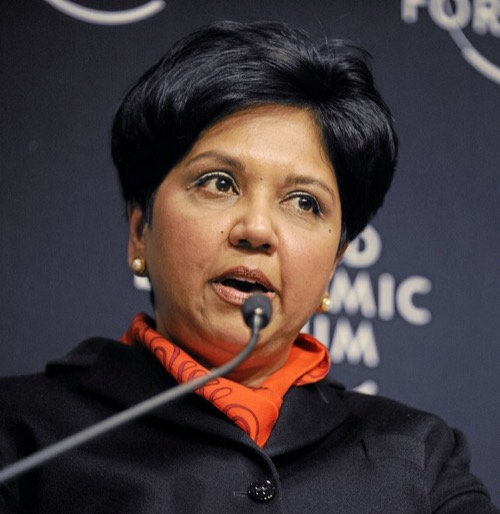
Former Chairman and CEO, PepsiCo · b. 1955 · Madras (Chennai), Tamil Nadu, India
Two calls made by hand, not formulas. how we score →
Summary
Middle-class in Chennai, she arrived in America in 1978 with no money and no network.
She worked a Yale dorm's overnight desk to cover tuition and interviewed for jobs in a sari because she couldn't afford a suit. Twelve years after PepsiCo hired her, she became its first woman and first immigrant woman of color CEO. Pay topped $31 million a year; she never owned a share of what she ran.
How it happened
Middle-class in Madras, now Chennai. Her father worked at the State Bank of Hyderabad; her mother ran the household. Her paternal grandfather, a judge, made her write "I will not make excuses" two hundred times whenever she fell short of a task. The family was Tamil Brahmin and conservative, short on cash rather than on standing.
A postgraduate diploma at the Indian Institute of Management Calcutta in 1976, then she read about Yale's public-and-private management program in a magazine and applied. Her family backed the move, which she has called surprising for a conservative household sending an unmarried daughter alone to another continent. She arrived in New Haven in 1978 without a scholarship covering the full cost, worked the midnight-to-5-a.m. shift at a Yale dormitory front desk to help pay for it, and went to job interviews wearing a sari because she couldn't afford a business suit.
Six employers across roughly fourteen years: a textile trading firm and Johnson & Johnson in India, then Boston Consulting Group, Motorola, and ABB in strategy roles, before PepsiCo hired her in 1994 as senior vice president for strategic planning. She became CFO in 2000 and president in 2001, building her record on divestitures and acquisitions rather than on sales.
PepsiCo named her chairman and CEO in 2006, its first woman CEO and, by most accounts, the first immigrant woman of color to run a Fortune 50 company. She led it for twelve years under a strategy she called "Performance with Purpose," pushing the portfolio toward less sugary products while defending the cola and snack business that funded everything else.
Her pay peaked at just over $31 million in 2017, all salary and stock under a plan the board set, not equity she owned. She stepped down as CEO in October 2018 and left the chairman role the following year. A 2018 podcast remark about snack chips "for women" briefly made her a punchline online; it didn't touch the twelve-year record around it.
The coded evidence
Thirteen groups, every claim sourcedFirst generation. Immigrated from India to the United States alone in 1978 for graduate school and later naturalized as a US citizen.
Multiple outlets describe her as a naturalized US citizen; the exact naturalization year isn't established in the sources reviewed.
↗ en.wikipedia.orgHer parents in Chennai were middle-class and salaried, with a family home but no property or savings positioned as a US backstop. Nothing was waiting for her in New Haven.
↗ womenshistory.orgNo family income floor once she left India. She worked roughly midnight to 5 a.m. as a dormitory receptionist at Yale to help cover tuition and living costs while enrolled full time in a two-year graduate program.
↗ fortune.comnot established
Sources describe an overnight job and unspecified financial aid at Yale; no loan balance or debt figure is established in the record reviewed.
↗ notablebiographies.comThe hardship was imposed, not chosen. There was nothing to fall back on.
The overnight shift and the sari-to-interviews detail both read as necessity: she has said her parents could not fund the degree.
↗ fortune.comFather worked at the State Bank of Hyderabad; mother was a homemaker.
↗ en.wikipedia.org2
Second of three children; her older sister, Chandrika Krishnamurthy Tandon, is a businesswoman and Grammy-winning musician.
↗ en.wikipedia.orgHer paternal grandfather, a judge, personally supervised her academic discipline as a child, including a standing rule that she write "I will not make excuses" two hundred times whenever she came up short.
A discipline and standards input, not a capital or access one.
↗ en.wikipedia.orgHer conservative Brahmin family supported her decision to leave India alone for American graduate school in 1978, which she has described as an unusual permission for an unmarried daughter in that household at that time.
↗ womenshistory.orgA middle-class neighborhood in Madras (now Chennai), Tamil Nadu.
↗ womenshistory.orgHoly Angels Anglo-Indian Higher Secondary School, then Madras Christian College for a bachelor's in physics, chemistry, and mathematics, then the Indian Institute of Management Calcutta.
↗ en.wikipedia.orgOne international move: Chennai to New Haven, Connecticut in 1978 for graduate school, arriving alone.
↗ womenshistory.orgIn India her family held a genuinely middle professional standing: a bank official father and a judge grandfather. None of that standing carried over on arrival in the US, where she started as an unfunded graduate student working the overnight desk shift.
↗ fortune.comnot established
No single named sponsor comparable to Ursula Burns's Wayland Hicks is documented for Nooyi's rise; her path reads as consulting-and-strategy credentialing across firms rather than one internal patron.
↗ en.wikipedia.orgPepsiCo, which she joined in 1994 as senior vice president for strategic planning and never left before becoming CEO twelve years later.
↗ en.wikipedia.org24
Approximate age at her first post-graduate strategy role, following her 1980 Yale graduation.
↗ en.wikipedia.org6
A textile trading firm and Johnson & Johnson in India, then Boston Consulting Group, Motorola, and ABB, then PepsiCo. Sources differ on the textile firm's name (Beardsell vs. Tootal), likely the same company under different references.
↗ en.wikipedia.orgAdmitted to the Indian Institute of Management Calcutta's postgraduate management program in 1974, one of India's most selective business schools.
↗ en.wikipedia.orgMaster's in public and private management, Yale School of Management (1980); postgraduate diploma in management, Indian Institute of Management Calcutta (1976); bachelor's in physics, chemistry, and mathematics, Madras Christian College (1974).
↗ en.wikipedia.orgnot established
Not established. No loan amount is documented in the sources reviewed.
↗ notablebiographies.comWorked roughly midnight to 5 a.m. as a dormitory receptionist at Yale while a full-time graduate student.
↗ fortune.comDirect academic route: an Indian bachelor's degree, an Indian management postgraduate diploma, then a US master's degree, with no employer sponsorship funding the US degree.
↗ en.wikipedia.org0
No venture to fail. A continuous run of employer moves rather than founding attempts.
↗ en.wikipedia.org50
Named CEO in 2006; born October 1955, so age at the appointment was 50 or just-turned-51 depending on the exact month, which isn't pinned down in the sources reviewed.
↗ en.wikipedia.orgCorporate strategy and consulting were opening to a first wave of internationally trained managers in the 1980s and 1990s when she moved through BCG, Motorola, and ABB, and consumer-packaged-goods companies were beginning to face real pressure over sugar and health by the time she became CEO in 2006, which shaped her "Performance with Purpose" strategy.
↗ en.wikipedia.orgConsumer packaged goods (food and beverage)
↗ en.wikipedia.org340000000
Forbes estimate as of May 2024, attributed to stock granted during her PepsiCo tenure.
↗ forbes.comJournalistic estimate
↗ forbes.com2024
↗ forbes.com31082648
Total fiscal-year-2017 compensation from PepsiCo's 2018 proxy summary compensation table: $1.7M salary, $9.24M stock awards, $14.7M non-equity incentive payouts, $5.19M pension/deferred-comp change, $251K other. Her peak disclosed year; FY2018 (partial year as CEO) was lower at $24,491,117 per the 2019 proxy.
↗ sec.govProxy statement
↗ sec.govHer wealth is almost entirely stock compensation accumulated over a 24-year corporate career, not an ownership stake in a company she founded or controls.
↗ forbes.comFirst woman to lead PepsiCo and, by multiple accounts, the first woman of color and first immigrant to lead a Fortune 50 company. Awarded India's Padma Bhushan, its third-highest civilian honor, in 2007.
↗ womenshistory.orgCapped
↗ sec.govStrategic, Outspoken, Polarizing
↗ nytimes.comPublic
↗ nytimes.comBefore
↗ womenshistory.orgMixed
An asset in business-press and case-study circles for most of her tenure; briefly a liability in February 2018 after comments on a podcast about snacks "for women" were picked up by a British tabloid and spread online under the hashtag Lady Doritos.
↗ nytimes.comWidely held up in business-school case studies and press as one of the most admired CEOs of her era, while the 2018 remarks made her a target of mockery in consumer and social-media discourse for a short period.
↗ nytimes.comThe controversy didn't touch her standing inside PepsiCo. She stayed CEO for another eight months and chairman for several more, and it reads today as a footnote next to a twelve-year run rather than a lasting mark on her reputation.
↗ en.wikipedia.orgStructural context
The cost-of-failure score comes from this person's own money and circumstances. But who they were in America carried its own weight, the same way their household or income did, and it shaped how hard the path was just as much. That part isn't in the cost-of-failure number. It's here instead.
Women ran 10.4% of Fortune 500 companies in 2023, an all-time high and still only a tenth of the seats. A 'broken rung' thins their numbers at every level below the top.
↗ forbes.comImmigrants and their children are overrepresented among America's biggest companies, as founders and as senior leaders. They got there through the visa, credential, and network hurdles that make the path harder to even start down.
↗ forbes.comAmong the people recorded here — women: 68 · Asian subjects: 11. Representation here is who reached these outcomes, not equal odds of reaching them.
Controlled comparisons
Each holds one thing constant and varies another, so the difference is the point. A list of similar names wouldn't tell you anything.