Kenneth Chenault
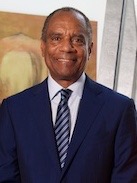
Former Chairman and CEO, American Express; Chairman and Managing Director, General Catalyst · b. 1951 · Mineola, New York
Two calls made by hand, not formulas. how we score →
Summary
His parents were a dentist and a dental hygienist, both top of their class at Howard, who paid for a private school instead of Hempstead's public one because of what their Black children would get there.
That bought him Bowdoin and Harvard Law, and those bought him a seat at American Express in 1981. Nine months into running the company, he led it through September 11. He never owned any of it.
How it happened
His father, Hortenius Chenault, was a dentist who reportedly passed the New York State dental exam with the highest score on record; his mother, Anne Quick Chenault, was a dental hygienist. Both had graduated top of their class at Howard University. Hempstead's public schools were, in his parents' judgment, not giving Black students much, so they enrolled him instead in the private Waldorf School in Garden City, through twelfth grade. He was the second of four children and a middling student until high school, when he became class president and captain of two sports teams.
An athletic scholarship took him to Springfield College first. He left before finishing and transferred to Bowdoin, earning a history degree magna cum laude in 1973, then went on to Harvard Law School. At Bain, after two years practicing corporate law, a fellow Harvard Law graduate named Mitt Romney mentored him and later credited him publicly with a clear head in confusing situations. American Express recruited him into strategic planning in 1981.
He climbed inside one company for two decades: merchandise services, the platinum and gold card division, vice chairman, president and chief operating officer, then chairman and CEO on January 1, 2001. That September 11th he was in Salt Lake City on business, on the phone with a New York employee when the first plane hit, and told security to evacuate the headquarters across the street from the World Trade Center immediately. Eleven Amex employees died. A week later he gathered 5,000 of them at the Paramount Theater, said he'd sought counseling himself, forgave months of late fees for cardholders who'd lost everything, and committed the company to staying downtown. It's the part of his tenure people bring up first.
He ran American Express for seventeen years, retiring in February 2018 as one of a small handful of Black executives who had led a Fortune 500 company — commonly counted as the third. His compensation peaked at just over $29 million in a single year, all salary and stock; he never owned a share of the business the way a founder does. He co-founded OneTen in 2020 to move a million Black Americans into jobs that don't require a four-year degree, sits on the boards of Berkshire Hathaway and Airbnb, and now chairs General Catalyst, a venture firm, without having built or owned either.
The coded evidence
Thirteen groups, every claim sourcedDescendant. Both parents attended Howard University; no immigration event in the recent family record.
↗ blackpast.orgTwo working professional parents throughout childhood — a dentist and a dental hygienist — in a stable household. No indication of housing insecurity at any point.
↗ blackpast.orgA salaried, then increasingly well-paid, corporate career from age 30 onward inside a single Fortune 500 company. The risk across his career was a stalled promotion, not the loss of a roof.
↗ referenceforbusiness.comThe hardship was imposed, not chosen. There was nothing to fall back on.
No poverty narrative, chosen or imposed, appears anywhere in the record.
↗ blackpast.orgFather Hortenius Chenault was a dentist, reportedly recording the highest score on the New York State dental exam as of the early 2010s. Mother Anne N. Quick Chenault was a dental hygienist. Both graduated top of their class at Howard University's dental programs.
↗ referenceforbusiness.comA parent worked for themselves, the strongest known predictor of founding.
Dentistry is typically a private-practice profession; the specific practice arrangement isn't independently detailed in the sources.
↗ blackpast.orgBoth parents attended Howard University; each finished at the top of their class.
↗ blackpast.orgHis parents paid private tuition at the Waldorf School in Garden City through twelfth grade rather than use Hempstead's public schools, specifically because of what they judged Black students received there. A deliberate redirection of professional income toward schooling, not a discretionary luxury.
↗ blackpast.orgHempstead, Long Island, New York — described as a mostly white, middle-class neighborhood.
↗ blackpast.orgThe private Waldorf School of Garden City, chosen over the local public schools; he was a middling student until a headmaster's mentorship turned it around, after which he became class president.
↗ referenceforbusiness.comGrew up in the midst of 1960s civil rights activism on Long Island, with his parents discussing developments as a family, in a majority-white community his parents judged would shortchange a Black child in its public schools.
↗ blackpast.orgAt Bain & Company, a fellow Harvard Law graduate named Mitt Romney mentored him and later credited him publicly, in a 1997 Ebony interview, with a clear head in confusing situations. He was recruited into American Express's strategic planning group in 1981.
↗ blackpast.orgCEO Harvey Golub named him head of U.S. Travel Services in 1993 and publicly designated him as successor in 1999, two years before handing over the chairmanship — an extended, deliberate handoff rather than a contested promotion.
↗ referenceforbusiness.com3
Rogers & Wells (law), Bain & Company (consulting), then American Express for the 37 years that make up the rest of the career.
↗ blackpast.orgJ.D., Harvard Law School, 1976; B.A. in history, magna cum laude, Bowdoin College, 1973.
↗ blackpast.orgnot established
Not established. Funding for Bowdoin and Harvard Law isn't detailed in the available record; coded as family-funded at the coded-summary level given the parents' professional income, but that inference isn't independently confirmed for either degree.
↗ referenceforbusiness.comPracticed as an attorney at Rogers & Wells, 1977–1979, before moving to consulting.
↗ referenceforbusiness.comDirect, but not straight: an athletic scholarship to Springfield College first, left before completing a degree there, then transferred to Bowdoin.
↗ blackpast.orgHarvard Law's alumni network supplied the Bain mentor (Mitt Romney) who shaped his early career; he later served on Bowdoin's board.
↗ blackpast.orgA continuous salary throughout; no gaps between roles to sustain.
↗ referenceforbusiness.comBecame CEO on January 1, 2001. Nine months later, American Express's headquarters across from the World Trade Center was heavily damaged in the September 11 attacks and unusable for months; the company lost 11 employees. His handling of the crisis, in his first year as CEO, became the defining episode of his tenure.
↗ 911memorial.orgNew York City (American Express headquarters, 3 World Financial Center). He was traveling in Salt Lake City on the morning of September 11, 2001, and directed the building's evacuation by phone.
↗ 911memorial.orgFinancial services — consumer and commercial payments
↗ forbes.comnot established
Forbes maintains a profile page for him but publishes no net-worth figure or methodology on it — itself notable, since Forbes does track him for board and compensation purposes. Third-party aggregators disagree by a factor of four: estimates found range from roughly $200M (Celebrity Net Worth) to $453M (GuruFocus, from disclosed AXP/ IBM/Airbnb stock holdings) to $750–800M (other aggregators). None discloses a full methodology tying share counts to a value; not established at the precision this schema requires.
↗ forbes.com29137014
Total FY2006 compensation from American Express's Summary Compensation Table in the 2007 proxy statement: $1.1M salary, $6.0M bonus, $5.13M stock awards, $12.53M option awards, $0.5M non-equity incentive, $2.75M pension-value change, $1.13M other. Cross-checked against 2007–2013 totals in later proxies (range roughly $17M–$28M), FY2006 was the highest single-year total found. Widely repeated figures of $50M (2007) and $42.8M (2008), cited for instance on Wikipedia, do not match the SEC Summary Compensation Table totals for those years ($26.1M and $27.3M respectively) and appear to use a different, non-SEC methodology (likely realized option-exercise value rather than grant-date accounting value); the proxy-statement figures are used here as the primary-source number.
↗ sec.govProxy statement
↗ sec.govNearly four decades of salary and equity compensation inside one public company, not an owned, appreciating asset base. He earned very well as an employee; he never held a founder's stake in American Express.
↗ sec.govCommonly counted as the third Black CEO of a Fortune 500 company (after Clifton Wharton at TIAA-CREF and Franklin Raines at Fannie Mae). Co-founded OneTen in 2020, a coalition committing to hire and advance a million Black Americans without four-year degrees. Named to Time's 2021 100 Most Influential list. Serves on the boards of Berkshire Hathaway, Airbnb, and the Harvard Corporation; formerly IBM, Procter & Gamble, and Facebook/Meta.
↗ forbes.comCapped
↗ sec.govLow key, calm under pressure, inspires by example rather than fear
Colleague characterizations, e.g. general counsel Louise Parent's description of him as someone who "inspires you to want to do your best," reinforced by widely reported accounts of his composed public response to September 11.
↗ referenceforbusiness.comInsiders
↗ referenceforbusiness.comBefore
The reputation for composure and quiet authority was established through his 1980s–1990s rise within Amex, before the CEO appointment and September 11 made it a public asset.
↗ referenceforbusiness.comAsset
↗ 911memorial.orgThe reputation accrued from behaviour rather than being manufactured.
↗ referenceforbusiness.comStructural context
The cost-of-failure score comes from this person's own money and circumstances. But who they were in America carried its own weight, the same way their household or income did, and it shaped how hard the path was just as much. That part isn't in the cost-of-failure number. It's here instead.
Men held about 90% of Fortune 500 CEO seats in 2023, and a wider majority of the rungs below. The ladder is widest for them the whole way up.
↗ forbes.comJust eight Fortune 500 CEOs were Black in 2023, about 1.6%, against roughly 13% of the labor force. The ladder narrows sharply by race near the top.
↗ finance.yahoo.comAmong the people recorded here — men: 115 · Black subjects: 58. Representation here is who reached these outcomes, not equal odds of reaching them.
Controlled comparisons
Each holds one thing constant and varies another, so the difference is the point. A list of similar names wouldn't tell you anything.