Marc Andreessen
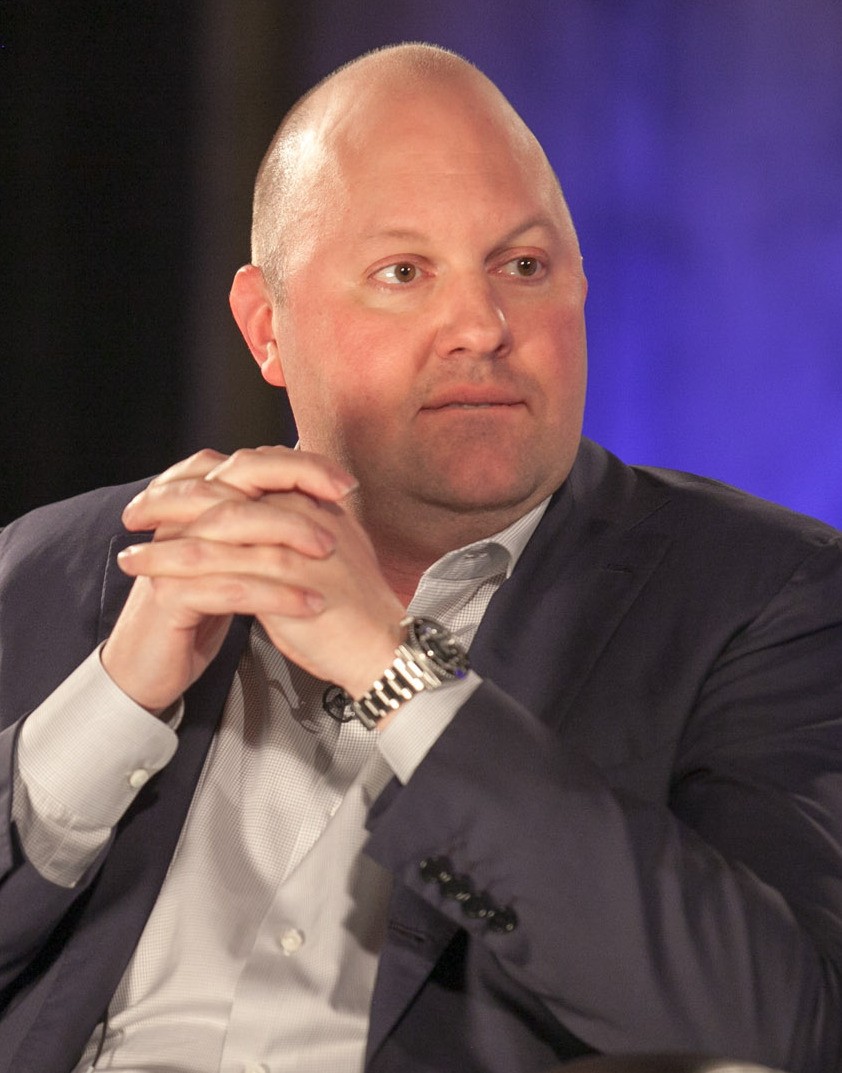
born Marc Lowell Andreessen
Co-creator of the Mosaic web browser; co-founder of Netscape and of the venture-capital firm Andreessen Horowitz (a16z) · b. 1971 · Cedar Falls, Iowa → New Lisbon, Wisconsin
Two calls made by hand, not formulas. how we score →
Summary
Grew up middle-class in small-town Wisconsin, son of a seed-company sales manager, and reached Silicon Valley through a public university, not an elite pipeline.
Co-creating the Mosaic browser opened the door; Jim Clark's money and the 1994 Netscape launch turned it into fame and wealth at 24. Andreessen Horowitz, founded in 2009, is now the bigger engine of both his wealth and influence.
People in this set who share a company with Marc Andreessen.
- Meg Whitman 2/3 eBay · Hewlett-Packard
- Palmer Luckey 3/0 Oculus VR · Meta Platforms
- Alexandr Wang 2/1 Meta Platforms
- David Sacks 2/1 Meta Platforms
- Drew Houston 2/0 Meta Platforms
- Dustin Moskovitz 2/1 Meta Platforms
- Jan Koum 7/4 Meta Platforms
- Kenneth Chenault 2/8 Meta Platforms
- Kevin Systrom 1/0 Meta Platforms
- Logan Green 3/0 eBay
- Luke Nosek 4/3 Netscape
- Mark Zuckerberg 1/1 Meta Platforms
- Patrick Collison 2/1 Meta Platforms
- Peter Thiel 2/2 Meta Platforms
- Reed Hastings 2/1 Meta Platforms
- Reid Hoffman 2/0 Meta Platforms
- Roy Clay Sr. 8/9 Hewlett-Packard
- Steve Chen 3/2 Meta Platforms
- Steve Jobs 3/1 Hewlett-Packard
- Steve Wozniak 2/0 Hewlett-Packard
- Tristan Walker 8/8 Andreessen Horowitz
Where they worked
How it happened
Andreessen was born on July 9, 1971, in Cedar Falls, Iowa, and grew up in New Lisbon, Wisconsin, a small town he later called "the sticks." His father, Lowell, was a sales manager for the agricultural seed company Pioneer Hi-Bred International; his mother, Patricia, worked in customer service at the mail-order retailer Lands' End. He went to public schools and then to the University of Illinois at Urbana-Champaign, a public, largely in-state school, for computer science. There was no family money, no coastal network, and no private-school pipeline behind him.
As a student he took a paid job at the university's federally funded supercomputing center, NCSA, where he and Eric Bina built Mosaic, the first widely used graphical web browser, released in 1993. The access that mattered wasn't money or connections. It was a seat inside a publicly funded research lab working on the internet before almost anyone outside it understood what that meant.
After graduating in December 1993 he moved to California, where Jim Clark, the Silicon Graphics founder, sought him out to commercialize Mosaic. Clark supplied the money and the credibility; Kleiner Perkins backed the round that followed. The company, renamed Netscape, went public in August 1995, and the stock's first-day run to $75 a share made Andreessen, at 24, a Time cover subject and a very rich man almost overnight. Nothing that came after was possible without this: it's the event that converted a research-lab hire into capital, fame, and a lifelong Rolodex.
AOL bought Netscape for roughly $4.3 billion in 1999, around the same time Andreessen co-founded Loudcloud, a web-hosting and infrastructure company, with Ben Horowitz. Loudcloud went public into the dot-com crash, survived by selling its managed-services arm and renaming itself Opsware, and was sold to Hewlett-Packard for about $1.6 billion in 2007. It was a harder, slower outcome than Netscape, built on actually running a business through a downturn rather than riding a single launch.
In 2009 Andreessen and Horowitz started their own venture firm with $300 million under management. Andreessen Horowitz has since grown into one of the largest and most influential firms in the industry, with roughly $90 billion in assets under management as of early 2026, and backed companies including Facebook, GitHub, Coinbase, and Airbnb. His partnership stake in that firm, not any single founding event, is now the larger engine of both his current wealth and his public influence.
Forbes put his personal net worth at about $1.9 billion as of October 2026. He sat on Facebook's board for years and was named in a 2016 shareholder lawsuit alleging he privately advised Mark Zuckerberg on defending a stock-structure plan while supposedly acting as an independent director. In October 2023 he published the "Techno-Optimist Manifesto," arguing that technology and markets are the primary engines of human progress, and by 2024 had shifted from decades of supporting Democratic candidates to backing Donald Trump, becoming a visible and polarizing figure in the process.
The coded evidence
Thirteen groups, every claim sourcedSome profiles describe him as self-identifying with German-American heritage, but no specific, well-documented ancestry beyond "White American" was found in the sources reviewed, so this is coded at the coarse facet level only.
↗ en.wikipedia.orgDescendant; no documented recent immigration in the family line.
↗ en.wikipedia.orgEnglish
Inferred from a US-born, English-speaking Midwestern family; not directly documented.
↗ en.wikipedia.orgA stable, employed two-parent household in a small Wisconsin town. Both parents worked ordinary jobs (sales manager and a customer-service role), with no documented family wealth, elite network, or coastal connections behind him. This is the contrast with the comfortable, elite-private-school pipeline common among his Silicon Valley peers: a secure floor, but not a soft one, and nothing resembling a safety net of capital or standing if an early attempt had failed.
↗ en.wikipedia.orgPaid student employment at NCSA, the university's federally funded supercomputing center, supported him while he and Eric Bina built Mosaic; once at Netscape he drew a salary and equity from a well-capitalized, Jim Clark-backed startup rather than self-funding from savings.
↗ en.wikipedia.orgnot established
No housing or income instability during the Mosaic or Netscape years is documented.
↗ en.wikipedia.orgFather, Lowell Andreessen, a sales manager for Pioneer Hi-Bred International, an agricultural seed company. Mother, Patricia, a customer-service representative for the mail-order retailer Lands' End.
↗ en.wikipedia.orgNeither parent was self-employed.
Both parents are described as employees of established companies rather than self-employed.
↗ en.wikipedia.orgnot established
No custodial change is documented; raised by both parents throughout childhood.
↗ en.wikipedia.orgNew Lisbon, Wisconsin, a small rural village of roughly 2,000 people, with no technology industry presence of any kind nearby.
↗ en.wikipedia.orgPublic schools in New Lisbon, Wisconsin, through high school.
↗ en.wikipedia.orgnot established
Rural Wisconsin had no computing or technology industry within daily reach; this is the opposite of the Silicon Valley or Boston-corridor childhoods common among his later peers.
↗ en.wikipedia.orgBorn in Cedar Falls, Iowa; raised in New Lisbon, Wisconsin; moved to Urbana-Champaign, Illinois for college; moved to Mountain View, California in 1994 to commercialize Mosaic. An internal, career-driven sequence of moves, not an international migration.
↗ en.wikipedia.orgJim Clark, the Silicon Graphics founder, sought Andreessen out after reading about Mosaic and proposed commercializing it; he supplied the founding capital and the credibility to assemble a company around a 22-year-old with no business track record.
↗ en.wikipedia.orgNCSA (National Center for Supercomputing Applications) at the University of Illinois, a federally funded research lab, where he held a paid student job and built Mosaic with Eric Bina.
↗ en.wikipedia.orgSkill, Idea
NCSA supplied technical skill-building and the Mosaic project itself. It did not supply capital, business credibility, or an industry network; those came later, from Jim Clark.
↗ en.wikipedia.orgMosaic was built with Eric Bina at NCSA. Netscape was co-founded with Jim Clark, who met him through Clark's own search for a commercial browser opportunity.
↗ en.wikipedia.org21
Paid technical work began with his NCSA student job and two IBM internships while still an undergraduate.
↗ en.wikipedia.org2
IBM (internships) and NCSA, before co-founding Netscape rather than being hired into it.
↗ en.wikipedia.orgB.S. in Computer Science, University of Illinois at Urbana-Champaign, December 1993.
↗ en.wikipedia.orgnot established
Not documented. In-state tuition at a public university was within reach of a middle-class dual-income household; no scholarship, military funding, or loan is mentioned in the sources reviewed.
↗ en.wikipedia.orgDirect — public, in-state university to a federally funded research-lab job, with no transfer, military, or elite-prep detour.
↗ en.wikipedia.orgThe University of Illinois mattered less as a brand than as the host of NCSA, a federally funded supercomputing center doing early internet research; that lab, not the university's name, put him in a position to build Mosaic and later be found by Jim Clark.
↗ en.wikipedia.orgJim Clark personally provided the capital to found Mosaic Communications Corporation in April 1994, before the company (soon renamed Netscape) raised an institutional round with Kleiner Perkins.
↗ en.wikipedia.orgIt needed capital up front, before it earned anything.
Netscape went public in August 1995 before becoming profitable, an unusual move at the time.
↗ en.wikipedia.orgFounding capital from Jim Clark personally, followed by an institutional round from Kleiner Perkins; the company went public in August 1995 at a closing-day market value of about $2.9 billion.
↗ en.wikipedia.orgJim Clark was not a passive check. As Netscape's co-founder and chairman, he supplied capital, operating credibility from Silicon Graphics, and the initial relationships that attracted further investors.
↗ en.wikipedia.orgNetscape raised significant outside venture capital and went public within roughly 16 months of founding. Loudcloud and Opsware were also venture-backed and later sold outright (to AOL and HP, respectively). Andreessen Horowitz itself is a compounding vehicle built on limited partners' capital, not his own money; his personal wealth comes from general-partner economics and carry on that fund, plus his own portfolio holdings, not from the roughly $90 billion the firm manages on behalf of its investors.
↗ en.wikipedia.orgAndreessen Horowitz, founded in 2009 with $300 million under management and grown to roughly $90 billion in assets under management as of early 2026, deploys outside limited-partner capital rather than his own; it is the structure behind most of his current wealth and influence, distinct from any single founding event.
↗ en.wikipedia.orgProceeds and reputation from Netscape's AOL sale and Opsware's HP sale were reinvested into founding Andreessen Horowitz in 2009 rather than being simply consumed.
↗ en.wikipedia.orgMosaic grew out of his own NCSA research-lab work rather than a prior employer's commission or a family business; Netscape's founding idea was to commercialize that existing project at Jim Clark's suggestion.
↗ en.wikipedia.orgnot established
No major failed venture before Netscape is documented; Mosaic and Netscape succeeded on close to the first attempt. A later venture, Ning (2004), underperformed relative to his other companies and sold for a comparatively modest $150 million in 2011, but this came well after his defining wealth event.
↗ en.wikipedia.orgThe first wave of commercial internet companies, before a dot-com bubble existed to compare it to; Netscape's IPO became the template investors later called a "Netscape moment."
↗ en.wikipedia.orgMountain View, California, where Mosaic Communications Corporation (soon Netscape) was founded in April 1994 after he relocated from Illinois.
↗ en.wikipedia.orgNetscape's August 1995 IPO, where the stock opened at $28, traded as high as $75, and closed at $58.25 on its first day, putting Andreessen on the cover of Time at 24.
↗ en.wikipedia.orgBuilt from scratch at each stage — Mosaic, Netscape, Loudcloud/Opsware, and Andreessen Horowitz — rather than acquiring an existing company or asset.
↗ en.wikipedia.org38
Age when Andreessen Horowitz was founded in July 2009; the structure behind most of his current wealth.
↗ en.wikipedia.orgnot established
The opposite pattern applies — he moved directly into the Silicon Valley hub in 1994 and has built there since.
↗ en.wikipedia.orgVenture capital; internet software (web browsers, enterprise infrastructure)
↗ forbes.com1900000000
Forbes real-time tracker figure, October 2, 2026. This is his personal net worth, built from Netscape and Opsware exit proceeds, his Andreessen Horowitz general-partner stake and carry, and personal portfolio holdings. It is NOT the same figure as a16z's roughly $90 billion in assets under management, which is limited-partner capital the firm deploys on investors' behalf, not his own wealth. Band figure only; no disclosed methodology.
↗ forbes.comJournalistic estimate
No single filing discloses a comprehensive personal net-worth figure; a16z is a private partnership.
↗ forbes.com2026
↗ forbes.comnot established
General-partner income at a private partnership like a16z is not subject to proxy-statement-style disclosure; not established.
↗ forbes.comAlmost entirely wealth rather than salary: proceeds from Netscape's 1999 AOL sale and Opsware's 2007 HP sale, plus general-partner carry and co-investment gains at Andreessen Horowitz since 2009.
↗ en.wikipedia.orgWrote the widely cited 2011 Wall Street Journal essay "Why Software Is Eating the World" and the 2023 "Techno-Optimist Manifesto." Held board seats at Meta/Facebook, Hewlett Packard Enterprise, and eBay (resigned 2014), and was named to the President's Council of Advisors on Science and Technology in 2026. Became a prominent and increasingly polarizing political commentator and donor after decades of backing Democratic candidates.
↗ en.wikipedia.orgUncapped
↗ en.wikipedia.orgnot established
No personal regulatory finding or consent decree against Andreessen is documented in the sources reviewed.
↗ en.wikipedia.orgIn April 2016, Facebook shareholders filed a derivative lawsuit alleging Andreessen, while serving as an independent Facebook board member, privately coached Mark Zuckerberg on messaging to defend a proposed non-voting share class later abandoned by the company. The allegation concerns a breach of fiduciary duty as a director; the sources reviewed do not establish a final adjudicated outcome.
Reported allegation, attributed to the shareholder complaint; not stated here as established fact.
↗ en.wikipedia.orgnot established
No ownership or dilution dispute among Netscape's, Opsware's, or a16z's own founders is documented in the sources reviewed.
↗ en.wikipedia.orgAfter
The 2016 Facebook board allegation came roughly two decades after Netscape's IPO and seven years after a16z's founding.
↗ en.wikipedia.orgUnrelated
A boardroom governance allegation at a portfolio-adjacent company; it did not produce his wealth or standing.
↗ en.wikipedia.orgnot established
Outcome of the 2016 shareholder complaint is not clearly established in the sources reviewed, so a gradient is not coded.
↗ en.wikipedia.orgVisionary, Provocateur, prolific essayist, Techno optimist, polarizing political commentator
↗ en.wikipedia.orgPress
↗ en.wikipedia.org4
Wikipedia, Forbes, a16z's own site, and Andreessen Horowitz's Wikipedia entry, among others reviewed.
↗ en.wikipedia.orgBefore
His reputation as a leading technologist and investor was established through Netscape and the a16z years, well before his post-2023 political turn.
↗ en.wikipedia.orgMixed
An asset for raising funds and attracting founders within tech and venture circles; increasingly a liability with segments of the broader public and political press.
↗ en.wikipedia.orgThe reputation was deliberately built, through books, press, and PR.
A long record of widely read essays, a manifesto, and heavy public and media presence reflects a deliberately built public-intellectual profile.
↗ a16z.comWithin the technology and venture-capital industry, Andreessen is widely credited as a foundational figure, from Mosaic through a16z. Since publishing the 2023 "Techno-Optimist Manifesto" and shifting his political donations toward Donald Trump and Republican candidates in 2024, reporting describes a sharper split: continued standing among many investors and founders alongside a more polarized reception in broader political and media discourse, where he is alternately described as a visionary or as a divisive, hard-right-aligned figure. No personal-conduct allegations beyond the matters described elsewhere in this record are established.
↗ en.wikipedia.orgnot established
No reputational collapse-and-recovery event is documented; his standing has shifted politically rather than following a crisis-and-recovery arc.
↗ en.wikipedia.orgStructural context
The cost-of-failure score comes from this person's own money and circumstances. But who they were in America carried its own weight, the same way their household or income did, and it shaped how hard the path was just as much. That part isn't in the cost-of-failure number. It's here instead.
Men founded the companies that took nearly all the venture funding and almost every top outcome, a tailwind that never shows up in one person's own circumstances.
↗ techcrunch.comWhite founders are heavily overrepresented among funded companies and top-tier wealth relative to their share of the population, an edge that has nothing to do with a person's own money.
↗ techcrunch.comAmong the people recorded here — men: 225 · White subjects: 125. Representation here is who reached these outcomes, not equal odds of reaching them.
Controlled comparisons
Each holds one thing constant and varies another, so the difference is the point. A list of similar names wouldn't tell you anything.

Related companies
Companies connected to Marc Andreessen through the profiled people they worked with. Each card says who the link runs through.