Steve Wozniak
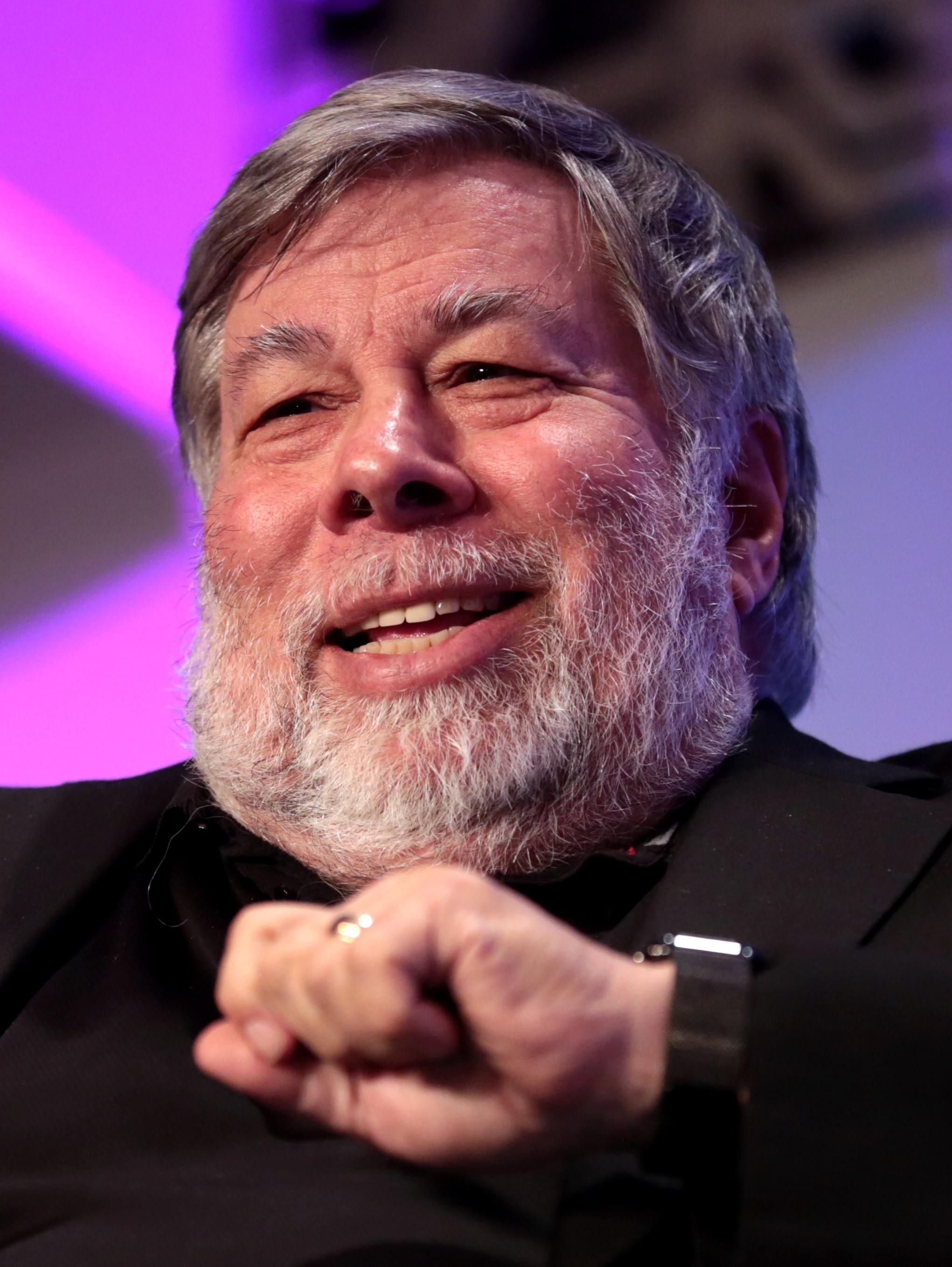
born Stephen Gary Wozniak
Co-founder of Apple; sole designer of the Apple I and primary designer of the Apple II · b. 1950 · San Jose, California
Two calls made by hand, not formulas. how we score →
Summary
Wozniak co-founded Apple with Steve Jobs in 1976, designed the Apple I almost entirely alone, and held a nearly identical ownership stake at the 1980 IPO.
Then he gave cheap stock to early employees, sold most of what remained, and left day-to-day work at thirty-four. Jobs kept building his fortune for three more decades. Wozniak, on the record, chose not to.
How it happened
His father, Francis "Jerry" Wozniak, was an electrical engineer at Lockheed who taught him electronics from an early age and told him engineers "could change the world," not just make money in it. The family was comfortable and stable in the San Jose-Sunnyvale corridor years before it was called Silicon Valley, with a father whose own field was the one his son would later remake.
He attended Homestead High School, the same school Jobs would later attend, and met Jobs in 1971 through a mutual friend, Bill Fernandez. Before Apple existed the two of them built and sold "blue boxes," illegal devices that spoofed the phone network's tones to place free long-distance calls, a lucrative, illicit dry run for building and selling something together. Wozniak worked as a calculator design engineer at Hewlett-Packard through the early 1970s, a salaried engineering job that gave him steady income while he tinkered.
Wozniak designed the Apple I largely by himself and demonstrated it to the hobbyists of the Homebrew Computer Club before it was a company. He and Jobs sold a calculator and a van for roughly $1,300 to fund the first circuit boards, then Mike Markkula's $250,000 investment and business plan turned the partnership into Apple Computer, founded in 1976 with Ronald Wayne, who sold his own stake back within days. Wozniak was the primary designer of the Apple II, the machine that actually built the company, and held a stake close to Jobs's own when Apple went public in 1980 at 25.
Ahead of the IPO, Wozniak sold roughly $10 million of his own stock, at low, pre-IPO prices, to early Apple employees he felt the company's formal option grants had shortchanged. Jobs was asked to do the same and declined. It is the clearest single fork in the record: same company, same moment, one founder redistributing the upside and the other keeping his.
A private plane he was piloting crashed on takeoff near Santa Cruz in February 1981; he survived with severe injuries and weeks of memory loss. He returned to Apple afterward but, feeling the Apple II division that still generated most of the company's revenue got too little institutional respect, left day-to-day employment in 1985 to start CL 9, a universal remote-control company, while remaining a nominal Apple employee and shareholder for decades after.
He has said publicly that he gave away the "vast majority" of his Apple wealth and that he deliberately avoided investing or accumulating more, telling interviewers he "didn't want to be near money" because of what it could do to him. Estimates of his current net worth cluster loosely around $100 million. Jobs, holding the similar stake he never gave away, died worth roughly $8.3 billion.
The coded evidence
Thirteen groups, every claim sourcedWhite (Polish and German descent)
Coarse public-record coding; race is a noisy, interpretive category.
↗ en.wikipedia.orgMulti-generation American descendant; his father Francis "Jerry" Wozniak was a native-born electrical engineer, not an immigrant.
↗ en.wikipedia.orgnot established
Not clearly established. As an adult he has described himself as atheist or agnostic; no documented account of the family's religious practice during his childhood.
↗ en.wikipedia.orgEnglish
↗ en.wikipedia.orgGrew up in his parents' home in the San Jose/Sunnyvale area, a stable, owned household he could and did return to throughout his twenties; never at risk during Apple's founding.
↗ en.wikipedia.orgHeld a salaried engineering job at Hewlett-Packard designing calculators through the years he was building the Apple I on the side, giving him a steady paycheck the entire time Apple was forming, unlike Jobs, who had no comparable job.
↗ en.wikipedia.orgnot established
Not applicable in the way it is for Jobs; there is no documented period of visible poverty, chosen or otherwise, in Wozniak's record.
↗ en.wikipedia.orgFather Francis "Jerry" Wozniak was an electrical engineer at Lockheed Corporation; mother Margaret Louise Wozniak (née Kern) was from Washington state, her occupation not established in the public record.
↗ en.wikipedia.orgNeither parent was self-employed.
Father was a salaried Lockheed engineer, not self-employed.
↗ en.wikipedia.orgFather held an engineering degree and worked as a professional engineer; mother's education not established.
↗ en.wikipedia.orgHis father personally taught him electronics from a young age and told him engineers, not salesmen, "changed the world," treating his technical obsession as worth serious attention rather than a distraction from school.
↗ en.wikipedia.orgRaised in San Jose and the surrounding Santa Clara Valley, inside the same emerging electronics corridor that would shortly be named Silicon Valley.
↗ en.wikipedia.orgHomestead High School in Cupertino, the same public school Steve Jobs later attended.
↗ en.wikipedia.orgGrew up with an electrical-engineer father and, more broadly, inside the same dense concentration of defense and electronics engineers that shaped the Jobs household a few miles away.
↗ en.wikipedia.orgnot established
Lockheed was aerospace/defense, not computing; his father's job did not provide a direct entry point into the personal-computer industry, even though it supplied engineering fluency and encouragement.
↗ en.wikipedia.orgThe Homebrew Computer Club, a Bay Area hobbyist group where Wozniak demonstrated the machine that became the Apple I before Apple existed as a company.
↗ en.wikipedia.orgSteve Jobs, introduced by mutual friend Bill Fernandez in 1971, when Wozniak was 21 and Jobs was 16. Wozniak supplied the engineering; Jobs supplied the product sense and the sales.
↗ computerhistory.orgnot established
Exact age at his first Hewlett-Packard job is not precisely documented.
↗ en.wikipedia.orgHad hands-on access to computers and engineering equipment as a teenager, well ahead of public availability, through his own electronics hobby and his HP job designing calculators.
↗ en.wikipedia.orgAttended the University of Colorado Boulder (expelled after his first year for hacking the university's computer system), then De Anza College, then transferred to UC Berkeley in 1971 to study electrical engineering and computer science. Left before finishing to work and build Apple, then returned years later, after Apple had made him independently wealthy, and completed his bachelor's degree in 1986 under the pseudonym "Rocky Raccoon Clark" so as not to draw attention.
↗ en.wikipedia.orgnot established
Not established; he was already wealthy by the time he completed the degree.
↗ en.wikipedia.orgA multi-stop path: University of Colorado Boulder, then De Anza College, then UC Berkeley, interrupted by leaving to build Apple, then completed under an assumed name in 1986.
↗ en.wikipedia.orgHe and Jobs raised the roughly $1,300 needed for the first batch of Apple I circuit boards by selling Wozniak's HP-65 calculator for about $500 and Jobs's Volkswagen van for about $1,500.
↗ computerhistory.orgMike Markkula, a retired Intel millionaire, personally invested $250,000 for a third of the company in early 1977 and wrote Apple's first business plan, converting a two-person partnership into a venture-backed company.
↗ finance.yahoo.comHeld a stake reported at roughly 7.9-8.7% of Apple at the 1980 IPO, a position close to, though somewhat smaller than, Jobs's own reported stake; both were diluted by Markkula's investment from the start.
↗ e.vnexpress.netRather than deploying his Apple windfall into further ventures the way Jobs redeployed his own into NeXT and Pixar, Wozniak sold roughly $10 million of stock to early employees ahead of the IPO at reduced prices, sold most of his remaining shares over time, and channeled a large share of what remained into philanthropy and teaching rather than building a second fortune.
↗ celebritynetworth.comSelf-generated: a hobbyist personal-computer board Wozniak designed for his own use and to show off at the Homebrew Computer Club, ahead of any market plan.
↗ en.wikipedia.orgBefore Apple, he and Jobs built and sold "blue boxes," illegal devices that spoofed AT&T's network tones to place free long-distance calls. Wozniak has spoken openly about this in his own accounts of the friendship, describing it as lucrative and as the first thing he and Jobs ever built and sold together.
Self-admitted by the subject in his own retellings (including his autobiography "iWoz"), not an allegation or inference.
↗ en.wikipedia.orgFounded Apple in 1976 at the start of the hobbyist personal-computer market, with the Homebrew Computer Club supplying both the technical community and the first audience for his design.
↗ en.wikipedia.org9
1976 to his 1985 departure from day-to-day work, the active window in which his stake could have compounded before he began converting it into cash and giveaways; unlike Jobs, he did not redeploy the proceeds into a second multi-decade venture.
↗ en.wikipedia.orgPersonal computer hardware design
↗ en.wikipedia.org100000000
No SEC filing, court record, or Forbes profile lists a definitive figure for Wozniak. Aggregator and journalistic estimates diverge widely: Celebrity Net Worth put the figure as low as $10 million as of 2026, citing his own statements about giving away the "vast majority" of his Apple wealth to charity and early employees; other outlets, citing a CNBC Make It estimate, cluster around $100 million; still others report $120-160 million. This is coded at the middle, best-corroborated figure, with the wide spread itself treated as part of the finding: even the estimate of his wealth is uncertain in a way Jobs's, drawn from public Apple and Disney stock, was not.
↗ marketrealist.comJournalistic estimate
↗ marketrealist.comHis remaining wealth is mostly the residue of Apple stock he chose not to sell down to zero, plus decades of speaking fees; he has said he does not invest. Apple has also paid him a stipend, reported around $120,000 a year, for continuing to represent the company publicly after 1985.
↗ en.wikipedia.orgExtensive cultural stature and honors independent of wealth: the National Medal of Technology (1985, with Jobs), the National Inventors Hall of Fame, the Heinz Award, founding funder of the Electronic Frontier Foundation, and years spent personally teaching computer classes to grade-school students.
↗ en.wikipedia.orgUncapped
Structurally uncapped, publicly traded founder equity, identical in kind to Jobs's. What differs is not the ceiling but the choice: he converted most of that uncapped upside into cash and gifts early rather than letting it compound.
↗ en.wikipedia.orgExpelled from the University of Colorado Boulder after his first year for hacking the university's computer system; before Apple, he and Jobs built and sold illegal "blue box" phone-phreaking devices. Both are recounted by Wozniak himself in his own retellings.
↗ en.wikipedia.orgIncidental
Formative to the Jobs-Wozniak partnership and to Wozniak's taste for building and selling something together, but not what produced Apple's actual product or its outcome.
↗ en.wikipedia.orgGenerous, Unassuming, engineer's engineer, allergic to accumulating wealth
↗ celebritynetworth.comPublic
The reputation is consistent across insiders, the press, and public accounts, unusually so.
↗ celebritynetworth.comBefore
His reputation as the unassuming engineer dates to Apple's earliest years and the Woz Plan stock giveaway, well before any of his later teaching and philanthropy.
↗ en.wikipedia.orgAsset
Unlike Jobs's "mixed" reputation as both visionary and difficult, Wozniak's reputation for generosity and lack of interest in money has functioned almost entirely as an asset, in speaking fees, goodwill, and continued relevance, rather than a liability.
↗ en.wikipedia.orgThe reputation accrued from behaviour rather than being manufactured.
No documented evidence of a deliberate image-shaping effort on the scale of Jobs's authorized biography; his reputation reads as the byproduct of repeated, consistent public statements and choices rather than a managed campaign.
↗ celebritynetworth.comLittle documented divergence: early employees who benefited from the Woz Plan, journalists, and the general public describe him consistently as generous and averse to wealth for its own sake.
↗ celebritynetworth.comStructural context
The cost-of-failure score comes from this person's own money and circumstances. But who they were in America carried its own weight, the same way their household or income did, and it shaped how hard the path was just as much. That part isn't in the cost-of-failure number. It's here instead.
Men founded the companies that took nearly all the venture funding and almost every top outcome, a tailwind that never shows up in one person's own circumstances.
↗ techcrunch.comAmong the people recorded here — men: 169 · White (Polish and German descent) subjects: 1. Representation here is who reached these outcomes, not equal odds of reaching them.
Controlled comparisons
Each holds one thing constant and varies another, so the difference is the point. A list of similar names wouldn't tell you anything.