Jawed Karim
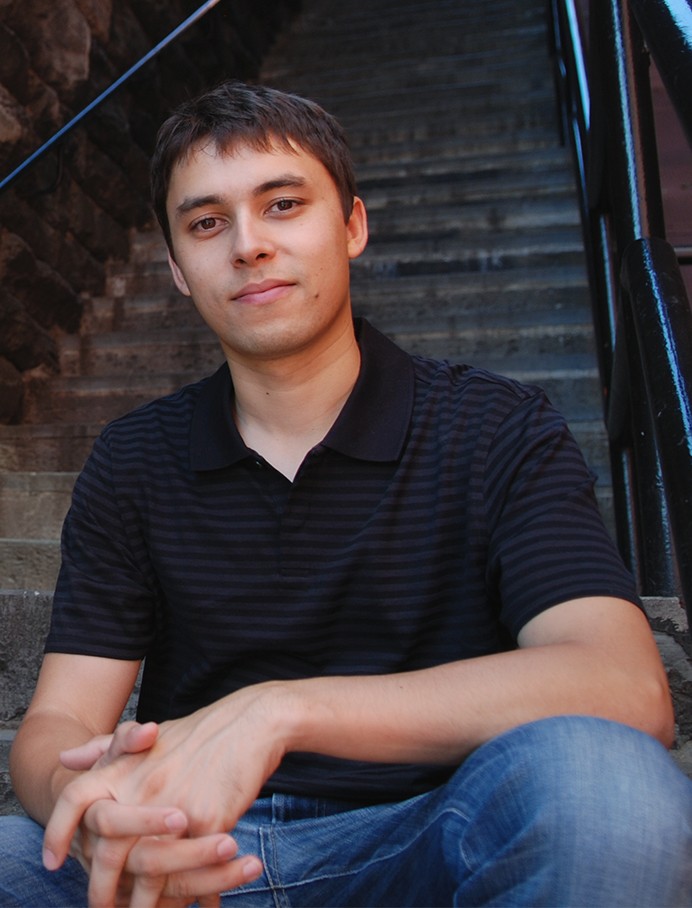
Co-founder of YouTube; posted the platform's first video · b. 1979 · Merseburg, East Germany
Two calls made by hand, not formulas. how we score →
Summary
Born in East Germany to a Bangladeshi scientist and a German biochemist, he moved to Minnesota at thirteen into an educated household.
He co-founded YouTube at PayPal in 2005 and posted its first video, then left early for Stanford instead of staying on full time. That's why his stake in the $1.65 billion Google deal was a fraction of his co-founders' — a smaller landing on the same jump.
How it happened
Jawed Karim was born October 28, 1979, in Merseburg, East Germany. His father, Naimul Karim, is a Bangladeshi research scientist who spent his career at 3M; his mother, Christine, is a German biochemist who later worked at the University of Minnesota. The family left East Germany for Neuss, West Germany, in the early 1980s, then moved to Saint Paul, Minnesota, in 1992, when Karim was about thirteen. He graduated from Saint Paul Central High School in 1997 and grew up trilingual, in German, English, and Bengali.
He enrolled at the University of Illinois at Urbana-Champaign to study computer science, interned at Silicon Graphics working on 3D data visualization, and left school before finishing his degree to join PayPal in 2002, where he helped build the company's real-time anti-fraud system. It was at PayPal that he met Chad Hurley and Steve Chen, and he later completed his bachelor's degree and went on to a master's in computer science from Stanford.
Karim co-founded YouTube with Hurley and Chen in February 2005, and it was Karim who created the site's first user account and posted its first video, "Me at the zoo," on April 23, 2005, filmed by a friend at the San Diego Zoo. The founding itself is the moment that produced his later payout, even though he chose not to work at YouTube full time: he stepped back into an informal advisory role that same year to start a master's program at Stanford, leaving Hurley and Chen to build the company day to day.
Google announced its acquisition of YouTube on October 9, 2006, for about $1.65 billion in stock, and closed it that November. Because he had stepped back to an adviser's role rather than staying on as an operator, Karim's founder equity was set far lower than Hurley's or Chen's — he received roughly 137,443 Google shares, worth about $64 million at the time, against Hurley's reported $345.6 million and a broadly similar sum for Chen. Same company, same founding date, same acquisition; a much smaller number because he'd already left day-to-day building for a classroom.
In 2008 Karim co-founded Youniversity Ventures (later Y Ventures) with Keith Rabois and Kevin Hartz, an early-stage fund that put seed money into Airbnb in 2009 and also backed Palantir, Reddit, and Eventbrite. He has stayed largely out of the public eye since, weighing in occasionally on YouTube's product decisions — he publicly criticized the platform's 2013 Google+ comment integration and its 2021 removal of public dislike counts.
The coded evidence
Thirteen groups, every claim sourcedSouth Asian (Bangladeshi) and German biracial
Coarse public-record coding. His father is Bangladeshi, his mother German; no source discusses his own racial self-identification.
↗ en.wikipedia.orgImmigrated to the United States at about thirteen, in 1992, with his parents; a 1.5-generation immigrant who did the bulk of his schooling in the US after arrival.
↗ en.wikipedia.orgGerman and Bengali; he is described as fluent in German, English, and Bengali.
↗ en.wikipedia.orgNo housing instability is documented at any point; the family had a stable home first in Neuss, West Germany, then in Saint Paul, Minnesota.
↗ en.wikipedia.orgKarim had a salaried engineering job at PayPal, and after eBay's 2002 acquisition of PayPal he held PayPal/eBay stock, before YouTube existed at all; he was not financially dependent on YouTube succeeding.
↗ en.wikipedia.orgnot established
Not established; no spouse or partner is documented in the sources reviewed.
↗ en.wikipedia.orgnot established
No period of documented financial hardship, chosen or imposed, appears in the record.
↗ en.wikipedia.orgFather Naimul Karim is a Bangladeshi research scientist who worked at 3M; mother Christine is a German biochemistry scientist who later worked at the University of Minnesota.
↗ en.wikipedia.orgNeither parent was self-employed.
Both parents are described as salaried research scientists (3M, University of Minnesota), not self-employed.
↗ en.wikipedia.orgBoth parents held scientific research careers requiring advanced degrees; specific degree levels are not documented.
↗ en.wikipedia.orgA two-parent, dual-scientist professional household with no documented inherited wealth or business ownership; the family's standing came from research careers, not capital.
↗ en.wikipedia.orgnot established
No specific detail on how his US public schooling or UIUC tuition were funded is documented.
↗ en.wikipedia.orgMerseburg, East Germany; then Neuss, West Germany; then Saint Paul, Minnesota.
↗ en.wikipedia.orgSaint Paul Central High School, a public high school, graduating in 1997.
↗ en.wikipedia.orgLeft East Germany for Neuss, West Germany, in the early 1980s while he was a young child, then the family emigrated again to Saint Paul, Minnesota, in 1992 when he was about thirteen — two international moves before adulthood.
↗ en.wikipedia.orgNone documented. Both parents continued in research science roles after each move (3M for his father, university biochemistry for his mother), rather than experiencing a documented downgrade in occupation on arrival.
↗ en.wikipedia.orgSome sources describe the family leaving East Germany, and later facing continued difficulty in West Germany, connected to discrimination against the family's mixed Bangladeshi-German background, before the 1992 move to the US.
Reported in secondary profiles rather than confirmed by Karim himself on the record; treated here as a low-confidence, illustrative detail rather than an established fact.
↗ welt.deA software engineering job at PayPal starting in 2002 put him alongside Chad Hurley and Steve Chen, the two people he would found YouTube with three years later.
↗ en.wikipedia.orgPayPal — Karim, Hurley, and Chen were all PayPal employees when they conceived YouTube; PayPal's 2002 sale to eBay left all three with capital and stock-option payouts before YouTube existed.
↗ en.wikipedia.orgNetwork, Skill, Credibility
PayPal supplied the co-founder relationships, engineering training, and "PayPal Mafia" credibility that helped YouTube raise money quickly.
↗ en.wikipedia.orgChad Hurley and Steve Chen, both former PayPal colleagues, co-founded YouTube with Karim in February 2005.
↗ en.wikipedia.orgnot established
No pre-existing public audience or platform is documented before YouTube's launch.
↗ en.wikipedia.orgYouTube let anyone upload and share video without a broadcaster, network, or publisher's approval; Karim's own "Me at the zoo" was the proof of concept that the format worked with no gatekeeper at all.
↗ cnn.com2
Silicon Graphics (internship) and PayPal are the only employers documented before YouTube.
↗ en.wikipedia.orgMS in computer science, Stanford University; BS in computer science, University of Illinois at Urbana-Champaign, completed after he had already left to join PayPal and later finished the degree.
↗ en.wikipedia.orgLeft UIUC before finishing his bachelor's degree to work full time at PayPal (2002), then completed the degree and enrolled at Stanford for a master's the same year he co-founded YouTube (2005), splitting his time between graduate study and the young company.
↗ en.wikipedia.orgDirect into a large public flagship university (UIUC) for computer science, an internship at Silicon Graphics, then a Stanford graduate degree — no community-college or nontraditional detour.
↗ en.wikipedia.orgStanford's computer science program is where he was studying when YouTube was acquired, and it is the credential and network he chose over staying on as a full-time YouTube operator.
↗ en.wikipedia.orgnot established
YouTube's first funding came from Sequoia Capital and Artis Capital Management between November 2005 and April 2006; whether any of Karim's personal money was put in before that is not documented.
↗ en.wikipedia.orgIt needed capital up front, before it earned anything.
YouTube grew on free hosting funded by venture capital well before it had a durable revenue model.
↗ en.wikipedia.orgBy 2005 Karim had a PayPal salary and PayPal/eBay stock from the 2002 acquisition, giving him personal capital and security independent of YouTube, though no source documents him investing that money directly into the company.
↗ en.wikipedia.orgYouTube's outside funding came from Sequoia Capital and Artis Capital Management, raised between November 2005 and April 2006, before the November 2006 sale to Google.
↗ en.wikipedia.orgHis founder-level equity was set before YouTube's outside funding rounds and before the Google sale, but at a smaller allocation than Hurley's or Chen's, reflecting his early step-back to part-time adviser rather than full-time co-founder.
↗ en.wikipedia.orgAccounts differ on the founders' original motivation (a video-dating site and a way to share personal video clips are both cited); Karim's own contribution most credibly documented is design and engineering work and being the one who posted the platform's proof-of-concept first video.
↗ en.wikipedia.orgKarim held founder equity in YouTube but, unlike Hurley (CEO) and Chen (CTO), was not an officer or full-time operator after early 2005; he is reported to have kept an informal advisory role while at Stanford, which is the documented reason his final equity was smaller than theirs.
↗ en.wikipedia.orgFounded as broadband home internet access was spreading in the US and consumer video codecs and Flash Player made in-browser video playback practical for the first time, just ahead of the wider social-video wave.
↗ en.wikipedia.orgSan Mateo, California, where YouTube was founded and initially based.
↗ en.wikipedia.orgBuilt — YouTube was created from scratch by the three founders, not acquired.
↗ en.wikipedia.org1
Unlike Hurley and Chen, Karim's own active involvement ran roughly one year, from the February 2005 founding to when he stepped back to an advisory role to start at Stanford later that year; the November 2006 sale to Google closed with him already in an adviser capacity.
↗ en.wikipedia.orgOnline video hosting and sharing (YouTube); later early-stage technology investing.
↗ en.wikipedia.org64600000
This is the documented core figure: 137,443 Google shares received in the November 2006 acquisition, reported at the time as worth roughly $64 million (some accounts round to $64.6 million using Google's February 2007 closing price). It is the basis for the magnitude band below, not the $1.65 billion YouTube deal price. Multiple low-quality web aggregators (not Forbes, which does not currently track him) put his current net worth around $300-350 million, citing his later venture investing through Youniversity Ventures (Airbnb, Palantir, Reddit, Eventbrite); that figure is plausible given those early Airbnb-era investments but is not independently verified by a tier-A source, so it is not used to set the coded band.
↗ en.wikipedia.orgJournalistic estimate
↗ en.wikipedia.org2007
Value reflects Google's share price around the February 2007 date this figure was reported, shortly after the November 2006 deal closed.
↗ en.wikipedia.orgnot established
No salary or annual income figure is documented for his PayPal role or any later position.
↗ en.wikipedia.orgHis documented wealth is almost entirely a one-time equity payout from the Google acquisition rather than salary; any income from Youniversity Ventures as an investor is not disclosed.
↗ en.wikipedia.orgCredited as the person who posted YouTube's first video, "Me at the zoo," which had drawn over 433 million views as of the sources reviewed and is treated as a landmark artifact of internet history.
↗ cnn.comUncapped
Founder equity and later venture investing are both uncapped, though the amount he ultimately realized was set by a smaller founding stake.
↗ en.wikipedia.orgnot established
No regulatory, criminal, civil, or founder-conduct matter is documented for Karim at any point.
↗ en.wikipedia.orgthe YouTube co-founder who posted the platform's first video, low-profile relative to Hurley and Chen after 2005, later a respected early-stage technology investor
↗ en.wikipedia.orgPublic
↗ en.wikipedia.org5
Wikipedia (Jawed Karim, YouTube, Chad Hurley articles), CNN's 2020 retrospective on "Me at the zoo," and secondary profiles on his family background and Youniversity Ventures, among sources reviewed.
↗ en.wikipedia.orgAfter
His public reputation as "the guy from the first YouTube video" solidified in retrospective coverage years after the 2005 upload, as the video's view count and cultural status grew.
↗ cnn.comAsset
No liability episodes are documented; his reputation as a co-founder and the first-video poster has functioned consistently as a credibility asset, including for his later investing work.
↗ en.wikipedia.orgThe reputation accrued from behaviour rather than being manufactured.
His public profile rests on the documented founding and the first video rather than a deliberate media campaign; he has kept a comparatively low public profile since.
↗ en.wikipedia.orgStructural context
The cost-of-failure score comes from this person's own money and circumstances. But who they were in America carried its own weight, the same way their household or income did, and it shaped how hard the path was just as much. That part isn't in the cost-of-failure number. It's here instead.
Men founded the companies that took nearly all the venture funding and almost every top outcome, a tailwind that never shows up in one person's own circumstances.
↗ techcrunch.comImmigrants and their children are overrepresented among America's biggest companies, as founders and as senior leaders. They got there through the visa, credential, and network hurdles that make the path harder to even start down.
↗ forbes.comAmong the people recorded here — men: 169 · South Asian (Bangladeshi) and German biracial subjects: 1. Representation here is who reached these outcomes, not equal odds of reaching them.
Controlled comparisons
Each holds one thing constant and varies another, so the difference is the point. A list of similar names wouldn't tell you anything.