Max Levchin
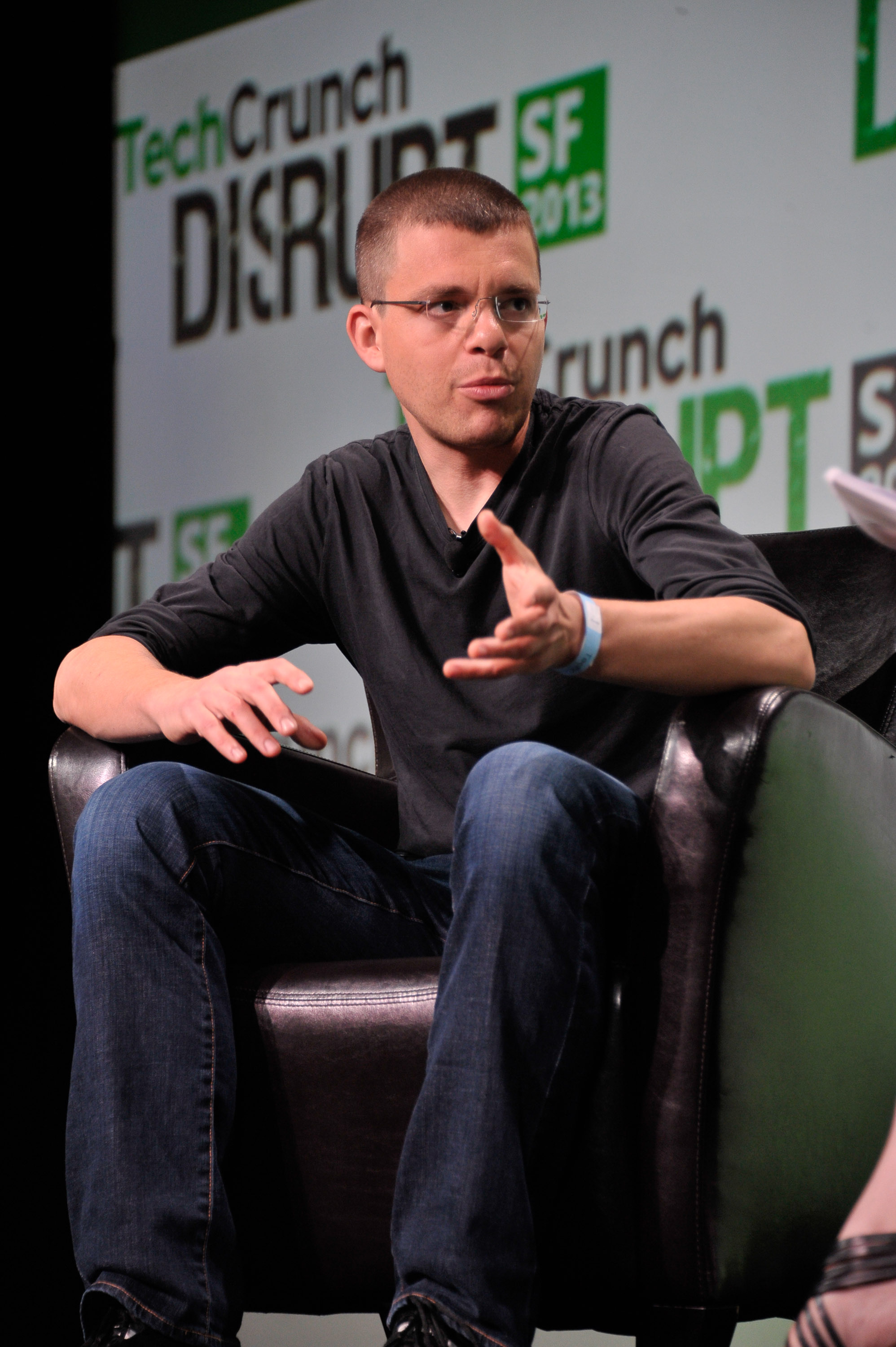
Co-founder and CTO of PayPal; founder of Slide; founder, CEO, and chairman of Affirm · b. 1975 · Kyiv, Ukrainian SSR, Soviet Union
Two calls made by hand, not formulas. how we score →
Summary
Born in Kyiv in 1975, Levchin fled to Chicago as a Jewish refugee in 1991 with roughly $700 as the USSR came apart.
He studied computer science at Illinois, moved to Palo Alto, and co-founded what became PayPal, building the fraud and CAPTCHA systems that kept it alive to its 2002 sale to eBay. He later founded Slide, helped seed Yelp, and in 2012 founded Affirm, which he still runs as CEO.
How it happened
Maxwell "Max" Levchin was born on July 11, 1975, in Kyiv, then part of the Ukrainian SSR, to a Ukrainian Jewish family. His mother, Lily Zeltsman, trained as a physicist. As a child he had serious respiratory problems, severe enough that doctors doubted he'd survive them; with his grandmother and parents pushing him toward it, he took up the clarinet to build his lung capacity.
In 1991, as the Soviet Union headed toward collapse, the family left Kyiv for the United States, reportedly citing the anti-Semitism Jewish families faced as the USSR unraveled. The trip was disorienting even by the standards of emigration: the USSR itself dissolved while they were still in transit, leaving them briefly stateless. They arrived in Chicago with the equivalent of roughly $600 to $700 among five family members and settled there, with Levchin enrolling at Mather High School. He already spoke some English but had a heavy accent and no feel for American life; he taught himself to sound less foreign by studying sitcoms and then retraining his ear on network news anchors.
He enrolled at the University of Illinois at Urbana-Champaign in 1993 and earned a B.S. in computer science in 1997. He didn't wait until graduation to start companies: in 1995, still an undergraduate, he co-founded NetMeridian Software and then SponsorNet New Media with fellow Illinois students Luke Nosek and Scott Banister. He later said he stayed on campus longer than planned because one of those companies was failing and he didn't want it to fail "in transit."
After graduating, Levchin moved to Palo Alto and, in December 1998, co-founded Fieldlink with Peter Thiel and Luke Nosek — a security startup that let users store encrypted data on Palm devices. Thiel put in the first $100,000; by February 1999 the company had raised $500,000, mostly from friends and family, including $35,000 from Thiel's parents. Levchin, a recent graduate with essentially no capital of his own, contributed engineering rather than money. Fieldlink became Confinity, which built the PayPal payments product, merged with Elon Musk's X.com in 2000, and took the PayPal name in 2001. As co-founder and chief technology officer, Levchin built much of the company's fraud-detection engine and co-created the Gausebeck-Levchin test, one of the first commercial CAPTCHAs, at a moment when payment fraud was close to sinking the business. PayPal went public in February 2002, and eBay bought it that October for $1.5 billion in stock — turning Levchin's roughly 2.3% stake into something like $34 million and turning a refugee college grad into a wealthy operator with a standing Silicon Valley network almost overnight.
In 2004 he founded Slide, a media-sharing service built for MySpace and Facebook, funded and staffed largely out of his PayPal-era money and connections. Google bought Slide in August 2010 for about $182 million, and Levchin joined as a vice president of engineering; Google shut the product down and he left a year later. In parallel, he was a key early investor in and chairman of Yelp's board from its 2004 founding until 2015, becoming its largest individual shareholder along the way. Late in 2011 he founded HVF ("Hard, Valuable, and Fun"), an exploratory shop for data-heavy ideas that also produced the Glow fertility app and Emerald Therapeutics.
Affirm was spun out of HVF (by then renamed 2012 MRL Investments LLC) in 2012, co-founded with Nathan Gettings and Jeff Kaditz to build point-of-sale installment lending, marketed as "buy now, pay later," as an alternative to credit cards. Levchin has run it as founder, CEO, and chairman ever since. Affirm went public on Nasdaq in January 2021. Its dual-class structure gives Levchin's Class B shares fifteen votes apiece against one vote for public Class A shares; as of September 2025 he controlled about 44% of total voting power while holding roughly 9% of the economic stake, largely through a family trust and an entity, 2012 MRL Investments LLC, that he controls outright.
Forbes puts his net worth at about $2.1 billion as of September 2026, built almost entirely on his Affirm holdings rather than salary — his base pay as CEO was $38,834 in fiscal 2025, and he doesn't participate in the executive cash bonus plan. He served on the CFPB's consumer advisory board from 2015 to 2018, funds the Levchin Prize for applied cryptography, joined the board of Coca-Cola in October 2025, and was named to Forbes' "Self-Made 250" list in April 2026.
The coded evidence
Thirteen groups, every claim sourcedFirst-generation immigrant; arrived in the US as a teenager in 1991 (1.5-generation).
↗ forbes.comThe family's 1991 emigration is documented across multiple sources as a Jewish refugee departure from the USSR.
↗ tryalma.comRussian
Not directly documented for Levchin specifically; inferred from the standard home language of Kyiv's Russified Jewish community in this era.
↗ en.wikipedia.orgNo documented housing fallback beyond the family's own resettlement in Chicago after 1991; sources describe no relative or sponsor already established there who housed them on arrival.
Not established in detail; general refugee-resettlement channels are the likely mechanism but are not documented specifically for this family.
↗ tryalma.comNone documented. The family arrived in Chicago in 1991 with roughly $600 to $700 total among five family members, and Levchin himself had no personal capital when he co-founded Fieldlink in 1998 — the company's seed money came from Peter Thiel and Thiel's family and friends, not from Levchin.
↗ forbes.comnot established
Not established for the period during which he built Fieldlink/Confinity.
↗ en.wikipedia.orgnot established
Not established; no student or personal debt is documented in the sources reviewed.
↗ en.wikipedia.orgThe 1991 emigration itself was unstable: the Soviet Union dissolved while the family was in transit to the US, leaving them briefly stateless before they resettled in Chicago.
↗ tryalma.comThe hardship was imposed, not chosen. There was nothing to fall back on.
The family's poverty on arrival was the product of forced political emigration, not chosen austerity.
↗ tryalma.comHis mother, Lily Zeltsman, trained and worked as a physicist in the Soviet system. His father's occupation is not established in the sources reviewed.
Sourced to secondary aggregator profiles rather than a primary interview; treat the mother's occupation as reasonably well corroborated and the father's as unknown.
↗ tryalma.comMother held physics training and credentials from the Soviet system; not established for his father.
↗ tryalma.comnot established
Not clearly established; one secondary source describes the emigrating family unit as five people, which may include grandparents rather than siblings.
↗ en.wikipedia.orgHis grandmother is credited, alongside his parents, with pushing him toward the clarinet as a child to help with his respiratory problems — the one documented extended-family presence in his childhood.
↗ en.wikipedia.orgnot established
How his University of Illinois tuition was financed is not established in the sources reviewed.
↗ en.wikipedia.org1
One major disruption — mid-adolescence emigration and a school-system change from Kyiv to Chicago's Mather High School, with a language transition.
↗ tryalma.comnot established
He had serious childhood respiratory problems in Kyiv, managed through clarinet-playing per family accounts, but no lasting disability into adulthood is documented, so this is not coded as a facet-level disability.
↗ en.wikipedia.orgLevchin has spoken publicly, including in a Bloomberg Television interview and in a video he narrated for the immigration-advocacy group FWD.us, about his family's 1991 flight from Kyiv as Jewish refugees as the Soviet Union collapsed around them, arriving in Chicago with roughly $600 to $700 between five family members, and about the disorientation of learning American English and customs as a teenager with a heavy accent.
Attributed to the subject's own public account; no third party is named or implicated.
↗ en.wikipedia.orgMather High School, a Chicago public high school described as having a multinational immigrant student body.
↗ tryalma.comKyiv, Ukrainian SSR (birth, 1975) to Chicago, Illinois (family emigration, 1991, with a period of statelessness in transit as the USSR dissolved) to Urbana-Champaign (University of Illinois, 1993-1997) to Palo Alto, California (1998, to found Fieldlink).
↗ grainger.illinois.eduHis mother's physics training in the Soviet system carried no automatic professional standing in the US; the family arrived in Chicago with roughly $600 to $700 total, a household reset from Soviet professional-class status to functional poverty on landing, even though the human capital and expectations of an educated family persisted internally.
↗ tryalma.comnot established
No relative already established in Chicago is documented as having hosted or employed the family on arrival.
↗ tryalma.comArrived speaking some English but with a heavy accent; taught himself American speech patterns by studying sitcoms and then retrained his accent against network news anchors before it stopped being a barrier.
↗ tryalma.comPeter Thiel, whom he met in Palo Alto in 1998 shortly after graduating; Thiel put up the first $100,000 to found Fieldlink and became its CEO.
↗ en.wikipedia.orgFieldlink/Confinity/PayPal, December 1998 to October 2002. It supplied seed capital he didn't have himself, a co-founder network that became the "PayPal Mafia," and, on eBay's acquisition, roughly $34 million from his stake — the capital base for everything he did afterward.
↗ en.wikipedia.orgCapital, Credibility, Network, Skill
↗ en.wikipedia.orgFieldlink/Confinity (1998) was co-founded with Peter Thiel and Luke Nosek, a University of Illinois classmate. Affirm (2012) was co-founded with Nathan Gettings (a Palantir co-founder) and Jeff Kaditz (formerly of First Data).
↗ en.wikipedia.org23
Age when he co-founded Fieldlink in Palo Alto in late 1998, shortly after his 1997 graduation.
↗ en.wikipedia.org0
He had already co-founded NetMeridian and SponsorNet as an undergraduate before Fieldlink; there was no separate employee stint first.
↗ grainger.illinois.eduThe University of Illinois computer science program put him in the same orbit as Luke Nosek and Scott Banister, both of whom became recurring collaborators — Nosek a Fieldlink/Confinity/PayPal co-founder.
↗ grainger.illinois.edu0
No conventional employee job is documented; he moved from student-run startups directly into founding Fieldlink/Confinity.
↗ grainger.illinois.eduUniversity of Illinois at Urbana-Champaign's computer science program — a strong but not Ivy-tier pipeline for his cohort, distinct from the Stanford-centric network that produced several of his PayPal peers.
↗ grainger.illinois.eduB.S. in Computer Science, University of Illinois at Urbana-Champaign (1997).
↗ en.wikipedia.orgRather than a part-time job, he co-founded and ran two small companies while still enrolled, NetMeridian Software and SponsorNet New Media.
↗ grainger.illinois.eduPublic refugee-resettlement high school to an in-state public flagship university, straight into founding companies with no graduate-school detour and no elite private-school stage.
↗ grainger.illinois.eduIllinois connected him to Luke Nosek, who became his Fieldlink/PayPal co-founder, and to Scott Banister, an early collaborator — the network that carried him from student projects into the Palo Alto startup scene.
↗ grainger.illinois.eduFieldlink's initial funding came from Peter Thiel, who put in $100,000, with a further $500,000 raised largely from friends and family (including $35,000 from Thiel's parents) by February 1999. Levchin, newly graduated and without capital of his own, contributed engineering rather than money.
↗ en.wikipedia.orgIt needed capital up front, before it earned anything.
Confinity/PayPal was seeded and grown on outside capital well before it had sustained fraud-adjusted revenue.
↗ en.wikipedia.orgSlide, founded in 2004, drew on capital and standing built up during the PayPal years rather than any income earned in between.
The precise financing of Slide's earliest months is not documented in detail in the sources reviewed.
↗ en.wikipedia.orgAffirm raised venture funding after spinning out of HVF/2012 MRL Investments LLC in 2012 and went public on Nasdaq in January 2021.
↗ sec.govWith his wife, Nellie Levchin, he co-founded the venture firm Scifi VC in 2010, investing as an operator-angel in companies including Uber, Stripe, and Anduril.
↗ en.wikipedia.orgAffirm has a dual-class structure: Class A common stock carries one vote per share, Class B carries fifteen. As of September 30, 2025, there were about 288.7 million Class A shares and 40.7 million Class B shares outstanding.
↗ sec.govProceeds and standing from PayPal's 2002 sale and Slide's 2010 sale to Google were redeployed into HVF in 2011 and then into founding Affirm in 2012, rather than into a passive portfolio.
↗ en.wikipedia.orgAffirm grew out of HVF, an exploratory company Levchin founded in 2011 to test ideas that leveraged large data sets; the installment lending concept was spun out and incorporated as a standalone company in 2012.
↗ sec.govPer Affirm's October 2025 proxy statement, Levchin beneficially owned 3,401,962 Class A shares (1.17% of class) and 26,485,472 Class B shares (65.04% of class), about 9% of total shares but 44.41% of total voting power, held directly, through the Levchin 2012 Irrevocable Trust, and through 2012 MRL Investments LLC, over which he has sole voting and investment power.
↗ sec.gov1
One of his two undergraduate companies (NetMeridian or SponsorNet) was failing as he prepared to leave campus; he said he stayed longer because he didn't want it "failing in transit."
↗ grainger.illinois.edunot established
Not established in detail; as a student-run venture the stakes and backers were small.
↗ grainger.illinois.eduFieldlink/Confinity was founded in December 1998, near the peak of the dot-com boom, then survived the 2000-2001 crash and a period of heavy payment fraud that nearly sank the company before eBay's 2002 acquisition closed the chapter on favorable terms.
↗ en.wikipedia.orgPalo Alto, California, in the middle of the first internet boom's startup density.
↗ en.wikipedia.orgBuilt from scratch both times: Fieldlink/Confinity/PayPal from a 1998 startup, and Affirm from an idea incubated inside his own HVF exploratory company rather than acquired.
↗ en.wikipedia.org28
From founding Fieldlink in 1998 through 2026, continuously building or running companies (PayPal, Slide, HVF, Affirm).
↗ en.wikipedia.orgFinancial technology — payments infrastructure (PayPal), consumer software (Slide), and consumer credit / buy-now-pay-later lending (Affirm)
↗ sec.govPublic equity
Forbes derives the figure mainly from his publicly disclosed, priced Affirm Class A/B holdings.
↗ forbes.com2026
↗ forbes.comnot established
As Affirm's CEO he draws only a nominal base salary, $38,834 in fiscal 2025, and does not participate in the executive cash incentive plan; his outcome is realized through equity, not salary, so no meaningful "peak annual income" figure applies.
↗ sec.govProxy statement
↗ sec.govHis PayPal-era stake was realized as eBay stock in the 2002 acquisition (about $34 million on a 2.3% stake); his Affirm wealth remains almost entirely paper, tracked to the public share price rather than sold down.
↗ en.wikipedia.orgAlmost entirely wealth rather than income: a nominal CEO salary at Affirm against a net worth built from PayPal and Slide sale proceeds and, predominantly now, Affirm equity value.
↗ sec.govCo-created the Gausebeck-Levchin CAPTCHA test; named MIT Technology Review's Innovator of the Year and a TR100 honoree in 2002; served on the CFPB's consumer advisory board (2015-2018); founded and funds the Levchin Prize for applied cryptography (since 2016); elected to Coca- Cola's board of directors (October 2025); named to Forbes' "Self-Made 250" (April 2026).
↗ en.wikipedia.org4
From founding Fieldlink in December 1998 to eBay's acquisition of PayPal closing in October 2002.
↗ en.wikipedia.orgUncapped
↗ sec.govnot established
No regulatory action against Levchin personally is documented. Affirm operates in a regulated consumer-lending space, and buy-now-pay-later products broadly drew a 2021-2022 Consumer Financial Protection Bureau inquiry, but no finding against Levchin individually or Affirm specifically is documented in the sources reviewed.
↗ en.wikipedia.orgnot established
No co-founder or ownership dispute at PayPal, Slide, or Affirm is documented in the sources reviewed.
↗ en.wikipedia.orgTechnical, Relentless, Data driven, the PayPal Mafia's 'consigliere'
↗ en.wikipedia.orgInsiders
The "consigliere" characterization comes from Silicon Valley/PayPal Mafia insiders rather than general press coverage.
↗ en.wikipedia.org7
Wikipedia, Forbes, SEC/Affirm proxy statement, the Immigrant Learning Center, Alma's immigration profile, the University of Illinois Grainger feature, and Peter Thiel's Wikipedia page, among sources reviewed.
↗ en.wikipedia.orgBefore
His reputation as PayPal's technical backbone was established well before Affirm's 2012 founding.
↗ en.wikipedia.orgAsset
↗ en.wikipedia.orgThe reputation was deliberately built, through books, press, and PR.
A run of media appearances (NPR's How I Built This, Bloomberg), the Levchin Prize, and active board and investing activity reflect a maintained public profile.
↗ en.wikipedia.orgStructural context
The cost-of-failure score comes from this person's own money and circumstances. But who they were in America carried its own weight, the same way their household or income did, and it shaped how hard the path was just as much. That part isn't in the cost-of-failure number. It's here instead.
Men founded the companies that took nearly all the venture funding and almost every top outcome, a tailwind that never shows up in one person's own circumstances.
↗ techcrunch.comWhite founders are heavily overrepresented among funded companies and top-tier wealth relative to their share of the population, an edge that has nothing to do with a person's own money.
↗ techcrunch.comImmigrants and their children are overrepresented among America's biggest companies, as founders and as senior leaders. They got there through the visa, credential, and network hurdles that make the path harder to even start down.
↗ forbes.comAmong the people recorded here — men: 169 · White subjects: 114. Representation here is who reached these outcomes, not equal odds of reaching them.
Controlled comparisons
Each holds one thing constant and varies another, so the difference is the point. A list of similar names wouldn't tell you anything.