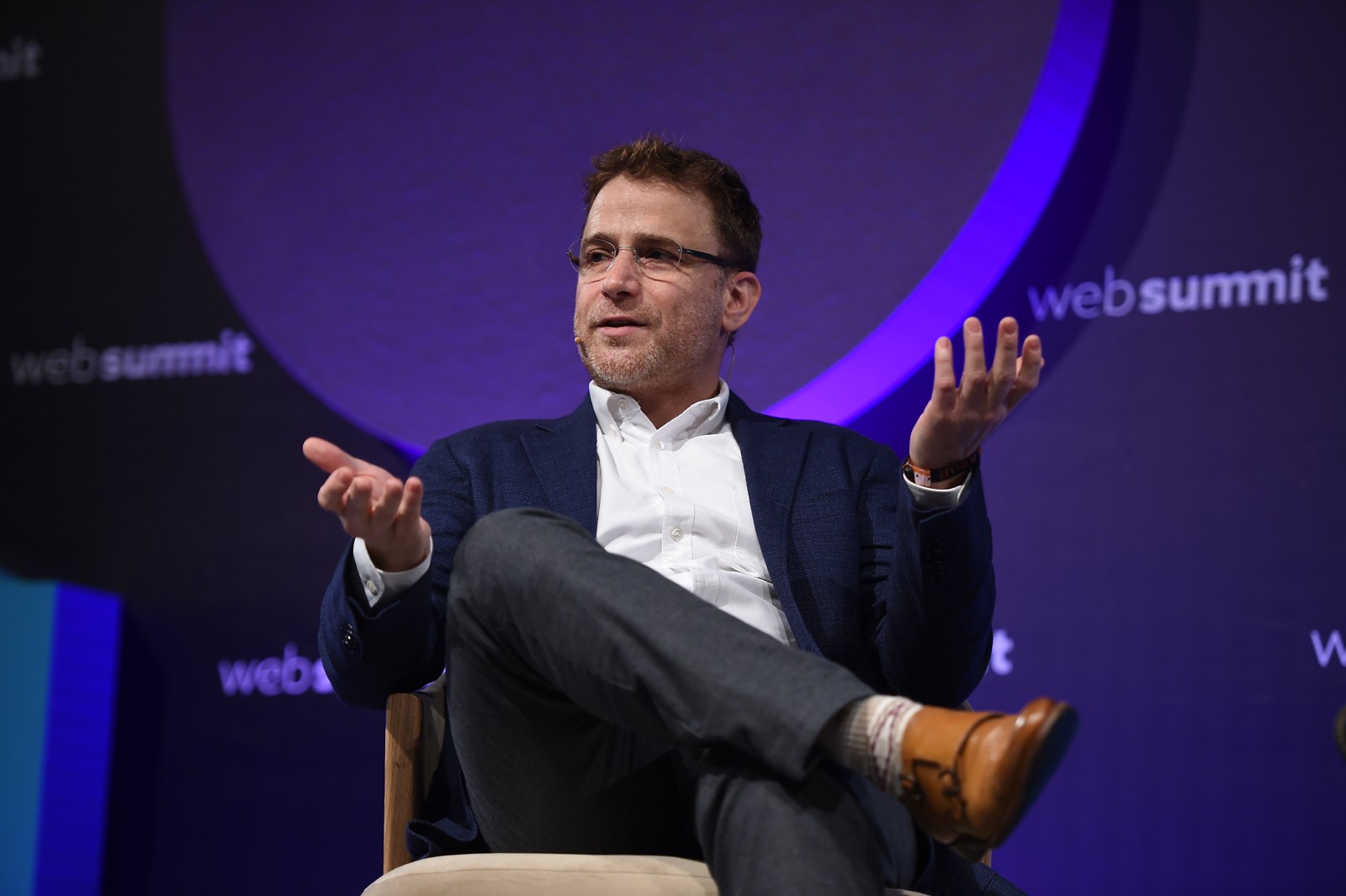
Stewart Butterfield
born Dharma Jeremy Butterfield
Co-founder of Flickr and Slack; CEO of Slack, 2009-2022 · b. 1973 · Lund, British Columbia, Canada
Two calls made by hand, not formulas. how we score →
Summary
Born on a rural commune, in a cabin with no running water, to American parents who'd left over the Vietnam War draft.
The family was middle-class in Victoria by school age. Two philosophy degrees, then two video games that both failed — Game Neverending and Glitch — and each threw off the real business as a byproduct: Flickr from the first, Slack from the second. Slack is the fortune.
How it happened
Born March 21, 1973, in Lund, British Columbia, and named Dharma Jeremy Butterfield. His father had left the United States to avoid conscription for Vietnam, and the family lived communally on the coast for his first five years, in a log cabin with no running water or electricity. When he was five the family moved to Victoria, on Vancouver Island, and life became considerably more conventional; he renamed himself Stewart at twelve.
He attended St. Michaels University School, a private secondary school in Victoria, then the University of Victoria, earning a B.A. in philosophy in 1996. He went on to Clare College, Cambridge, for a Master of Philosophy in 1998, writing on nineteenth-century scientific thinkers. He spent the next few years doing freelance web design and consulting, including co-founding the small site Gradfinder.com in 2000, and met Caterina Fake in San Francisco that same year.
In 2002 he co-founded Ludicorp in Vancouver with Fake, who became his wife, to build a browser-based multiplayer game called Game Neverending. The game itself never found an audience, but a photo-sharing feature the team had built for it, letting players swap images inside the game, worked as a product on its own. They shipped it separately as Flickr in February 2004, and Yahoo acquired Ludicorp in March 2005 for a price that was never officially disclosed; contemporaneous reporting put it in the low tens of millions, commonly cited as $22-25 million.
He stayed on as general manager of Flickr inside Yahoo, growing the product for three years, before resigning in June 2008 and leaving that July. He and Fake divorced later that year.
He co-founded Tiny Speck in 2009 with Cal Henderson, Flickr's former head of engineering, to build another game, an online world called Glitch. The company raised roughly $17.2 million in venture funding between 2009 and 2011, from Accel Partners, Andreessen Horowitz, and others, well ahead of any material revenue. Glitch launched publicly in September 2011 and never found a large enough audience; Tiny Speck shut it down in December 2012.
Rather than wind the company down, Butterfield and the team looked at what they'd actually built to coordinate their own work on Glitch: an internal messaging tool. They rebuilt it as a standalone product and announced Slack in August 2013, backed by the same investor relationships and capital base Tiny Speck already had. It was this decision, not the original game, that turned a second failed venture into the company that made him a billionaire.
Slack signed up 8,000 companies in its first 24 hours after launching publicly in February 2014. It passed 135,000 paying customers by early 2015, took a $340 million round that December, and crossed 10 million daily active users across more than 600,000 organizations by its 2019 S-1. Slack went public on the NYSE via direct listing on June 20, 2019, opening at $38.50 a share and closing its first day with a market value reported between roughly $19.5 billion and $21.4 billion depending on the measure used, instantly making him a billionaire on paper.
Salesforce announced its acquisition of Slack on December 1, 2020, for approximately $27.7 billion in cash and stock; the deal closed in July 2021. Butterfield stayed on as Slack's CEO inside Salesforce until December 2022, when he departed and Lidiane Jones took over.
Forbes put his net worth at about $1.6 billion as of September 2026, built overwhelmingly from Slack equity and its conversion into Salesforce cash and stock. His earlier Flickr exit, worth roughly $22-25 million to the company, was a real outcome but a small one next to what the second failed game produced.
The coded evidence
Thirteen groups, every claim sourcedComplicated in both directions. His American parents emigrated to Canada before he was born, making him Canadian-born to immigrant parents there. He then relocated to the United States as an adult for work, first through Yahoo after the 2005 Flickr acquisition and later while building Slack in San Francisco, while remaining a Canadian citizen throughout — Slack's 2019 S-1 still lists part of his salary as originally set in Canadian dollars.
Coded coded.migration from his own adult relocation to the US, which is a professional move rather than a hardship-driven immigration; see the note on that field.
↗ sec.govnot established
Not established. His parents are described as back-to-the-land counterculture émigrés, which suggests a secular household, but no source states this directly.
↗ en.wikipedia.orgnot established
No documented gap out of work; about a year passed between leaving Yahoo in July 2008 and co-founding Tiny Speck in 2009, but he appears to have been actively working throughout.
↗ en.wikipedia.orgA rural commune cabin with no running water or electricity for his first five years, by his parents' choice rather than necessity, then a stable, comfortable household in Victoria, British Columbia, from age five onward, including a private secondary school.
↗ en.wikipedia.orgLudicorp/Flickr's early funding is not well documented. Tiny Speck, which produced Slack, raised roughly $17.2 million in venture capital between 2009 and 2011, so by the time of the 2013 pivot to Slack the company was already well-capitalized by outside investors rather than running on his personal savings.
↗ gamesbeat.com1
He and Caterina Fake had one child, born July 2007, before Tiny Speck was founded in 2009 and before Slack's 2013 pivot.
↗ en.wikipedia.orgnot established
No homelessness or comparable instability is documented during his own venture-building years. The rustic childhood years predate any of his companies and were his parents' choice, not something he experienced while building.
↗ en.wikipedia.orgThe hardship was chosen. There was a home to go back to if it failed.
The commune years were a deliberate counterculture choice by American parents who had the option to return to conventional life, and did — the family moved to Victoria and became middle-class when he was five. Test per SCHEMA.md: had it continued five more years, the family had somewhere else to go. Coded low-moderate hardness (3) on that basis, not as a hard-landing childhood.
↗ en.wikipedia.orgNot documented in detail. His parents are described as back-to-the-land counterculture émigrés from the US in the early 1970s who later settled into a more conventional, middle-class life in Victoria, British Columbia.
No named occupation for either parent located in sources reviewed.
↗ en.wikipedia.orgLund, British Columbia, a remote coastal community, for his first five years; then Victoria, British Columbia, a comfortable, middle-class provincial capital, through adolescence.
↗ en.wikipedia.orgSt. Michaels University School, a private secondary school in Victoria, then the University of Victoria and Clare College, Cambridge.
↗ en.wikipedia.orgVictoria and Vancouver had no significant technology cluster in the 1990s comparable to Silicon Valley; his industry access came later, through Cambridge and then meeting Caterina Fake in San Francisco.
↗ en.wikipedia.orgLund, BC to Victoria, BC at age five; Victoria to Cambridge, England for graduate school; back to Canada (Vancouver) to co-found Ludicorp in 2002; then to the US (Yahoo, Sunnyvale-area, from 2005; San Francisco for Tiny Speck/Slack from 2009), while retaining Canadian citizenship throughout.
↗ en.wikipedia.orgCaterina Fake, whom he met in San Francisco in 2000 and later married, co-founded Ludicorp and Flickr with him. Cal Henderson, Flickr's head of engineering, followed him to co-found Tiny Speck and later served as Slack's chief technology officer — a technical partner who moved with him across three companies.
↗ en.wikipedia.orgCaterina Fake at Ludicorp/Flickr (2002); Cal Henderson at Tiny Speck/Glitch/Slack (2009).
↗ en.wikipedia.org27
Freelance web design and Gradfinder.com, around 2000, before Ludicorp's 2002 founding.
↗ en.wikipedia.orgSlack spread inside organizations largely through use itself — anyone invited into a team's Slack became a prospective new team elsewhere — which drove growth well ahead of any large marketing budget.
↗ en.wikipedia.org1
Yahoo, 2005-2008, following its acquisition of Ludicorp, is the only conventional employer documented; every other period was spent as a founder.
↗ en.wikipedia.orgMaster of Philosophy, Clare College, Cambridge, 1998 (thesis on nineteenth-century scientific thinkers); B.A. in philosophy, University of Victoria, 1996.
↗ en.wikipedia.orgPrivate secondary school to a Canadian public university to an elite UK graduate program, completed on schedule with no documented financial interruption.
↗ en.wikipedia.orgCambridge conferred credibility that likely helped in later fundraising conversations, though no specific co-founder or investor connection is documented as originating there; his Flickr and Slack co-founders came from San Francisco and Vancouver networks instead.
↗ en.wikipedia.orgnot established
Ludicorp's initial funding before the 2005 Yahoo acquisition is not well documented in sources reviewed; no first-check figure or investor is named.
↗ en.wikipedia.orgIt needed capital up front, before it earned anything.
Both Glitch and, later, Slack were built on venture capital raised well ahead of meaningful revenue.
↗ gamesbeat.comTiny Speck raised about $1.5 million in seed funding in 2009 from Accel, Andreessen Horowitz, and angel investors; a $5 million Series A in 2010 led by Accel; and a $10.7 million Series B in 2011 from Andreessen Horowitz and Accel — roughly $17.2 million total before Glitch shut down and the team pivoted to Slack in 2013.
↗ gamesbeat.comSlack raised additional large rounds after the 2013 pivot, including a $340 million round in December 2015, ahead of a direct listing on the NYSE in June 2019 valued at roughly $19.5-21.4 billion depending on the measure used. Salesforce announced its acquisition of Slack for approximately $27.7 billion in cash and stock in December 2020, closing in July 2021. Per Slack's 2019 Form S-1, Butterfield beneficially owned about 8.6% of the company's shares ahead of the direct listing.
The S-1's beneficial-ownership table lists 43,240,141 shares for Butterfield, 8.6% of the class. A 2019 Forbes report separately put his voting control, via Slack's ten-vote Class B shares, at about 17.8% ahead of the direct listing; that voting figure is not independently confirmed in the S-1 text reviewed here.
↗ sec.govRather than cashing out after Flickr, he used the proceeds and his reputation as a successful founder to raise venture funding quickly for Tiny Speck. He also sold a portion of his Slack shares in pre-IPO transactions — a November 2017 company share repurchase and an April 2018 stock transfer to SoftBank's Vision Fund — while remaining the company's largest individual shareholder through the 2019 direct listing.
↗ sec.govBoth of his major products began as byproducts of a failed game: a photo-sharing feature built for Game Neverending became Flickr, and an internal team-communication tool built to coordinate work on Glitch became Slack.
↗ en.wikipedia.orgSlack used a dual-class structure with Class B shares carrying enhanced votes, which let Butterfield's roughly 8.6% economic stake carry disproportionate voting weight — reported at about 17.8% of total voting power ahead of the 2019 direct listing.
↗ forbes.com2
Game Neverending (Ludicorp, shelved around 2004) and Glitch (Tiny Speck, shut down December 2012) both failed as originally conceived. Neither is a clean failure in the usual sense — each one produced, almost as a byproduct, the tool that became the actual business: Flickr from the first, Slack from the second. This is the rare pattern where the failure contains the success rather than merely preceding it, and it is the defining fact of his career.
↗ en.wikipedia.orgLudicorp's early backers absorbed the cost of Game Neverending's failure; Tiny Speck's venture investors, Accel and Andreessen Horowitz, absorbed roughly $17.2 million of risk on Glitch, which then carried over as the capital base for Slack rather than being written off.
↗ gamesbeat.comAbout a year between resigning from Yahoo in June 2008 and co-founding Tiny Speck in 2009.
↗ en.wikipedia.orgBetween the Yahoo departure and Tiny Speck, and again between Glitch's 2012 shutdown and Slack's 2013 pivot, he was sustained by Flickr-exit proceeds and a founder reputation strong enough to raise new venture capital quickly rather than needing to find wage work.
↗ en.wikipedia.orgLaunched into a period of rising enterprise SaaS adoption and frustration with email-based team coordination, with mobile-native, always-on workplace tools becoming normal and venture capital readily available for the category.
↗ en.wikipedia.orgSan Francisco, where Tiny Speck was based when the team pivoted from Glitch to Slack.
↗ en.wikipedia.orgBuilt — Slack grew out of Tiny Speck's own internal tool rather than being acquired or licensed from elsewhere; Flickr similarly grew out of Ludicorp's own internal game tooling.
↗ en.wikipedia.org40
Age at Slack's 2013 founding, the point his largest equity position began compounding.
↗ en.wikipedia.org8
From Slack's 2013 founding to the July 2021 close of the Salesforce acquisition, when his equity converted to cash and Salesforce stock.
↗ en.wikipedia.orgEnterprise software and workplace messaging (Slack); earlier, photo-sharing (Flickr)
↗ en.wikipedia.org1600000000
Forbes real-time billionaires tracker, as of September 24, 2026, ranked around #2,565 globally. Built overwhelmingly from Slack equity and its 2021 conversion into Salesforce cash and stock, not from the much smaller Flickr exit. No filing discloses his exact current holdings, so this should be read as a band figure.
↗ forbes.comJournalistic estimate
↗ forbes.com2026
↗ forbes.com430000
Base salary from July 1, 2018 per Slack's 2019 Form S-1; his salary was set at CAD$320,000 (about $234,949) before that date, paid in Canadian dollars. Cash salary understates his real compensation, which was overwhelmingly restricted stock.
↗ sec.govProxy statement
Sourced from the S-1's compensation disclosure rather than a later annual proxy statement, but the same disclosure standard applies.
↗ sec.govHe sold some shares before the IPO, including in a November 2017 company repurchase and an April 2018 transfer to SoftBank's Vision Fund, but the large majority of his wealth stayed in Slack equity until the July 2021 Salesforce acquisition converted it into cash and Salesforce stock.
↗ sec.govWealth is almost entirely appreciated founder equity and its post-acquisition conversion rather than accumulated salary; his disclosed cash salary stayed modest relative to his stock holdings.
↗ sec.govSlack became a standard workplace tool, reaching more than 10 million daily active users across over 600,000 organizations by its 2019 S-1. Butterfield was named to Time's 100 most influential people (2006), MIT Technology Review's TR35 (2005), and was Inc.'s Company of the Year honoree via Slack (2015); the double-pivot story became a widely cited case study in product development.
↗ en.wikipedia.orgUncapped
↗ en.wikipedia.orgnot established
No regulatory finding or proceeding against Butterfield or Slack is documented in sources reviewed.
↗ en.wikipedia.orgnot established
↗ en.wikipedia.orgnot established
No adverse civil judgment against Butterfield personally is documented.
↗ en.wikipedia.orgnot established
↗ en.wikipedia.orgUnrelated
No documented conduct finding exists to assess for instrumentality; included for schema completeness.
↗ en.wikipedia.orgunderstated, design-and-product-minded founder, the philosophy major who pivoted twice into billion-dollar companies, candid about failure as a normal part of the process rather than something to hide
↗ en.wikipedia.orgPress
↗ en.wikipedia.org5
Covered independently by, at minimum, Time, Forbes, Inc., Wired, and Fast Company over two decades; not an exact count.
↗ en.wikipedia.orgBefore
His reputation as a credible product founder was established through Flickr and its 2005-2006 press coverage, well before Slack's 2019 direct listing.
↗ en.wikipedia.orgAsset
His willingness to narrate two failed games as the origin of two successful products has been treated in coverage as a distinctive, favorable founder story rather than a liability.
↗ en.wikipedia.orgnot established
He has given extensive interviews telling the pivot story (e.g. the "Masters of Scale" podcast, 2017), but it's not established whether this reflects deliberate reputation-building or simply an accurate, frequently-asked-about account.
↗ en.wikipedia.orgnot established
No major film, book, or dramatization of Butterfield's story specifically is documented.
↗ en.wikipedia.orgnot established
No major reputational crisis requiring recovery is documented; his December 2022 departure from Slack was reported as a planned exit following the Salesforce acquisition, not an ouster.
↗ en.wikipedia.orgStructural context
The cost-of-failure score comes from this person's own money and circumstances. But who they were in America carried its own weight, the same way their household or income did, and it shaped how hard the path was just as much. That part isn't in the cost-of-failure number. It's here instead.
Men founded the companies that took nearly all the venture funding and almost every top outcome, a tailwind that never shows up in one person's own circumstances.
↗ techcrunch.comWhite founders are heavily overrepresented among funded companies and top-tier wealth relative to their share of the population, an edge that has nothing to do with a person's own money.
↗ techcrunch.comImmigrants and their children are overrepresented among America's biggest companies, as founders and as senior leaders. They got there through the visa, credential, and network hurdles that make the path harder to even start down.
↗ forbes.comAmong the people recorded here — men: 169 · White subjects: 114. Representation here is who reached these outcomes, not equal odds of reaching them.
Controlled comparisons
Each holds one thing constant and varies another, so the difference is the point. A list of similar names wouldn't tell you anything.