Richard Branson
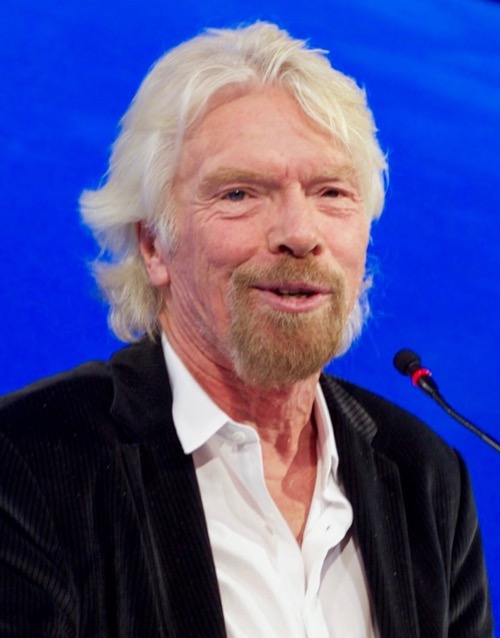
Founder, Virgin Group · b. 1950 · Blackheath, London → Surrey, England
Two calls made by hand, not formulas. how we score →
Summary
His father was a barrister and his grandfather sat on the High Court.
When he needed cash for his first venture, his mother sold a found necklace and handed him the proceeds. When a tax scheme he ran caught up with him in 1971, she remortgaged the house rather than let it end his career. That's the net "just take the leap" leaves out.
How it happened
A barrister father and a grandfather who sat on the High Court. Dyslexic and, by his own account, restless in a classroom, he struggled at Stowe and left at 16 with no qualifications, after a headmaster told him he'd either end up in prison or become a millionaire. He'd already launched a magazine, Student, the year before.
He ran the magazine and then a mail-order record business out of the same free office, a church crypt off Bayswater Road. His mother sold a necklace she'd found and gave him the roughly £100 in proceeds; he's said he couldn't have started Virgin without it. A favorite aunt later loaned him the money to buy the country house that became his first recording studio.
In 1971 customs officers caught Virgin selling records domestically that had been falsely declared as export stock, dodging a 33% tax. He spent a night in custody. The case never reached a full trial; his family helped cover a settlement reported at roughly £60,000-£70,000 by remortgaging the house. He's said the scare is what forced Virgin to get financially disciplined.
Records became an airline, then mobile phones, trains, financial services, health clubs, hotels, and eventually a space company, each new venture launched on the credibility and cash the last one had built. Not every bet paid off; Virgin Cola, Virgin Cars, Virgin Orbit, and Virgin Hyperloop all failed, but none of it was money he personally had to cover.
A knighthood in 2000, a fortune Forbes puts around $2.8 billion, and in 2021 a trip to the edge of space on his own company's vehicle. Fifty- some years after the church crypt, he's still starting new ventures. Most retellings of the early years skip the remortgaged house.
The coded evidence
Thirteen groups, every claim sourcednot established
Not established. He has described himself as an atheist as an adult (2011); the religious character of his upbringing isn't documented.
↗ en.wikipedia.orgThe family home was a real backstop, not a figure of speech. When he was arrested in 1971 his mother posted the house as bail, and by one account she later remortgaged it to help cover the tax settlement.
The remortgage detail (as opposed to bail) is separately reported at https://luxatic.com/richard-branson-the-man-behind-virgin-group/ — accounts differ on whether it was posted as bail, remortgaged for the settlement, or both.
↗ slate.comThe hardship was chosen. There was a home to go back to if it failed.
He ran the business out of a free church-crypt office and lived cheaply in a London commune while starting out, which reads as gritty. But his family had already shown it would supply cash on request and absorb a real crisis later, so the scarcity had a floor under it the whole time.
↗ luxatic.comFather Edward James Branson was a practicing barrister. Mother Eve (born Evette Huntley Flindt) served in the Women's Royal Naval Service, toured postwar Germany as a ballet dancer with ENSA, then worked as an air hostess, before running smaller ventures of her own from home.
↗ en.wikipedia.orgA parent worked for themselves, the strongest known predictor of founding.
Eve managed real estate and ran small home-based ventures over the years alongside her other work; not a single defined family business, so coded with lower confidence than a clear case.
↗ en.wikipedia.orgHis grandfather, Sir George Arthur Harwin Branson, was a High Court judge and Privy Councillor. Combined with a barrister father, this is a family with real standing inside the English legal establishment, on top of whatever it had in the bank.
↗ en.wikipedia.orgHis family let him leave formal schooling at 16 for a magazine, and when it needed money, his mother supplied it directly rather than pushing him toward something safer. A family able to absorb the downside was also one willing to fund the upside.
↗ en.wikipedia.orgDyslexic, diagnosed in childhood, and has since described himself as having ADHD. He struggled academically at Stowe and left at 16 without qualifications, though he's said the same wiring pushed him toward delegating detail work and keeping messages simple.
Dyslexia is well documented; the ADHD description is self-reported.
↗ en.wikipedia.orgBorn in Blackheath, southeast London; the family later lived in the Surrey commuter belt. Solidly professional geography, not working-class.
↗ en.wikipedia.orgA run of private schools: Scaitcliffe prep, Cliff View House, then Stowe, a boarding public school in Buckinghamshire, until he left at 16.
↗ biography.comHe built Student magazine himself while still at school, then the mail-order record business out of the same free office space, a crypt under a church near Bayswater Road. The work was his own; the door was already open.
↗ biography.comStudent's first issue drew about $8,000 in advertising revenue, enough to distribute 50,000 free copies. Those readers became Virgin's first mail-order customers before the record shop or the label existed.
↗ biography.com0
No record of him ever working for someone else; straight from school to his own ventures.
↗ en.wikipedia.orgLeft Stowe School at 16 with no qualifications. No college.
↗ biography.comHis mother sold a necklace she'd found and gave him the roughly £100 in proceeds — "Without that £100, I could never have started Virgin," he's said. A favorite aunt separately loaned him the money to buy The Manor, the country house he converted into a recording studio in 1971, and he paid her back once he could.
The £100/necklace detail is corroborated at https://en.wikipedia.org/wiki/Eve_Branson; Forbes carries the aunt-loan detail for The Manor.
↗ forbes.comThe family home was pledged on his behalf during the 1971 tax case — posted as bail, and by a separate account later remortgaged to help cover the settlement.
↗ slate.comMixed rather than one strategy. The early record business ran on family money and its own revenue with no institutional investors; the airline and later ventures used bank debt, outside partners, and, for Virgin Galactic, public shareholders after the 2019 listing.
↗ en.wikipedia.orgBought Necker Island in the British Virgin Islands in 1978 for around $180,000 out of Virgin's early profits (he's separately cited $120,000), then spent roughly $10 million over three years turning it into a private retreat. At the time this was consumption more than reinvestment; it later became a bookable business asset.
↗ en.wikipedia.orgVirgin Atlantic's origin is a personal-experience story he tells often: a cancelled flight to Puerto Rico left him stranded, so he chartered a plane and sold the empty seats to the other stranded passengers to cover the cost.
↗ en.wikipedia.orgVirgin Group itself stayed privately held and Branson-controlled. Individual units diluted differently — Virgin Galactic went public via a 2019 SPAC merger and left Virgin Investments Limited holding about 11.9% of the resulting company, while Virgin Mobile and Virgin Money US were sold outright. Control stayed with the parent company, not with every subsidiary.
↗ en.wikipedia.org9
Rough count of distinct industries where the Virgin name was licensed or built into a new company for a stake rather than a fee: music, air travel, mobile/telecom, rail, financial services, health and fitness, hotels, cruises, space. Some of these later failed or sold.
↗ en.wikipedia.orgnot established
No failed attempt preceded the breakthrough. The failures came later, as brand extensions after the fortune already existed: Virgin Cola, Virgin Cars, Virgin Brides, Virgin Digital Help, Virgin Orbit (Chapter 11, April 2023), Virgin Hyperloop (shut down January 2024).
↗ en.wikipedia.orgThe early ventures didn't fail outright, so the family safety net was mainly tested once, by the 1971 tax case. The later brand-extension failures were absorbed by the wider Virgin Group and its outside investors, not by him personally.
↗ en.wikipedia.org19
Sources vary on the exact year the mail-order business started (1969-1971); the Oxford Street shop followed and Virgin Records the label launched in 1972.
↗ luxatic.comUK record retailers still held fairly rigid prices in the early 1970s, which is the gap mail order undercut, legally at first and then via the export-tax scheme that funded part of the difference. A decade later, deregulation of transatlantic air routes is what let Virgin Atlantic challenge British Airways' near-monopoly at all.
↗ en.wikipedia.orgMostly built from nothing: the magazine, the mail-order label, the airline. Virgin Galactic is a partial exception, licensing the SpaceShipOne technology designed by Burt Rutan and funded by Paul Allen rather than developing spaceflight technology in-house.
↗ en.wikipedia.org57
Roughly 1969 to 2026. He's kept founding new ventures rather than leaving one early win to compound untouched, which is a different kind of duration than a single held asset.
↗ en.wikipedia.orgDiversified consumer and travel brands
↗ en.wikipedia.org2800000000
Forbes real-time figure as of 8 Aug 2026. Combines a public stake (Virgin Galactic) with private-company estimates across the rest of Virgin Group, so treat as directional rather than precise.
↗ forbes.comAggregator
↗ forbes.com2026
↗ forbes.comAlmost entirely wealth in owned and part-owned businesses rather than salary — a public stake in Virgin Galactic plus private holdings across the rest of Virgin Group.
↗ en.wikipedia.orgKnighted in 2000 "for services to entrepreneurship." Co-founded The Elders with Nelson Mandela and Peter Gabriel in 2007. In July 2021 he became the first founder of a space company to personally fly to the edge of space aboard his own company's vehicle.
↗ en.wikipedia.org3
From leaving school at 16 with Student to launching the Virgin mail-order business around 19.
↗ biography.comUncapped
↗ en.wikipedia.orgHM Customs and Excise caught Virgin selling records domestically that had been falsely declared as export stock, avoiding a 33% Purchase Tax; officers used UV-marked decoy stock ordered through Virgin's own mail order to prove it. He was arrested and held overnight in 1971. The case was resolved through a settlement, reported at roughly £60,000-£70,000 covering back tax and penalty, rather than a full criminal trial.
Wikipedia (en.wikipedia.org/wiki/Richard_Branson) describes this as resulting in a tax-evasion conviction; Slate's account, cited here, frames it as an out-of-court settlement following the arrest.
↗ slate.comHe has written about the episode himself, describing how the financial shock forced Virgin to become "obsessively focused" on cash discipline afterward, a shift he credits with helping the company survive.
↗ slate.comDuring
↗ slate.comProduced the advantage
The scheme funded part of the price gap that let Virgin undercut High Street record shops in its first years. This wasn't incidental to the business, it was part of how it competed on price.
↗ slate.comCrime
↗ slate.comFine absorbed
One night in custody, then a financial settlement his family helped fund. No lasting criminal record surfaced later, and no license, deal, or knighthood was ever put at risk by it.
↗ slate.comShowman, Maverick, Adventurous, Publicity savvy
↗ forbes.comPublic
↗ forbes.comBefore
↗ forbes.comAsset
The showman reputation is what let the Virgin name walk into a new industry, records, planes, phones, with instant recognition already attached, because people already had an opinion about him personally.
↗ forbes.comThe reputation was deliberately built, through books, press, and PR.
Deliberate publicity stunts, cross-Atlantic balloon and boat record attempts, kitesurfing records, dressing up for product launches, built the persona on purpose rather than it simply accruing from behavior.
↗ en.wikipedia.orgCelebrated in business coverage as an entrepreneurial icon and brand-builder. A harder edge shows elsewhere: tax-justice campaigners and a Labour shadow chancellor called for his knighthood to be stripped after he shifted his personal tax residence to the British Virgin Islands in 2013, and the January 2026 Epstein-email revelation drew sharper public criticism than anything earlier in his career.
↗ en.wikipedia.orgStructural context
The cost-of-failure score comes from this person's own money and circumstances. But who they were in America carried its own weight, the same way their household or income did, and it shaped how hard the path was just as much. That part isn't in the cost-of-failure number. It's here instead.
Men founded the companies that took nearly all the venture funding and almost every top outcome, a tailwind that never shows up in one person's own circumstances.
↗ techcrunch.comWhite founders are heavily overrepresented among funded companies and top-tier wealth relative to their share of the population, an edge that has nothing to do with a person's own money.
↗ techcrunch.comAmong the people recorded here — men: 169 · White subjects: 114. Representation here is who reached these outcomes, not equal odds of reaching them.
Controlled comparisons
Each holds one thing constant and varies another, so the difference is the point. A list of similar names wouldn't tell you anything.